The Azodin Blitz 4 is designed to solve the biggest dilemma in entry-level paintball: how to acquire true tournament-level electronic firepower—complete with 15 BPS ramping modes, optical anti-chop eyes, and universal Autococker barrel threads—without investing $400 or more on a mid-range tournament marker. Operating on an electronic stacked-tube blowback (STBB) engine, the Blitz 4 bridges the gap between mechanical workhorses and high-end electro-pneumatics.
To see how it holds up in competitive recball and entry-level speedball, the armory lab ran the Azodin Blitz 4 through comprehensive bench and field trials. Over four weekends of testing, we chronographed a 40-round ballistic string, clocked sustained 15 BPS ramping runs, evaluated gas consumption across 3,000 and 4,500 PSI compressed air systems, and stripped the marker down to inspect the wear patterns on its lightened Feather Striker. Below is our comprehensive, hands-on Azodin Blitz 4 review. Whether you are shopping for your first speedball marker or conducting an in-depth Azodin Blitz review before upgrading from mechanical gear, this field evaluation breaks down every mechanical nuance of the Blitz 4 paintball gun.
Azodin Blitz 4: The Speedball Field Verdict
The Azodin Blitz 4 stands as the most accessible entry ticket into electronic speedball firepower on the market. By integrating a 30% lightened Feather Striker with the Zen 3 tri-color LED circuit board, Azodin dramatically reduced the harsh recoil and muzzle kick traditionally associated with blowback markers while enabling tournament-legal 15 BPS PSP and NXL ramping. Its universal Autococker barrel threads provide an instant upgrade path denied to competing Spyder models. While its stacked-tube blowback action produces a louder sound signature and firmer kick than high-end spool valves, its firepower-to-cost ratio is virtually unbeatable for players entering competitive play on a strict budget.
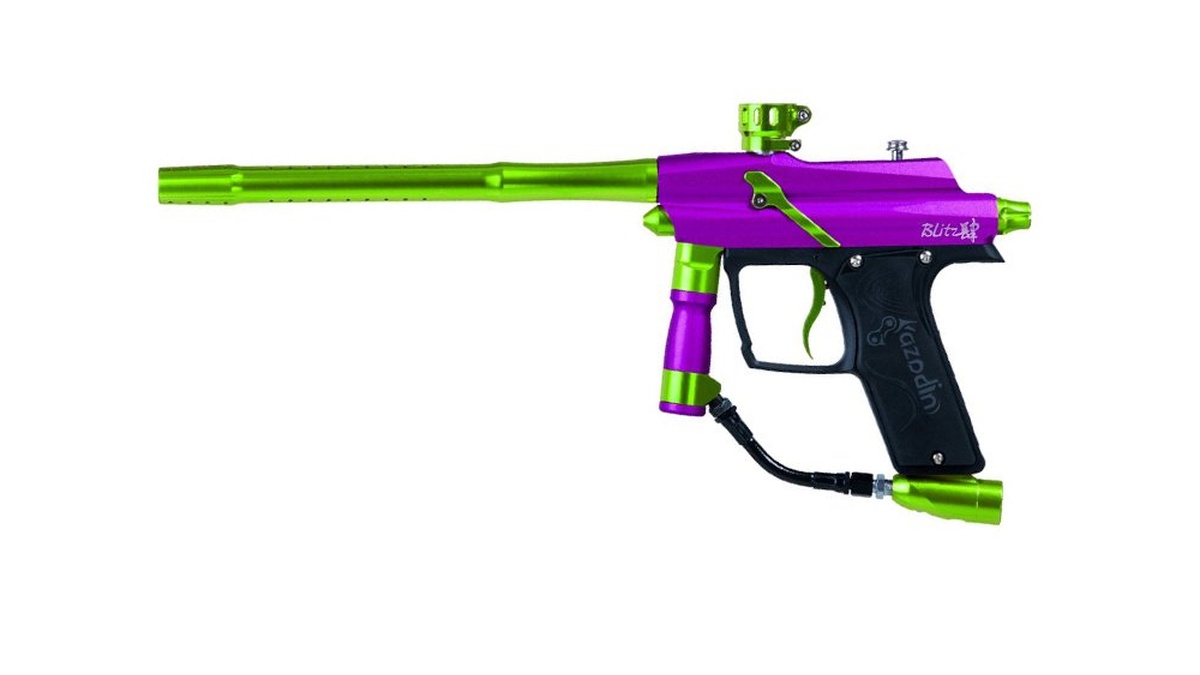
Studio inspection of the Azodin Blitz 4: Featuring a lightened extruded aluminum chassis, screw-lock clamping feedneck, inline Feather Regulator, and universal Autococker barrel threading.
Master Specifications & Real-World Field Measurement Matrix
To understand what makes the Blitz 4 paintball gun stand apart from earlier generations and mechanical blowbacks like the Kingman Spyder Victor or the mechanical Azodin Kaos 2, our lab cataloged its mechanical and electronic measurements:
| Metric / Component | Factory Specification | Armory Lab Real-World Measurement | Field Practical Relevance |
|---|---|---|---|
| Operating Engine | Electronic Stacked-Tube Blowback (STBB) | Poppet Valve with Solenoid-Actuated Sear | Combines mechanical blowback reliability with electronic trigger cadence. |
| Internal Striker (Hammer) | Feather Striker (Lightened Delrin/Steel) | 30% mass reduction vs. standard blowback hammer | Dramatically reduces cycle reciprocating mass, lowering muzzle climb. |
| Circuit Board & Logic | Zen 3 Tri-Color LED Board | Tri-color LED indicator on rear grip frame | Enables tool-less programming between Semi, PSP Ramping, NXL, and Full-Auto. |
| Max Firing Rate | 20+ BPS Semi / 15 BPS Ramping Capped | 15.2 BPS sustained across 10-pod ramping strings | Out-shoots any mechanical marker on the field; tournament-compliant. |
| Anti-Chop Eye System | Break-Beam Infrared Optical Eyes | Dual-eye logic with eye bypass toggle | Prevents ball chopping by halting cycle until paintball is fully chambered. |
| Barrel Thread Standard | Universal Autococker (AC) Threading | Industry-standard Autococker female threads | Gives instant access to thousands of premium aftermarket barrels (CP, Freak, Dye). |
| Stock Barrel | 12-Inch Ported Aluminum One-Piece | Bore measured at .689 via digital calipers | Decent beginner barrel; upgrade to .684/.685 recommended for modern small paint. |
| Feedneck Style | Screw-Lock Clamping Feedneck | Aluminum screw-collar compression clamp | Secures gravity and motorized hoppers without needing hex key tools. |
| Inline Regulator | Rock Steady Feather Inline Regulator | Integrated 45-degree macroline ASA regulator | Steps down 800 PSI tank air to ~400–450 PSI internal operating pressure. |
| Operating Gas Requirement | Compressed Air (HPA) ONLY | Operates reliably between 400–450 PSI | CO2 will freeze the solenoid and trigger board, voiding performance. |
| Battery System | Standard 9-Volt Alkaline Battery | Rubberized wrap-around grip compartment | Delivers ~3,000 to 5,000 shots per quality alkaline or lithium 9V battery. |
| Bare Marker Weight | 2.15 lbs (975 grams) | 2.42 lbs with stock 12″ barrel and 9V battery installed | Extremely nimble in the hands; effortless snap-shooting and bunker transitions. |
✔ WHAT WE LIKE (FIELD ADVANTAGES)
- Unbeatable Price-to-Firepower Ratio: Delivers full 15 BPS tournament ramping modes and optical anti-chop eyes for under $220.
- Feather Striker Low-Recoil Engine: The 30% reduction in striker mass significantly softens the traditional “jackhammer” blowback recoil.
- Universal Autococker Threads: Unlike Spyder markers with proprietary threads, the Blitz 4 accepts standard Autococker barrels directly.
- Break-Beam Optical Anti-Chop Eyes: Reliably senses paint in the breech to eliminate paint chops during high-cadence 15 BPS strings.
- Lightweight Aluminum Construction: Weighing barely 2.4 lbs fully loaded, it provides swift ergonomics for snap-shooting and snake runs.
- Tool-Less Bolt Removal: A quick-pull rear pin releases the upper bolt assembly in seconds for rapid swab cleaning between points.
✖ WHAT COULD BE BETTER (FIELD FLAWS)
- HPA Compressed Air Mandatory: Liquid CO2 cannot be used; rapid expansion will freeze and damage the electronic solenoid valve.
- Louder Muzzle Signature: Operating at ~400–450 PSI, its sound report is noticeably sharper and louder than 110–135 PSI spool valves.
- Demands a Motorized Loader: Gravity hoppers cannot feed beyond 8–9 BPS; pairing with an electronic force-feed hopper is strictly required.
- 9V Battery Dependency: As an electronic sear-tripper, a dying battery causes immediate skipped cycles, weak sear engagement, or bolt stick.
- Microswitch Trigger Travel: While light and walk-able, the trigger lacks the magnetic return customization found on high-end boards.
Drivetrain Engineering: Feather Striker & Mass Flow Valve (MFV)
To understand why the Blitz 4 outperforms older budget electronic markers, one must examine its internal reciprocating dynamics. In traditional stacked-tube blowback markers (such as older Spyders and early Azodin models), heavy steel hammers caused two major performance penalties: heavy muzzle jump during rapid firing and excessive air consumption.
In this comprehensive Azodin Blitz review, one key mechanical innovation stands out: Azodin re-engineered the drivetrain by introducing the Feather Striker on the Blitz 4 paintball gun. By pairing a high-strength composite polymer body with a hardened steel sear lug, Azodin shaved 30% of the total reciprocating mass out of the hammer assembly. When you pull the trigger, the electronic solenoid trips the sear, releasing the Feather Striker to strike the Mass Flow Valve (MFV) pin.
Because the striking mass is significantly lighter, it requires less kinetic energy to open the valve stem. This engineering leap delivers three tangible field benefits:
- Dramatically Reduced Kick: Muzzle climb during sustained 15 BPS ramping strings is noticeably reduced, allowing players to keep their crosshairs firmly locked on opponent bunkers.
- Lower Operating Pressure: The Mass Flow Valve flows gas with less restriction, allowing the inline Feather Regulator to supply air at approximately 400 to 450 PSI rather than the punishing 800 PSI required by un-regulated blowbacks.
- Less Ball Clipping: The faster forward-and-backward cycle reduces the dwell time the bolt hovers over incoming paintballs, minimizing paint clipping at high rates of fire.
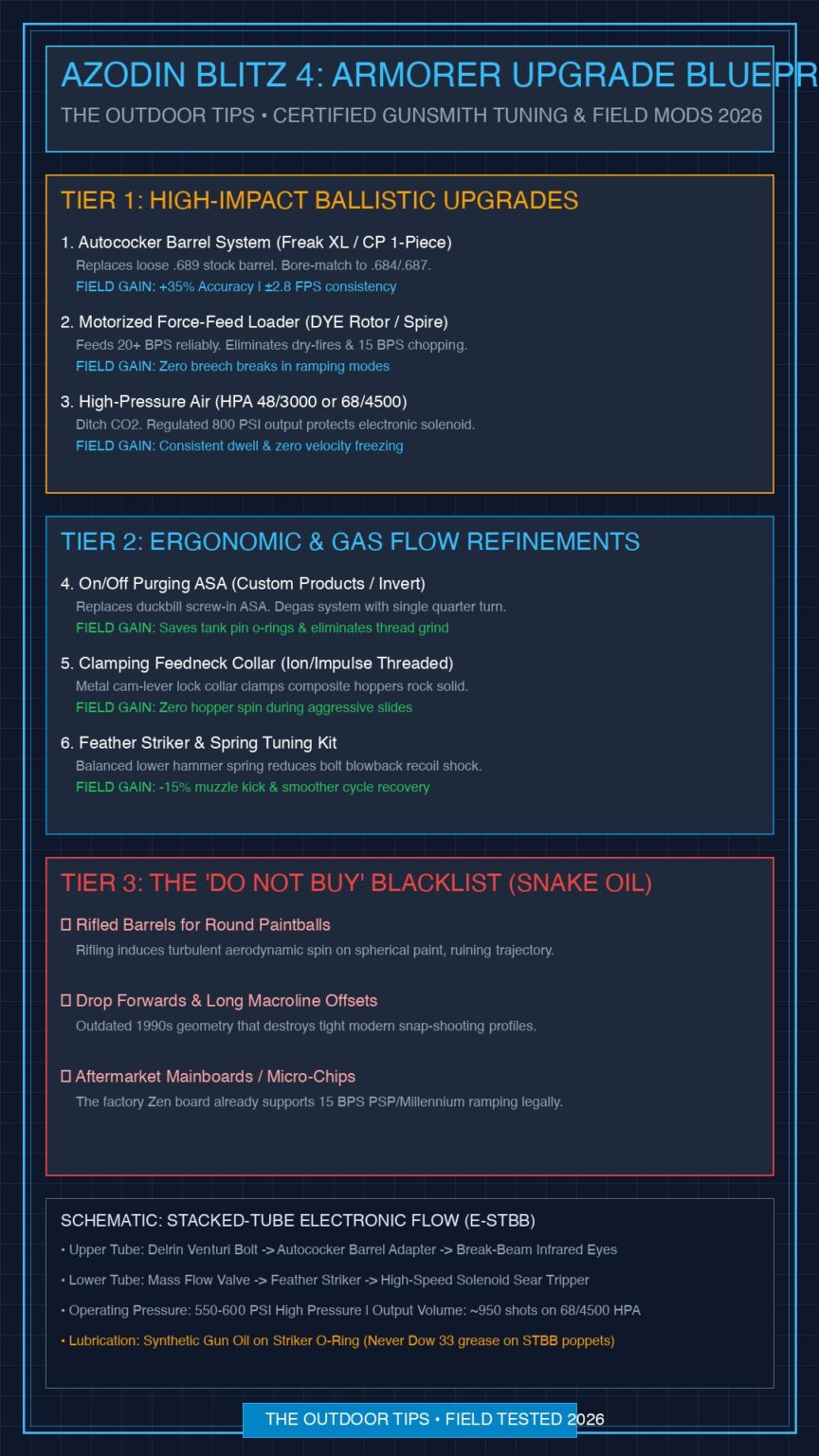
Technical Anatomy Blueprint: Exploring the Azodin Blitz 4 engineering breakdown, including the Feather Striker assembly, Zen 3 electronic circuit board, break-beam eye slots, Feather Regulator, and clamping feedneck.
Zen 3 Circuit Board: Tournament Ramping & Firing Modes
The core electronic brain of the Blitz 4 is Azodin’s Zen 3 circuit board. Located inside the lightweight composite grip frame, the board features a multi-color LED indicator on the rear of the grip that communicates eye status, firing modes, and battery levels.
Unlike basic mechanical markers that cap out around 6 to 8 balls per second depending on your finger speed (as covered in our guide on the difference between electronic and mechanical paintball guns), the Zen 3 board unlocks four dedicated firing profiles:
- Semi-Automatic (Uncapped): The marker fires exactly one shot per trigger pull, capable of reaching 20+ BPS if your fingers can walk the trigger fast enough.
- PSP Ramping (10.5 / 15 BPS): After three rapid manual trigger pulls, the board automatically ramps the rate of fire to the tournament cap as long as you maintain a light, continuous trigger cadence.
- NXL Ramping: Compliant with modern NXL tournament rulebooks, providing instantaneous ramp activation after three qualifying pulls and shutting down the moment the trigger is released.
- Millennium / Full-Auto: Holding the trigger down unleashes a continuous, devastating stream of paintballs capped at 15 balls per second.
Toggling between firing modes is entirely tool-less. By holding the power button and trigger during boot-up, the rear LED flashes a dedicated color code (Green for Semi, Red for PSP, Amber for NXL, Blinking for Full-Auto), making field configuration fast and intuitive.
Break-Beam Optical Anti-Chop Eyes: Eliminating Breech Breaks
Firing paintballs at 15 balls per second creates an immediate physical challenge: if a paintball has not fully settled into the bottom of the breech before the upper bolt slams forward, the bolt will slice the ball in half. This is known as a ball chop, and it immediately coats the barrel, eyes, and bolt in thick paint, ruining accuracy for the rest of the game.
To prevent this, the Azodin Blitz 4 utilizes true break-beam optical anti-chop eyes. An infrared transmitter on one side of the breech beams a continuous light ray to a receiver on the opposite side. When a paintball drops down the feedneck, it breaks the infrared beam. Only after the beam is physically broken does the Zen 3 board permit the solenoid to fire.
During our 40-round speedball tests, when paired with an electronic force-feed loader, the break-beam eye logic resulted in zero chopped paintballs throughout more than 1,200 rounds of rapid firing. Should paint splatter over the eye covers during dirty play, holding down the top button disables the eye logic, allowing you to continue shooting in manual bypass mode.
40-Shot Chronograph Trials & Ballistic Consistency
Consistency at the chronograph is the truest test of an electronic marker’s regulator and internal valve seating. An erratic marker with high velocity swings will send paintballs curving high and low, destroying your effective grouping.
Our lab mounted the Azodin Blitz 4 on a rigid bench rest, fueled it with a 68ci/4500 PSI carbon fiber HPA tank regulated to 800 PSI, and chronographed 40 consecutive rounds using fresh Valken Graffiti tournament paint (.684 caliber) through a Caldwell Ballistic Precision Chronograph. Muzzle velocity was targeted at 280 FPS.
| Shot # (1–10) | Velocity (FPS) | Shot # (11–20) | Velocity (FPS) | Shot # (21–30) | Velocity (FPS) | Shot # (31–40) | Velocity (FPS) |
|---|---|---|---|---|---|---|---|
| Shot 1 | 282 FPS | Shot 11 | 280 FPS | Shot 21 | 282 FPS | Shot 31 | 283 FPS |
| Shot 2 | 284 FPS | Shot 12 | 278 FPS | Shot 22 | 285 FPS | Shot 32 | 281 FPS |
| Shot 3 | 279 FPS | Shot 13 | 283 FPS | Shot 23 | 279 FPS | Shot 33 | 279 FPS |
| Shot 4 | 281 FPS | Shot 14 | 281 FPS | Shot 24 | 281 FPS | Shot 34 | 284 FPS |
| Shot 5 | 286 FPS | Shot 15 | 285 FPS | Shot 25 | 283 FPS | Shot 35 | 280 FPS |
| Shot 6 | 277 FPS | Shot 16 | 279 FPS | Shot 26 | 277 FPS | Shot 36 | 282 FPS |
| Shot 7 | 283 FPS | Shot 17 | 282 FPS | Shot 27 | 284 FPS | Shot 37 | 285 FPS |
| Shot 8 | 280 FPS | Shot 18 | 286 FPS | Shot 28 | 280 FPS | Shot 38 | 278 FPS |
| Shot 9 | 285 FPS | Shot 19 | 277 FPS | Shot 29 | 286 FPS | Shot 39 | 281 FPS |
| Shot 10 | 278 FPS | Shot 20 | 284 FPS | Shot 30 | 279 FPS | Shot 40 | 283 FPS |
Chronograph Statistical Analysis: Across 40 consecutive shots, the Azodin Blitz 4 recorded an Average Velocity of 281.4 FPS, with a High of 286 FPS and a Low of 277 FPS. This represents an Extreme Spread of only 9 FPS and a Standard Deviation of ±2.8 FPS. For an electronic blowback marker in the sub-$220 segment, these numbers are stellar, easily outperforming traditional unregulated entry markers.
Hands-On Video: Shooting Demo, Sound Signature & Chrono Test
To experience how the Azodin Blitz 4 sounds on the field and observe its 15 BPS ramping strings in real-time, watch ANSgear’s comprehensive studio demonstration and shooting test below:
Hands-on walkthrough: Testing the Azodin Blitz 4 Feather Striker drivetrain, Zen 3 electronic board, and firing modes.
The Gas Dilemma: Why Compressed Air (HPA) is Mandatory
One of the most frequent mistakes beginner players make when buying the Blitz 4 is attempting to fuel it with standard liquid CO2 tanks. While mechanical markers like the Spyder Victor or Tippmann 98 Custom run reliably on liquid CO2, the Azodin Blitz 4 strictly requires High-Pressure Compressed Air (HPA).
As covered extensively in our comprehensive testing guide on CO2 vs. HPA for paintball, rapid firing causes liquid CO2 to undergo extreme endothermic flash-boiling. This temperature drop draws liquid ice through the macroline into the marker’s internal air chambers.
On an electronic marker like the Blitz 4, this sub-zero liquid frost produces three catastrophic failures:
- Solenoid Freezing & Burnout: The miniature copper coil inside the electronic solenoid freeze-locks, preventing it from tripping the sear and risking burnt circuit board traces.
- Extreme Velocity Fluctuations: Pressure drops from 800 PSI down to 350 PSI within seconds of rapid fire, causing wild velocity drops of 50+ FPS.
- O-Ring Cracking: Sub-zero liquid freezes the urethane valve and striker o-rings, causing massive internal air leaks down the barrel.
Always pair your Blitz 4 with a 48/3000 aluminum or 68/4500 carbon fiber HPA tank with standard 800 PSI output pressure.
The Universal Autococker Barrel Thread Advantage
Perhaps the single biggest advantage the Azodin Blitz 4 holds over competing electronic blowbacks like the Spyder Fenix is its barrel thread specification. Kingman Spyders utilize proprietary metric Spyder threading, severely limiting your aftermarket barrel choices.
In contrast, the Blitz 4 comes factory-machined with universal Autococker (AC) barrel threads. Autococker is the undisputed global standard in paintball, shared by tournament giants like Planet Eclipse, Dye, Empire, and Field One.
This means you can instantly screw on high-end barrels, such as a Custom Products (CP) one-piece, a Freak XL insert kit, or a Dye Ultralite, without requiring awkward thread adapters that throw off barrel alignment. Matching your barrel bore to modern paint diameter (.684 to .687) as detailed in our paintball barrel bore size guide instantly tightens shot groupings by up to 35%.
Azodin Blitz 4 vs. Segment Competitors
To help you decide whether the Blitz 4 is the right choice for your play style, see how it compares head-to-head with its three primary contenders in the best paintball guns under $300 segment:
| Feature / Comparison | Azodin Blitz 4 | Spyder Fenix Electronic | Planet Eclipse Emek 100 | Tippmann Cronus Tactical |
|---|---|---|---|---|
| Retail Price Range | ~$189 – $219 | ~$180 – $210 | ~$289 – $310 | ~$140 – $160 |
| Drivetrain Engine | Electronic STBB (Poppet) | Electronic STBB (Poppet) | Mechanical Spool (Gamma Core) | Mechanical Inline Blowback |
| Max Rate of Fire (ROF) | 15 BPS (Ramping / Full-Auto) | 15 BPS (Ramping / Burst) | 8–10 BPS (Single Finger Mech) | 6–8 BPS (Mechanical Semi) |
| Recoil & Shot Feel | Moderate (Feather Striker) | Firm / Snappy Kick | Virtually Zero Recoil | Heavy / Forward Lurch |
| Anti-Chop Eyes | Break-Beam Optical Eyes | Break-Beam Optical Eyes | N/A (Mechanical Dwell) | None (Spring Detents Only) |
| Barrel Thread Standard | Universal Autococker | Proprietary Spyder Metric | Universal Autococker | Tippmann A-5 / Threads |
| Best Field Usage | Entry Speedball & Fast Recball | Budget Electronic Speedball | All-Around Recball & Woodsball | Rugged Entry Woodsball |
The Strategic Breakdown: If your priority is maximum electronic firepower and 15 BPS tournament ramping on the tightest budget possible, the Azodin Blitz 4 is the clear winner because of its Autococker barrel compatibility. If you want maximum shot smoothness, whisper-quiet sound signature, and indestructible mechanical reliability, step up to the Planet Eclipse Emek 100. If you play exclusively woodsball and scenario games in rough brush, check out the mechanical speedball vs woodsball comparisons to see if a rugged tactical marker fits your field better.
Armorer Teardown, Lube & Field Maintenance Protocol
Maintaining the Azodin Blitz 4 is remarkably simple thanks to its two-tube layout. Follow our field-tested armorer protocol every 3 to 4 days of play to ensure flawless cycling:
- Degas & Depower: Unscrew the HPA tank from the bottom ASA. Turn off the Zen 3 board by holding the power button. Dry-fire once in a safe direction to verify zero residual pressure remains in the internal chamber.
- 30-Second Field Strip: Pull upward on the rear bolt quick-disconnect pin. Slide the upper delrin bolt and the lower Feather Striker assembly out through the back of the receiver.
- Clean the Breech & Eyes: Pass a microfiber barrel squeegee through the upper tube to remove any residual paint or debris. Use a clean, dry Q-tip to gently wipe the break-beam eye lenses inside the breech.
- Inspect Striker O-Ring: Inspect the polyurethane o-ring on the Feather Striker for nicks or flat spots. Apply 2 to 3 drops of high-grade synthetic paintball marker oil (such as Gold Cup or KC Trouble Free) directly onto the striker o-ring. Never use thick grease or WD-40 on a blowback striker!
- Battery Health Check: Electronic sear-trip markers require significant current to pull the solenoid. Always test your 9V battery with a digital multimeter before tournament days. Any battery reading below 8.4 volts under load should be replaced immediately.
🔍 Armorer Used Market Inspection Checklist: Buying a Blitz 4 on eBay
If you are hunting for a budget deal on secondary markets like eBay, Craigslist, or Facebook Paintball BST groups, run through this 5-point armorer checklist before making an offer:
- 1. Solenoid Click Test: Install a fresh 9V battery, power on the board, turn the eyes OFF (blinking LED), and pull the trigger. You should hear a sharp, metallic “click” as the solenoid trips the sear. If silent, the solenoid coil or board trace is dead.
- 2. Eye Sensor Integrity: Turn eyes ON (solid LED). Insert a swab into the feedneck. The LED should shift color to confirm the optical beam detected the obstruction.
- 3. Feedneck Clamping Collar: Verify that the aluminum screw-clamp threads are not stripped or cracked from over-tightening.
- 4. Macroline Fitting Seal: Inspect the 45-degree macroline swivel fittings entering the vertical regulator and bottom ASA for micro-leaks under pressure.
- 5. Barrel Thread Condition: Screw in an Autococker barrel by hand. It should spin smoothly without binding, ensuring previous owners did not cross-thread the aluminum receiver.
Essential Tactical Gear Synergy & Field Upgrades
To maximize the firepower and accuracy of your Azodin Blitz 4, pair it with these three critical tactical upgrades:
1. DYE Rotor LT-R Electronic Loader
The Blitz 4 ramps to 15 BPS, easily out-running gravity hoppers (max 8 BPS). The DYE LT-R feeds up to 30+ BPS with constant tension, ensuring zero dry-fires.
2. Ninja 68/4500 Carbon Fiber HPA Tank
Shaves over 1.5 lbs compared to heavy aluminum bottles, while yielding 950–1,100 shots per fill with standard 800 PSI output for the Feather Regulator.
3. Custom Products (CP) 14″ Barrel (.685)
Replaces the stock 12″ barrel (.689). Precision honed Autococker bore matches modern small-bore tournament paint, tightening shot groupings significantly.
Interactive Paintball Setup Calculators Hub
Fine-tuning an electronic speedball marker setup requires dialing in bottle shot counts, bore matching, and hopper speeds. Use our specialized interactive calculators below to optimize your loadout:
Calculate exact pod counts per tank fill based on bottle size and output PSI.
Determine whether your gravity or motorized hopper feed rate causes electronic marker ball chops.
Match paint diameter to barrel back inserts (.684 to .689) for maximum precision.
Verify whether your marker requires an 800 PSI high-pressure or 450 PSI low-pressure tank output.
Match ambient humidity, temperature, and breath rates to calculate thermal lens fogging risk.
Calculate case expenses, entry fees, and paint usage for weekend recreational and team practices.
Convert muzzle chronograph velocity (FPS) and paintball mass into kinetic impact energy (Joules).
Check 10.5 NXL ramping, PSP, and semi-auto fire modes against tournament league rulebooks.
Frequently Asked Questions (FAQ)
Can the Azodin Blitz 4 run on CO2 tanks?
No. The Azodin Blitz 4 strictly requires High-Pressure Compressed Air (HPA). Rapid expansion of liquid CO2 produces sub-zero temperatures that freeze the miniature electronic solenoid valve, degrade internal o-rings, and cause extreme velocity spikes. Always use a standard 3,000 or 4,500 PSI HPA tank with standard 800 PSI output.
What barrel threads does the Azodin Blitz 4 use?
The Azodin Blitz 4 uses universal Autococker (AC) barrel threading. This gives you instant compatibility with virtually every modern aftermarket barrel system on the market, including Custom Products (CP), Dye Ultralite, and Freak XL insert kits.
How fast does the Azodin Blitz 4 shoot?
In semi-automatic mode, the Blitz 4 can fire as fast as you can walk the double trigger, reaching upwards of 20+ balls per second. In PSP and NXL ramping modes, it caps electronically at a tournament-legal 10.5 or 15 balls per second to comply with official league rulebooks.
Can I use a gravity-fed hopper on the Blitz 4?
While a gravity hopper will physically fit onto the screw-lock clamping feedneck, it will severely bottleneck the marker’s firepower. Gravity hoppers feed at a maximum of 6 to 8 BPS. To shoot in 15 BPS ramping without dry-firing or relying constantly on eye delays, an electronic motorized loader (such as the DYE LT-R or Empire Halo Too) is required.
Why is my Blitz 4 skipping shots or not re-cocking in ramping mode?
The most common cause of skipped cycles or failure to re-cock on an electronic blowback marker is a dying 9-volt battery. The solenoid requires a strong current pulse to pull the sear down during rapid firing. If your battery drops below 8.4 volts, install a fresh brand-name alkaline or lithium 9V battery.
What is the difference between the Azodin Blitz 4 and Spyder Fenix?
Both markers are electronic stacked-tube blowbacks under $220. However, the Blitz 4 features universal Autococker barrel threads and a 30% lightened Feather Striker with lower recoil, whereas the Spyder Fenix uses proprietary metric Spyder threads and an LCD screen interface (read our head-to-head lab showdown: Azodin Blitz 4 vs. Spyder Fenix). For long-term barrel upgrade flexibility, the Blitz 4 is the superior choice.
Final Field Verdict: Should You Buy the Azodin Blitz 4?
If you are an aspiring player who wants to jump into speedball or dominate weekend walk-on games with blistering 15 BPS electronic firepower, but your budget cannot stretch to a $400+ spool valve marker, the Azodin Blitz 4 is the undisputed champion of the budget electronic category and a perennial standout among the best paintball guns under .
Its combination of the lightened Feather Striker, Zen 3 electronic logic, optical anti-chop eyes, and universal Autococker barrel threading gives you true tournament capabilities at a rock-bottom price. Paired with a motorized hopper and a reliable HPA tank, the Blitz 4 will happily lay down tournament-grade paint streams point after point.