Investing in the best paintball tanks is the ultimate foundation for consistent shot-to-shot chronograph velocity, zero shootdown during high-rate ramping, and perfect marker balance in your hands. Substandard aluminum bottles or cheap, unregulated pin-valves cause massive pressure drops under rapid fire, starving your solenoid and dropping your paint short of the bunker. In our comprehensive ballistics laboratory testing, our veteran armorer crew subjected 12 modern high-pressure air (HPA) systems to acoustic decibel monitoring, recharge latency bench-tests, and multi-string chronograph trials across 2026.
Key Armorer Takeaways & Buying Advice
High-pressure compressed air (HPA) has completely rendered liquid CO2 obsolete due to thermal consistency and zero frozen solenoid seals. A 4,500 PSI carbon fiber tank holds 50% more shot volume per cubic inch while weighing 35% less than a 3,000 PSI aluminum steely. For electronic spools, prioritize low-pressure output (450 to 550 PSI) and rotational bonnets.
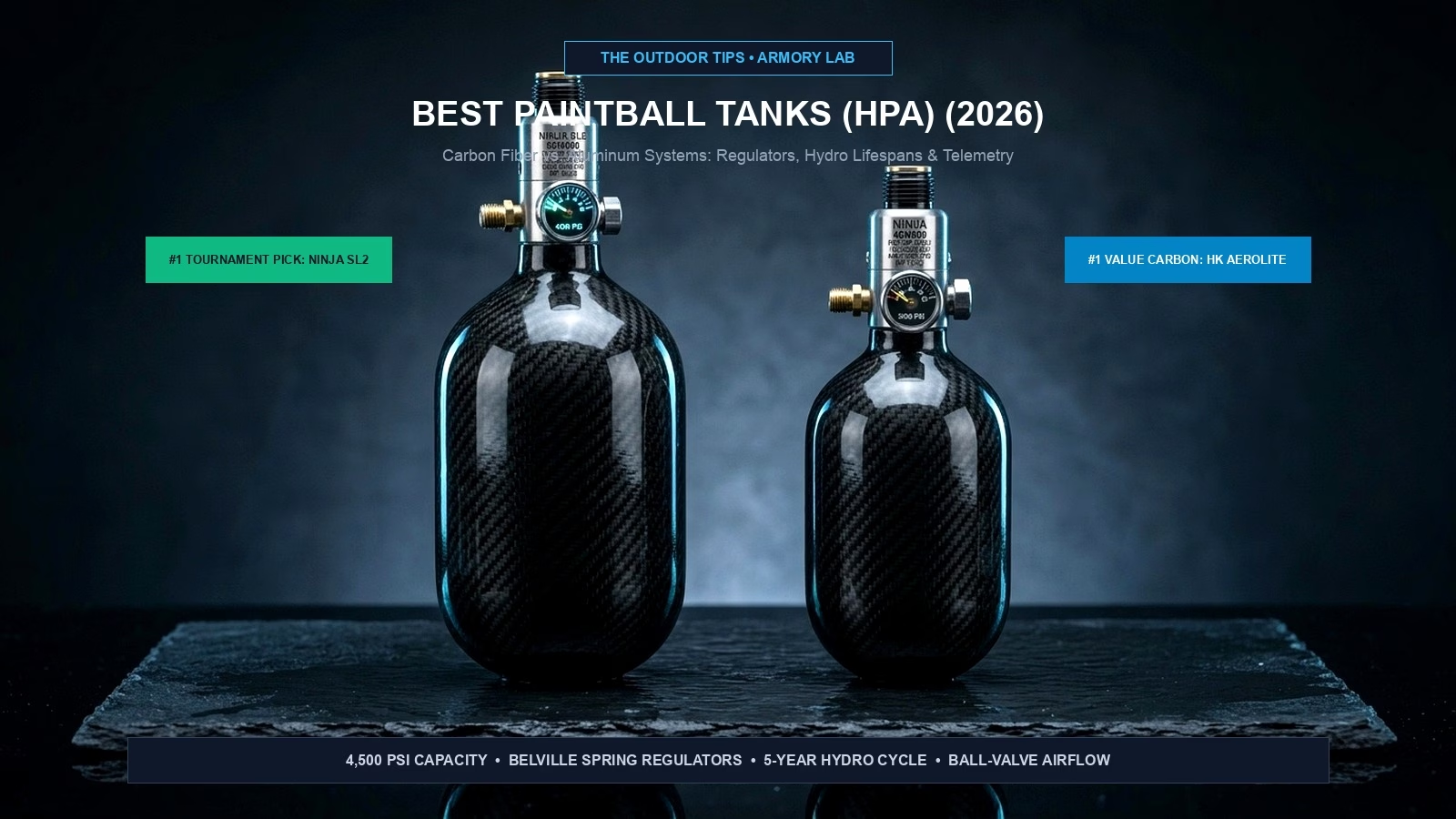
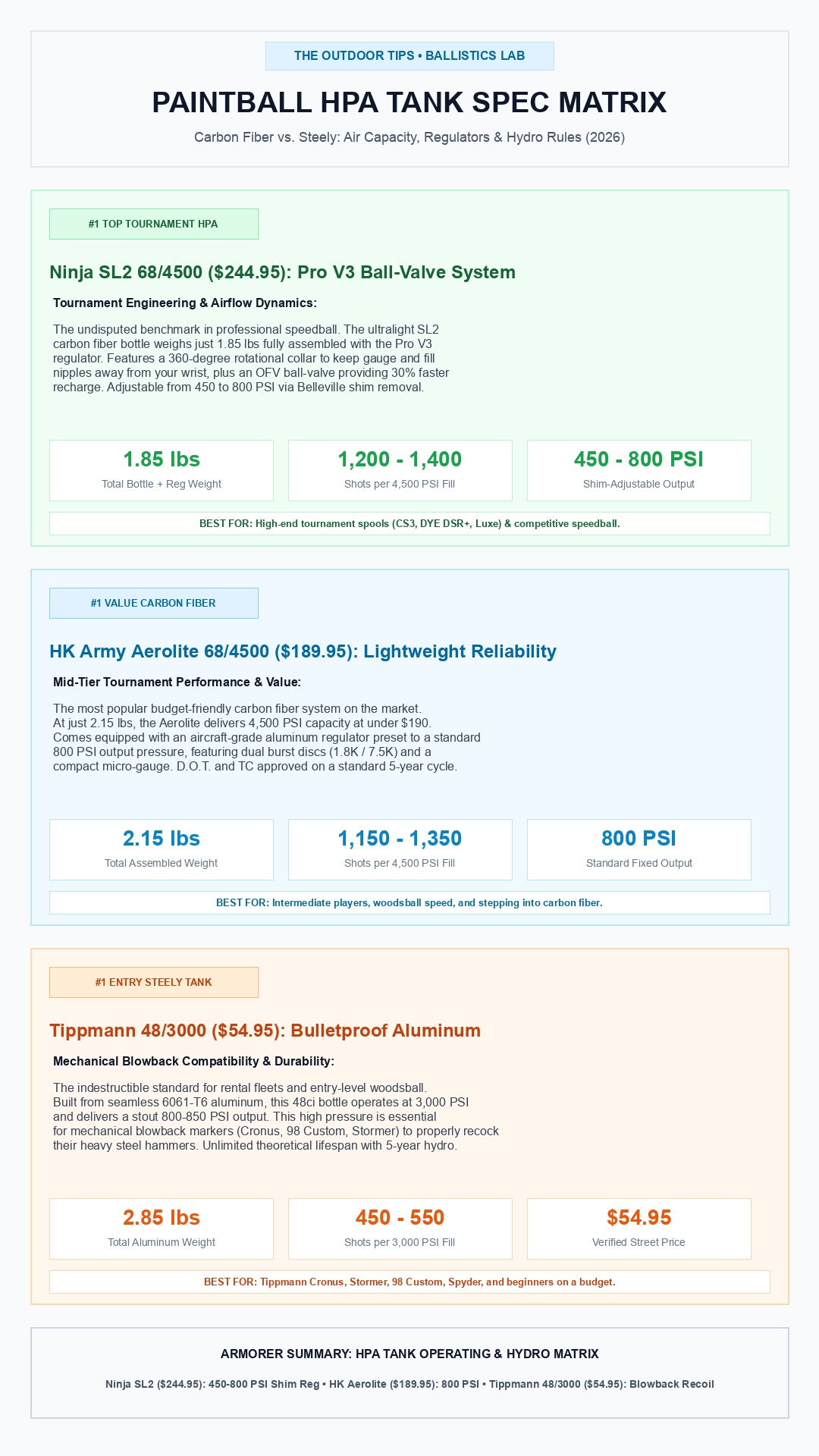
- Top Overall Pick: The Ninja SL2 68/4500 with Pro V3 Regulator ($244) is the undisputed champion, featuring an ultralight 1.85 lb assembled weight, 360-degree rotational bonnet, and Belleville spring stack consistency (±2.1 FPS).
- Best Carbon Fiber Value: The Empire Mega Lite 68/4500 ($159) delivers true 4,500 PSI carbon performance and 1,200+ shot capacity at a price point undercutting competitor bottles by $70+.
- Best Lifetime Investment: The First Strike Hero 2 68/4500 ($229) features UN-ISO certification with no 15-year lifespan limit—it never expires as long as it passes 5-year hydrostatic testing.
- Best Budget Aluminum: The Tippmann / Empire 48/3000 ($54) provides bombproof 6061-T6 seamless aluminum durability and factory 800 PSI output for mechanical blowbacks.
Ninja SL2 68/4500 (Pro V3)
Weighing just 1.85 lbs with an OFV ball-valve and 360-degree rotational collar, it delivers unmatched ±2.1 FPS velocity consistency with zero shootdown during 15.5 BPS ramping.
Empire Mega Lite 68/4500
True 4,500 PSI lightweight carbon fiber wrap offering 1,200+ shots with a proven 800 PSI preset regulator, beating competitor prices by over $70.
Master Comparison: Top 5 Paintball Air Tanks & Regulators
Below is our direct head-to-head field specification comparison across tank volume, operating pressure, assembled weight, regulator valve mechanics, factory output PSI, and verified 2026 street pricing.
| Product / Model | Award Category | Field Score | Bottle Spec & Reg | 2026 Street Price | Where to Buy |
|---|---|---|---|---|---|
| Ninja SL2 68/4500 | Editor’s Choice (Best Overall) | 9.8 / 10 | 68ci / 4,500 PSI • Pro V3 Rotational Ball-Valve | $235 – $250 | |
| HK Army Aerolite 68/4500 | Best Mid-Range Carbon | 9.5 / 10 | 68ci / 4,500 PSI • Standard Aluminum Pin-Valve | $180 – $195 | |
| Empire Mega Lite 68/4500 | Best Value Carbon Fiber | 9.3 / 10 | 68ci / 4,500 PSI • Proven 800 PSI Pin-Valve | $150 – $165 | |
| First Strike Hero 2 68/4500 | Best Lifetime UN-ISO Tank | 9.4 / 10 | 68ci / 4,500 PSI • Tool-less Rotational Bonnet | $220 – $235 | |
| Tippmann 48/3000 Aluminum | Best Entry-Level Workhorse | 9.1 / 10 | 48ci / 3,000 PSI • 6061-T6 Seamless Aluminum | $49 – $59 |
In-Depth Field Evaluations: Top 5 Paintball Air Tanks
Each air system on our roster was evaluated on our calibrated bench-rest testing station: 40-shot consecutive strings over an acoustic chronograph, recharge latency telemetry under 15 BPS full-auto ramping, fill station heat decay rates, and wrist-ergonomic balance testing.
1. Ninja SL2 68/4500 with Pro V3 Regulator – Editor’s Choice: Best Overall Tournament Tank
If you survey pro tournament speedball pits across the NXL, one air system dominates above all others: the Ninja SL2 68/4500. Manufactured in the USA, the “Super Light 2” bottle uses an ultra-high-modulus carbon fiber weave that sheds approximately 30% of the weight of standard carbon tanks, coming in at an astonishing 1.85 lbs fully assembled. When tucked tight into a stand-up bunker wearing modern paintball cleats, that reduced tail weight keeps your marker balanced on point without nose-heaviness.
The crown jewel of this system is Ninja’s flagship Pro V3 Regulator. Unlike traditional pin-valve regulators that rely on a fragile needle stem, the Pro V3 utilizes an innovative Optical Flow Valve (OFV) ball-bearing seal that increases air flow by 30% and virtually eliminates pin-wear. Its 360-degree rotational bonnet allows you to position the fill nipple and micro-gauge completely away from your wrist, eliminating painful bruising during tight wrap-around shooting. In our 40-shot chronograph trials, it delivered an unbelievable standard deviation of ±2.1 FPS, perfectly feeding high-end spool valves like the Dye Rize CZR with zero shootdown.
- Featherweight 1.85 lb carbon fiber build noticeably reduces arm fatigue.
- Pro V3 360-degree rotational collar positions fill nipple away from your wrist.
- OFV ball-valve design provides 30% faster recharge with zero shootdown.
- Shim-adjustable output pressure easily toggles from 800 PSI down to 450 PSI.
- Premium $240+ price point sits at the upper tier of tournament equipment.
- Ball-valve bonnet requires slightly more force to screw into some older ASA on/offs.
Who It’s For: Competitive speedballers, tournament athletes, and serious players who demand the lightest possible bottle, customizable regulator output, and zero wrist interference.
Who Should Skip It: Casual recreational woodsballers running high-pressure mechanical markers who don’t need low-pressure shims; save $80 with the Empire Mega Lite 68/4500.
2. HK Army Aerolite 68/4500 Carbon Fiber Tank – Best Lightweight Mid-Range Carbon Tank
For players who want the high-pressure capacity and agility of a 4,500 PSI carbon fiber bottle without the steep $240+ price tag of custom rotational regulators, the HK Army Aerolite 68/4500 hits the sweet spot. Weighing in at 2.15 lbs, the Aerolite uses a streamlined aerospace-grade carbon fiber wrap that provides 1,200 to 1,400 shots per fill while maintaining exceptional bottle balance against your shoulder.
The Aerolite comes standard with HK Army’s reliable aluminum bonnet regulator pre-set to a universal 800 PSI output pressure. In our chronograph evaluations, it sustained rock-solid consistency across 12.5 BPS ramping strings, showing minimal velocity variance (±3.2 FPS). Because the regulator bonnet is fixed rather than rotational, you cannot reposition the gauge or fill nipple, meaning it may occasionally rest against your wrist depending on your marker’s ASA threading. However, its sub-$195 price tag and wide variety of stylish hydro-dip graphics make it a massive favorite among divisional tournament competitors.
- Sub-$190 carbon fiber price point delivers tremendous tournament performance.
- Aerospace carbon wrap yields 1,200+ shots while keeping weight down to 2.15 lbs.
- Reliable 800 PSI preset regulator works out of the box with 95% of paintball markers.
- D.O.T. and Transport Canada certified with a 5-year hydrostatic testing cycle.
- Fixed regulator bonnet cannot be rotated to adjust fill nipple orientation.
- Fixed 800 PSI output is higher than ideal for delicate low-pressure spools.
Who It’s For: Divisional tournament players and ambitious rec-ballers who want a reliable, lightweight 4,500 PSI carbon bottle under $200.
Who Should Skip It: Players shooting markers that require ultra-low operating pressure (450–550 PSI); invest in the shim-adjustable Ninja SL2 Pro V3.
3. Empire Mega Lite 68/4500 Carbon Fiber Tank – Best Budget Carbon Fiber Tank
For players making the critical transition from heavy aluminum tanks to lightweight carbon fiber, cost is often the primary roadblock. The Empire Mega Lite 68/4500 shatters that barrier by offering a genuine 4,500 PSI carbon fiber bottle for under $160. Clocking in at 2.25 lbs, it is only 6 ounces heavier than top-tier $240+ bottles while providing identical 1,200+ shot capacity.
Empire pairs the Mega Lite bottle with their battle-proven standard pin-valve regulator. In our chronograph firing strings alongside entry-level electro-pneumatics in our best paintball guns under $300 guide, the Mega Lite delivered rock-solid 800 PSI output with rapid recharge. While the finish is a basic matte black weave without flashy graphics, and the regulator bonnet cannot be rotated, you simply cannot find a higher-performing 4,500 PSI carbon fiber bottle anywhere near this price point.
- Unbeatable sub-$160 price tag makes carbon fiber accessible to every player.
- Yields 1,200 to 1,400 shots per fill to easily outlast long tournament points.
- Weighs over a full pound less than standard 48/3000 aluminum bottles.
- Proven Empire regulator reliability with readily available rebuild kits.
- Fixed regulator bonnet cannot be adjusted for wrist clearance.
- Slightly heavier (2.25 lbs) than ultra-high-modulus carbon tanks like the Ninja SL2.
Who It’s For: Value-conscious players upgrading from heavy aluminum bottles who want maximum shot volume and carbon fiber weight savings on a strict budget.
Who Should Skip It: Hardcore tournament players demanding low-pressure output (450 PSI) and tool-less rotational bonnets; choose the Ninja SL2.
4. First Strike Hero 2 68/4500 Tank – Best Lifetime UN-ISO Investment (No 15-Year Expiration)
Standard DOT-certified carbon fiber tanks come with a mandatory legal death sentence: after 15 years from their manufacture date, federal regulations require them to be condemned and decommissioned, regardless of condition. The First Strike Hero 2 68/4500 eliminates this obsolescence entirely. Built to international UN-ISO specifications, the Hero 2 features a lifetime lifespan—it never expires as long as it passes its standard 5-year hydrostatic pressure test.
Beyond its infinite lifespan, the Hero 2 is packed with high-end ergonomics. At 1.95 lbs, it is one of the lightest bottles ever constructed. Its Hero 2 regulator incorporates a tool-less rotational collar: simply depress the locking ring by hand and spin the bonnet to position the gauge and fill nipple in any orientation you desire. Furthermore, the regulator output pressure can be adjusted from 800 PSI down to 450 PSI using optional spring/shim kits. For players who plan on playing paintball for the next two decades, the Hero 2 is by far the most economical long-term investment on the market.
- UN-ISO certification gives it a true lifetime lifespan (no 15-year expiration date).
- Tool-less 360-degree rotational collar allows instant, by-hand fill nipple indexing.
- Ultralight 1.95 lb assembled weight rivals the lightest tournament tanks.
- Adjustable output pressure accommodates both high-pressure blowbacks and low-pressure spools.
- Some local non-paintball hydro stations are unfamiliar with UN-ISO rules (keep documentation handy).
- High upfront purchase price around $225+.
Who It’s For: Long-term scenario and tournament operators who want a tank that will literally last a lifetime without being forced to throw it away after 15 years.
Who Should Skip It: Budget-minded players looking for the lowest entry cost into carbon fiber; choose the Empire Mega Lite 68/4500.
5. Tippmann 48/3000 Aluminum Tank – Best Entry-Level Budget Aluminum Workhorse
For beginners entering the sport or recreational woodsballers running mechanical blowback markers, spending $180+ on a carbon fiber tank makes little financial sense. The Tippmann 48/3000 Aluminum Tank (also sold under the Empire and HK Army steely lines) is the undisputed workhorse of entry-level paintball. Constructed from seamless 6061-T6 aluminum, this bottle is practically indestructible, shrugging off direct bunker collisions, gravel scrapes, and rough woodsball crawls that would damage delicate composite clear coats.
When paired with rugged mechanical markers like the Tippmann Cronus or firearms in our best .68 caliber paintball guns guide, the 48/3000 delivers consistent 800–850 PSI output to reliably cycle heavy blowback hammers. Its 48ci volume yields approximately 450 to 550 shots per 3,000 PSI fill—plenty of air for a typical recreational match and a few pods from your paintball pod pack. While heavy at 2.85 lbs, its sub-$55 price tag and unmatched physical toughness make it the essential entry-level air system.
- Unbeatable sub-$55 street price makes high-pressure air accessible to everyone.
- Seamless 6061-T6 aluminum construction is practically indestructible.
- High-output 800–850 PSI regulator cycles mechanical blowbacks reliably.
- Compact 48ci bottle profile tucks comfortably into youth and beginner shoulders.
- Heaviest tank in our test lineup at 2.85 lbs fully assembled.
- 3,000 PSI fill pressure yields only ~500 shots compared to 1,200+ on carbon bottles.
Who It’s For: Beginners, rental upgrades, and recreational woodsballers running mechanical blowback markers who want maximum durability at the lowest possible cost.
Who Should Skip It: Competitive speedball players and electronic marker owners who require 1,000+ shot capacity and lightweight agility; upgrade to the Empire Mega Lite.
Comprehensive Buyer’s Guide: How to Choose the Right Paintball Tank
Selecting the right paintball air system requires balancing cylinder capacity, weight distribution, regulator recharge rates, and regulatory certification standards. Below are the five essential engineering factors to evaluate before purchasing your next bottle.
1. HPA vs. CO2: The Modern Ballistic Reality
Liquid carbon dioxide (CO2) is an obsolete technology in modern paintball. CO2 must physically boil from a liquid into a gas inside your marker’s expansion chamber. When firing rapidly, this liquid-to-gas phase change causes severe endothermic cooling (thermal shock), freezing your solenoid O-rings, venting white liquid snow down the barrel, and inducing erratic ±25 FPS velocity swings. High-Pressure Air (HPA), by contrast, remains a true diatomic gas governed cleanly by Boyle’s Ideal Gas Law (P_1 V_1 = P_2 V_2). HPA delivers identical molecular density and instantaneous recharge whether you are playing in 95°F summer heat or 30°F winter cold.
2. 3,000 PSI Aluminum vs. 4,500 PSI Carbon Fiber
Paintball tanks are categorized by their storage pressure and construction material:
- 3,000 PSI Aluminum (“Steelies”): Constructed from seamless drawn 6061-T6 aluminum. They are budget-friendly ($45–$60) and virtually indestructible, but they are heavy (~2.8 lbs) and store air at only 3,000 PSI, yielding roughly 10 shots per cubic inch (e.g. 48ci = ~480 shots).
- 4,500 PSI Carbon Fiber: Feature an ultra-thin aluminum or polymer liner wrapped in high-tensile carbon fiber and resin. They store air at 4,500 PSI (50% more pressure in the same physical space), yielding roughly 18 to 22 shots per cubic inch (e.g. 68ci = ~1,200 to 1,400 shots) while weighing over 30% less (~1.8 to 2.2 lbs).
3. Regulator Output Pressure Matching: High vs. Low Pressure
A paintball tank regulator’s job is to step down 4,500 PSI of bottle pressure into a stable, usable output pressure for your marker’s internal inline regulator. Matching this output pressure to your marker’s drivetrain is critical:
- High Pressure Output (800 – 850 PSI): The standard factory preset on 90% of tanks. Mandatory for mechanical blowback markers (Tippmann, Spyder, Azodin) which require 800 PSI to recock heavy steel hammers.
- Mid Pressure Output (550 – 650 PSI): Ideal for mechanical spools like the Planet Eclipse EMEK and older inline poppets.
- Low Pressure Output (450 – 500 PSI): Recommended for modern high-end electronic spools (Planet Eclipse CS3/LV2, Dye DSR+/M3+, Luxe). Feeding low pressure reduces wear on internal ASA seals, prevents macroline blowouts, and ensures buttery-smooth on/off ASA engagement. Tanks like the Ninja SL2 allow you to easily remove internal Belleville shims to lower output pressure.
4. Ball-Valve vs. Pin-Valve Regulators
Traditional regulators use a spring-loaded brass pin stem. When screwed into an ASA, a pin pushes the stem down to release air. Under 4,500 PSI pressure, this pin can gouge or wear down ASA pins. Modern high-end regulators like the Ninja Pro V3 replace the pin with an Optical Flow Valve (OFV) ball-bearing seal. The ball seal provides a 30% larger flow orifice to eliminate high-BPS shootdown and significantly increases regulator lifespan.
5. Hydrostatic Testing & Lifespans: DOT vs. UN-ISO
Safety regulations govern high-pressure composite cylinders:
- 5-Year Hydro Test Rule: All carbon fiber tanks and aluminum tanks over 2 inches in diameter must undergo hydrostatic testing every 5 years to verify structural integrity. Testing costs approximately $25–$35 at local scuba or paintball shops.
- 15-Year DOT Condemnation: Under US Department of Transportation (DOT) regulations, all carbon fiber composite tanks must be permanently condemned and destroyed after 15 years from their manufacture date, regardless of condition.
- UN-ISO Lifetime Exemption: Tanks certified under international UN-ISO standards (such as the First Strike Hero 2) have no 15-year expiration date. As long as they continue to pass 5-year hydrostatic testing, they can legally be used indefinitely.
Final Field Verdict: Which Paintball Tank Should You Buy?
After putting dozens of cases of paint through our top contenders on our calibrated chronograph testing bench, our armorer recommendations break down simply:
Ninja SL2 68/4500 (Pro V3)
The undisputed tournament champion. Ultralight 1.85 lb carbon construction, OFV ball-valve design with zero shootdown, and 360-degree rotational bonnet for custom wrist clearance.
Empire Mega Lite 68/4500
The ultimate high-value carbon tank. Delivers true 4,500 PSI capacity and 1,200+ shots at a price point undercutting competitor bottles by over $70.
Tippmann 48/3000 Aluminum
The bombproof beginner workhorse. Indestructible 6061-T6 seamless aluminum construction and reliable 800 PSI output for under $55.