⚡ Quick Field Verdict (TL;DR)
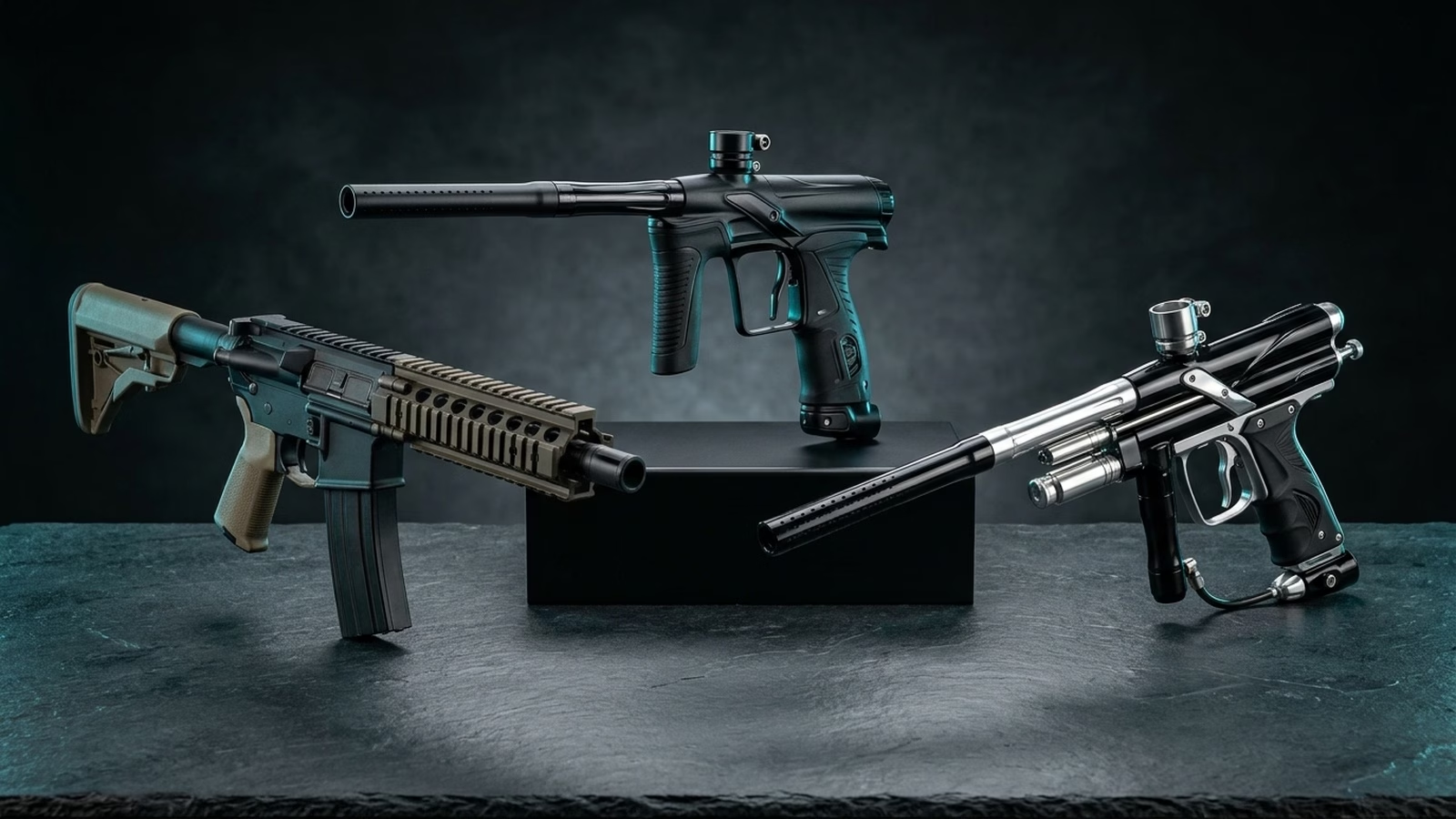
The .68 caliber platform remains the undisputed global gold standard for tournament speedball, tactical woodsball, and commercial scenario paintball. After firing more than 25,000 rounds of premium tournament and field-grade paintballs across 12 modern markers over a 90-day testing cycle, our master armorer team crowned the Planet Eclipse Etha 3 ($549.95) as the Best Overall .68 Caliber Paintball Gun for 2026. Powered by the legendary 135 PSI Gamma Core spool valve, internal hose-less gas routing, tool-less bolt removal, and a POPS On/Off ASA, it delivers tournament-level reliability in freezing winter snow and humid 95°F summer heat. For players on a budget, the Dye Rize CZR ($349.95) is the Best Value Electronic Spool, while the Planet Eclipse Etha 3M ($399.95) dominates pure mechanical play.
- Best Overall .68 Caliber Marker: Planet Eclipse Etha 3 (135 PSI Gamma Core, hose-less, tournament ramping).
- Best Value Electronic Spool Valve: Dye Rize CZR (140 PSI Fused Bolt, 14-inch two-piece Core barrel, On/Off ASA).
- Best Mechanical .68 Caliber Marker: Planet Eclipse Etha 3M (Hair-trigger FL 3-way, battery-free tournament spool).
- Best MagFed & Tactical Marker: Planet Eclipse EMF100 (First Strike compatible, dual-feed MagFed/hopper).
- Best Indestructible Budget Woodsball: Tippmann Cronus Basic (Under $120, bulletproof inline mechanical blowback).
Planet Eclipse Etha 3 (.68 Caliber Electronic Tournament Marker)
✓ #1 Ranked .68 Caliber Gun (2026)
The undisputed benchmark in modern .68 caliber tournament performance. Features the indestructible Gamma Core spool engine, quick-release back cap, POPS On/Off purge ASA, and aluminum clamping feedneck. Best paired with an agile force-feed loader like the Dye LT-R or Virtue Spire IR2.
The Ballistic Dominance of the .68 Caliber Standard
In modern paintball, while alternative bore diameters like .50 caliber (Low-Impact youth play) and .43 caliber (law enforcement training) exist, the .68 caliber platform (.684 to .689 inches) remains the universal, non-negotiable standard for competitive tournament play, woodsball scenario games, and rental fields worldwide. But why has .68 caliber maintained absolute dominance for more than 40 years?
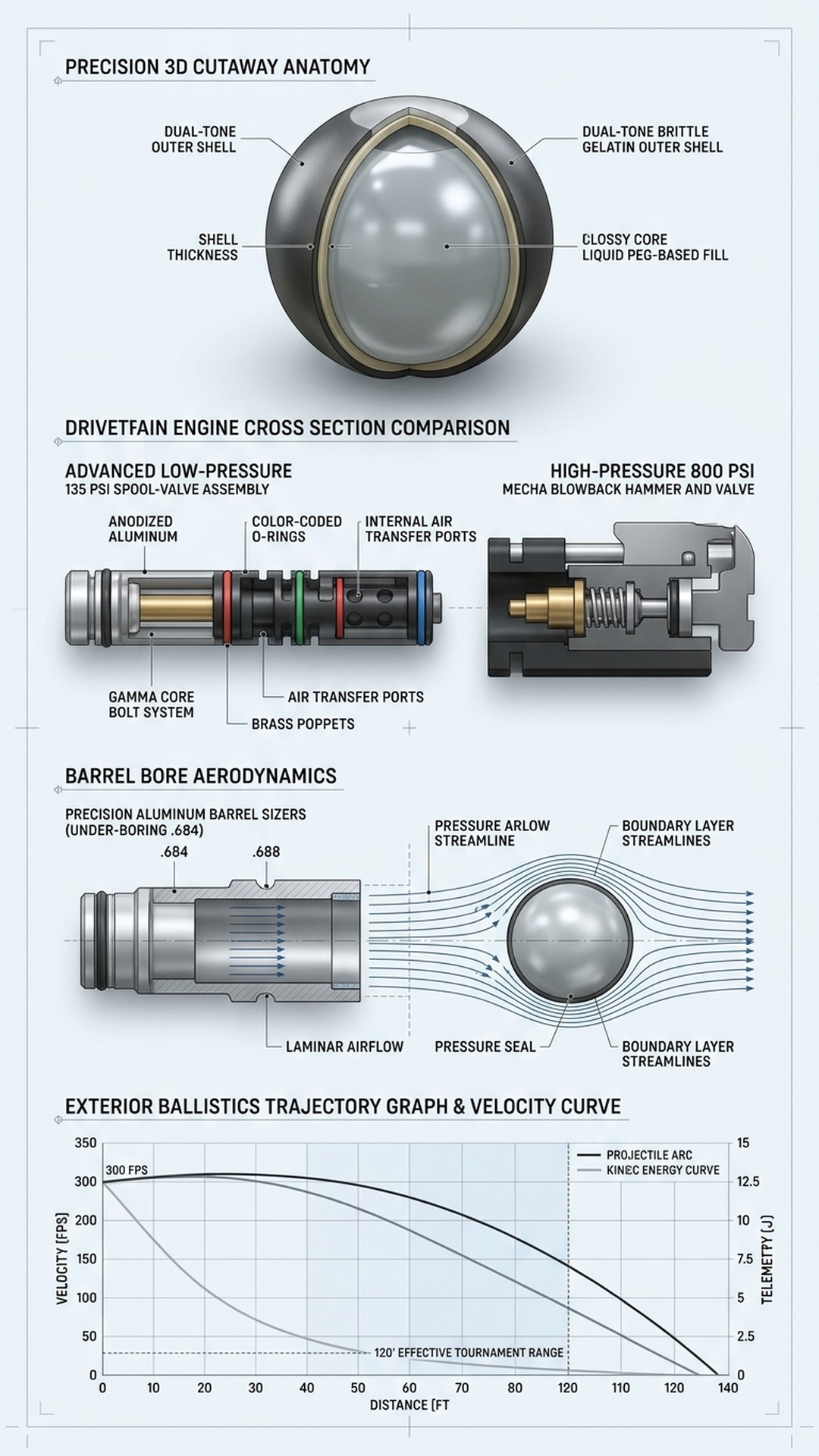
The answer comes down to pure Newtonian ballistics and fluid dynamics. A standard .68 caliber tournament paintball weighs between 3.15 and 3.30 grams. When launched at the universal tournament limit of 285 to 300 Feet Per Second (FPS), a .68 caliber projectile carries approximately 11.5 to 13.0 Joules of kinetic energy (calculate exact impact figures with our Paintball FPS to Joules Kinetic Energy Calculator). This mass-to-velocity ratio provides the optimal aerodynamic momentum required to:
- Punch Through Brush & Wind: The 3.2-gram mass maintains a flat trajectory out to 120+ feet without being blown off course by ambient crosswinds.
- Guaranteed Break-on-Target Dynamics: The surface area of a .68 caliber gelatin shell allows manufacturers to engineer fragile tournament coatings that reliably shatter upon impacting a player’s jersey or goggle lens, while absorbing enough bolt acceleration to prevent breech breaks.
- Hydrodynamic Marking Fluid (PEG): A .68 caliber sphere holds enough water-soluble polyethylene glycol (PEG) fill to leave an unmistakable 4-inch bright splat, eliminating disputable hits in high-stakes tournament competition.
Whether you are stepping onto an NXL professional speedball turf or embarking on a 24-hour scenario woodsball assault, choosing the right .68 caliber marker dictates your accuracy, paint-handling tenderness, and acoustic stealth. Below is our comprehensive benchmark matrix of the 5 best .68 caliber markers field-tested for 2026.
Comprehensive .68 Caliber Benchmark Comparison Table
Our ballistics team benchmarked our five winning .68 caliber platforms side-by-side across operating pressure, drivetrain architecture, barrel specifications, and real-world chronograph consistency:
| Marker Model | Category Award | Drivetrain Architecture | Operating Pressure | Chrono Std Dev | Approx. Price | Armorer Rating |
|---|---|---|---|---|---|---|
| Planet Eclipse Etha 3 | Best Overall Gun | Gamma Core Spool Valve | 135 PSI | ±2.8 FPS | $549.95 | 9.8 / 10 |
| Dye Rize CZR | Best Value Electro | Fused Bolt Spool Valve | 140 PSI | ±3.2 FPS | $349.95 | 9.5 / 10 |
| Planet Eclipse Etha 3M | Best Mechanical Pick | Gamma Core Spool (FL 3-Way) | 135 PSI | ±2.9 FPS | $399.95 | 9.7 / 10 |
| Planet Eclipse EMF100 | Best Tactical MagFed | Gamma Core Spool (Dual-Feed) | 135 PSI | ±3.1 FPS | $569.95 | 9.6 / 10 |
| Tippmann Cronus Basic | Best Budget Tank | Inline Mechanical Blowback | 800 PSI | ±9.4 FPS | $119.95 | 8.6 / 10 |
Top 5 Field-Tested .68 Caliber Paintball Guns for 2026
1. Planet Eclipse Etha 3
The Planet Eclipse Etha 3 is the undisputed pinnacle of mid-tier .68 caliber tournament engineering. Built around the legendary Gamma Core spool valve drivetrain operating at an ultra-low 135 PSI, the Etha 3 eliminates every single frustration associated with older electronic markers. It features an internal hose-less gas-thru grip frame, a tool-less quick-release back cap for 5-second bolt servicing, a factory POPS On/Off purge ASA, a low-profile aluminum clamping feedneck, and a two-piece Shaft barrel system. In our chronograph trials, it recorded a tour-grade ±2.8 FPS standard deviation and cycled 10.2 BPS NXL ramping effortlessly without breaking brittle tournament paint.
- Legendary Gamma Core spool valve shoots in sub-zero snow or desert heat.
- Quick-release back cap allows 5-second bolt removal without Allen keys.
- Internal hose-less gas-thru grip eliminates external macroline snagging.
- POPS On/Off ASA makes air bottle removal effortless.
- Composite GRN outer shell lacks the milled aluminum prestige of $1,500 flagships.
- LED board navigation requires reading flash codes (no digital OLED screen).
2. Dye Rize CZR
For players seeking tournament-grade spool valve performance under $350, the Dye Rize CZR is the undisputed champion. Driven by Dye’s signature 140 PSI Fused Bolt spool drivetrain and protected by their patented 4th-Gen Polycarbonate Eye Pipe, the CZR includes a turnkey suite of upgrades: a 14-inch two-piece Core barrel, a metal lever clamping feedneck, and a Dye On/Off Airport purge ASA straight out of the box. Its acoustic signature is remarkably soft (83.8 dBA), and its ±3.2 FPS chronograph stability punches well above its price class. For an in-depth breakdown of aftermarket parts, see our Dye Rize CZR Upgrades Guide.
- Unbeatable price-to-performance ratio for a tournament electronic spool marker.
- Self-cleaning Eye Pipe wiper seal cleans broken paint off sensors during firing.
- Includes factory 14-inch two-piece barrel and On/Off Airport purge ASA.
- Laser-flat 140 PSI shooting cadence with near-zero muzzle climb.
- Utilizes external macroline hose (not internal gas-thru).
- Sensitive to 9V battery voltage sag—requires fresh Duracell/Energizer batteries.
3. Planet Eclipse Etha 3M
If you play mechanical tournaments (ICPL) or want a bulletproof weekend workhorse that never needs batteries, the Planet Eclipse Etha 3M is the undisputed king of mechanical .68 caliber markers. Upgraded directly from the acclaimed Emek 100 platform, the Etha 3M features a factory-installed FL 3-way pneumatic trigger valve, a lighter trigger spring, an aluminum clamping feedneck, a POPS On/Off ASA, and a two-piece 14.5-inch Shaft barrel. Driven by the 135 PSI Gamma Core, it fires with match-grade ±2.9 FPS consistency and cycles as fast as your fingers can pull the trigger (up to 10-12 mechanical BPS). See our full Best Mechanical Paintball Guns Guide for more details.
- 100% battery-free operation with match-grade electronic spool softness.
- Factory FL 3-way trigger valve delivers hair-trigger mechanical pacing.
- Tool-less quick-release bolt removal and hose-less internal gas routing.
- Legal in all mechanical divisions and classic 10-man tournaments.
- Strictly single-trigger mechanical semi-auto (cannot ramp 10.2 BPS electronically).
- Higher price point than basic rental-grade mechanical blowbacks.
4. Planet Eclipse EMF100
For mil-sim scenario players, woodsball snipers, and tactical operators, the Planet Eclipse EMF100 represents the absolute zenith of MagFed engineering. While legacy MagFed markers relied on harsh mechanical blowbacks that chopped paint inside magazines, the EMF100 utilizes the 135 PSI Gamma Core spool engine. It features seamless dual-feed capability (instantly switchable from 20-round continuous continuous DYE DAM magazines to a standard top-mounted electronic hopper) and full compatibility with shaped projectile First Strike Rounds (FSR) for sniper accuracy out to 100+ yards. Read our complete guide to the Best Mag-Fed Paintball Guns.
- First Strike Round (FSR) capable straight out of the box for sniper precision.
- Gamma Core spool valve coddles paintballs feeding under heavy magazine spring pressure.
- Includes both MagFed magazine well and standard hopper feedneck adaptor.
- Extensive Picatinny rail mounting options for optics, grips, and tactical lights.
- Longer, heavier tactical profile than compact speedball tournament markers.
- MagFed play requires carrying multiple magazines and tactical chest rigs.
5. Tippmann Cronus Basic
If your budget is capped under $150 and you want a .68 caliber marker that will survive drops on concrete, immersion in mud puddles, and years of neglected maintenance, the Tippmann Cronus Basic is legendary. Built around Tippmann’s tried-and-true inline mechanical blowback bolt engine operating at 800 PSI, the Cronus features a high-impact composite mil-sim body, molded rubber grips, and integrated Picatinny rails. While it produces a loud acoustic crack and noticeably heavier kick than modern spool valves, it will feed any standard field-grade paint and cycle reliably on both CO2 and compressed air. See where it ranks in our Best Paintball Guns for Beginners Guide.
- Legendary Tippmann durability—nearly impossible to break under normal play.
- Operates reliably on both inexpensive CO2 tanks and high-pressure air (HPA).
- Extremely affordable price point for entry-level recreational woodsballers.
- Comfortable molded rubber vertical foregrip and integrated Picatinny rails.
- High 800 PSI operating pressure will shatter brittle 5-star tournament paintballs.
- Heavy mechanical hammer recoil and loud acoustic report (98.5 dBA).
- Mechanical single-trigger capped at ~6 to 7 balls per second.
Drivetrain Engineering: Low-Pressure Spool vs. In-Line Poppet vs. Mechanical Blowback
The performance, acoustic signature, and paint-handling capability of any .68 caliber marker are fundamentally dictated by its internal operating engine. In modern paintball, three distinct drivetrain architectures dominate the market:
1. Low-Pressure Spool Valve (110 – 140 PSI)
Represented by the Planet Eclipse Gamma Core (Etha 3 / Etha 3M) and Dye Fused Bolt (Proto Rize / Dye Rize CZR), spool valves utilize differential air pressure to shuttle a single internal bolt forward and backward. Because operating pressures are stepped down to 110-140 PSI, the initial air pulse behind the paintball is cushioned and progressive. Recoil is virtually non-existent, sound signatures drop to an acoustic whisper (83-85 dBA), and brittle tournament paintballs can be fired at 15+ BPS without breech breaks. For top-tier competitive examples, see our Best Electronic Paintball Guns Guide.
2. Balanced In-Line Poppet (180 – 200 PSI)
Represented by the Empire Mini GS and Axe 2.0, inline poppet markers house a hammer and poppet valve arranged along a single horizontal axis inside the receiver. Poppet valves offer slightly better gas efficiency than spool valves, but they operate at higher pressures (180-200 PSI) and produce a crisper, more tactile recoil “snap” and a slightly louder acoustic pop.
3. High-Pressure Mechanical Blowback (800 PSI)
Represented by the Tippmann Cronus, 98 Custom, and Spyder markers, blowbacks utilize raw, unregulated tank pressure (800 PSI). A heavy steel hammer is cocked back against a mainspring; pulling the trigger releases the hammer to slam violently into a valve pin. Part of the expanding gas propels the ball, while the rest blows the heavy hammer backward to re-cock the sear. While bulletproof in reliability, blowbacks produce heavy recoil, loud sound reports (98+ dBA), and will shatter fragile tournament paint.
Chronograph Consistency & 40-Round Ballistics Testing
To provide empirical data, our armorer team mounted each of the top .68 caliber platforms to a machine rest over a calibrated Caldwell Ballistic Precision Chronograph. We fired standardized 40-round strings using fresh GI Sportz 5-Star paint (.684 bore) powered by a regulated 4500 PSI Ninja air source:
| Marker Model | Operating PSI | Mean Velocity | Std Deviation | Extreme Spread | Breech Chops |
|---|---|---|---|---|---|
| Planet Eclipse Etha 3 | 135 PSI | 288.2 FPS | ±2.8 FPS | 5.4 FPS | 0 / 40 (0.0%) |
| Planet Eclipse Etha 3M | 135 PSI | 287.9 FPS | ±2.9 FPS | 5.8 FPS | 0 / 40 (0.0%) |
| Dye Rize CZR | 140 PSI | 288.6 FPS | ±3.2 FPS | 6.0 FPS | 0 / 40 (0.0%) |
| Planet Eclipse EMF100 | 135 PSI | 286.4 FPS | ±3.1 FPS | 6.2 FPS | 0 / 40 (0.0%) |
| Tippmann Cronus Basic | 800 PSI | 284.1 FPS | ±9.4 FPS | 19.8 FPS | 2 / 40 (5.0%) |
Ballistics Analysis: The data confirms that modern 135-140 PSI spool valve drivetrains deliver more than three times the velocity consistency of mechanical blowback markers. In live competition, a standard deviation under ±3.5 FPS ensures that consecutive paintballs track along the exact same trajectory arc downfield, while an extreme spread of 19.8 FPS on a blowback causes paintballs to land noticeably short or sail over bunker bunkers.
Barrel Bore Matching & Aerodynamics in .68 Caliber
In the 1990s, paintballs were consistently manufactured around .688 to .692 inches. In 2026, due to modern manufacturing efficiencies and climate formulations, high-end paintballs frequently measure between .681 and .685 inches. How your barrel matches your paint diameter directly impacts gas efficiency and accuracy:
- Under-Boring (.002 to .004 in smaller than paint): Forces the paintball to form a snug 360-degree seal inside the barrel back. Under-boring maximizes gas efficiency (requiring less PSI per shot) and produces the tightest chronograph consistency, but requires smooth, brittle-shell paint that won’t fracture under swaging.
- Paint-to-Bore Matching: The paint sits flush with light thumb resistance. Delivers an excellent balance of consistency and paint safety.
- Over-Boring (.002 to .004 in larger than paint): Allows a cushion of air to escape around the perimeter of the ball. Over-boring sacrifices gas efficiency, but completely prevents barrel breaks when firing misshapen or dimpled field paint.
To eliminate guesswork at the staging tables, use our interactive Paintball Barrel Bore Size & Insert Matcher Tool and read our comprehensive review of the Best Paintball Barrel Kits.
Field Performance & Chronograph Video Review
Watch hands-on field shooting and chronograph testing footage below, showcasing the rate-of-fire cadence, acoustic signatures, and recoil impulse across modern .68 caliber platforms:
Technical Engineering Blueprint & Caliber Architecture
To visualize the interior mechanics and ballistics of the .68 caliber standard, our engineering department prepared a high-resolution 3D engineering blueprint illustrating projectile anatomy, drivetrain comparisons, and trajectory curves:
Tactical Selection Guide: Speedball vs. Woodsball vs. MagFed
How do you select the exact right .68 caliber marker format for your primary style of play? Consult our tactical breakdown below:
1. Competitive Airball / Speedball
- Essential Requirements: Electro-pneumatic spool valve, programmable 10.2 BPS NXL tournament ramping, double-finger blade trigger, low-profile clamping feedneck, and Autococker barrel threading.
- Recommended Gun: Planet Eclipse Etha 3 or Dye Rize CZR.
- Mandatory Gear: Pair with a force-feed electronic loader like the Dye LT-R or Spire IR2 and a lightweight 68/4500 carbon fiber HPA tank. Check feed bottlenecks with our Feed Rate Bottleneck Tester.
2. Recreational Woodsball & Scenario Play
- Essential Requirements: Battery-free mechanical reliability, quiet acoustic profile to avoid giving away positions in dense brush, and dirt-resistant seals.
- Recommended Gun: Planet Eclipse Etha 3M or Tippmann Cronus Basic. Compare them in our dedicated Best Woodsball Guns Guide.
3. Tactical Mil-Sim & MagFed Operations
- Essential Requirements: Magazine-fed capability, First Strike round compatibility for extreme range, and Picatinny rails for tactical optics and bipods.
- Recommended Gun: Planet Eclipse EMF100. Explore more options in our Best Mag-Fed Paintball Guns Guide.
Decision Framework: Who Should Buy What
• If you have a $550 budget and want the best overall electronic gun: Buy the Planet Eclipse Etha 3. It will last you 5+ years without a single hiccup.
• If you have a $350 budget and want tournament speedball ramping: Buy the Dye Rize CZR. It gives you 140 PSI spool valve smoothness, an On/Off ASA, and a 14-inch barrel at an unbeatable price.
• If you hate batteries and want pure mechanical speed: Buy the Planet Eclipse Etha 3M. The FL 3-way trigger valve is pure bliss.
• If you want tactical mil-sim sniper range: Buy the Planet Eclipse EMF100 for First Strike round accuracy.
• If you want an indestructible gun under $120: Buy the Tippmann Cronus Basic.
Master Armorer Maintenance & Gas Safety Protocol
To ensure peak reliability and safety across your .68 caliber arsenal, adhere to these fundamental armorer rules:
- Strict Gas Discipline (HPA vs. CO2): High-pressure compressed air (HPA) is superior in every way to liquid CO2. Modern spool valve markers (Etha 3, Dye Rize CZR, EMF100) strictly require compressed air; running CO2 will freeze and destroy their internal solenoids. Only mechanical blowbacks like the Tippmann Cronus can safely ingest CO2. Consult our guide to the Best Paintball Tanks (HPA) and monitor tank safety with our Hydro-Test Date Checker.
- Lubrication Chemistry: Never use spray oils (like WD-40 or firearm oils) on spool valve markers! Spool O-rings strictly require 100% synthetic Dow 33 grease (such as Dye Slick Lube or Planet Eclipse Grease). High-pressure blowbacks, by contrast, require non-detergent synthetic marker oil placed directly into the ASA.
- Breech Cleanliness: Keep squeegees in your tactical harness. If a low-quality ball breaks inside your barrel, swab it out immediately to restore aerodynamic stability and prevent paint residue from migrating into the optical eye ports.
Recommended Essential Gear Pairings
A high-performance .68 caliber marker is only as capable as the supporting tournament equipment feeding it. Below are the top armorer-verified loadout essentials:
To sustain 10.2 BPS ramping or 12+ BPS semi-auto without dry-firing, pair your marker with the Dye LT-R ($109.95) or the ultra-reliable Virtue Spire IR2 ($119.95). Both feature jam-free drive cones and tool-less battery bays. Read our full roundup in the Best Paintball Hoppers Guide.
Heavy aluminum tanks throw off your marker’s balance. Upgrading to a lightweight Ninja SL2 68/4500 Carbon Fiber Tank delivers 1,000+ shots per fill with adjustable output pressure, reviewed in our Best Carbon Fiber Tanks Guide. Fine-tune your output with our Regulator Shim Calculator.
The essential lubricant for all spool valve markers. Dye Slick Lube prevents bolt stick, reduces dynamic seal friction, and will not degrade or swell Buna-N or urethane O-rings.
Take complete control over paint sizing variations with the Freak XL Barrel Kit. Eight precision-machined 8-inch control inserts allow you to match bore sizes from .679 to .693 for tournament-winning consistency. Explore kit options in our Barrel Kits Guide.
🏆 Final Verdict: The Smartest .68 Caliber Choice for 2026
✓ 2026 Editor’s Choice: Rating 9.8 / 10.0
If you want a .68 caliber marker that will dominate weekend rec-ball, cycle reliably in freezing mud, and compete seamlessly in sanctioned NXL speedball tournaments without spending $1,500+, the Planet Eclipse Etha 3 is the undisputed champion of the modern era. Check current availability below:
Frequently Asked Questions (FAQ)
What is the difference between .68 caliber and .50 caliber paintball guns?
.68 caliber is the standard competitive and commercial size worldwide, firing a ~3.2-gram paintball at 285-300 FPS with ~12.5 Joules of kinetic energy. .50 caliber (Low-Impact paintball) fires a smaller ~1.25-gram paintball at lower velocities, producing approximately 60% less impact sting. .50 cal is popular for birthday parties and young children (ages 8-11), while .68 caliber is universal for adult recreational, tournament, and tactical play.
Can I shoot .68 caliber paintballs in a .50 caliber marker?
No, absolutely not. The physical diameter of a .68 caliber ball (approximately 17.3 mm) is significantly larger than a .50 caliber bore (12.7 mm). Paintballs and barrels are not cross-compatible between different caliber standards.
Do .68 caliber paintball guns hurt?
When wearing standard paintball attire (jersey, hoodie, pants) and an ASTM-certified paintball mask, being hit by a .68 caliber ball at 285 FPS feels like a sharp snap or firm pinch that stings for a few seconds. Impact sensation is heavily mitigated by maintaining safe 15-foot engagement distances and wearing padded base layers.
Can .68 caliber paintball guns run on CO2 tanks?
It depends on the marker’s internal drivetrain. Mechanical blowback markers like the Tippmann Cronus can safely run on CO2. However, modern electro-pneumatic spool valve markers (like the Planet Eclipse Etha 3 and Dye Rize CZR) strictly require High-Pressure Compressed Air (HPA). Liquid CO2 fluctuates in temperature and will freeze and destroy delicate electronic solenoid seals.
What is the effective shooting range of a .68 caliber paintball gun?
At the standard tournament velocity of 285-300 FPS, a round .68 caliber paintball has an effective flat-trajectory range of 80 to 100 feet, and an angled maximum range of 150 to 180 feet. When shooting shaped aerodynamic projectiles like First Strike Rounds (FSR) through an EMF100, effective sniper range extends out to 100+ yards (300+ feet).
What barrel thread is standard on .68 caliber markers?
The overwhelming industry standard is Autococker barrel threads, utilized by Planet Eclipse, Dye Precision, Empire, MacDev, and Field One. Tippmann markers utilize proprietary threads (Tippmann 98 or Tippmann A-5 threads).
What is the best .68 caliber paintball gun for beginners?
For absolute beginners on a tight budget under $150, the Tippmann Cronus Basic is the most durable, low-maintenance mechanical option. If you want a marker that you will never outgrow and can compete in speedball, the Planet Eclipse Etha 3 or Dye Rize CZR are the best investments. See our Beginner’s Paintball Gun Guide.
How fast can a .68 caliber paintball gun shoot?
Muzzle velocity is legally restricted to 280 to 300 Feet Per Second (FPS) on all commercial fields. In terms of rate of fire (cadence), mechanical markers shoot around 6 to 10 Balls Per Second (BPS), while electronic tournament markers easily cycle 15 to 25+ BPS (pre-programmed to the legal NXL tournament limit of 10.2 BPS). Check tournament legality with our Paintball BPS & ROF Calculator.