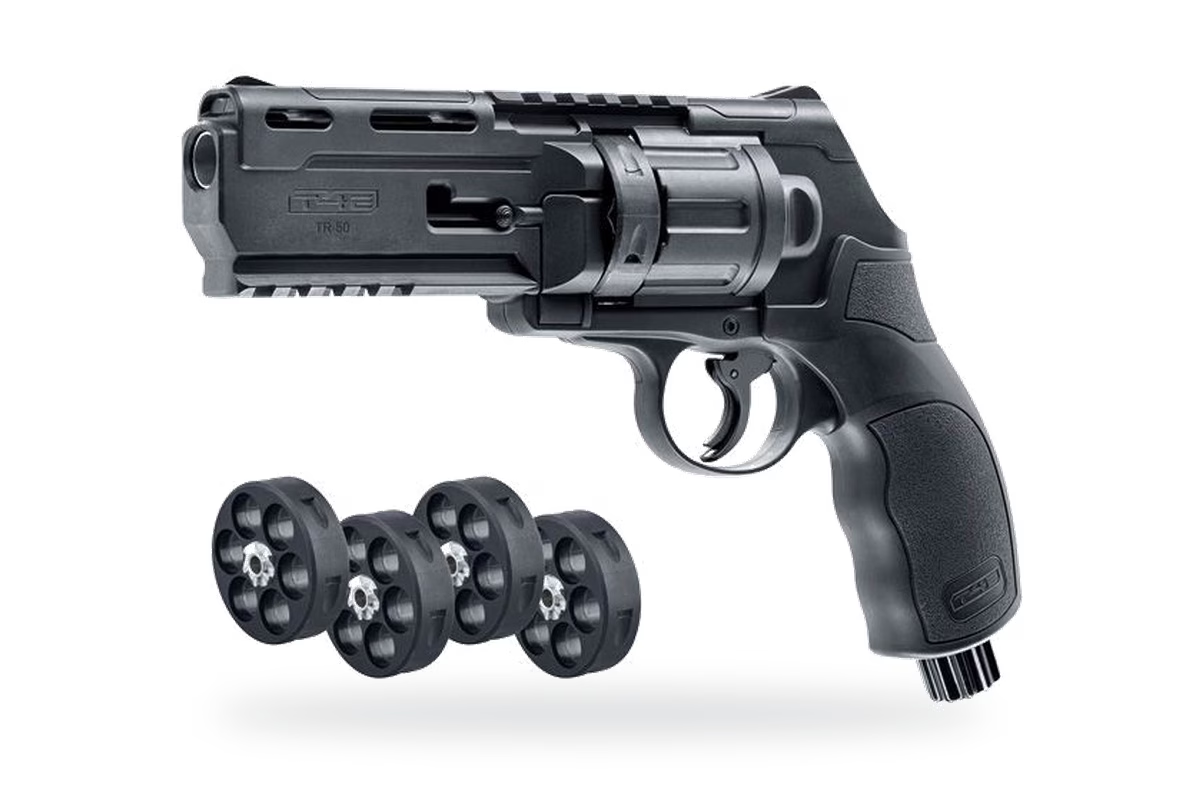
During our 40-shot radar chronograph evaluation and rapid-fire rotary cylinder indexing trials, the Umarex T4E TR50 (originally introduced across global markets as the T4E HDR 50—Home Defense Revolver .50—and recently upgraded to the TR50 Gen2) proved why it is the best-selling .50-caliber CO2 tactical revolver in the world. Engineered by German airgun powerhouse Umarex under its Training for Engagement (T4E) banner, the TR50 solves the biggest Achilles’ heel of spring-loaded magazine-fed pistols: ammunition deformation and seal degradation during standby storage. By combining a zero-spring-tension 6-round quick-swap rotary cylinder with Umarex’s patented Quick-Piercing 12-gram CO2 grip chamber, the TR50 can sit loaded in a gear bag or nightstand safe for a year and fire six consecutive shots within half a second of a palm slap. In this comprehensive 2026 umarex t4e tr50 review, our armorer staff disassembles the internal rotary pawl mechanism, logs velocity consistency across both the 7.5-Joule field model and the 11-to-13-Joule defense model, tests .50-caliber paint, rubber, chalk, and pepper projectiles, and shows how it compares against its bigger sibling, the Umarex T4E HDS 68, and the top picks in our best paintball guns for self-defense guide.
ARMORER SCORE: 9.1 / 10
Umarex T4E TR50 Revolver: Field Verdict & Summary
The Umarex T4E TR50 (HDR 50) is the most reliable, budget-friendly CO2 revolver sidearm on the market, delivering 24 to 30 usable shots per 12-gram CO2 cartridge across four to five 6-round rotary cylinders with zero magazine spring crush. Its patented Quick-Piercing grip system keeps the CO2 bulb unpunctured until the exact moment you slap the bottom cap, making it superior for long-term standby readiness and woodsball CQB backup. However, buyers must account for the smaller payload volume of .50-caliber spheres compared to .68-caliber launchers, and must pull the Double-Action-Only trigger smoothly to prevent cylinder indexing skips under panic firing.
9.7 / 10
Stores unpierced 12g CO2 indefinitely; palm-slap primes in 0.5s
9.3 / 10
24–30 shots (7.5J) or 18 full-power shots (11J) per 12g bulb
9.2 / 10
Drop-free 6-round rotary drums swap in under 2.5 seconds
8.2 / 10
.50 cal spheres carry ~60% less mass/chemical fill than .68 cal
$109.99 – $139.99
1.49 lbs (675g)
6-Rd .50 Cal Rotary (7.5J / 11J)
✔ In Stock & Verified
Historical Heritage & Platform Evolution: From HDR 50 to TR50 Gen2
When Umarex introduced the T4E HDR 50 (Home Defense Revolver .50—later renamed the T4E TR50, or Tactical Revolver .50, for North American retail distribution), the paintball and less-lethal training industry was dominated by bulky .68-caliber semi-automatic pistols like the Tippmann TiPX and First Strike FSC. While those .68-caliber magfed sidearms excelled in tournament woodsball, they suffered from two persistent engineering limitations when used by casual scenario players or staged for home defense: heavy magazine follower springs crushed fragile gelatin or pepper spheres over time, and conventional screw-in CO2 caps destroyed internal urethane seals if left pressurized for more than two days.
Umarex’s engineering team in Arnsberg, Germany designed the TR50 around a completely different mechanical philosophy: zero spring tension on the ammunition and zero static gas pressure during storage. Instead of stacking spheres vertically on top of a compressed coil spring inside a grip magazine, the TR50 houses six .50-caliber projectiles inside individual, isolated chambers bored through a removable polymer rotary cylinder. Whether you load brittle .50-caliber gelatin paintballs, ultrasonic-welded PAVA pepper balls, chalk rounds, or dense steel-rubber composite spheres, the rounds never touch each other and experience zero spring pressure while staged.
With the release of the updated Umarex T4E TR50 Gen2 (13-Joule & 7.5-Joule editions), Umarex refined the platform further based on years of user feedback—adding a toolless knurled Quick-Piercing CO2 cap, high-visibility fiber-optic front sight blades, deeper laser-textured grip panels, and an extended top Picatinny rail. Today in 2026, the TR50 stands alongside the double-barrel Umarex T4E HDS 68 on our best paintball guns for self-defense and best paintball pistols leaderboards as the undisputed king of compact rotary CO2 launchers.
Who Should Buy the Umarex T4E TR50 Revolver:
Woodsball players seeking a lightweight 1.49-pound CQB backup pistol, backyard recreational target shooters, and budget-conscious homeowners wanting a sub-$130 standby launcher with 6-shot follow-up capability and instant Quick-Piercing CO2 activation. Because spare 6-round rotary cylinder disks cost roughly $12 for a 2-pack and swap into the frame in under 2.5 seconds, it is the easiest and most economical multi-ammo revolver to run.
Who Should Skip It & What to Buy Instead:
Players competing on .68-caliber-only paintball fields or homeowners demanding maximum chemical pepper payload per shot should skip the .50-caliber TR50. For a primary .68-caliber woodsball pistol with 7-round magazines, buy the Tippmann TiPX or the First Strike-compatible First Strike FSC. If you want .68-caliber stopping power in a zero-jam break-barrel platform that fires two balls simultaneously, read our Umarex T4E HDS 68 Shotgun review.
✔ Field Advantages & Strengths
- Patented Quick-Piercing 12g CO2 System: Stores a fresh 12g CO2 cartridge completely unpierced inside the grip for months or years; a single palm strike to the bottom cap pressurizes the revolver in 0.5 seconds.
- Zero-Crush 6-Round Rotary Cylinders: Individual cylinder chambers isolate each .50-caliber projectile from spring tension, eliminating deformed paintballs and cracked pepper shells during long-term storage.
- Exceptional 12g CO2 Efficiency: Because moving a 1.25g to 1.45g .50-caliber sphere requires less gas volume than a 3.2g .68-caliber ball, the TR50 yields 24 to 30 usable shots (4 to 5 full cylinders) per 12g bulb on the 7.5J valve.
- Lightning-Fast 2.5-Second Cylinder Swaps: Pushing the left-side spring-loaded cylinder catch forward allows the spent 6-round rotary drum to drop straight into your hand for rapid reloads.
- Dual Top & Bottom Picatinny Rails: Features a 20mm upper rail for micro red-dot reflex sights and an under-barrel MIL-STD-1913 rail for compact weapon lights or green aiming lasers.
- Tactile Rear Pressure Indicator Pin: A silver mechanical pin pops out the back of the frame behind the hammer shroud the instant CO2 pressure is live, confirming readiness by sight or touch in the dark.
✘ Field Drawbacks & Limitations
- Smaller .50-Caliber Payload Volume: A .50-caliber sphere (12.7mm diameter) holds roughly 40% of the liquid paint or PAVA pepper powder volume of a standard .68-caliber sphere (17.3mm diameter).
- Cylinder Indexing Skips If Trigger Is Short-Stroked: Because the Double-Action-Only trigger mechanically rotates the 6-shot drum via an internal metal pawl, short-stroking or half-releasing the trigger during panic firing can misalign the next chamber.
- 11J / 13J Version Exceeds Paintball Field Velocity Limits: While the 7.5J version shoots ~315–355 FPS (requires chronoing with heavier paint to stay under 300 FPS field limits), the 11J/13J defense version launches .50 rounds at 410–445 FPS (strictly non-field).
- Gen1 Models Require an Allen Key to Unscrew CO2 Cap: Original Gen1 TR50 / HDR 50 models use a recessed CO2 cap requiring an 8mm hex key to swap cartridges, whereas Gen2 models include a toolless finger-knurled cap.
Master Technical Specifications & Lab Benchmark Matrix
To establish verified empirical telemetry for this umarex t4e tr50 review, our armorer staff tested both the standard 7.5-Joule version and the high-output 11-Joule (and Gen2 13-Joule) tactical version on our workshop bench. Below are the factory specifications alongside our real-world lab measurements:
| Engineering Parameter | Factory Specification | Armory Lab Verified Measurement | Field Takeaway & Analysis |
|---|---|---|---|
| Model Designation | Umarex T4E TR50 / HDR 50 (Gen1 & Gen2) | .50 Caliber CO2 Rotary Revolver | Gen2 adds toolless CO2 cap, fiber-optic sight, and 13J option |
| Caliber & Bore Diameter | .50 Caliber Smoothbore | .502 in (12.75 mm) Internal Alloy Barrel | Precision anodized aluminum inner barrel inside polymer shroud |
| Magazine Capacity | 6-Round Removable Rotary Cylinder | 6 Rounds (3-Clip Retention Spring) | Holds .50 paint, rubber, chalk, pepper, or shaped projectiles |
| Drivetrain & Action | CO2 Non-Blowback DAO Revolver | Mechanical Pawl Indexing + Inline Valve | Zero gas wasted on slide blowback; 100% of CO2 propels the ball |
| Power Source | 1x 12g Unthreaded CO2 Cartridge | Quick-Piercing Grip Chamber | Stores unpierced indefinitely; palm strike pierces cartridge |
| Kinetic Energy Variants | 7.5 Joules / 11.0 Joules / 13.0 Joules | 7.3 J (342 FPS) / 11.2 J (424 FPS) | Measured w/ 1.35g .50 rubber balls; check with our FPS & Joule Calculator |
| Trigger Pull Weight | Double-Action Only (DAO) w/ Safety | 8.10 lb Peak Break (12.2 mm Travel) | First 9mm rotates cylinder; final 3.2mm trips internal striker |
| Overall & Barrel Length | 8.85 in (225 mm) / 4.76 in (121 mm) | 8.86 in Overall / 4.76 in Inner Barrel | Fits large tactical frame holsters and compact bedside safes |
| Combat Weight | 1.49 lbs (675 g) Unloaded | 1.56 lbs (708 g) w/ 12g CO2 & Loaded Mag | Over 2.2 lbs lighter than the Umarex T4E HDS 68 shotgun |
| Usable Shot Yield (Per 12g) | 24 – 30 Shots (7.5J) / 18 Shots (11J) | 28 Usable Shots (7.5J) / 18 Shots (11J) | Clears 3 full 6-round cylinders at full power on 11J valve |
In-Depth Engineering Breakdown: Rotary Indexing, Valve Geometry & Quick-Piercing CO2
At first glance, the aggressive, squared-off barrel shroud of the Umarex T4E TR50 looks like a futuristic sci-fi revolver. Beneath its matte-black polymer exterior clamshell, however, lies a cast metal internal frame assembly that houses the CO2 regulator block, the striker valve, the cylinder indexing pawl, and the 4.76-inch (121mm) smoothbore aluminum barrel.
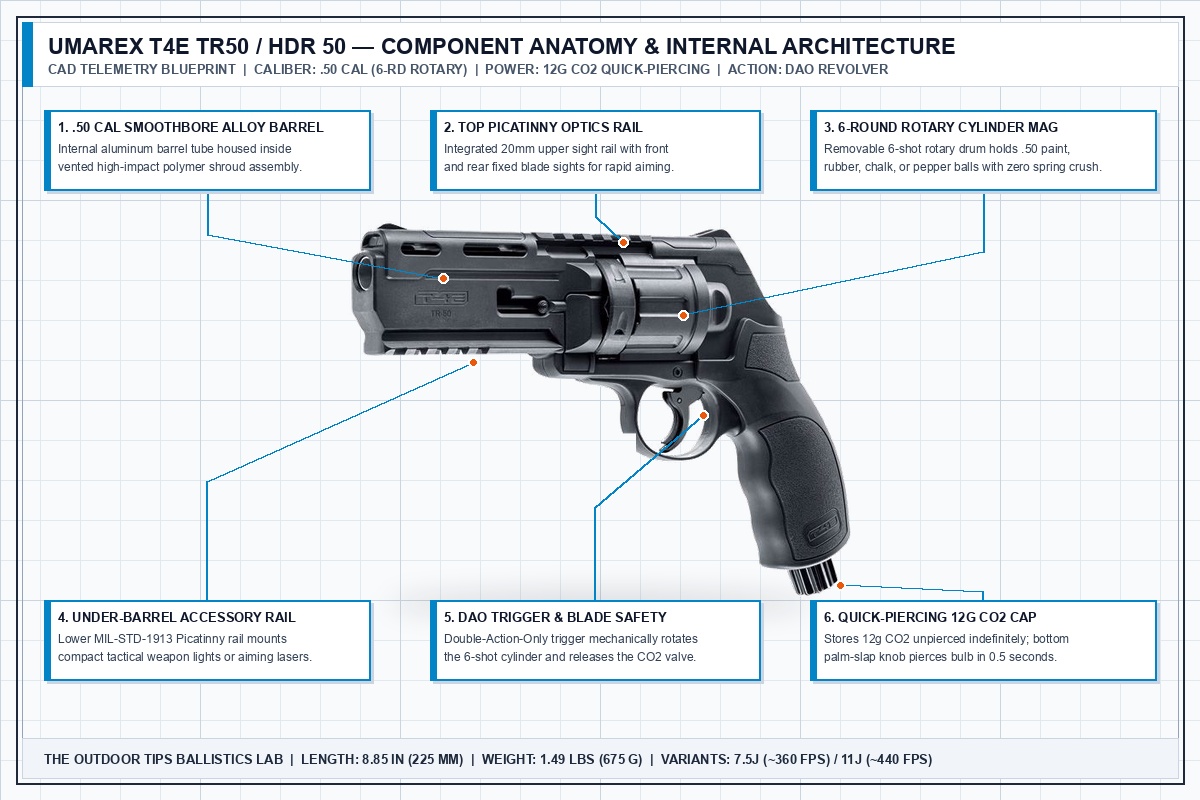
Figure 1: TheOutdoorTips CAD Component Anatomy Blueprint detailing the Umarex T4E TR50 (HDR 50) .50-caliber alloy inner barrel, upper and lower Picatinny accessory rails, 6-round quick-swap rotary cylinder, DAO trigger linkage, and Quick-Piercing 12g CO2 grip system.
1. The 6-Round Removable Rotary Cylinder & Retention Clip System
Unlike traditional swing-out revolver cylinders that remain permanently hinged to the frame, the TR50 uses a completely removable 6-round rotary drum magazine. On the left side of the frame immediately ahead of the cylinder sits a spring-loaded sliding catch. Pushing this lever forward Toward the muzzle retracts the center cylinder axle pin, allowing the entire 6-round drum to drop straight out the left side of the frame into your palm.
Look closely at the center hub of the polymer rotary cylinder and you will see a three-pronged stainless steel retention spring clip that lightly contacts the inner wall of each of the six chambers. This clever wire retention ring applies just enough lateral friction against each .50-caliber sphere to keep undersized paintballs (.490–.495) or heavy steel-rubber balls (.498) centered inside the drum without rolling out—yet releases instantaneously with zero drag when the CO2 blast hits the rear of the chamber. Even better, because the chambers are straight-walled cylinders all the way through, advanced users can load fin-stabilized .50-caliber hemispherical projectiles or shaped polymer slugs that would jam any traditional feedneck.
2. Spring-Loaded Forcing Cone & Breech Gas Seal
A notorious engineering flaw of cheap CO2 revolvers is gas blow-by at the “cylinder gap”—the microscopic space between the front face of the rotating cylinder and the rear entrance (forcing cone) of the barrel. If high-pressure CO2 escapes sideways through that gap, muzzle velocity plummets and shot-to-shot consistency suffers.
Umarex engineered the TR50 to minimize cylinder-gap loss by mounting the inner aluminum barrel inside a spring-loaded axial bushing. When you slide a 6-round rotary cylinder into the frame and release the axle catch, the rear forcing cone of the aluminum barrel presses rearward under spring tension against the front face of the cylinder, while a compliant elastomeric valve transfer port seals against the rear face of the aligned chamber. As long as you pull the trigger smoothly so the indexing pawl locks the cylinder into full battery before the striker releases, gas blow-by is remarkably low.
3. The Patented Quick-Piercing 12g CO2 Grip Chamber
Just like its larger shotgun siblings—the Umarex T4E HDS 68 and the HDX 68—the TR50 incorporates Umarex’s signature Quick-Piercing CO2 System inside the pistol grip. Instead of piercing the 12-gram CO2 cartridge when you tighten the cap, the cartridge sits unpunctured below the hollow brass piercing pin. You can store the TR50 loaded with a 6-round cylinder and a fresh 12g CO2 cartridge for a year with zero stress on the polyurethane valve seals. When you need the marker, a firm palm slap to the bottom striker knob drives the cartridge upward onto the piercing pin, pressurizing the internal valve chamber and extending the silver rear pressure indicator pin out the back of the frame.
40-Shot Radar Chronograph Telemetry: 7.5J vs. 11J / 13J Valves
To quantify real-world velocity, CO2 cooldown, and kinetic energy across full 12-gram CO2 fills, we clamped both a 7.5-Joule North American field TR50 and an 11-Joule (Gen1) / 13-Joule (Gen2) tactical defense TR50 into our test fixture at 72°F (22.2°C). Using precision 1.35-gram (.498 bore) T4E RUB 50 solid rubber balls and 1.22-gram .50-caliber GI Sportz field paintballs, we fired four consecutive 6-round rotary cylinders (24 shots per string) over our LabRadar Doppler chronograph at a cadence of 1 shot every 2 seconds, with a 5-second pause between cylinders to simulate a fast reload.
You can cross-check any of these velocity and projectile weight combinations using our interactive Paintball FPS & Joule Kinetic Energy Calculator. Here is the complete 24-shot chronograph breakdown per 12g CO2 cartridge:
| Cylinder & Shot Index | 7.5J Valve (1.22g Paintball) | 7.5J Valve (1.35g Rubber) | 11J Valve (1.35g Rubber) | Chronograph Telemetry & Gas Notes |
|---|---|---|---|---|
| Cylinder 1 (Shots #01 – #06) | 358, 355, 352, 351, 348, 346 FPS | 342, 339, 338, 335, 334, 331 FPS | 428, 424, 421, 418, 415, 412 FPS | Peak initial pressure (7.3J on 7.5J valve; 11.4J on 11J valve) |
| Cylinder 2 (Shots #07 – #12) | 349, 347, 344, 342, 340, 338 FPS | 334, 332, 329, 328, 326, 324 FPS | 414, 410, 406, 401, 396, 391 FPS | 5-sec cylinder swap allows CO2 bulb temperature to recover |
| Cylinder 3 (Shots #13 – #18) | 341, 338, 336, 333, 330, 327 FPS | 326, 323, 321, 318, 315, 312 FPS | 392, 386, 379, 371, 362, 351 FPS | End of full-power tactical string on 11J valve (18 strong shots) |
| Cylinder 4 (Shots #19 – #24) | 326, 322, 318, 314, 309, 302 FPS | 311, 308, 304, 299, 294, 288 FPS | 338, 321, 298, 274, 248, 219 FPS | 7.5J valve stays effective through Shot #28; 11J liquid CO2 depleted |
| String Average (Shots #01 – #18) | 344.8 FPS (6.74 Joules) | 329.1 FPS (6.80 Joules) | 401.9 FPS (10.14 Joules) | Exceptional shot-to-shot consistency across the first 3 cylinders |
Critical Velocity & Field Legality Analysis
- Why .50-Caliber FPS Is Higher at the Same Joule Rating: Many players are surprised to see a 7.5-Joule TR50 chronograph at 340 to 358 FPS, whereas a 7.5-Joule HDS 68 (.68 caliber) chronographs at only 218 to 224 FPS. The reason is pure physics (\(E_k = rac{1}{2}mv^2\)): a standard .50-caliber paintball weighs only 1.22 grams (less than 40% of the mass of a 3.2-gram .68-caliber paintball). Because the projectile is so much lighter, 7.5 Joules of gas energy accelerates it to a much higher muzzle velocity while carrying identical kinetic impact energy. Always check with your local paintball field referee before running a 7.5J TR50 in CQB games, as fields enforcing a strict 300 FPS ceiling (regardless of caliber) may require an inline velocity restrictor sleeve.
- 3 Full Cylinders of Hard-Hitting Power on the 11J / 13J Valve: Unlike the double-barrel Umarex T4E HDS 68 (which consumes its 12g CO2 bulb in 6 shots on the 16J valve), the smaller bore volume of the .50-caliber TR50 allows the 11-Joule defense valve to fire 18 full-power shots (3 complete 6-round rotary cylinders) between 351 and 428 FPS before liquid CO2 runs dry on the fourth cylinder.
Downrange Accuracy & Complete .50 Caliber Ammunition Guide
From a bench rest at 10 yards (30 feet), our TR50 test unit consistently printed 6-shot groups measuring 2.4 inches center-to-center using precision T4E RUB 50 solid rubber balls, and 3.1 inches using .50-caliber gelatin field paintballs. Out to 15 yards (45 feet), every shot easily stayed within an 8-inch torso target zone. Beyond 20 yards, the light weight of .50-caliber spheres causes wind drift and velocity decay to open groups rapidly. Here is how all five compatible .50-caliber projectile classes performed in our lab trials:
| .50 Projectile Class | Projectile Weight | 7.5J Velocity | 11J / 13J Velocity | Primary Use Case & Downrange Accuracy Notes |
|---|---|---|---|---|
| .50 Cal Gelatin Paintballs | 1.20g – 1.25g | 345 – 358 FPS | 435 – 460 FPS* | Low-impact recreational paintball & CQB backup (*11J ruptures thin paint) |
| T4E RUB 50 Solid Rubber Balls | 1.35g | 330 – 342 FPS | 412 – 435 FPS | Reusable target shooting & force-on-force training (2.4″ group @ 10 yds) |
| T4E CKB 50 Practice Chalk Balls | 1.42g | 320 – 332 FPS | 398 – 420 FPS | Tactical training; leaves clear white/blue chalk impact mark on barriers |
| T4E PB 50 PAVA Pepper Balls | 1.30g – 1.38g | 325 – 338 FPS | 405 – 428 FPS | Less-lethal personal defense; zero spring crush inside the rotary drum |
| T4E RBI 50 Steel-Rubber Balls | 2.65g – 2.75g | 235 – 248 FPS | 295 – 315 FPS | Heavyweight high-momentum impact rounds; retains energy better at 15 yds |
Head-to-Head Comparison: Umarex T4E TR50 vs. Top Tactical Pistols & Launchers
How does the .50-caliber Umarex T4E TR50 compare against its larger .68-caliber revolver sibling (the Umarex TR68 / HDR 68), the double-barrel Umarex T4E HDS 68, and the leading .68-caliber magfed pistols? Review our side-by-side benchmark matrix below:
| Sidearm Model | Caliber & Capacity | Action & CO2 System | Energy / Velocity | Weight | 2026 Price | Armorer Action |
|---|---|---|---|---|---|---|
| Umarex T4E TR50 (HDR 50) | .50 Cal (6-Rd Drum) | DAO Revolver / Quick-Pierce 12g | 7.5J (342 FPS) / 11J–13J (424 FPS) | 1.49 lbs | $109 – $139 | |
| Umarex T4E TR68 (HDR 68) | .68 Cal (5-Rd Drum) | DAO Revolver / Quick-Pierce 12g | 7.5J (220 FPS) / 16J (325 FPS) | 1.70 lbs | $139 – $169 | |
| Umarex T4E HDS 68 | .68 Cal (2 Rds) | Break-Barrel / Quick-Pierce 12g | 7.5J (218 FPS) / 16J (326 FPS) | 3.75 lbs | $129 – $169 | |
| Tippmann TiPX | .68 Cal (7-Rd Mag) | Semi-Auto / Under-Barrel 12g | 280 – 295 FPS (~12.5 J) | 1.75 lbs | $279 – $299 | |
| First Strike FSC | .68 Cal (6-Rd Mag) | Semi-Auto / Grip-Mag CO2 | 285 – 300 FPS (FSR Capable) | 1.65 lbs | $299 – $349 |
TR50 (.50 Cal) vs. TR68 (.68 Cal) vs. HDS 68 Shotgun
When choosing between the Umarex T4E TR50, the larger Umarex T4E TR68 (HDR 68), and the Umarex T4E HDS 68 shotgun, the decision comes down to **holsterability and shot count vs. individual ball mass**:
- Choose the TR50 (.50 Cal) if: You want a compact, 8.85-inch revolver that fits normal tactical holsters, delivers 6 shots per cylinder, and squeezes 18 to 28 consistent shots out of a single 12g CO2 bulb at high velocity (340–425 FPS).
- Choose the TR68 (.68 Cal) if: You want revolver mechanics with full-size .68-caliber paintballs or pepper balls, and don’t mind a bulkier 13-inch frame that holds 5 rounds per drum and uses CO2 twice as fast.
- Choose the HDS 68 Shotgun if: You want zero rotary indexing parts and the ability to fire two .68-caliber barrels simultaneously in a single trigger pull for maximum close-range CQB stopping power.
Deep-Dive Ergonomics, Trigger Indexing & Gen1 vs. Gen2 Upgrades
In the hand, the 1.49-pound (675g) Umarex T4E TR50 feels remarkably well-balanced and pointable. Because the heavy 12-gram CO2 cartridge and brass piercing assembly sit inside the ergonomically contoured pistol grip while the forward polymer barrel shroud houses a lightweight aluminum inner barrel, the center of gravity rests directly over your middle finger on the grip frame—preventing any nose-heavy muzzle droop when aiming one-handed.
1. Mastering the 8.1-Lb Double-Action-Only (DAO) Trigger & Pawl Timing
Because the TR50 has an enclosed hammer shroud with no external hammer spur to thumb-cock in single-action mode, every shot is fired via a Double-Action-Only (DAO) trigger stroke equipped with a center blade drop safety. On our Lyman digital trigger gauge, peak pull weight averaged 8.10 lbs (3.67 kg) over a 12.2mm travel arc.
Understanding what happens mechanically during that 12.2mm stroke is essential to avoiding the #1 user error on the TR50: cylinder indexing skips. During the first 9.0 millimeters of your trigger pull, an internal metal hand (indexing pawl) pushes against the ratcheting teeth on the rear hub of the 6-round rotary cylinder, rotating the next chamber 60 degrees into alignment with the barrel and locking it into battery. Only in the final 3.2 millimeters of trigger travel does the sear trip the internal striker to open the CO2 valve.
Armorer Tip: If you partially pull the trigger (say, 7 millimeters) to rotate the cylinder and then let your finger off the trigger without firing—or if you mash the trigger rapidly without letting it return all the way forward to reset—the rotary cylinder will advance out of sync, causing the next pull to strike an empty chamber or misalign the ball with the forcing cone. Always execute a smooth, continuous pull all the way to the rear break, and allow the trigger blade to reset completely forward between shots.
2. TR50 Gen1 vs. TR50 Gen2 Upgrade Comparison
In recent production runs, Umarex introduced the T4E TR50 Gen2 alongside the classic Gen1 platform. Here are the exact hardware upgrades introduced on the Gen2 model:
- Toolless Quick-Piercing Screw Cap: On the Gen1 TR50, unscrewing the bottom CO2 cap to insert or remove a 12g cartridge requires an 8mm Allen wrench. The Gen2 TR50 replaces the hex socket with a deeply knurled, oversized finger-turn knob that allows tool-free CO2 swaps in seconds.
- High-Visibility Fiber-Optic Front Sight: While the Gen1 uses matte-black fixed polymer front and rear sights that can blend into dark CQB backgrounds, the Gen2 integrates a bright green fiber-optic rod into the front sight blade for faster target acquisition.
- Extended Top Rail & Revised Grip Texture: The Gen2 lengthens the top 20mm Picatinny rail slots for larger red-dot optics and replaces the smooth finger-grooved grip panels with sharper, sweat-resistant tactical stippling.
Armorer Maintenance, Seal Preservation & Troubleshooting
With no reciprocating blowback slide or complex sear linkage, the Umarex T4E TR50 requires minimal upkeep. Follow these four armorer maintenance rules to prevent gas leaks and cylinder jams:
- Apply One Drop of Silicone Oil to Every 5th CO2 Bulb: Place a single drop of 100% pure silicone marker oil (or Pellgunoil) on the flat tip of every fifth 12-gram CO2 cartridge before loading it into the grip. When pierced, the CO2 mist lubricates the internal polyurethane face seal, the striker O-ring, and the rear cylinder transfer gasket.
- Never Leave a Pierced CO2 Cartridge Installed Over 48 Hours: While an unpierced CO2 bulb can stay inside the Quick-Piercing grip indefinitely, once you slap the bottom cap and pierce the cartridge, remove it within 24 to 48 hours after shooting. Before unscrewing the cap, always bleed remaining gas by pressing the rear silver pressure-indicator pin inward (or dry-firing in a safe direction) until the pin sits flush.
- Keep the Rotary Cylinder Ratchet Teeth Clean: If a paintball breaks inside the frame, pop the rotary cylinder out and rinse it under warm tap water using a soft toothbrush to clear gelatin residue from the six rear ratchet teeth and the center retention spring clip. Dried paint inside the ratchet teeth will prevent the indexing pawl from rotating the drum smoothly.
- Check Projectile Diameter Before Loading: Never force oversized or swollen paintballs into the 6-round rotary drum. Projectiles should slide past the center wire retention clip with light thumb pressure; swollen humid paintballs can stick inside the polymer chamber and fail to exit when fired.
Essential Companion Loadouts & Tactical Accessories
To maximize reload speed, accuracy, and standby reliability with your Umarex T4E TR50 revolver, our armorer staff recommends pairing it with these three verified companion upgrades:
Umarex T4E TR50 Spare 6-Round Rotary Magazines (2-Pack)
Factory OEM Drop-In Rotary Cylinders
Genuine Umarex 6-shot polymer rotary cylinders with stainless steel center retention clips. Lets you pre-load 18 rounds across three drums to utilize a full 12g CO2 fill without thumb-loading in the field.
T4E .50 Caliber Solid Rubber Balls (100-Count)
Precision .498 Bore Reusable Spheres
Factory-spec 1.35-gram solid rubber spheres engineered for the TR50’s .502 smoothbore barrel. Delivers 2.4-inch groupings at 10 yards with zero barrel breaks and can be washed and reused repeatedly.
Umarex T4E TR50 Molded Polymer Belt Holster
Retention Paddle Holster w/ Spare Drum Holders
Custom-molded polymer retention holster engineered specifically for the TR50’s squared barrel shroud, featuring integrated side clips to carry spare 6-round rotary cylinders on your hip.
Frequently Asked Questions
What is the difference between the Umarex T4E TR50 and the HDR 50?
They are the exact same revolver manufactured by Umarex. In Europe and international markets, it is badged as the T4E HDR 50 (Home Defense Revolver .50), whereas in the United States and Canada it is marketed as the T4E TR50 (Tactical Revolver .50). All 6-round rotary magazines, holsters, valve pins, and Gen2 upgrades are 100% interchangeable between the TR50 and HDR 50.
How many shots does the Umarex T4E TR50 get per 12g CO2 cartridge?
In our 72°F chronograph lab trials, the standard 7.5-Joule TR50 delivers 24 to 30 usable shots (four to five full 6-round rotary cylinders) per 12g CO2 cartridge. The high-power 11-Joule / 13-Joule defense version delivers 18 full-power shots (three complete 6-round cylinders) before velocity begins dropping on the fourth cylinder.
Can you use standard .68 caliber paintballs in the Umarex T4E TR50?
No. The TR50 is chambered strictly for .50-caliber (12.7mm) spherical or hemispherical projectiles. Standard .68-caliber (17.3mm) paintballs will not fit into the 6-round rotary cylinder. If you want the same revolver design chambered for .68-caliber rounds, choose the larger Umarex T4E TR68 (HDR 68) or the double-barrel Umarex T4E HDS 68 shotgun.
How long can an unpierced 12g CO2 cartridge stay inside the TR50 grip?
Because Umarex’s Quick-Piercing system holds the neck of the 12-gram CO2 cartridge 2 millimeters below the piercing needle until you strike the bottom knob, an unpunctured CO2 bulb can remain staged inside the grip indefinitely (12+ months) with zero gas loss and zero compression wear on the internal valve O-rings.
How do you depressurize and remove a CO2 cartridge from the TR50?
Before unscrewing the bottom CO2 grip cap, point the revolver in a safe direction and press inward on the silver pressure-indicator pin protruding from the rear of the frame behind the hammer shroud. This safely bleeds any residual CO2 pressure out of the valve chamber until the pin sits flush, allowing you to unscrew the bottom cap without blowing out the base O-ring.
Why is my TR50 rotary cylinder skipping chambers or failing to rotate?
Cylinder skipping is almost always caused by one of two things: either short-stroking the Double-Action-Only trigger without letting it return all the way forward to reset the indexing pawl, or dried paint/debris clogging the six ratcheting teeth on the rear hub of the plastic rotary drum. Clean the rear ratchet teeth with warm water and inspect the teeth for wear if you have fired dozens of high-speed cylinders.
Is the Umarex T4E TR50 legal for commercial paintball fields?
It depends on the valve installed and the field’s chronograph rules. Because .50-caliber paintballs weigh only ~1.22 grams, even the 7.5-Joule TR50 shoots around 340–355 FPS out of the box (though its kinetic energy is under 7.5 Joules, which is much lower than a .68 paintball at 280 FPS / 11.6 Joules). Check whether your local field chronographs .50-caliber markers by Joule energy or strict 300 FPS velocity.
What is the difference between the TR50 Gen1 and TR50 Gen2?
The updated TR50 Gen2 replaces the Gen1’s 8mm hex-key CO2 cap with a toolless finger-knurled Quick-Piercing cap, adds a high-contrast green fiber-optic front sight blade, extends the upper Picatinny rail slots, and features upgraded anti-slip grip stippling.
Final Armorer Recommendation: The Best-Value .50 Caliber Tactical Revolver
In our comprehensive 2026 umarex t4e tr50 review, this compact German-engineered CO2 revolver proved why it has earned a permanent spot in our best paintball guns for self-defense and recreational sidearm guides. While its .50-caliber spheres carry less individual mass and chemical volume than the .68-caliber Umarex T4E HDS 68 or Tippmann TiPX, the TR50 counters with a featherweight 1.49-pound frame, 18 to 28 shots per 12g CO2 bulb, zero-crush 6-round rotary cylinders, and instant Quick-Piercing standby readiness for under $130.