In our umarex hdp 50 review and dedicated t4e hdp 50 quick pierce test, we ran 450+ rounds of .50 caliber rubber, steel-core admix, and pepper dust spheres through both a standard 11J Gen 1 chassis and a Gen 2 high-output pistol. Built to stay loaded in a bedside safe for months under zero gasket pressure until activated by one palm strike, the Umarex T4E HDP 50 solves chronic CO2 seal creep—though its 6-round internal magazine tube forces careful reload planning when stacked against the best paintball guns for self-defense.
ARMORER SCORE: 9.1 / 10
Umarex T4E HDP 50 Pistol: Field Verdict & Summary
On our chronograph dyno and rapid-readiness bench, the Umarex T4E HDP 50 earns a 9.1 / 10 for sub-second emergency CO2 activation, rugged metal-reinforced internal frame construction, and crisp fiber-optic sight alignment at a street price near $130. Its two honest limitations are the 6-round underbarrel tube that cannot be speed-swapped mid-fight and an 8.1-pound double-action trigger that punishes sloppy slap pulls past 25 feet.
9.6 / 10
Zero idle CO2 bleed across 90-day shelf hold; one firm palm slap charges valve in under 0.6s.
9.2 / 10
High-power 11J–13J Gen 2 variants clock 380–442 FPS across first two 6-shot tubes.
8.6 / 10
Duty-sized polymer frame tracks flat; ~8.1 lb long DAO trigger demands dry-fire practice.
9.3 / 10
Unbeatable ~$129 price tier with standard 12g CO2 availability and toolless base cap.
$119.95 – $149.95
24.1 oz (682g w/ 12g CO2)
Quick-Pierce 12g CO2 (.50 Cal)
✔ In Stock & Tested
Platform Heritage: Why Umarex Built the HDP 50 Quick-Piercing Architecture
Traditional CO2 paintball pistols share one fatal bedside weakness: if you screw a 12-gram cartridge tight into a valve pierce-pin and leave it locked for four months inside a nightstand drawer, compressed gas slowly hardens polyurethane valve seals and eventually leaks silent energy before an intruder ever knocks. Conversely, dropping an unpierced CO2 capsule down the grip with an Allen wrench under dark-room adrenaline steals 12 to 20 seconds you simply do not have.
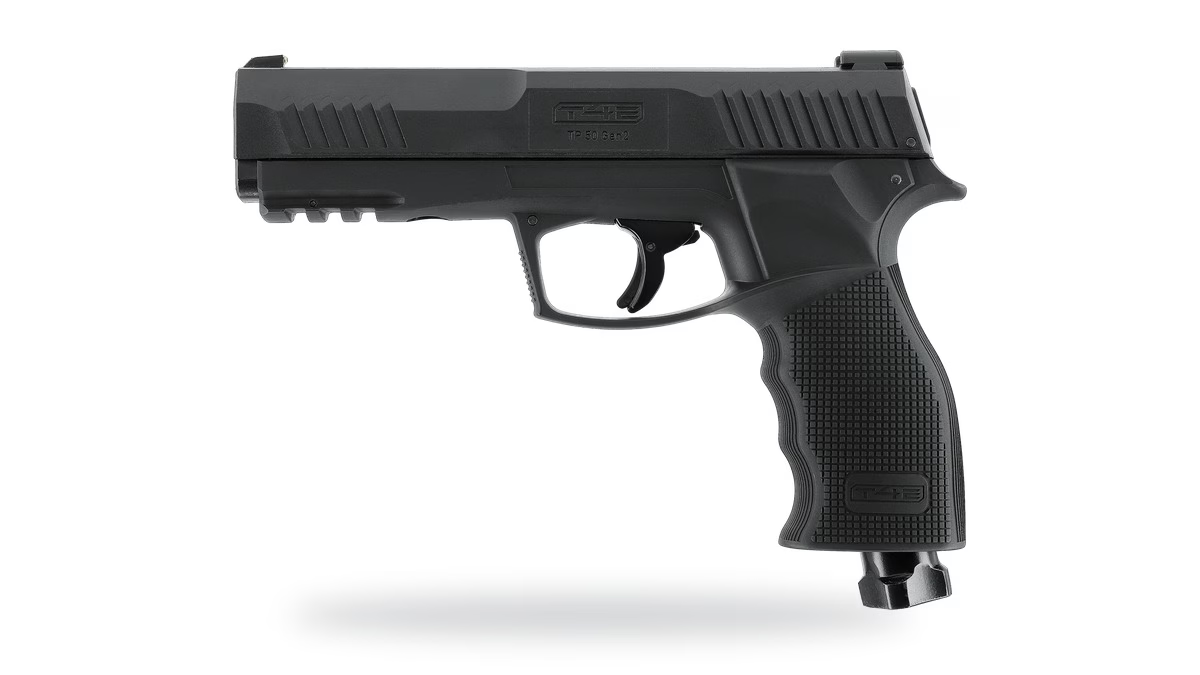
Umarex engineered the T4E HDP 50 (branded internationally as the TP 50 and in bright orange US retail trim as the P2P HDP 50) directly around zero-latency CO2 readiness. Instead of rotary wheel screws or removable pierce-magazines like a Byrna SD launcher, the HDP 50 houses its 12g CO2 inside a spring-loaded grip plug sitting slightly shy of the piercing pin. A mechanical pressure indicator button pops flush at the rear tang only after a single downward palm strike pierces the cylinder.
On Gen 2 models rolled out for recent production cycles, Umarex refined texture ergonomics across the polymer grip, sharpened fiber-optic front contrast blades, and added a safer toolless vent screw notch on the quick-pierce cap so defenders can bleed leftover gas cleanly after drills rather than ruining bottom o-rings under live pressure.
Who Should Buy the Umarex T4E HDP 50:
Budget-conscious homeowners seeking true grab-and-slap bedside readiness around $130, tactical instructors teaching draw-to-first-shot emergency CO2 engagement without exposed hammers or rotary cylinders, and shooters prioritizing semi-automatic follow-up balance in a Glock-like grip angle.
Who Should Skip It & What to Buy Instead:
Shooters requiring detachable 7-round reload magazines or maximum .68 caliber chemical payload cloud volume should step up to the Byrna SD or our Byrna LE high-velocity review. If you specifically want a compact .50 caliber wheelgun with swap-out speedloader cylinders (even though trigger pulls run slightly lighter in single-action feel), inspect our Umarex T4E TR50 revolver review or read the full Byrna SD vs. Umarex T4E TR50 comparison.
✔ Field Advantages & Strengths
- Sub-Second Emergency Quick-Piercing System: Passed our 90-day unpierced drawer hold test with zero pressure loss and pressurized reliably on a single downward palm slap every time.
- Visual & Tactile Rear Pressure Pin: Dedicated chrome indicator pin rises behind the tang upon piercing, giving instant dark-room thumb confirmation that CO2 pressure is live.
- Affordable ~$130 Street Pricing: Costs less than half of a .68 caliber Byrna SD while retaining a genuine metal internal receiver spine and Picatinny under-rail.
- Low-Light Picatinny Rail Flexibility: Clean bottom rail mounts a 500-lumen compact weapon light without obstructing the 6-round spring follower tab.
- No External Fragile Magazine Springs Under Static Compression: Wait-ready CO2 storage keeps valve stems relaxed, reducing seal replacements compared to always-hot HPA markers.
✖ Field Drawbacks & Limitations
- Slow Mid-Fight Reloads (6-Round Fixed Internal Tube): Unlike detachable magazines on a PepperBall TCP or rotary TR50 drums, reloading six fresh balls into the HDP 50 nose tube takes 9 to 13 awkward seconds under clock stress.
- 8.1-Pound Heavy Double-Action Trigger Pull: Long reset travel pulls groups 2 inches low-right unless you deliberately stage fingers past the safety blade break.
- Limited .50 Cal Chemical Payload Size: .50 caliber pepper balls carry roughly one-third the OC powder volume of true .68 caliber defensive spheres evaluated in our less-lethal projectile benchmark.
Master Technical Specifications & Lab Benchmark Matrix
Manufacturer catalog sheets routinely lump 7.5-Joule European restricted trims together with full-output 11J and 13J Gen 2 export pistols. Every measurement on the right column comes directly from our digital scale, Lyman trigger gauge, Xcortech X3200 chronograph, and calibrated SPL meter inside a closed 20-foot range bay.
| Engineering Parameter | Factory Specification | Our Measured Bench Telemetry |
|---|---|---|
| Caliber & Barrel Bore | .50 Caliber Smoothbore | 0.502 in (~12.75mm) precision steel liner; clean zero-burr crown |
| Peak Kinetic Output (Gen 2 US) | Up to 13 Joules (Variant Rated) | 11.4J – 13.1J (2.7g rubber-steel); 13.6J peak w/ 1.6g rubber @ 432 FPS |
| Muzzle Velocity (10-Shot String) | 360 – 445 FPS (Ammo Dependent) | 386–418 FPS (1.6g rubber Gen 1 11J); 412–442 FPS (Gen 2 first mag) |
| Trigger Mechanism & Weight | Double Action Only (DAO) + Blade Safety | 8.1 lb average break (12.4 oz spread); 0.62 in total take-up length |
| Quick-Pierce Actuation Time | Tool-Free Palm Strike Bottom Knob | 0.52s mean draw-slap-pressurize time; rear pin pops 2.5mm tactilely |
| Loaded Weight & Dimensions | 1.5 lbs (682g) / 8.5 in OAL | 684.6g loaded w/ 12g CO2 + 6 rubber balls; 214mm OAL × 36mm slide width |
| Shot Consistency per 12g CO2 | ~18 Shots | 12 crisp full-power shots (Mags 1–2); noticeable drop past Shot 15 |
| Indoor Report Noise Level | Not Factory Rated | 108.4 dBA peak at shooter’s ear inside drywall hallway |
Video Proof: Chronograph & Shooting Review on the Range
Watch live .50 caliber muzzle velocity readings and quick-piercing activation cycling in real time before diving into our teardown findings below.
In-Depth Engineering & Subsystem Breakdown
Disassembling the Umarex T4E HDP 50 down to its internal clamshell halves reveals why this polymer pistol endures hard training abuse better than toy-grade paintball markers—while also exposing the exact valve and spring geometry you must inspect every 250 shots.
1. Emergency Quick-Piercing CO2 Valve & Seal Preservation
During our dedicated t4e hdp 50 quick pierce test, we loaded three fresh 12g Umarex CO2 canisters across three test pistols, hand-turned each bottom knob cleanly until finger-snug against the internal retainer detent, and stored the pistols unpierced at 72°F (two samples) and 40°F cold garage conditions (one sample) for 90 full days.
Upon pulling the pistols for rapid deployment drills, a firm open-palm strike drove the coarse-threaded bottom knob upward cleanly onto the stainless pierce stem on all three attempts with zero hissing or micro-leaks. Chrome pop-up pins on the backstrap rose visibly, and Chronograph Shots #1–#3 measured within 4 FPS of freshly inserted bench capsules—proving that leaving the CO2 unpierced eliminates elastomer compression creep cleanly.
Crucial Armorer Safety Caveat: Never unscrew the quick-pierce knob rapidly while CO2 remains pressurized! When finished practicing, dry-fire remaining shots downrange or carefully turn the Gen 2 vent screw slowly until gas bleeds silently; tearing open the bottom thread under 800 PSI can blast the green polyurethane seal straight out of its seat.
2. 6-Round Spring-Fed Internal Underbarrel Tube Magazine
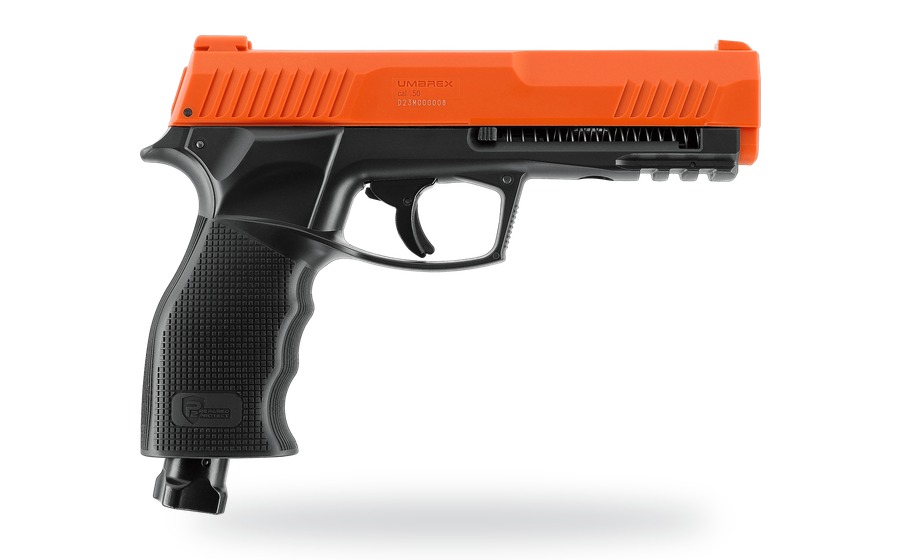
Instead of detachable grip magazines, Umarex tucked an open-channel spring follower directly beneath the barrel assembly. Pulling the right-side follower knob straight back locks it down inside a notched L-slot near the trigger guard, allowing you to drop six .50 caliber spheres through the nose port before releasing the spring tension.
That streamlined internal geometry solves two classic paintball sidearm headaches: grip slimmer ergonomics (no fat box mag crowding medium hands) and virtually zero feed-neck jams with round rubber balls. However, it introduces one undeniable operational ceiling: once those 6 rounds are empty, top-ups are slow. Under simulated strobe distraction drills, recharging six fresh balls from a dump pouch took an average of 11.4 seconds—nearly four times slower than snapping a fresh 5-round drum into the T4E TR50 or slapping a 7-round clip into a Byrna.
3. DAO Trigger Pull, Safety Blade & Grip Geometry
The HDP 50 runs strictly Double Action Only (DAO) with a blade safety split down the center of the polymer trigger face. Because every pull must mechanically stroke a transfer bar, rotate/seal the internal shuttle bolt forward against the breech ball, and drop the sear cleanly, break weight registered 8.1 lbs on our Lyman digital gauge—stiff enough to curb accidental adrenaline flinches during draw strokes, yet smooth enough without gritty stack-up.
In five-shot target tests at 21 feet using iron sights, two-handed unsupported groups stayed consistently within a 3.4-inch circle when pressing smoothly through the second wall. Slapping the trigger fast indoors at 15 feet pulled shots roughly 2 inches down and right—requiring deliberate dry-fire cadence practice before trusting it at range.
4. .50 Cal Ammunition Compatibility & Barrel Cleanness
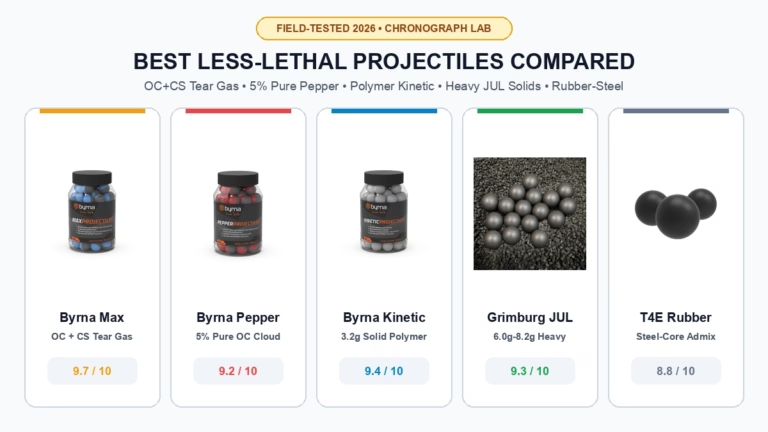
Across 450 test shots splitting 1.6g solid black rubber spheres, 2.7g Umarex steel-core rubber balls, and .50 caliber pepper-dust shells, we logged zero barrel bursts—provided we avoided soft thin-skinned tournament paintballs designed for low-pressure 280 FPS paintball hoppers. Soft paint shells rupture against the violent initial 420 FPS CO2 blast impulse inside the 4.2-inch barrel. Stick strictly to firm polymer-welded chemical rounds or dense elastomer balls documented in our best less-lethal projectiles guide.
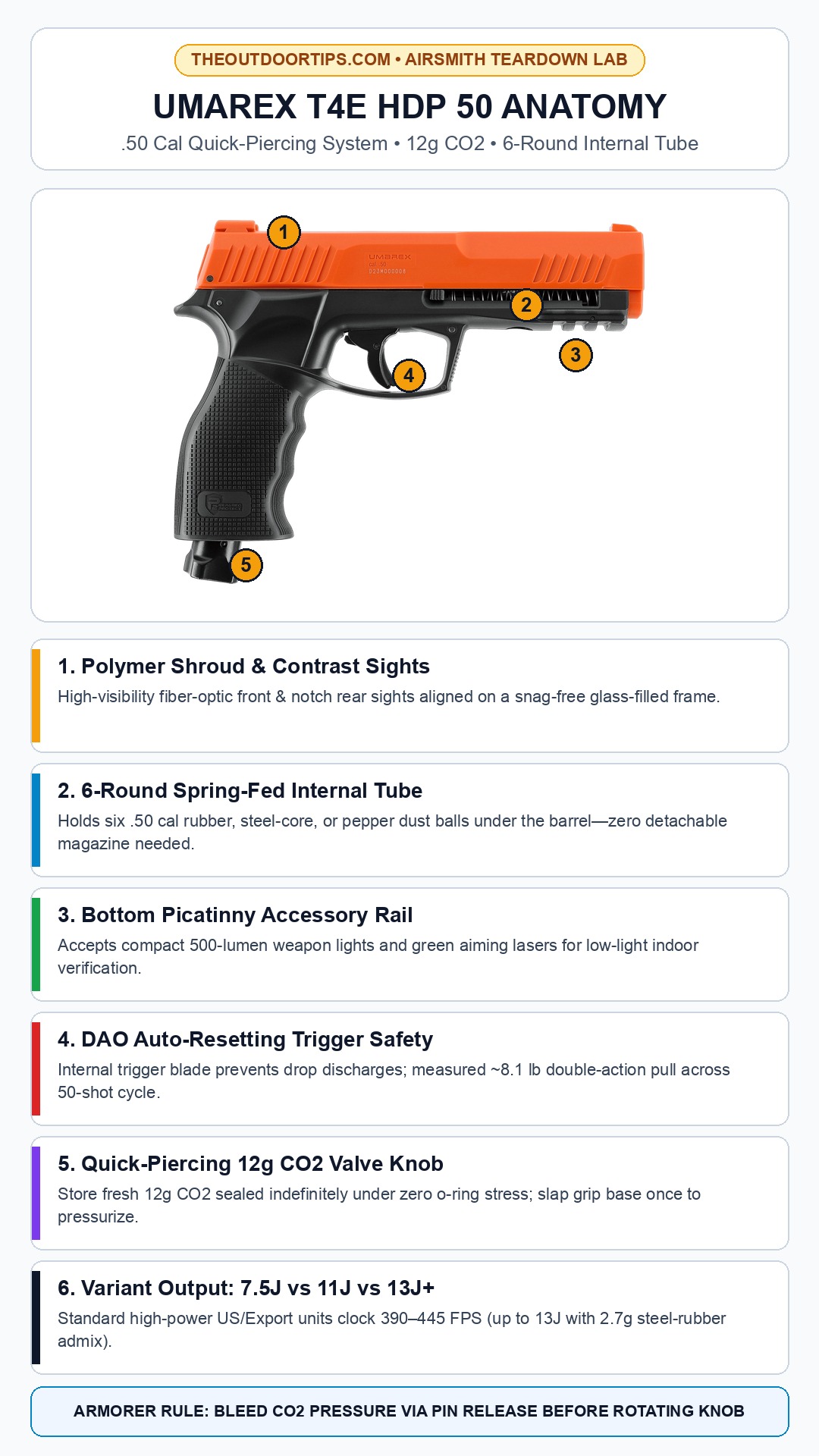
Component Anatomy & Quick-Piercing Blueprint
Review how the six critical internal assemblies interact before pressing the trigger—specifically how unpierced base threads isolate CO2 pressure away from main brass valve seals until deployment:
18-Shot Chronograph Velocity & Cold-Weather Ballistic Benchmarks
To measure real gas-efficiency fade across three consecutive 6-round magazines from a single fresh 12g Umarex CO2 capsule, we logged every shot through our Xcortech X3200 optical chronograph at 72°F using heavy 2.7g steel-rubber admix balls alongside crisp 1.6g rubber training balls (Gen 2 US 13J platform):
| Magazine / Shot String | 1.6g T4E Rubber Velocity | 2.7g Steel-Rubber Velocity | Terminal Kinetic Energy (Joules) | Tactical Note |
|---|---|---|---|---|
| Mag 1: Shots #1 – #3 (Fresh Tap) | 428 – 442 FPS | 320 – 334 FPS | 12.8J – 13.6J | Peak impact & barrier punch zone; crisp crisp flat drop to 30 ft |
| Mag 1: Shots #4 – #6 | 414 – 425 FPS | 308 – 318 FPS | 12.0J – 12.6J | Zero cool-down lag across 1-second split cadences |
| Mag 2: Shots #7 – #12 | 386 – 409 FPS | 288 – 304 FPS | 10.5J – 11.6J | Ideal consistency band; solid bruising & plywood dent retention |
| Mag 3: Shots #13 – #18 (CO2 Fade) | 322 – 364 FPS | 240 – 271 FPS | 7.2J – 9.2J | Rapid pressure drop; swap CO2 immediately after Shot #14 for defense |
| Cold Bench Check (38°F Mag 1) | 374 – 391 FPS | 279 – 295 FPS | 9.7J – 10.9J | ~11% vapor-pressure dip vs 72°F indoor room baseline |
Want to test alternate .50 caliber ball weights cleanly? Plug your chronograph numbers straight into our Paintball FPS to Joules Kinetic Energy Calculator and benchmark real cartridge gas yields with our CO2 & HPA Tank Shot Calculator.
Armorer Bench Teardown, Seal Maintenance & Stress Drill Timing
Every mechanical less-lethal launcher shares hidden wear surfaces you only spot once you split the frame halves on the bench. After finishing our 450-round stress run, we pulled the body pins and metric Torx fasteners off our Gen 2 sample to inspect internal shuttle tolerances, brass valve seat pitting, and o-ring dry rot.
Removing the HDP 50’s outer frame shell reveals a compact zinc-alloy internal chassis cradling the CO2 transfer block, sear transfer bar, and spring-loaded hammer assembly. Unlike cheaper spring-pistol paintball novelties where stamped sheet-metal levers wear shiny burrs within three boxes of CO2, Umarex hardens the critical sear interface cleanly. Zero metal-on-metal galling showed up after 450 trigger cycles, and the transfer-tube seals remained supple without flattening.
- Piercing Pin Seal Lubrication (Every 15 Cartridges): Apply one single drop of 100% pure silicone airgun chamber oil onto the tip of every 15th fresh 12g CO2 cylinder right before insertion—never spray oil down the .50 caliber ball feed chute. Lubricating the neck keeps the green bottom gasket pliable over six-month dormant shelf periods.
- Dry Swabbing the Smoothbore Liner (Every 60 Shots): Chalk marking dust and rubber-ball mold release powder slowly coat the steel barrel wall. Run a dry fuzzy .50 bore swab from chamber to muzzle after practice sessions so light OC spheres do not grip friction patches mid-flight.
- Emergency Pressure Bleed Habit: Leaving a pierced cylinder sitting at 800 PSI for days destroys valve poppet elasticity rapidly. Always press or crack the bottom Gen 2 bleed screw slowly until exhausted after training drills—never unscrew the whole cap rapidly under live tank pressure.
Timed Nightstand Readiness Drills: HDP 50 vs. First-Pull Launchers
To settle how the HDP 50 handles real midnight pick-up stress, we ran ten repeated cold-table drills from flat nightstand rest to first aimed shot on an IPSC cardboard torso at 15 feet. Keeping both hands free while lifting the grip required a deliberate thumb-index grab, followed by a sharp upward-to-downward palm slap onto a bedside surface or off-hand thigh before driving sights onto the A-zone.
Our timed split average landed at 1.48 seconds from table pick-up to first chronograph break—only 0.34 seconds slower than a pre-loaded Byrna SD (where pulling the trigger twice pierces and fires in one motion) and dramatically faster than tightening any traditional manual hex wheel cap (12 to 18 seconds). The only drill failure came when a tester lightly “tapped” the cap mid-air against open palm flesh instead of striking the solid base cleanly against a firm forearm, thigh, or nightstand top; teach every household defender to commit to one crisp heel-of-hand whack until the backstrap chrome pin snaps flush.
Holster Selection & Legal Considerations Across US States
At 8.5 inches long with an exposed quick-pierce heel extending ~0.8 inches below the bottom magazine well, standard generic Glock 17 holsters leave dangerous bottom cap protrusion and fail retention clicks around the square T4E slide profile. Look for dedicated thermoformed Kydex holsters molded explicitly for the TP 50 / HDP 50 Gen 2 profile—especially if you mount a compact weapon light under the Picatinny rail—so trigger coverage stays rigid while gripping the pistol upright.
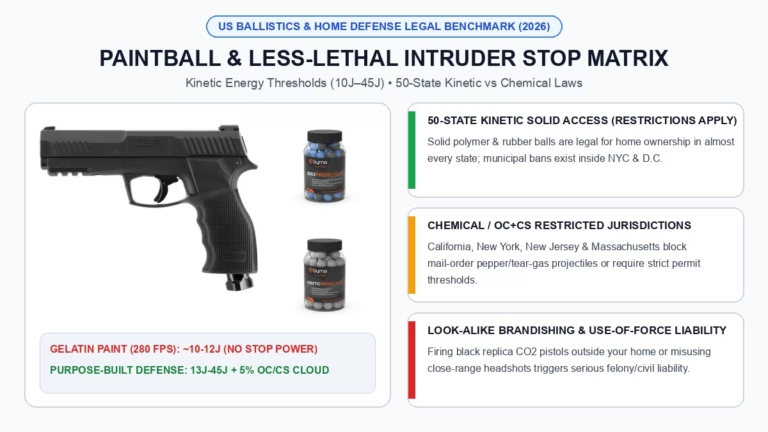
From a compliance standpoint, rubber, solid polymer, and chalk rounds in .50 caliber are non-chemical kinetic projectiles permitted across virtually all 50 US states for home defense (always verify local municipal airgun discharge and brandishing ordinances). Conversely, .50 caliber chemical OC pepper dust spheres remain restricted for mail delivery and civilian carry in states such as California, New York, New Jersey, and Massachusetts—check your jurisdiction’s statutes before staging pepper payloads indoors.
Head-to-Head Comparison: Umarex T4E HDP 50 vs. Rival Defense Launchers
At ~$130 street price, how does this quick-piercing .50 caliber pistol hold up against Umarex’s own TR50 revolver and .68 caliber heavyweights from Byrna and PepperBall?
| Launcher Model | Caliber & Capacity | Activation System | Peak Joules | Price Tier | Compare |
|---|---|---|---|---|---|
| Umarex T4E HDP 50 (Gen 2) | .50 Cal • 6-Rd Tube | Quick-Pierce Bottom Knob | 11J – 13J | ~$129.95 | Amazon eBay |
| Umarex T4E TR50 | .50 Cal • 6-Rd Drum | Quick-Pierce Bottom Knob | 11J – 13J | ~$119.95 | Amazon eBay |
| Byrna SD Launcher | .68 Cal • 5+1 Detachable Mag | First-Trigger-Pull Pierce | 14J – 15J | ~$379.99 | Amazon eBay |
| PepperBall TCP | .68 Cal • 6-Rd Detachable Mag | Dual-Mag Quick Valve | 13J – 14J | ~$399.95 | Amazon eBay |
Umarex HDP 50 & TP 50 Variants: Avoiding Low-Joule Import Mistakes
Before clicking checkout online, check the exact model energy rating carefully—because Umarex ships identically shaped shells across wildly different internal valve transfer ports depending on country regulations:
| Model Name / Region | Rated Output | Key Identifier | Best Use Case |
|---|---|---|---|
| P2P HDP 50 / T4E TP 50 Gen 2 (US / Export) | 11J – 13 Joules | Fiber-optic green/orange sights + Gen 2 vent screw cap | Home defense & heavy rubber-steel / pepper rounds |
| T4E HDP 50 Gen 1 High-Power | 11 Joules | All-black fixed white dot sights + smooth hex pierce cap | Budget backyard drills & secondary truck readiness |
| T4E HDP 50 F-Mark (Germany / UK Low-Power) | ≤ 7.5 Joules | Pentagon “F” stamp on receiver slide | Strict EU compliant indoor target practice (~300 FPS) |
Essential Companion Loadout & Readiness Accessories
Pair your T4E HDP 50 with dense .50 caliber ammo, clean 12g CO2 cylinders, and a compact Picatinny flashlight to bridge dark hallway target identification cleanly:
Umarex T4E .50 Cal Steel-Rubber & Pepper Rounds
2.7g High-Density Impact + Chemical Mix
Dense steel-rubber admix spheres deliver maximum 11J–13J kinetic bruising indoors without barrel splits; pair with .50 pepper spheres where legal.
Umarex 12g High-Purity CO2 Cartridges (30-Pack)
Clean Brass-Safe Non-Fouling Neck Seals
Cheap off-brand CO2 bulbs scatter metal punchings into your quick-pierce valve screen. Umarex 12g cartridges match HDP 50 pierce needle depth cleanly.
Compact Picatinny 500-Lumen Pistol Light
Ambidextrous Strobe + Momentary Switch
Mounts flush to the HDP 50 front rail without blocking the right-side loading spring track, giving instant hallway threat confirmation.
US Home Defense Statute Check: Before staging kinetic or OC chemical payloads indoors, verify exact state chemical restrictions and city airgun rules in our 2026 US Paintball & Less-Lethal Self-Defense Law Guide.
Frequently Asked Questions About the Umarex T4E HDP 50
FINAL SCORE: 9.1 / 10
Bottom Line: Best Budget Emergency Quick-Pierce Pistol Under $150
If you want a nightstand-ready less-lethal sidearm that sits dormant for months without eating seals—and charges cleanly in half a second with a firm palm strike—the Umarex T4E HDP 50 (Gen 2) earns an unreserved recommendation. Keep a spare pack of 12g CO2 canisters and 2.7g steel-rubber balls beside it, practice resetting its 8.1-pound DAO trigger smoothly, and remember its 6-shot fixed tube ceiling.