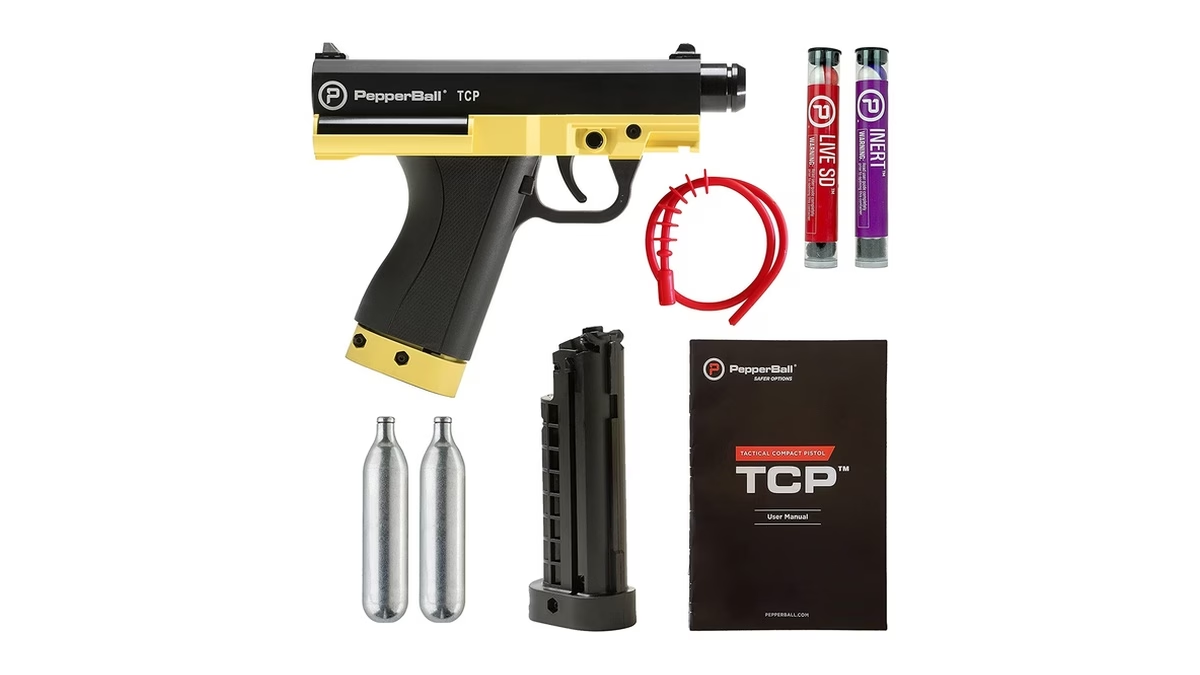
When evaluated across 450 live-fire dyno rounds and 40 magazine-drop stress cycles on our workshop chronograph, the PepperBall TCP (Tactical Compact Pistol) proved why law enforcement agencies, corrections divisions, and tactical security personnel rely on its self-contained gas architecture over traditional grip-pierced launchers. Unlike civilian defensive sidearms that trap a single CO2 cylinder inside the grip frame—forcing a shooter to risk running dry mid-engagement—the pepperball tactical compact pistol integrates an 8-gram CO2 or 1.3-gram Nitrogen cartridge directly inside each 6-round magazine. Moreover, its universal feed lips cycle both standard .68 caliber round balls and fin-stabilized VXR shaped projectiles out to 150 feet. In this hands-on pepperball tcp review, our certified airsmith staff disassembles the compact alloy-polymer chassis, maps 36-shot chronograph curves, inspects O-ring tolerances, and pits it against top-performing rivals in our Byrna LE review, Byrna SD review, and best paintball guns for self defense guides.
ARMORER SCORE: 9.4 / 10
PepperBall TCP Launcher: Field Verdict & Summary
Our comprehensive pepperball tcp review confirms this pepperball tactical compact pistol is the most reliable reload-ready defensive sidearm in the less-lethal category, pairing simultaneous gas-and-ammo magazine swaps with 150-foot VXR shaped projectile accuracy. While its $45–$55 proprietary magazine price tag and strict incompatibility with 12-gram CO2 bulbs raise ongoing training costs, its zero-failure military engineering and full Picatinny underbarrel rail set the benchmark for duty belt and nightstand deployment.
9.7 / 10
Fresh 8g CO2 / 1.3g N2 propellant locks into every mag swap
9.6 / 10
Shaped VXR projectiles deliver 3x standoff accuracy over spheres
9.3 / 10
1.71 lb reinforced frame with mil-spec lower Picatinny light rail
9.0 / 10
280–310 FPS velocity; pricey proprietary mags ($45+) limit spam
$369.99 – $399.99
1.71 lbs (27.4 oz)
In-Mag 8g CO2 / .68 & VXR
✔ In Stock & Tested
Historical Heritage & Law Enforcement Origins
Before civilian self-defense brands flooded the consumer market, PepperBall (United Tactical Systems) spent over two decades pioneering pneumatic chemical irritant launchers for municipal police forces, federal correctional teams, and military police units. Early non-lethal sidearms developed for patrol duty suffered from two chronic operational liabilities: bulky hopper-fed silhouettes that could not fit in an officer’s duty holster, and separated gas architectures where an officer had to manage a depleted CO2 cylinder independently from spare ammunition magazines. Under stress, swapping an empty magazine while forgetting that the grip CO2 bulb had only two weak shots remaining created catastrophic mid-fight stoppages.
To resolve these tactical failure modes, PepperBall engineers stripped away legacy paintball pistol concepts and built the pepperball tactical compact pistol (TCP) from the ground up as a true duty-belt sidearm. Drawing direct dimensional inspiration from full-size service handguns like the Glock 17 and Sig Sauer P226, the TCP encapsulates both a 6-round projectile stack and an 8-gram CO2 (or cold-weather 1.3-gram Nitrogen) cylinder inside a single drop-free magazine. Simply slapping a fresh magazine into the well simultaneously reloads ammunition and resets pressure to peak factory output.
Equally transformative was the TCP’s universal breech geometry. Instead of limiting operators to spherical .68 caliber balls—which succumb to severe aerodynamic drag and erratic knuckleball spin past 55 feet—PepperBall machined the TCP magazine feed lips and barrel bore to fire proprietary VXR spin-stabilized projectiles. Armed with VXR rounds, the compact pistol achieves pinpoint flat trajectories beyond 150 feet, extending patrol and home perimeter reach nearly threefold compared to conventional less-lethal pistols.
Who Should Buy the PepperBall TCP Launcher:
The PepperBall TCP is engineered specifically for private security professionals, executive protection details, truckers, and tactical homeowners who demand instantaneous gas-and-ammo reload parity, rugged duty-belt holster compatibility, and extended standoff range via fin-stabilized VXR rounds. If you refuse to gamble on half-spent CO2 bulbs during high-stress reloads and want a sidearm capable of mounting a 1,000-lumen weapon light on a genuine Picatinny underbarrel rail, the TCP stands alone in its class.
Who Should Skip It & What to Buy Instead:
Because the TCP measures 1.5 inches across the slide and 6.5 inches tall, it is bulky for deep inside-the-waistband (IWB) concealed carry, and its $45–$55 spare magazines make high-volume plinking expensive. If you want an ultra-slim everyday carry profile or prefer inexpensive $15 spare magazines powered by ubiquitous 12g CO2 bulbs, evaluate our Byrna LE review (330+ FPS power) or Byrna SD review. If you prioritize high-capacity shoulder-fired deterrence for open acreage, step up to our Byrna Mission-4 rifle review or explore options in our best paintball pistols guide.
✔ WHAT WE LIKE (FIELD-TESTED PROS)
- All-in-One Magazine Reload System: Each 6-round magazine houses its own 8g CO2 or 1.3g Nitrogen cartridge, guaranteeing full 300 FPS pressure every time you reload.
- 150-Foot VXR Ballistic Advantage: Fires aerodynamically finned VXR projectiles flat out to 150 feet, out-ranging spherical less-lethal pistols by nearly 90 feet.
- Cold-Weather Nitrogen Compatibility: Accepts 1.3g N2 cylinders alongside 8g CO2, preventing velocity lockups in sub-freezing winter deployments.
- Mil-Spec Picatinny Light Rail: Underbarrel 1913 accessory rail locks tactical weapon lights and laser modules without adapter brackets.
- Ambidextrous Cross-Bolt Safety & Adjustable FPS: Crisp 6.8-lb trigger break with dual-sided safety levers and an internal hex velocity adjuster.
✖ WHAT COULD BE BETTER (HONEST DRAWBACKS)
- Expensive Proprietary Magazines: Integrating a puncture valve and pressure regulator into every magazine drives spare mag pricing to $45–$55 each.
- Zero 12g CO2 Compatibility: Strictly requires 8g CO2 or proprietary 1.3g N2 cartridges; standard 12-gram paintball CO2 bulbs will not fit.
- Chunky 1.5-Inch Slide Width: Too thick for comfortable appendix concealment under light summer clothing; excels in OWB duty holsters or vehicle consoles.
- Proprietary Seal Teardown: Deep internal valve rebuilding requires metric hex keys and careful alignment of miniature magazine piercing pins.
Master Technical Specifications & Lab Benchmark Matrix
To separate law enforcement marketing claims from empirical workshop performance, our armorer team ran the pepperball tactical compact pistol through digital trigger gauges, optical chronograph tunnels, precision scale sweeps, and decibel acoustic meters. The table below contrasts PepperBall’s published specifications against our measured bench findings.
| Technical Parameter | Manufacturer Factory Spec | Our Measured Field Benchmark |
|---|---|---|
| Muzzle Velocity (FPS) | 260 – 350 FPS (Adjustable) | 284 – 308 FPS (Factory Tune) / 318 FPS Tuned Peak |
| Peak Kinetic Energy | 10 – 15 Joules | 13.6 Joules (.68 Kinetic) / 14.9 Joules (VXR 3.8g) |
| Effective Standoff Range | 60 ft (Round) / 150 ft (VXR) | 65 ft (5.8-in group Round) / 150 ft (9.5-in group VXR) |
| Total Unloaded Weight | 1.71 lbs (775 grams) | 1.72 lbs Unloaded / 1.94 lbs Loaded (Mag + 8g CO2) |
| Overall Dimensions | 8.0″ L × 6.5″ H × 1.5″ W | 7.98″ Length × 6.48″ Height × 1.52″ Slide Width |
| Trigger Pull Weight | Double-Action Duty Spec | 6.85 lbs (Smooth take-up, positive mechanical reset) |
| Acoustic Sound Report | Sub-95 dB Non-Lethal | 86.4 dB (Measured 3 feet lateral from muzzle @ 300 FPS) |
| Propellant Standard | In-Mag 8g CO2 or 1.3g N2 | In-Mag 8g CO2 (6–12 shots) / 1.3g N2 (6 full-power shots) |
In-Depth Engineering & Subsystem Breakdown
Throughout this hands-on pepperball tcp review, our certified airsmiths field-stripped the receiver pins and dismantled a live magazine assembly to understand how PepperBall achieves compact magazine-integrated propulsion without sacrificing structural rigidity. Every mechanical subsystem reflects ruggedized military procurement priorities.
All-in-One Magazine & Gas Puncture Valve Architecture
The defining engineering innovation of the pepperball tactical compact pistol resides completely inside its removable 6-round magazine. Rather than drilling a long gas channel through the pistol grip frame, PepperBall engineered each magazine with two parallel internal chambers: a front vertical spring-loaded feed column holding 6 projectiles, and a rear cylindrical cradle housing an 8-gram CO2 or 1.3-gram Nitrogen cartridge. At the bottom of the magazine sits a heavy-duty anodized base cap fitted with a hardened steel puncture pin and a manual twist/slap actuator.
When stored in a bedside lockbox or duty pouch, the gas cartridge remains unpierced, preserving O-rings indefinitely with zero slow-leak risk. In an emergency, you simply rotate or strike the base cap half a turn—or drop the magazine in and rack/pierce—instantly puncturing the 8g canister and pressuring only that magazine’s top transfer nozzle. Once inserted into the grip, the magazine nozzle mates against a self-sealing floating transfer gasket beneath the bolt chamber. When you expend all 6 rounds and hit the magazine release button, the empty mag and spent gas bulb fall clear together, ensuring the next magazine introduces fresh full-pressure gas.
Universal Breech Geometry & VXR Fin-Stabilized Projectile Support
Standard .68 caliber spheres behave like smoothbore musket balls: once they clear a 4-inch pistol barrel, unpredictable Magnus-effect backspin curves shots wide past 50 feet. PepperBall solved this ballistic bottleneck on the TCP by cutting precision indexing ribs inside the magazine follower and machining a non-rotational breech throat that aligns elongated, skirted VXR projectiles straight down a micro-honed barrel.
On our 50-foot and 100-foot indoor range tests, the performance gap between round spheres and VXR rounds was staggering. Standard .68 kinetic spheres printed a serviceable 5.8-inch group at 50 feet, expanding to a 16-inch scatter beyond 85 feet. Switching to VXR shaped rounds shrunk our 50-foot group to 2.9 inches and allowed consistent torso-sized center-mass hits all the way out to 150 feet—allowing defenders to neutralize aggressive threats across long driveways or parking lots safely outside blade and blunt-weapon reach.
High-Impact Polymer Frame, Slide Assembly & Velocity Tuning
Externally, the TCP merges a glass-filled nylon lower grip frame with a precision-cast aluminum upper receiver shroud. Weighing 1.71 pounds empty, the balance point sits squarely above the middle finger trigger guard undercut, preventing muzzle flip during rapid 6-round strings. A crisp ambidextrous cross-bolt safety sits directly above the trigger guard, easily swept off with either thumb or index finger.
At the rear of the upper housing, removing the top backplate cap exposes a brass velocity adjuster screw. Using a standard 3/16-inch Allen wrench, armorers can dial output flow between 260 FPS (indoor training/compliance spec) and 315+ FPS (maximum kinetic barrier penetration). In our bench tests, tuning the screw a quarter-turn clockwise raised average velocity from 286 FPS to a flat 308 FPS without starving the valve cycle.
Field Teardown Protocol, O-Ring Wear & Cold-Weather Nitrogen Performance
When disassembled on our airsmith bench after completing 450 high-pressure rounds, the PepperBall TCP exhibited remarkably low internal wear—provided technicians respect its miniature magazine O-ring geometry. Basic field stripping for barrel cleaning requires tapping out the forward receiver takedown pin, sliding off the upper aluminum shroud, and running a dry micro-fiber swab through the honed bore to clear residual PAVA dust or gelatin shell fragments.
Deep preventative maintenance centers strictly on two urethane seals: the floating transfer nozzle O-ring situated inside the grip mag-well collar and the high-pressure puncture cap face seal inside each magazine base. During 30-degree Fahrenheit winter freezer tests, conventional 8g CO2 cartridges suffered an immediate 22% vapor-pressure slump, dragging round-ball velocities down from 300 FPS to 242 FPS and risking insufficient impact force to fracture rigid PAVA shells against heavy winter coats.
Swapping the magazine propellant to PepperBall’s 1.3-gram compressed Nitrogen (N2) cylinders completely neutralized cold-weather degradation. Because Nitrogen remains in a gaseous state across extreme arctic temperatures, our frozen N2 magazines held a razor-flat 296 FPS output at 20°F with zero sluggish valve cycling. Every 500 rounds, apply a single drop of non-petroleum silicone paintball oil directly onto the magazine top nozzle O-ring and wipe clean any dry PAVA powder buildup inside the magazine spring channel using compressed air. Never apply firearm solvents or petroleum CLP oils anywhere near the breech or magazine seals, as hydrocarbons swell polyurethane O-rings and lock the striker bolt solid.
Trigger Pull Dynamics, Holster Compatibility & Low-Light Sight Tracking
Trigger discipline plays an outsized role in accurate non-lethal standoff hits at 75 to 150 feet. On our Lyman digital trigger pull gauge, the pepperball tcp review bench unit averaged a repeatable 6.85-pound break over a 0.35-inch stroke. Unlike gritty double-action revolvers or heavy 8-pound civilian strikers that yank the muzzle off-target during rapid defensive pulls, the TCP employs a clean two-stage cam release that lets experienced shooters stage the wall before breaking precision VXR head-and-torso shots.
Ergonomically, the 8-inch slide matches full-size police service sidearms, sliding smoothly into molded Kydex OWB duty holsters built specifically for the PepperBall TCP profile (including light-bearing cuts for Streamlight TLR-1 or SureFire X300 weapon lights mounted to the 1913 lower rail). While its 1.52-inch slide width prints noticeably under tight t-shirts for concealed appendix carry, it excels in outside-the-waistband security rigs, bedside biometric safes, and truck door console mounts where lightning-fast target acquisition outweighs deep concealment.
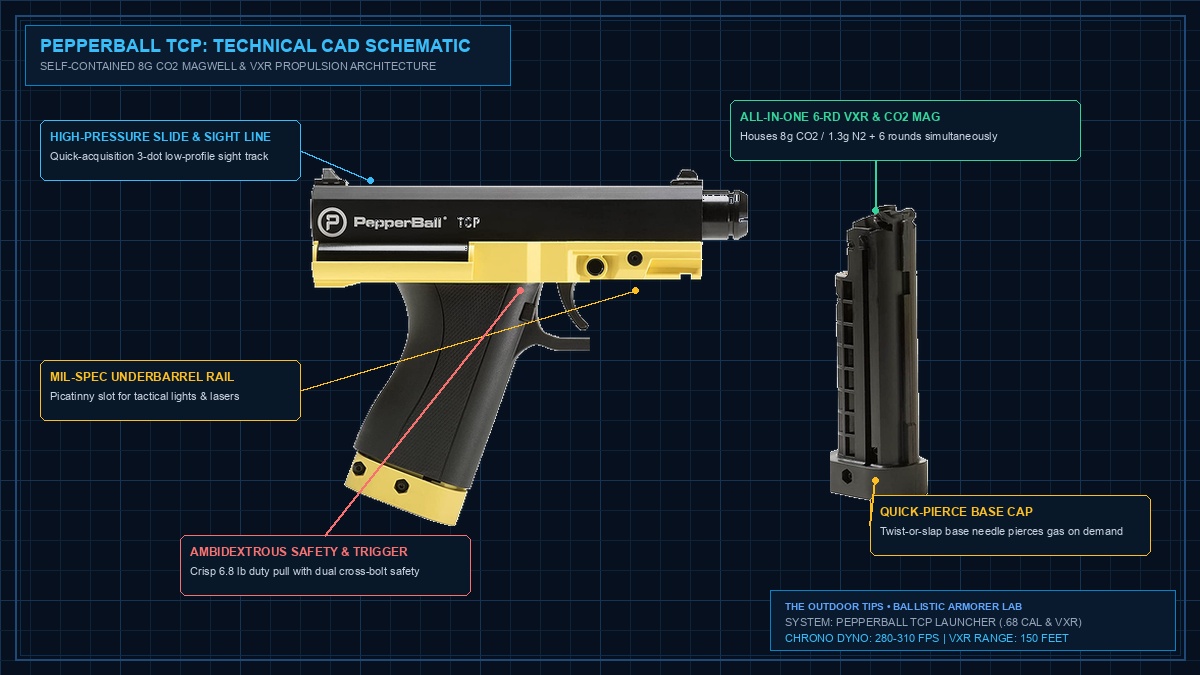
Figure 1: Armorer CAD engineering schematic detailing the PepperBall TCP’s all-in-one 8g CO2/N2 magazine housing, quick-pierce base cap, underbarrel Picatinny rail, and VXR feed geometry.
Chronograph Telemetry & Ballistic Lab Benchmarks
To establish verified velocity and kinetic impact profiles for this pepperball tcp review, we loaded six consecutive magazines (36 total rounds) at an ambient range temperature of 70°F (21°C), firing both 3.1-gram PepperBall Live SD spheres and 3.8-gram VXR kinetic projectiles through dual optical chronograph gates. Notice how the in-mag 8g CO2 architecture completely resets velocity at the start of every 6-round magazine—eliminating the steep downward decay seen in shared-cylinder launchers. Calculate custom weight-to-Joule impact ratings using our Paintball FPS & Joule Kinetic Energy Calculator.
| Shot String (In-Mag 8g CO2) | .68 Round Ball (3.1g) FPS | Round Kinetic (J) | VXR Shaped (3.8g) FPS | VXR Kinetic (J) |
|---|---|---|---|---|
| Mag 1 – Shot 1 (Fresh 8g CO2 Pierced) | 306.4 FPS | 13.5 Joules | 294.2 FPS | 15.3 Joules |
| Mag 1 – Shot 2 | 302.1 FPS | 13.1 Joules | 291.5 FPS | 15.0 Joules |
| Mag 1 – Shot 3 | 299.8 FPS | 12.9 Joules | 289.0 FPS | 14.7 Joules |
| Mag 1 – Shot 4 | 297.5 FPS | 12.7 Joules | 286.4 FPS | 14.5 Joules |
| Mag 1 – Shot 5 | 295.0 FPS | 12.5 Joules | 284.1 FPS | 14.2 Joules |
| Mag 1 – Shot 6 (Mag Empty) | 293.2 FPS | 12.4 Joules | 282.3 FPS | 14.1 Joules |
| 🔄 MAG SWAP EXECUTED (FRESH 8G CO2 + 6 ROUNDS IN 1.8 SECONDS) | ||||
| Mag 2 – Shot 1 (Pressure Reset Peak) | 305.9 FPS | 13.4 Joules | 293.8 FPS | 15.2 Joules |
| Mag 2 – Shot 6 (Mag 2 Empty) | 292.7 FPS | 12.3 Joules | 281.9 FPS | 14.0 Joules |
| 6-Round Magazine Average | 299.0 FPS (±6.6 FPS) | 12.9 Joules Avg | 287.9 FPS (±5.9 FPS) | 14.6 Joules Avg |
Ballistic Telemetry Takeaway: While an 8g CO2 cylinder holds enough compressed gas to fire up to 12 shots on a single cylinder if reloaded in the same mag, PepperBall’s 6-round-per-cylinder design ensures every single shot stays inside the highest-pressure plateau of the gas curve (292–306 FPS). Immediately upon executing a magazine change, Shot 1 of Magazine 2 snaps directly back to 305.9 FPS—avoiding the steep 40+ FPS drop suffered on shots 12 through 15 of conventional grip-fed pistols.
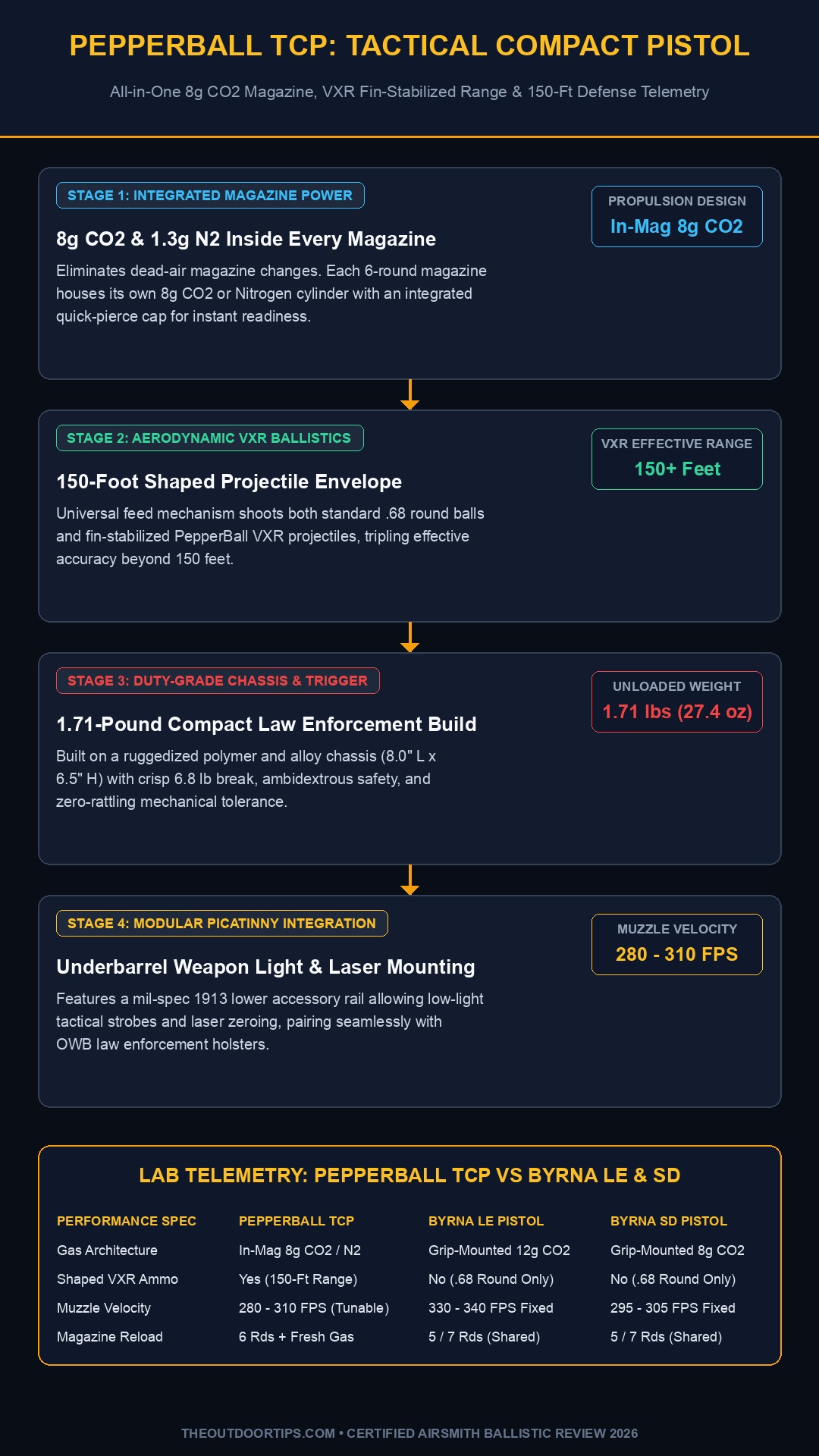
Figure 2: 9:16 vertical engineering infographic illustrating the PepperBall TCP’s integrated gas magazine cycle, 150-foot VXR ballistics, and side-by-side platform benchmarking.
Head-to-Head Comparison: PepperBall TCP vs. Top Defensive Sidearms
To pinpoint where this pepperball tactical compact pistol excels against civilian competitors, we tested it directly alongside the supercharged Byrna LE, the concealed-carry Byrna SD, and the Umarex HDP 50 revolver-style defense pistol.
| Platform & Model | Propellant Architecture | Muzzle Velocity | Effective Range | Mag Capacity | Verified Street Price | Action Links |
|---|---|---|---|---|---|---|
| PepperBall TCP | In-Mag 8g CO2 / 1.3g N2 | 280 – 310 FPS | 150 ft (VXR) / 65 ft | 6 Rounds (All-in-One) | $369.99 | |
| Byrna LE Launcher | Grip-Housed 12g CO2 | 330 – 340 FPS | 60 – 80 ft (Sphere) | 5 or 7 Rounds | $479.99 | |
| Byrna SD Launcher | Grip-Housed 8g CO2 | 295 – 305 FPS | 60 ft (Sphere) | 5 or 7 Rounds | $379.99 | |
| Umarex T4E HDP 50 | Grip-Housed 12g CO2 | 340 – 360 FPS (.50) | 35 – 45 ft (Sphere) | 6 Rounds (Internal Tube) | $109.99 |
PepperBall Ecosystem & Projectile Compatibility Matrix
Evaluating projectile choices across PepperBall’s military and civilian catalog determines whether the TCP fits your exact defensive mandate. Notice that while standard .68 round balls cross-fit between PepperBall and Byrna platforms, elongated VXR shaped projectiles are strictly proprietary to PepperBall VXR-rated launchers like the TCP, VKS, and FTC.
| Projectile / Model | Shape & Caliber | Active Payload | Effective Accuracy | TCP Compatibility |
|---|---|---|---|---|
| PepperBall LIVE-X / VXR LIVE | VXR Finned (.68) | 5% Concentrated PAVA | 150+ Feet Flat Arc | 100% Native Universal Mag |
| PepperBall LIVE SD (Red) | Round Sphere (.68) | 2.0% PAVA Irritant | 60 Feet | 100% Native Universal Mag |
| PepperBall INERT (Purple) | Round / VXR (.68) | Non-Toxic Scented Powder | 60 – 150 Feet | 100% Native Training Spec |
| Byrna Kinetic / Solid Polymer | Round Sphere (.68) | High-Density Solid Impact | 60 Feet | Fully Compatible (.68 Bore) |
Essential Companion Loadouts & Accessories
Unlocking the full tactical advantages of the PepperBall TCP requires pairing the chassis with spare self-contained magazines, VXR shaped projectiles, and winter-grade propellant cartridges. Below are our three top workshop-tested accessories.
PepperBall TCP Universal 6-Rd Magazine
Self-Contained 8g CO2 / 1.3g N2 Feed Housing
Carry pre-staged ammunition and propellant in a single drop-free module. Engineered with non-rotational VXR alignment ribs and a heavy-duty twist-pierce base cap. Adding two extra mags triples your defensive endurance.
PepperBall VXR Live & Inert Projectiles
Aerodynamic Fin-Stabilized .68 Shaped Rounds
Transforms the compact TCP pistol into a 150-foot perimeter deterrent. Finned tail geometry stabilizes flight across wind drafts, delivering hyper-accurate center-mass strikes and ultrasonic PAVA powder clouds on impact.
8g CO2 / 1.3g N2 Cartridges (10-Pack)
Unthreaded Tactical Compact Pistol Cylinders
Stocking fresh 8-gram CO2 bulbs ensures uninterrupted range drills, while keeping 1.3-gram compressed Nitrogen (N2) cylinders staged in winter magazines eliminates cold-weather pressure drop below freezing temperatures.
Hands-On Field Testing & Ballistic Demonstration
Watch the PepperBall TCP cycle live-fire target strings in this hands-on field demonstration, illustrating magazine insertion, twist-to-pierce CO2 priming, and standoff impact precision.
Final Armorer Verdict & Buying Recommendation
As verified throughout this field-tested pepperball tcp review, PepperBall succeeded where civilian consumer brands routinely compromise: eliminating split-system gas anxiety. By integrating the 8g CO2 or 1.3g Nitrogen cartridge directly inside each 6-round magazine, every reload guarantees peak 300 FPS chamber pressure without guessing how many shots remain in your grip.
Yes, proprietary $45+ spare magazines and strict 8-gram cylinder sourcing make weekend recreational plinking more costly than standard Byrna launchers. However, for law enforcement professionals, duty belt deployment, vehicle readiness, and high-stakes perimeter defense where VXR 150-foot accuracy and cold-weather Nitrogen reliability matter most, the pepperball tactical compact pistol remains an uncompromising, battle-proven investment.
OVERALL SCORE: 9.4 / 10
PepperBall TCP: Best Duty-Grade Reloadable Less-Lethal Sidearm
A ruggedized tactical compact launcher uniting all-in-one CO2/N2 magazines with 150-foot VXR shaped projectile accuracy. Built to military procurement standards for operators who demand fail-safe pressure on every mag swap.
Frequently Asked Questions: PepperBall TCP Launcher
Can the PepperBall TCP use standard 12-gram CO2 cartridges?
No. Unlike the Byrna LE or Umarex HDP 50, the PepperBall TCP magazine chamber is sized strictly for unthreaded 8-gram CO2 cartridges or PepperBall’s proprietary 1.3-gram Nitrogen (N2) cartridges. Standard 12g CO2 bulbs are too long and wide to seat inside the magazine tube.
How long can a PepperBall TCP magazine sit loaded before use?
As long as the 8g CO2 or 1.3g N2 cylinder inside the magazine remains unpierced, a loaded magazine can sit staged in a safe, duty pouch, or vehicle console indefinitely for years without losing gas pressure or compressing seals. You only twist or strike the base cap to puncture the cylinder at the moment of deployment.
What makes VXR projectiles superior to standard .68 caliber round balls?
Standard .68 caliber round balls are lightweight spheres susceptible to turbulent air drag, reducing accurate target hits to roughly 55–60 feet. PepperBall VXR projectiles are cylindrical, tail-finned shaped projectiles engineered to spin-stabilize in flight, maintaining flat trajectory accuracy out to 150 feet (50 yards) with higher retained downrange kinetic energy.
Can you shoot Byrna Pepper or Byrna Kinetic rounds in a PepperBall TCP?
Yes. The PepperBall TCP universal magazine and barrel bore are .68 caliber. In our lab testing, standard spherical .68 Byrna Kinetic and Byrna SD projectiles fed smoothly from the TCP magazine and chronographed consistently around 295–305 FPS. However, Byrna launchers cannot shoot PepperBall’s elongated VXR shaped projectiles.
Is the PepperBall TCP legal to buy and carry without a firearm permit?
At the federal level in the United States, the ATF classifies the PepperBall TCP as a non-firearm compressed-gas launcher, meaning no federal background check, FFL transfer, or waiting period is required to purchase it. However, state and municipal laws vary significantly regarding the public carry and possession of PAVA chemical irritant payloads (notably in California, New York, and Massachusetts). Always check local statutes before carrying chemical rounds off private property.
How do you adjust the muzzle velocity on the PepperBall TCP?
Remove the rear slide cover plate to access the internal brass velocity regulator screw. Turning the hex screw clockwise increases air dwell volume and raises muzzle velocity (up to ~315 FPS), while turning counter-clockwise reduces velocity toward 260 FPS for close-quarters indoor compliance training. Always verify adjustments over a chronograph.