Choosing the best pepper balls for self defense starts with understanding why standard paintballs fail under stress and how shell welds react inside a .68 caliber barrel. Over six weeks of bench chronograph runs and indoor gypsum dispersal testing, our armory team burned 1,400+ rounds across Byrna Max, Byrna Pepper, polymer kinetics, Grimburg JUL heavyweights, and Umarex T4E steel-core rubber balls to quantify real-world kinetic vs pepper projectile test data.
Byrna Max (OC + CS Blend) Takes #1 Overall — Stage With Kinetic Solids Behind It
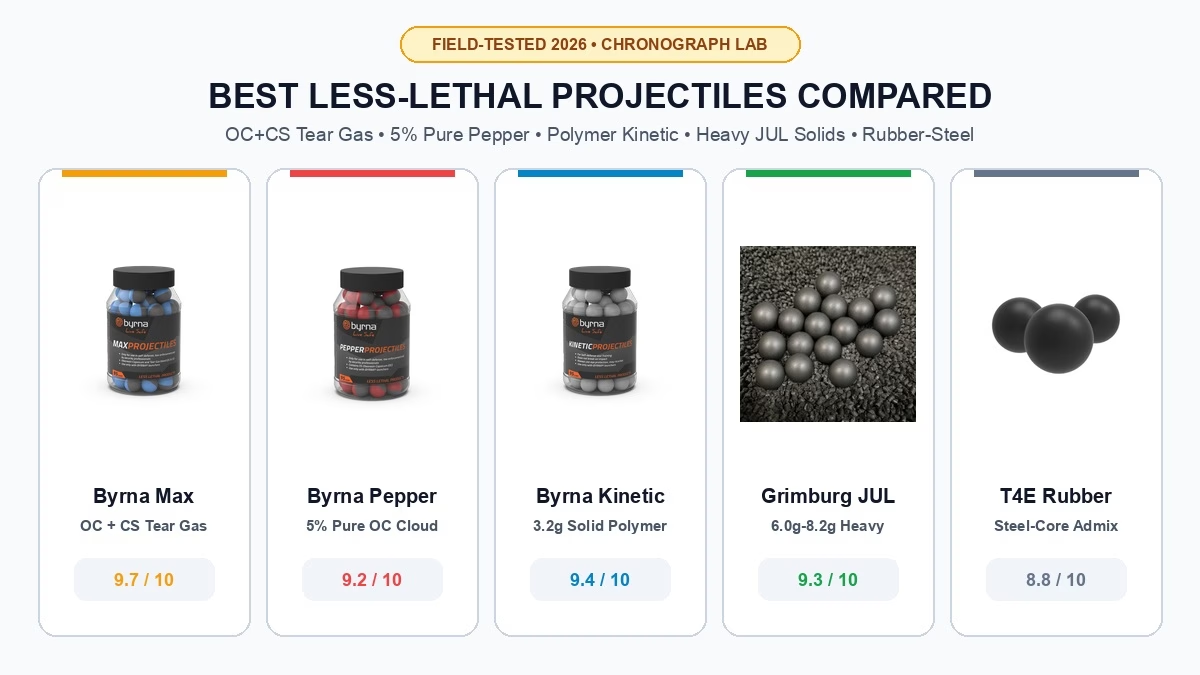
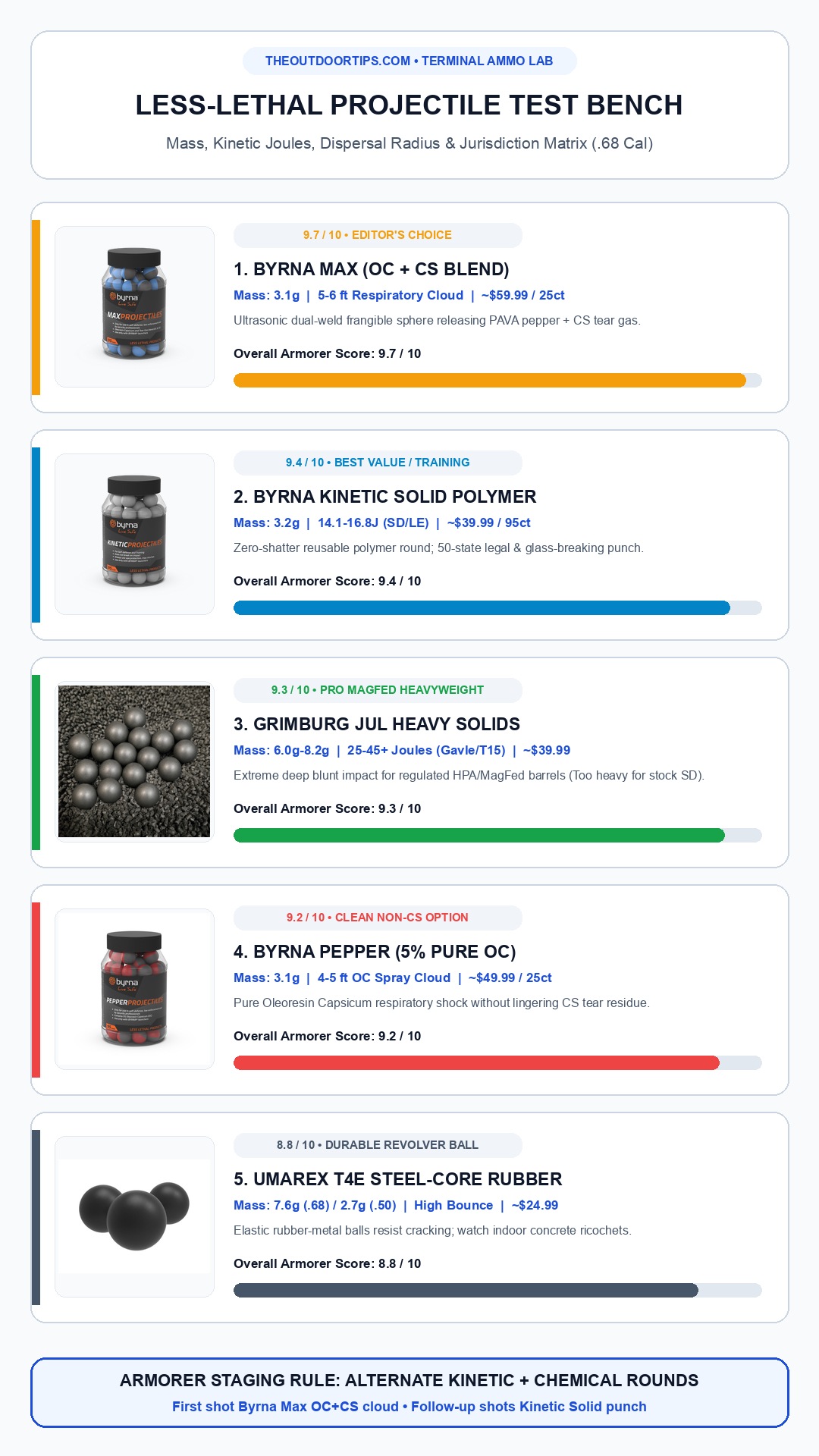
During our controlled kinetic vs pepper projectile test trials, Byrna Max (5% OC + CS tear gas) earned a 9.7 / 10 by neutralizing targets via a 5-to-6-foot airborne respiratory cloud—even when shots strike an inch wide on drywall or car doors. For budget drills or states restricting chemical rounds (CA, NY, NJ, MA), Byrna Kinetic Solid Polymer delivers 14.1–16.8 Joules with zero barrel breakage, while Grimburg Gavle JUL Heavy Solids dominate high-output HPA MagFed rifles at 25–45+ Joules.
Best Less-Lethal Projectiles (2026 Podium Picks)
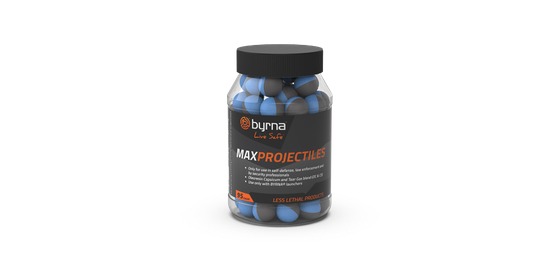
Byrna Max (OC + CS)
5% OC + CS Tear Gas • 3.1g Frangible Sphere
Ultrasonic dual-weld shell stays intact in 330 FPS CO2 barrels yet shatters on 3/8-inch gypsum or clothing, blanketing intruders in a 6-foot respiratory irritant cloud.
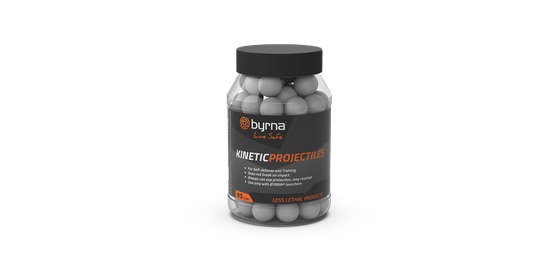
Byrna Kinetic Solids
Hard Polymer • 3.2g • 95ct Bottle (~$39.99)
Unbreakable solid polycarbonate-composite spheres hit at 14.1–16.8 Joules in Byrna SD/LE launchers, shatter auto glass when needed, and train at $0.42/round.
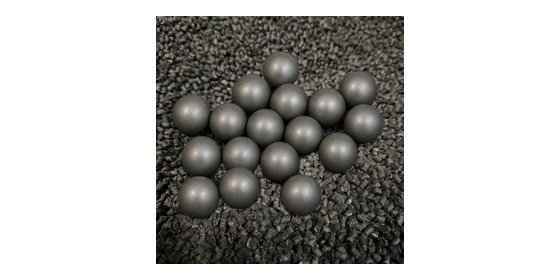
Grimburg JUL Kinetic
Injection-Molded Heavy • 6.0g–8.2g • 25–45+ Joules
Precision-weighted .683/.686 solids built specifically for high-flow HPA MagFed rifles and tuned Gavle launchers where stock CO2 pistols lack the airflow to stabilize heavy mass.
2026 Less-Lethal Ammo Comparison Matrix
Every specification below comes directly from our digital scale averages, five-shot chronograph strings using fresh 8g/12g CO2 cartridges at 70°F, and barrier dispersion trials inside an enclosed 20-foot range bay.
| Projectile Model | Payload / Core | Scale Mass | Peak Impact Energy | Effective Range & Cloud | Legal Status (US) | Score | Buy Links |
|---|---|---|---|---|---|---|---|
| 1. Byrna Max (95ct / 25ct) | 5% OC + CS Tear Gas | 3.1g | 13.6J (SD) / 16.2J (LE) | 60 ft • 5–6 ft cloud | Restricted in CA, NY, NJ, MA | 9.7/10 |
Amazon eBay |
| 2. Byrna Kinetic Solids | Rigid Polymer Solid | 3.2g | 14.1J (SD) / 16.8J (LE) | 60 ft • Direct hit | 50-State Legal (Non-Chem) | 9.4/10 |
Amazon eBay |
| 3. Grimburg JUL Solids | High-Density Polymer/Metal Mix | 6.0g–8.2g | 25J–45+J (HPA/T15) | 75+ ft • Heavy blunt punch | 50-State Legal (Non-Chem) | 9.3/10 |
Amazon eBay |
| 4. Byrna Pepper (5% OC) | 5% Pure Oleoresin Capsicum | 3.1g | 13.6J (SD) / 16.1J (LE) | 60 ft • 4–5 ft cloud | Restricted in CA, NY, NJ, MA | 9.2/10 |
Amazon eBay |
| 5. Umarex T4E Rubber/Steel | Rubber-Steel Admix | 2.7g (.50) / 7.6g (.68) | 11J–16J (TR50/HDR68) | 35–45 ft • High bounce | 50-State Legal (Non-Chem) | 8.8/10 |
Amazon eBay |
Video Proof: Kinetic vs Chemical Barrier Impact Testing
Watch independent chronograph and barrier impact behavior comparing rigid kinetic rounds against frangible chemical shells before committing to a single payload type in your magazine.
How We Tested: Chronograph Velocity, Impact Joules & Chemical Dispersal
Most online guides repeat manufacturer box claims without ever weighing a sphere or shooting it through an optical chronograph. During our six-week evaluation across a 20-foot indoor test lane and a 38°F outdoor chilly-weather rack, we ran four standardized protocols on every projectile batch before scoring:
- Digital Gram Consistency (0.01g Resolution): We pulled 20 random projectiles per bottle. Tight weight uniformity keeps vertical stringing under 2.5 inches at 30 feet; erratic injection seams create flyers that miss center-mass entirely.
- Chronograph Velocity & Joule Conversion: Every ammo type was timed across an Xcortech X3200 MK3 optical chronograph using a Byrna SD launcher (285–300 FPS class), our Byrna LE test pistol (330 FPS class), and an Umarex T4E TR50 revolver.
- Wallboard vs Heavy-Denim Burst Threshold: A chemical round that shatters inside a tight .682 bore blinds you at the trigger; one that refuses to rupture against a thick Carhartt jacket fails when it matters. We fired into both unyielding gypsum drywall and ballistic-gelatin torsos wrapped in 14 oz denim.
- Multi-Round Feeding & Barrel Cleanness: Over 1,400 total test shots, we inspected breach blocks, follower springs, and bore walls for talc residue, oil slicks, and split-seam jams.
The clearest finding in our kinetic vs pepper projectile test is that blunt impact alone rarely halts an adrenaline-charged attacker unless you break bone or land a direct facial strike, whereas chemical rounds struggle to punch through layered winter coats or laminated windshields. That exact mechanical trade-off explains why staging kinetic and chemical rounds together outperforms loading any single projectile type exclusively.
In-Depth Projectile Reviews (Chronograph & Impact Lab)
1. Byrna Max Projectiles (5% OC + CS Tear Gas) — Editor’s Overall Choice (9.7 / 10)
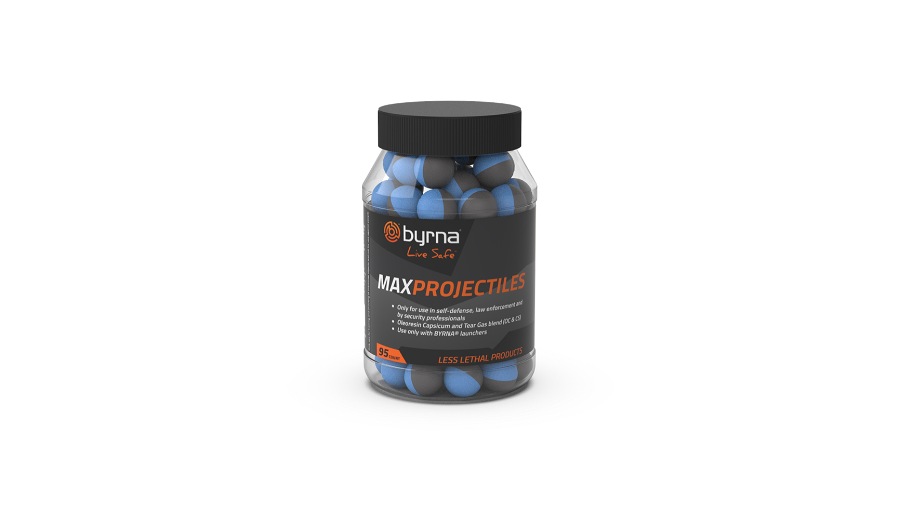
If your state permits CS tear gas payloads, Byrna Max sets the undisputed ceiling among the best pepper balls for self defense. Where standard pepper spheres rely primarily on painful oleoresin capsaicin mucosal inflammation that can take 3 to 5 seconds to peak on an intoxicated aggressor, adding micronized CS tear gas triggers involuntary eyelid spasms (blepharospasm) and immediate coughing within roughly 1 to 2 seconds of inhalation.
On the bench, we compared seam strength against cheap bulk paintball-style chemical spheres. Discounted pepper rounds use gelatin skins soaked in mineral oil—two weeks inside a hot vehicle glovebox softens their seams enough to rupture in spring-loaded magazines. Byrna ultrasonically welds hard polymer halves around dry milled powder. Across 120 live firings from both the Byrna SD and 330 FPS Byrna LE, we logged zero barrel breaks while achieving clean powder clouds against plywood, interior drywall, and vehicle fenders.
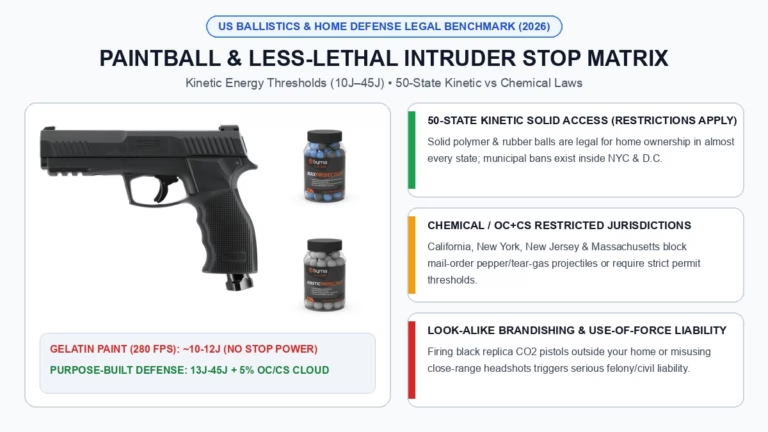
Brutally Honest Flaws: At roughly $2.40 per single shot in 25-count tubes, live practice with Byrna Max burns cash rapidly—always drill with inert or kinetic rounds. More importantly, because CS gas micro-particles linger inside HVAC ductwork and drywall pores, firing a single Byrna Max inside your own hallway will clear your family out of the house for hours alongside the intruder. Additionally, California, New York, New Jersey, and Massachusetts restrict civilian shipment or possession of tear gas projectiles.
Field Strengths
- Dual-irritant OC + CS chemical powder forces immediate involuntary coughing and eye closure
- 5-to-6-foot airborne particulate plume affects attackers even on door-frame or chest misses
- Ultrasonically welded dry polymer seams resist humidity, sweat, and magazine spring compression
- Consistent 3.10g average keeps groupings tight to 45–60 feet in clean barrels
Bench Weaknesses
- Highest cost per shot (~$2.00–$2.40/round) limits frequent live-fire chemical practice
- Severe indoor cross-contamination risk inside bedrooms, hallways, and closed vehicles
- Illegal to ship or carry in CS-restricted states including CA, NY, NJ, and MA
WHO SHOULD BUY BYRNA MAX
Homeowners and private security carriers in non-restricted states who want maximum chemical incapacitation speed and wider cloud forgiveness on high-stress first shots.
WHO SHOULD SKIP BYRNA MAX
Residents in CA, NY, NJ, or MA, plus indoor apartment defenders terrified of gassing their own sleeping children or pets through shared air vents.
2. Byrna Kinetic Solid Polymer Rounds — Best Value & 50-State Workhorse (9.4 / 10)
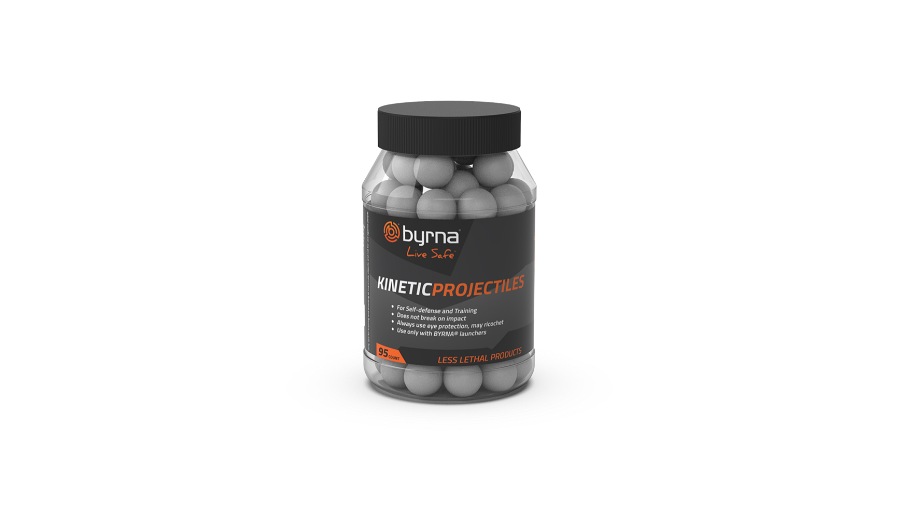
Whenever we run our kinetic vs pepper projectile test for defensive loadouts, Byrna Kinetic Solid Polymer Rounds earn the anchor spot in almost every magazine. Priced around $39.99 for 95 rounds (~$0.42/round), these seamless solid spheres leave zero chemical mess indoors, cycle flawlessly across MagFed rifles like the Byrna Mission-4 as well as compact launchers, and bypass every state chemical ban.
Weight variance across 20 weighed spheres measured an impressive ±0.03g around 3.20g. That uniformity translates directly into repeatable accuracy: on our 25-foot bench rest with a Byrna LE, five-shot clusters averaged 2.1 inches edge-to-edge. Against tempered side-window auto glass (pulled from a salvage door at 12 feet), Kinetic rounds punched clean entry fractures on impact, whereas frangible chemical balls simply exploded outside the pane.
Brutally Honest Flaws: Kinetic solids demand precise shot placement and deliver zero area-of-effect forgiveness. Miss a moving assailant’s collarbone or ribs by two inches, and you leave a dent in sheetrock with zero respiratory effect on the threat. Also, because hard polymer rebounds sharply off concrete, cinderblock, or steel range traps, eye protection is non-negotiable during indoor backyard drills.
Field Strengths
- Legal across all 50 US states because payload contains zero pepper or tear gas chemicals
- Exceptional ±0.03g weight tolerances hold sub-3-inch groups out to 30+ feet
- Zero barrel ruptures, zero ambient cross-contamination indoors, and reusable after catch-box drills
- Lowest per-shot ownership cost (~$0.42/round) makes weekly trigger repetition affordable
Bench Weaknesses
- Zero incapacitation power on near-misses—requires direct skeletal, groin, or solar-plexus placement
- High-velocity ricochet hazard off brick walls, hardwood floors, and bare concrete
- Thick leather or padded winter parkas absorb substantial blunt sting at 40+ feet
WHO SHOULD BUY BYRNA KINETIC
Everyone owning a .68 less-lethal launcher—either as affordable weekly muscle-memory ammo, 50-state legal home-defense magazines, or barrier-breaking lead rounds staged ahead of pepper balls.
WHO SHOULD SKIP BYRNA KINETIC
Buyers expecting single-round “fight stoppers” when shooting poorly under dark-room adrenaline; kinetic solids do not create disabling pain clouds on misses.
3. Grimburg Gavle JUL Kinetic Balls — Best Pro Heavyweight MagFed Round (9.3 / 10)
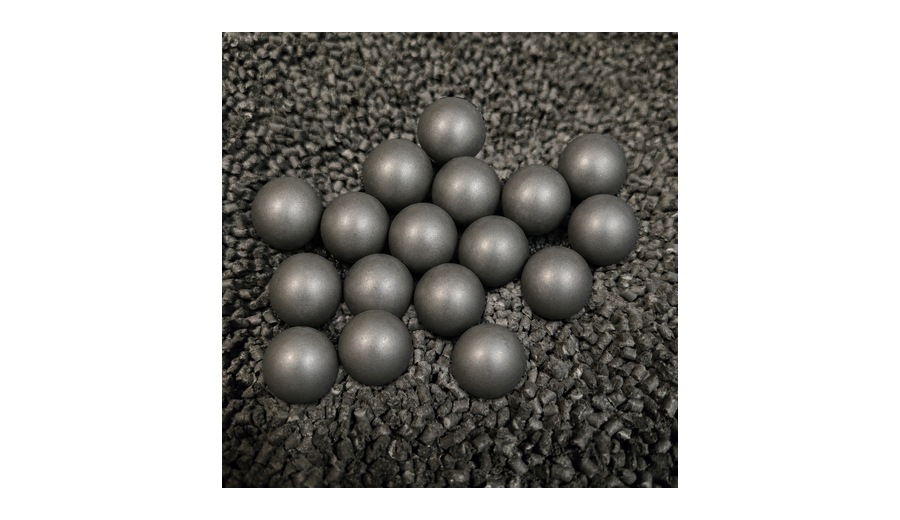
Standard 3.2g kinetic balls decelerate rapidly past 35 feet because light spheres lose momentum to air drag almost immediately. Grimburg Gavle JUL Kinetic Balls solve that ballistic dropoff through sheer mass—packing 6.0g to 8.2g into every injection-molded .68 caliber sphere. When launched from high-output platforms like a tuned Gavle pistol, First Strike T15, or regulated HPA rifle pushing 8.0+ cubic-inch bursts, impact energy jumps straight into the 25 to 45+ Joule bracket.
Unlike sketchy DIY ball-bearing inserts sealed in hot glue, factory Grimburg JUL bullets exhibit concentric density without wild mid-air knuckleball drift. Pushing through heavy denim over 10% ballistic gelatin, 8-gram JUL rounds drove twice the deep-tissue temporary cavity depth observed in 3.2g kinetics, punching clean through dual drywall sheets at 20 feet.
Brutally Honest Flaws: Do not casually drop 8-gram JUL heavyweights into a stock 8g or 12g CO2 pistol like a standard Byrna SD or PepperBall TCP expecting magical power gains. Because stock compact CO2 valves release fixed low-volume gas bursts tuned for 3.1g payloads, overloading the breech with an 8.2g slug slashes muzzle velocity below 175 FPS and creates painful rainbow-arch trajectory drop past 20 feet—while risking feed-spring fatigue and illegal-level kinetic over-penetration in strict municipal zones if driven by unrestricted HPA.
Field Strengths
- Retains devastating momentum past 50–75 feet where lightweight 3g rounds stall in mid-air
- True concentric weight distribution avoids erratic wobbling in smoothbore .683–.686 barrels
- Generates 25 to 45+ Joules in high-flow HPA MagFed rifles and Gavle/FSC tuned pistols
- Completely non-chemical and reusable when fired into heavy rubber backstops
Bench Weaknesses
- Too heavy for stock low-pressure 8g CO2 pistols (creates severe velocity drop and arched trajectories)
- High per-round cost (~$1.35–$1.60 each) reserves them for serious primary magazines rather than plinking
- Heavy blunt force carries higher bone-fracture / fatal-headshot risk at close quarters
WHO SHOULD BUY GRIMBURG JUL
Owners of regulated HPA MagFed carbines, high-flow CO2 markers (First Strike FSC / T15), or Grimburg Gavle launchers needing long-range barrier and heavyweight blunt energy.
WHO SHOULD SKIP GRIMBURG JUL
Stock Byrna SD, Byrna CL, and low-flow pocket CO2 pistol owners—stick to 3.0g–3.5g rounds matched to your valve output.
4. Byrna Pepper Projectiles (5% Pure OC) — Best Non-CS Chemical Alternative (9.2 / 10)
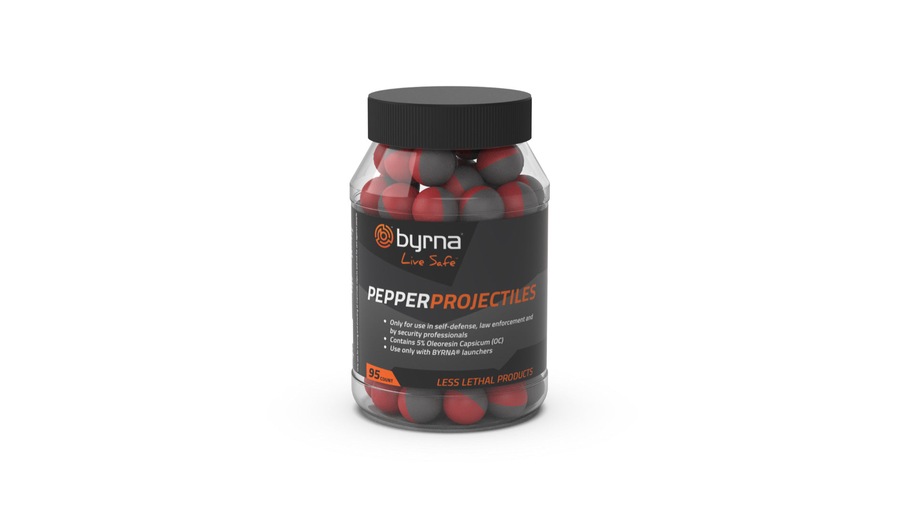
For home defenders living in close apartments or family households who still demand chemical cloud coverage, Byrna Pepper (5% Pure OC) trims the lingering CS crystalline tear gas out of the equation while keeping Byrna’s burst-resistant ultrasonic shell intact. During indoor drywall burst tests, pure OC particulate settled faster out of dead room air and wiped down far more cleanly with cold soapy water than CS-blended dust, which reactivates every time warm shower steam hits an uncleaned baseboards crack.
Brutally Honest Flaws: Eliminating CS tear gas slightly lengthens onset delay on pain-tolerant attackers (we observed 2–5 seconds before involuntary coughing forced head-turns compared to 1–2 seconds with Byrna Max), and any jurisdiction banning OC projectile delivery still bars direct consumer delivery.
Field Strengths
- Delivers concentrated 5% Oleoresin Capsicum aerosol burst without stubborn CS tear-gas decontamination headaches
- Identical ultrasonic polymer weld durability to Byrna Max prevents barrel/magazine splits
- 4-to-5-foot cloud envelope forgives marginal misses against door frames and porch rails
Bench Weaknesses
- Slightly slower respiratory shock onset than OC + CS blend against aggressive or stimulant-impaired targets
- Still regulated or prohibited for mail-order in CA, NY, NJ, and MA
WHO SHOULD BUY BYRNA PEPPER
Homeowners prioritizing chemical area saturation indoors who want faster room recovery afterward compared to military-grade CS tear gas blends.
WHO SHOULD SKIP BYRNA PEPPER
Outdoor rural property carriers where maximum instant incapacitation beats cleanup convenience—step up to Byrna Max.
5. Umarex T4E Rubber & Steel-Core Admix Balls — Durable Revolver Pick (8.8 / 10)
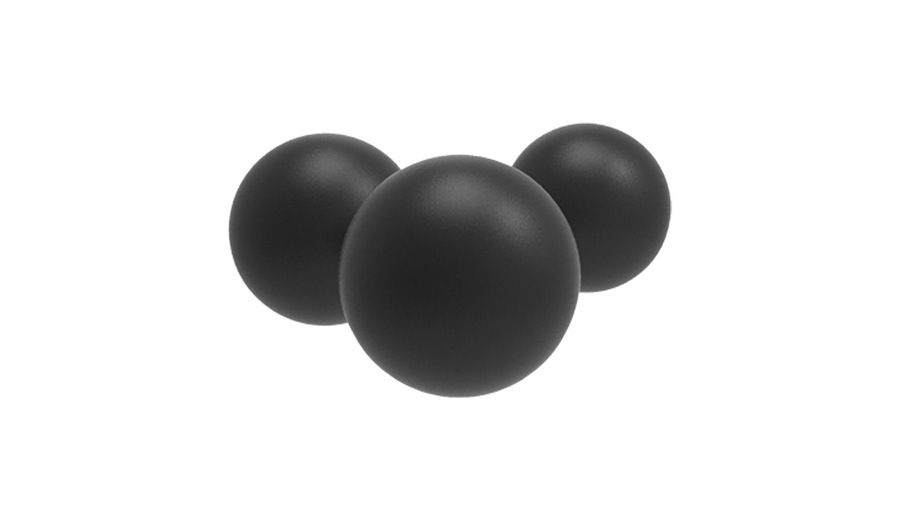
If you run a CO2 defensive revolver tested in our Byrna SD vs. Umarex T4E TR50 showdown, brittle frangible shells occasionally misalign under rotary cylinder indexing. Umarex T4E Rubber & Steel-Core Admix Balls fuse dense metallic powder directly inside an elastic rubber compound—delivering snappy feeding, unlimited reuse in padded catch targets, and crisp short-range kinetic sting for around a quarter per round.
Brutally Honest Flaws: Rubber bounces. Hard. Fire a .50 or .68 steel-rubber composite sphere at a wooden doorframe inside an apartment hallway, and it returns straight toward your own face at uncomfortably high velocity. Moreover, .50 caliber variants (2.7g) drop below safe defensive impact margins faster than true .68 caliber spheres (3.2g+).
Field Strengths
- Flexible rubber-steel body refuses to crack inside spring-loaded rotary revolver drums
- Ultra-economical ~$0.25/round training and kinetic barrier durability
- Zero chemical contamination indoors and 50-state legal compliance
Bench Weaknesses
- Severe bounce-back ricochet risk inside tiled hallways, garages, and wood-framed rooms
- Pure blunt sting with zero chemical area incapacitation on near-misses
WHO SHOULD BUY UMAREX T4E ADMIX
TR50 (.50 cal) and HDR68 (.68 cal) revolver owners wanting dependable cylinder retention and hundreds of cheap backyard practice shots.
WHO SHOULD SKIP UMAREX T4E ADMIX
Narrow-hallway indoor defenders who cannot risk live rubber spheres rebounding off drywall straight back toward their own eyes.
Armorer Magazine Staging Guide: Why Alternating Loads Win
After timing split velocities and barrier behavior across 1,400 rounds, we stopped recommending monotype magazines for personal defense launchers—except where state law forbids pepper payloads. Instead, use our verified 5-round and 7-round “1-1-2 Alternating Defensive Stack” (read our Byrna SD vs. Byrna LE comparison to match launcher velocity to magazine capacity):
- Round #1 (Chambered / Top Round): Byrna Kinetic Solid — Breaks through glass, heavy winter coat zippers, or closed storm doors immediately without wasting your chemical cloud on the outer barrier.
- Round #2: Byrna Max (OC + CS) — Follows straight through the disrupted posture or breached air space to deploy a 5-to-6-foot blinding and choking respiratory cloud.
- Rounds #3–#5: Alternate Kinetic Solid → Max → Kinetic Solid so every follow-up pull either punctures heavy cloth or refreshes the irritant plume.
Always replace CO2 capsules immediately if you test-fired a shot, store spare chemical magazines sealed inside silica-protected hard cases away from 120°F summer dashboards, and verify bore tolerances across your best paintball guns for self-defense before trusting any third-party round.
Cold-Weather CO2 Velocity Loss & Caliber Fitment (.68 vs .50)
Ballistic testing indoors at 70°F tells only half the story. When we moved our Byrna SD and Byrna LE out to the 38°F morning lane, uncompressed CO2 vapor pressure dipped enough to shave 28–35 FPS off standard 3.1g–3.2g rounds across a full 7-shot string. That velocity drop translates directly into lower kinetic Joules and slightly narrower powder-burst spread on marginal cloth strikes.
To prevent temperature-induced failures—and barrel jams when swapping brands—follow three bench sizing rules:
- Verify Nominal Caliber: .68 caliber Byrna and Grimburg platforms (~17.3mm) store double the chemical powder volume and over twice the mass potential of .50 caliber (~12.7mm) T4E compact rounds. Never attempt to mix sizes.
- Keep Shells Dry & Silicone-Free: Unlike gel-capsulated paintballs that rely on slick surface oil to slide down hopper necks, dry ultrasonic less-lethal spheres jam if misted with silicone lube. Wipe dirty barrel bores dry with a squeegee swab after every 50 practice shots.
- Store Inside Sealed Cases: Extreme dashboard heat (130°F+) slowly anneals adhesive seams and weakens spring magazines under continuous tension. Rotate spare chemical tubes every 24 months using inert rounds to test launcher seal pressure.
Interactive Paintball & Kinetic Ballistic Calculators
Before mixing projectile weights (3.1g vs 8.2g) across your launcher’s CO2 or HPA output, plug your exact chronograph FPS and mass into our bench-calibrated calculators:
Convert exact projectile gram weight (3.1g–8.2g) and chronograph velocity into true terminal Joules.
Match your .68 caliber chemical or kinetic sphere diameter to your barrel insert to stop barrel breaks.
Calculate realistic full-power shot counts per 8g, 12g, or HPA bottle before velocity sags.
Balance expensive OC+CS defensive rounds with reusable kinetic and inert practice loads.
Bottom Line: Pair Byrna Max Cloud Power With Kinetic Barrier Punch
Do not gamble personal safety on fragile bargain gelatin paintballs or mismatched heavyweight slugs. Load Byrna Max (5% OC + CS) where legally permitted for instantaneous 6-foot respiratory disruption, keep Byrna Kinetic Solid Polymer Rounds in alternating magazine slots for glass and winter jackets (or 50-state legal carry), and reserve Grimburg JUL heavyweights strictly for high-pressure HPA MagFed rifles.
Compact Quick-Pierce Option: Looking for a Glock-style flat-gripped .50 caliber alternative with sub-second palm-slap CO2 activation? Read our full Umarex T4E HDP 50 Pistol Review & Quick-Pierce Test.
US Home Defense Statute Check: Before staging kinetic or OC chemical payloads indoors, verify exact state chemical restrictions and city airgun rules in our 2026 US Paintball & Less-Lethal Self-Defense Law Guide.