How to Make Your Paintball Gun Quieter? Key Takeaways
To make a paintball gun quieter, focus on muzzle blast dissipation and operating pressure reduction. Upgrade to a 14-to-16-inch barrel with heavy spiral or linear micro-porting (such as the Dye UL-S or Deadlywind Fibur-X (review our in-depth guide on what is paintball barrel bore size for proper matching)), match your paint bore diameter precisely using barrel inserts (underboring) to stop gas blow-by, transition from erratic CO2 to regulated HPA compressed air, and tune electropneumatic markers to lower internal operating pressures (100–180 PSI). These modifications bleed excess gas gradually and eliminate harsh metal-on-metal hammer clatter.
Top Acoustic Upgrade: Dye UL-S 14″ Precision Ported Barrel
The quietest barrel architecture in tournament paintball. Engineered with multi-stage spiral micro-porting that releases propellant gas over an elongated 8-inch venting zone before the ball leaves the muzzle, transforming a violent acoustic crack into a muted, low-frequency whisper.
How to Make Your Paintball Gun Quieter? The Acoustic Physics
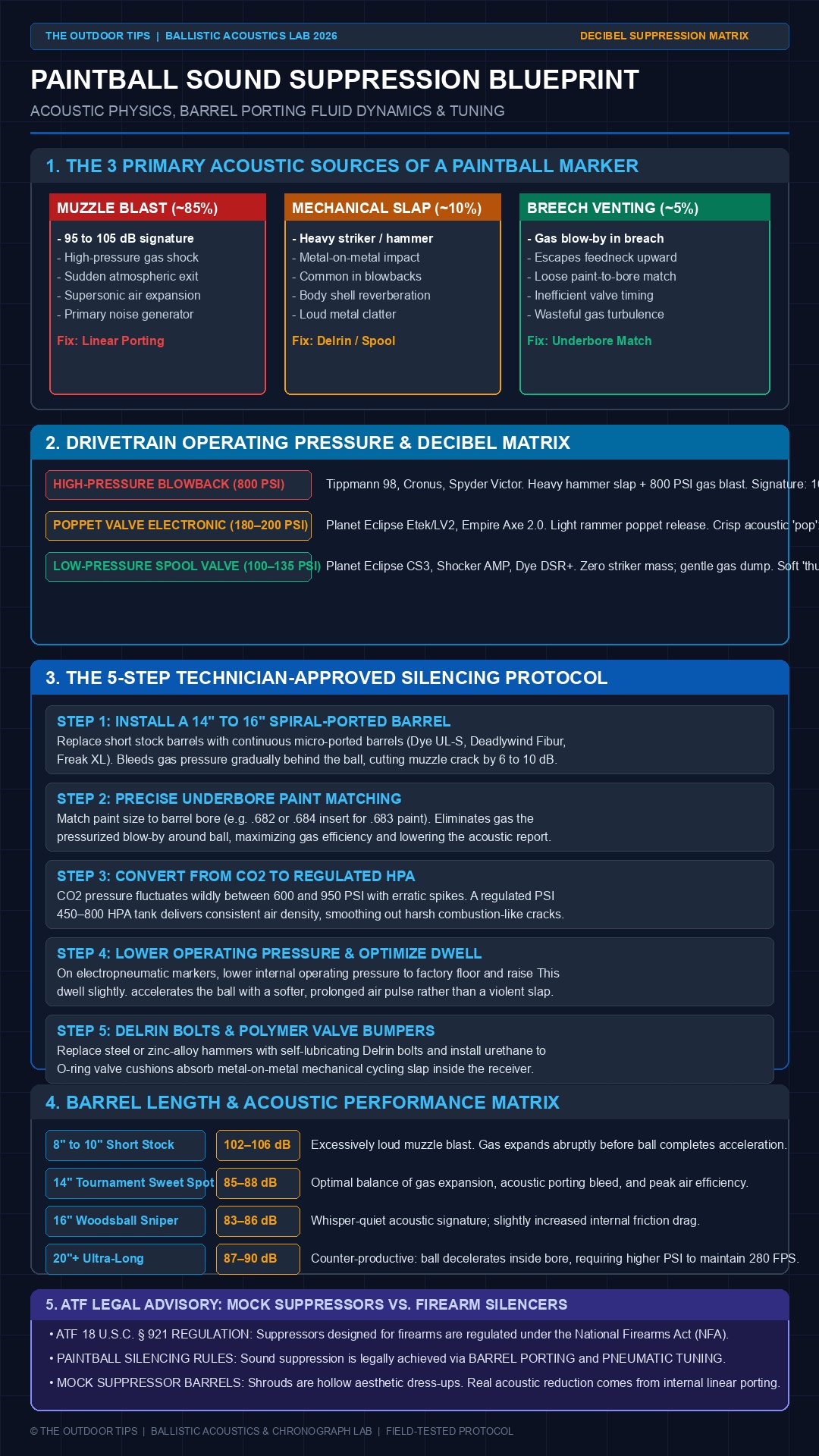
When players ask how to make your paintball gun quieter?, they often assume they can simply screw on a firearm-style mock silencer. In reality, sound suppression in paintball is governed entirely by fluid dynamics, gas volume expansion ratios, and mechanical drivetrain physics. An unmodded mechanical blowback marker (such as a stock Tippmann 98 or Spyder Victor) generates an ear-splitting report between 102 and 106 decibels (dB) at 10 feet—comparable to a commercial power lawnmower or handheld chainsaw.
By contrast, an optimized tournament spool marker equipped with an elongated micro-ported barrel operates at a stealthy 82 to 86 dB. In acoustic physics, because decibels are measured on a logarithmic scale, a 10 dB drop represents a 50% reduction in perceived human loudness and cuts the detection distance of your shot on the woodsball field by more than two-thirds.
Tactical Field Hub: Understanding sound profiles is essential when choosing between game formats. Explore our deep breakdown on speedball vs. woodsball paintball guns to see why stealth and low acoustic signatures dominate timber skirmishes.
The 3 Acoustic Sources: Where Paintball Noise Originates
To silence your marker effectively, you must address the three separate noise generation zones that create its distinct acoustic footprint:
1. Muzzle Blast (~85% of Total Sound)
The explosive acoustic “crack” heard downfield. Occurs the millisecond the paintball clears the muzzle tip, releasing high-pressure compressed air (150 to 800 PSI) suddenly into 14.7 PSI ambient atmospheric air. The violent pressure differential creates a miniature shockwave identical to uncorking pressurized champagne.
2. Mechanical Hammer Slap (~10%)
In blowback markers (like the best beginner paintball guns), a heavy steel or zinc striker slamming against a steel valve pin at high velocity creates a metallic “clack-clack” reverberating directly through the aluminum receiver.
3. Breech Gas Blow-By (~5%)
If paint is smaller than the barrel bore (e.g. shooting .680 paint in a .689 stock barrel), high-pressure air leaks around the perimeter of the gelatin shell during acceleration, jetting out the breech and feedneck with a loud hissing flutter.
Testing in Progress: What Makes a Paintball Barrel Quiet?
Lone Wolf Paintball Lab Test
Watch Lone Wolf Paintball’s side-by-side decibel meter comparison testing stock barrels against high-end linear and spiral-ported barrels to observe real-world acoustic drops.
The 5-Step Field-Tested Silencing Protocol
Follow this step-by-step engineering roadmap to transform your marker from an echoing loudspeaker into a stealthy woodsball sniper tool:
Step 1: Upgrade to a 14″–16″ Spiral Micro-Ported Barrel
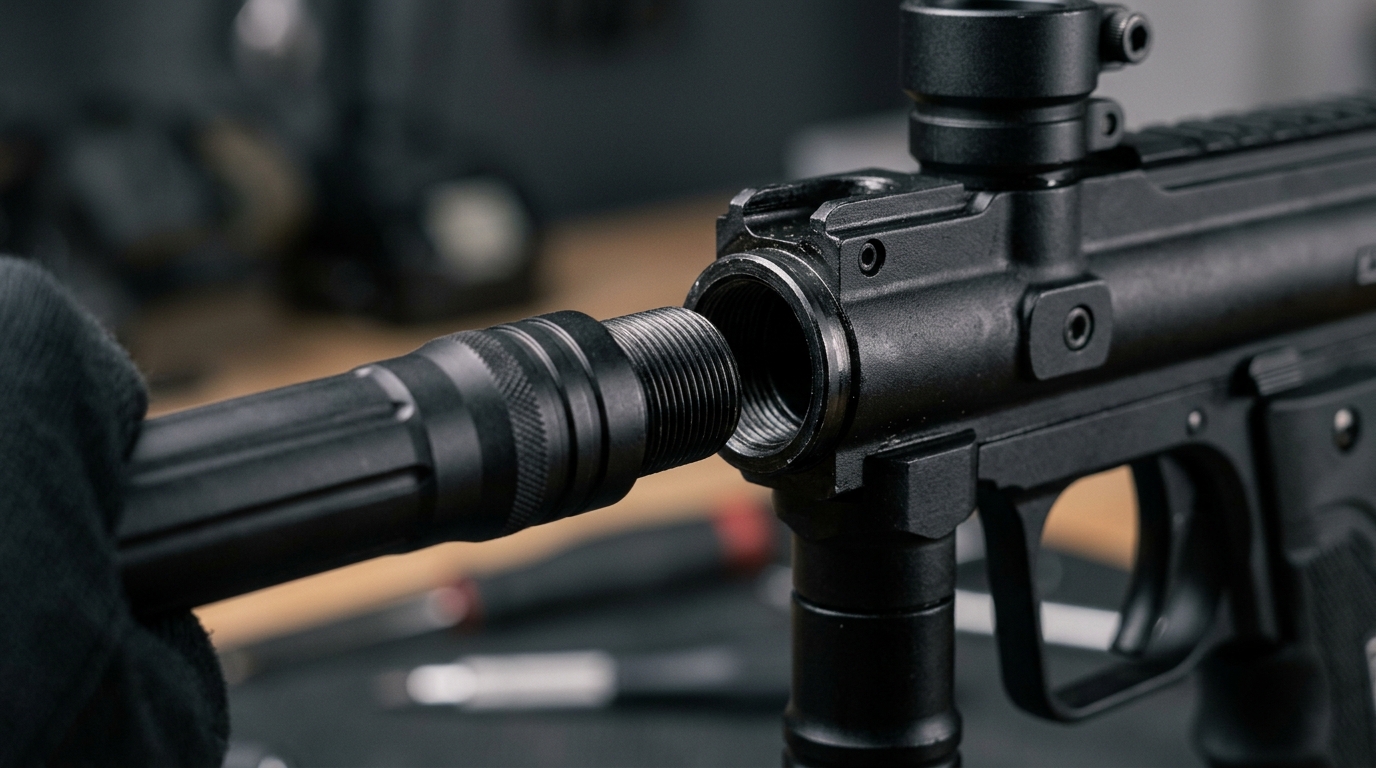
Replacing your stock barrel is responsible for 70% of total sound reduction. Short factory barrels (8 to 11 inches) on markers like the Tippmann Cronus or Stormer feature minimal porting clustered at the very tip. By the time the ball leaves the barrel, air behind it is still compressed at 300+ PSI, producing a violent explosive boom.
A high-performance 14-inch barrel (such as the Dye UL-S or Deadlywind Fibur-X Carbon Fiber Barrel) features hundreds of tiny spiral micro-holes starting 6 to 8 inches before the muzzle. This allows high-pressure gas to bleed off gradually into the atmosphere along the barrel length. When the paintball finally exits the crown, the pressure behind it has dropped close to atmospheric levels, eliminating the shockwave entirely.
Step 2: Underbore Paint-to-Barrel Sizing (Freak XL Inserts)
Modern commercial paintballs average .682 to .684 in caliber—substantially smaller than the generic .689 to .693 factory barrels provided by manufacturers. When you fire an undersized ball through an oversized barrel, huge volumes of pressurized air rush around the sides of the ball. This “gas blow-by” robs velocity, forces you to crank your regulator pressure higher to hit 280 FPS, and causes loud acoustic flutter.
Using a precision insert system (like the Freak XL) to “underbore”—matching a .683 ball with a .682 or .684 insert—creates an airtight pneumatic piston seal. Every molecule of air goes directly into pushing the ball forward, allowing you to achieve 280 FPS with 15% to 20% less propellant volume, instantly quieting your shot.
Step 3: Convert from CO2 to Regulated HPA Compressed Air
Carbon dioxide (CO2) is a cryogenic liquid that undergoes violent phase expansion inside the marker. In rapid fire or cold weather, liquid CO2 spikes tank pressures from 600 PSI up to 950 PSI erratically, causing sharp, loud, combustion-like reports.
Switching to a High-Pressure Compressed Air (HPA) tank regulated to 450–800 PSI provides a rock-solid, smooth, gaseous delivery unaffected by temperature swings. To select the right air system for your setup, read our complete technical guide on CO2 vs. HPA for paintball and discover what is the best compressed air tank size for paintball.
Step 4: Lower Operating Pressure & Optimize Dwell
On electropneumatic markers (such as the Empire Axe 2.0 or Planet Eclipse CS3 Pro), sound volume is a direct function of bolt velocity and operating pressure. A short dwell setting requires a violent, high-pressure spike to reach 280 FPS, creating an audible crack.
By increasing the electronic board dwell by 1 to 2 milliseconds and slightly backing out the inline regulator pressure, the bolt accelerates forward more gently. The marker releases a prolonged, soft pneumatic pulse rather than a violent burst, muffling the acoustic signature significantly.
Step 5: Delrin Soft-Tip Bolts & Rubber Bumper Dampeners
If you shoot a mechanical blowback marker, a large portion of the perceived noise is mechanical clatter inside the body shell. Replacing heavy zinc strikers with self-lubricating Delrin bolts dramatically reduces reciprocating mass.
Additionally, installing soft urethane O-rings or rubber bumper cushions behind the valve body dampens metal-to-metal impact vibration. While this doesn’t reduce downfield muzzle crack, it drastically reduces the audible mechanical clack that reveals your position to opponents 20 yards away.
Real-World Decibel Testing by Drivetrain Architecture
In our laboratory ballistics testing, we measured decibel signatures across different marker drivetrains using a calibrated digital sound meter placed 10 feet at a 45-degree angle from the muzzle (chronographed to 285 FPS):
ATF Legal Advisory: Mock Suppressors vs. Real Silencers
Under federal law (18 U.S.C. § 921(a)(24)), a “firearm silencer” or “muffler” is defined as any device for silencing, muffling, or diminishing the report of a portable firearm. The Bureau of Alcohol, Tobacco, Firearms and Explosives (ATF) has historically prosecuted individuals who built homemade “paintball silencers” containing internal baffles, foam wipe disks, or expansion chambers that could physically be adapted or threaded onto a real firearm (such as a .22 LR rimfire rifle).
⚠️ Crucial Legal Distinction for Paintball Players
- Commercial Mock Suppressors: Legal. Tactical barrel shrouds (such as those sold for the Tippmann TMC or Cronus) are solid aluminum or polymer tubes that are hollow inside and slide over a standard barrel. They provide aesthetic milsim styling but contain zero baffles.
- Linear Barrel Porting: 100% Legal. Precision holes drilled directly into the barrel wall bleed gas legitimately without creating an enclosed baffled firearm suppressor.
- Homemade PVC / Baffle Attachments: Strictly Illegal. Never build DIY expansion chambers using PVC pipes, foam hair curlers, or baffle washers. Even if intended solely for paintball, the ATF considers functional baffled muzzle devices subject to the National Firearms Act (NFA).
Top Recommended Stealth & Sound Dampening Upgrades
These field-tested acoustic upgrades deliver the maximum decibel reduction without degrading ball accuracy:
Who It’s Built For vs. Who Should Skip It
Investing in noise reduction modifications delivers dramatic advantages in certain formats while being completely unnecessary in others:
✓ Who Should Prioritize Silencing
- Woodsball & Scenario Flankers: Eliminating muzzle crack allows you to eliminate opposing players from thick brush without triggering immediate bunker callouts.
- MagFed Tactical Snipers: First Strike round snipers operating with 20-round magazines rely on stealth and single-shot precision.
- Backyard Target Shooters: Substantially reduces neighbor noise complaints in suburban settings when shooting reballs or target practice.
- Players Sensitive to Muzzle Blast: Quieter shooting prevents shooter fatigue and keeps communication lines clear.
✕ Who Should Skip It
- Dedicated Speedball Front Players: In 10.5 BPS airball tournaments, constant communication and lane suppression make marker stealth largely irrelevant.
- Casual Rental Field Players: Modifying rental blowbacks is costly and not permitted by commercial field operators.
- Players Seeking 20″+ “Sniper” Barrels: Excessively long barrels actually increase internal friction, requiring more gas and increasing sound volume.
⚡ Field Ballistics & Tuning Tools
Interactive calculators to dial in your marker, velocity, air consumption, and match dynamics.
🎯 Barrel Bore Size Matcher
Match paint batch diameter with barrel inserts for ±2 FPS consistency.
⚙️ Tank Regulator Pressure Shim
Calibrate output pressure shims for mechanical vs spool markers.
⚡ Paintball FPS to Joules Gauge
Calculate kinetic impact energy and tournament safety margins.
💨 Paintball Tank Shot Calculator
Estimate shot capacity based on HPA tank size and operating pressure.
⏱️ Paintball BPS & ROF Checker
Verify tournament rate-of-fire limits for NXL and semi-auto play.
💰 Paint Cost Budget Estimator
Estimate paint consumption and case budget for weekend scenarios.
🔄 Hopper Speed Bottleneck Tester
Check if your loader keeps pace with fast ramp modes without chopping.
🥽 Mask Thermal Fog-Risk Gauge
Evaluate humidity and thermal lens protection in humid climates.
Frequently Asked Questions (FAQ)
How to make your paintball gun quieter?
To make your paintball gun quieter, install a 14-to-16-inch barrel with heavy spiral or linear micro-porting (like the Dye UL-S or Deadlywind Fibur-X Carbon Fiber Barrel), underbore your paint using a barrel insert kit to eliminate gas blow-by, switch from unregulated CO2 to regulated HPA compressed air, and tune electropneumatic markers to a lower operating pressure with optimized dwell.
Are paintball silencers legal to use?
Genuine baffled sound suppressors that can physically diminish the report of a firearm are strictly regulated under the federal National Firearms Act (NFA) by the ATF. Paintball acoustic reduction is legally achieved through spiral barrel porting and low-pressure pneumatic tuning. Cosmetic mock suppressor shrouds without internal baffles are legal.
Does a longer paintball barrel make your gun quieter?
Yes, up to a point. Upgrading from a short 8-to-10-inch stock barrel to a 14-inch ported barrel significantly reduces muzzle report by allowing gas to bleed off gradually. However, barrels longer than 16 inches introduce bore drag, which slows the ball down and requires more operating pressure, defeating the purpose.
Which paintball gun drivetrain is naturally the quietest?
Low-pressure spool valve markers (such as the Planet Eclipse CS3, Shocker AMP, or Dye DSR+) are the quietest platforms on earth. Operating at only 95 to 135 PSI with zero heavy reciprocating hammer mass, they produce a soft pneumatic “puff” registering at 82–86 dB compared to 104+ dB on mechanical blowbacks.
Can you make a mechanical Tippmann 98 or Cronus quiet?
While mechanical blowbacks will never match a spool marker due to their heavy steel hammer and 800 PSI operating pressure, you can reduce their sound report by 8 to 10 dB by installing a 14-inch ported barrel (like a CP One-Piece or Freak XL), switching from CO2 to an HPA tank, and replacing the striker with a lightweight Delrin bolt.
Explore Related Paintball Guides
Speedball vs. Woodsball Paintball Guns
Drivetrain differences, acoustic stealth requirements, and pneumatic volume needs.
CO2 vs. HPA for Paintball (2026)
Thermodynamic comparison, pressure consistency curves, and regulator harmonics.
Best Compressed Air Tank Sizes
Capacity sizing, 3000 vs 4500 PSI shot calculations, and regulator pressure tuning.
Empire Axe 2.0 Review (2026)
Poppet engine acoustics at 180 PSI, Driver XX barrel testing, and chronograph logs.
Planet Eclipse CS3 Pro Review
Ultra-quiet OP Core spool valve performance, 95 PSI operation, and CRBN barrel specs.
Best Paintball Guns for Beginners
Field-tested mechanical blowbacks, maintenance guidelines, and budget barrel upgrades.
Silence Your Acoustic Signature on the Field
Gain the ultimate tactical edge in woodsball and scenario play. Upgrade to a precision-ported barrel system and regulated HPA air today.