⚡ Quick Storage Matrix (TL;DR): The Preservation Golden Rules
Quick Answer: To keep paintballs shooting laser-straight without in-bore barrel breaks or flight wobbling, preserve them within these strict environmental parameters:
- Ideal Storage Temperature: 60°F to 70°F (15°C to 21°C). Stable thermal mass is critical; never allow temperatures to swing wildly.
- Ideal Relative Humidity: 40% to 50% RH. This maintains the gelatin shell’s ductile plasticizer equilibrium.
- Estimated Storage Life: 3 to 6 months in standard factory bags; up to 12 months in airtight gasketed containers with desiccant and rotation.
- Optimal Storage Location: A climate-controlled interior closet, finished basement, or insulated gear room (NEVER a garage, attic, car trunk, or shed).
- Case Rotation Frequency: Invert sealed bags and cases 180 degrees every 2 to 3 weeks (14 to 21 days) to eliminate gravitational flat spots and dimples.
Equipment Tested • In Stock & Verified
Plano Tactical .50 Cal Ammo Can
MSRP: $19.99 | Water-Resistant Rubber O-Ring Gasket | Holds 1,000+ Paintballs
Dry & Dry 10g Silica Gel Packs (50-Pack)
MSRP: $11.99 | Food & Gelatin Safe | Regulates RH to Optimal 45%
Paintballs are not inert plastic projectiles; they are delicate, bio-degradable, hygroscopic gel-capsules. Manufactured from pharmaceutical-grade animal gelatin and filled with water-soluble polyethylene glycol (PEG), paintballs constantly interact with ambient moisture and heat. For an in-depth breakdown of raw ingredient chemistry, read our guide on whether paintballs contain plastic and how their water-soluble fill formula washes out of clothes.
When paintballs are improperly stored in hot car trunks, unconditioned garages, or open cardboard boxes, the consequences on the field are catastrophic: distorted egg-shaped shells that hook wildly off target, swollen shells that jam inside .685 barrel bores, and brittle gelatin seams that explode inside hoppers and breeches. In this comprehensive technical guide, we break down the thermodynamics of gelatin preservation, desiccant saturation calculations, airtight container hierarchies, and empirical lab chronograph testing logs to keep your paint shooting laser-straight for up to a full year.
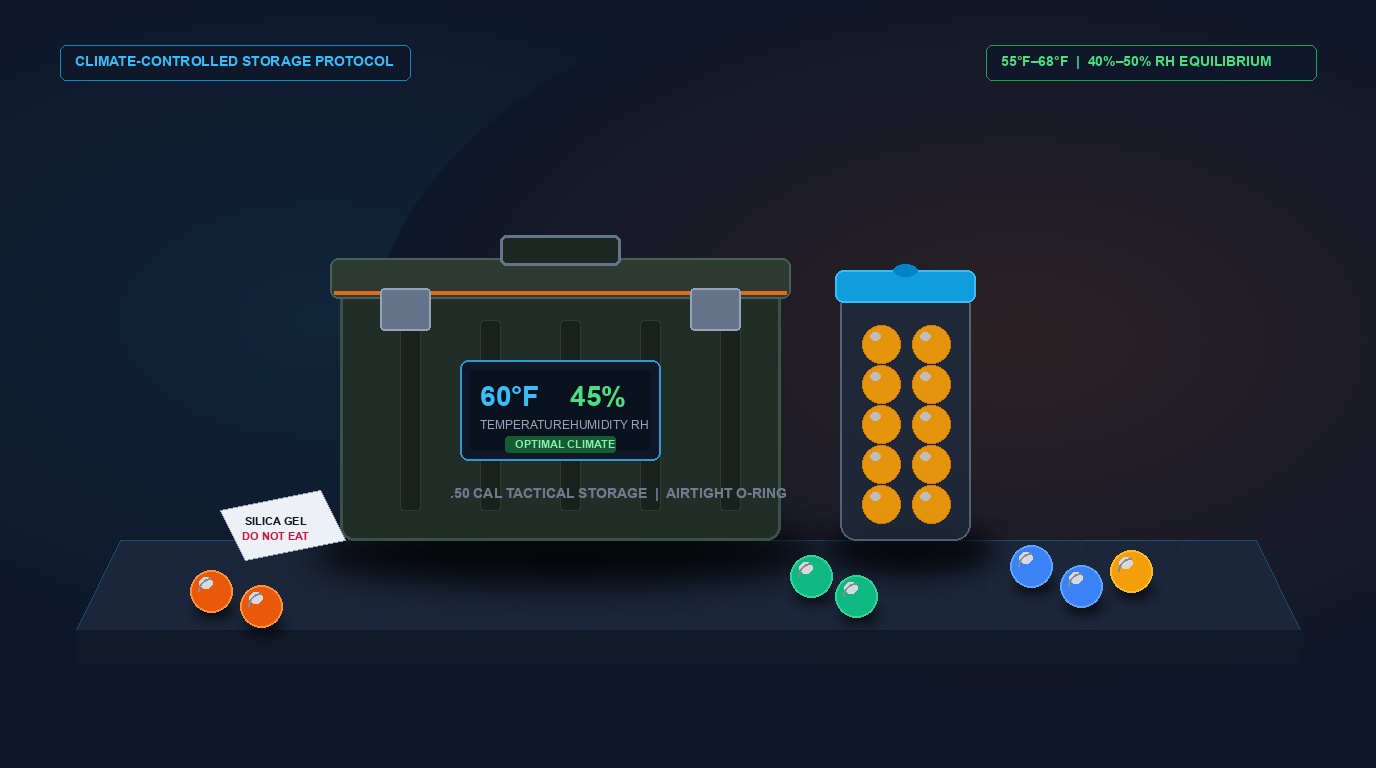
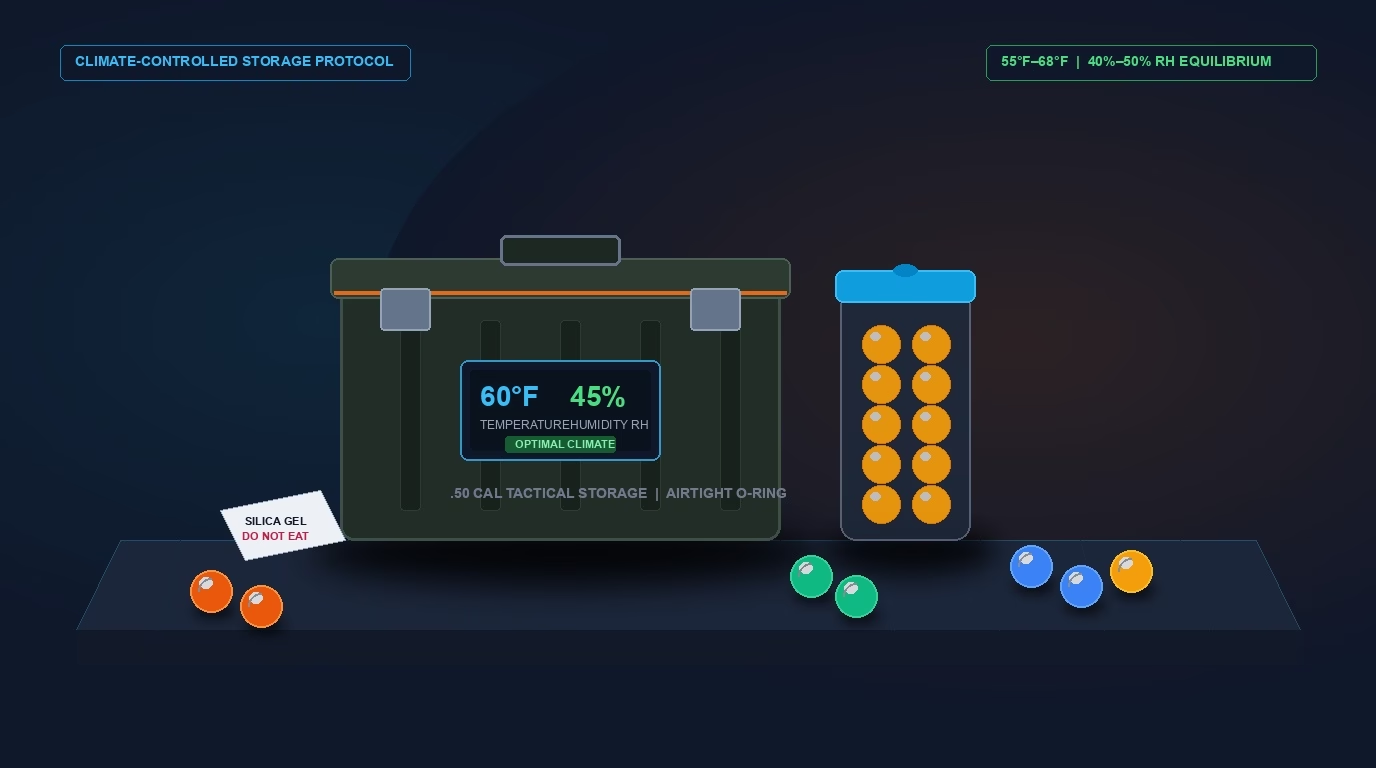
The gold-standard paintball storage protocol: An airtight O-ring gasketed ammo can, desiccant silica gel packets, and an LCD hygrometer showing an optimal 60°F and 45% relative humidity.
Storage Conditions Comparison: Optimal vs. Degradation Thresholds
To understand the fine line between factory-fresh paintballs and ruined ammunition, examine our empirical storage parameter matrix below:

Comprehensive technical blueprint detailing the gelatin shell chemistry, relative humidity equilibrium curve, the 14-day rotation cycle, and lab ballistics data.
2. The Thermodynamics of a Paintball: Gelatin Shell & PEG Dynamics
To master paintball storage, you must understand the materials science behind the sphere. A modern .68 caliber paintball consists of two distinct components:
- The Capsule Shell: Formed from two molded gelatin ribbons welded together at a central equatorial seam, treated with plasticizers (glycerin and sorbitol) to impart flexible resilience.
- The Liquid Fill: A non-toxic emulsion of Polyethylene Glycol (PEG), cosmetic thickeners, non-staining food-grade dye, and surfactants.
Why Paintballs Are Highly Hygroscopic
Gelatin is a biological polymer derived from collagen. In its dry state, gelatin contains polar hydrophilic amino acid chains that actively attract and bind atmospheric water vapor. This makes the paintball shell hygroscopic—it continuously breathes moisture in and out in an effort to match the ambient relative humidity of its environment. This dynamic leads to two catastrophic failure modes:
Failure Mode A: High Humidity (>55% RH) — Swelling, Softening & Dimpling
When paintballs sit in an atmosphere exceeding 55% RH (such as an uninsulated garage, outdoor shed, or rainy staging area), the gelatin absorbs ambient water molecules. This excess hydration weakens the intermolecular hydrogen bonds between peptide chains:
- Plastic Deformation & Bore Expansion: The shell softens and physically swells. A ball produced to a precision .685 caliber can expand past .692 within 72 hours, creating extreme friction in tight barrels. How tight a ball fits inside your barrel directly dictates muzzle sound and air consumption—see our guide on how to make your paintball gun quieter and our field test on the Empire Axe 2.0 for bore-to-paint dynamics.
- Severe Magnus-Effect Aerodynamic Wobbling: Softened gelatin develops flat spots (dimpling) under the weight of resting paintballs. When fired, these asymmetric indentations disrupt the aerodynamic laminar airflow around the sphere, inducing wild curving hooks and corkscrews past 50 feet.
- Target Bounces: Excessively soft shells flex upon impact rather than fracturing, bouncing harmlessly off opponents’ jerseys without registering an elimination.
Failure Mode B: Low Humidity (<35% RH) — Dehydration & Brittle Shattering
Conversely, when paintballs are stored in desert climates, dry winter air, or over-desiccated sealed containers below 35% RH, moisture evaporates out of the gelatin:
- Loss of Plasticizer Water Bonds: Sorbitol and glycerin require trace moisture to maintain shell ductility. Without it, the gelatin transforms from a tough, flexible membrane into micro-brittle glass.
- Hopper & Breech Chops: As soon as an electronic hopper paddle or mechanical feeder touches the ball, or when the marker’s bolt drives forward at 280 FPS, the brittle shell shatters instantly in the breech, coating the optics, detents, and barrel in thick soup.
3. The Busted “Freezer Myth”: Chemical & Ballistic Dangers
One of the oldest, most hazardous urban legends across paintball fields is: “Does freezing paintballs make them hit harder and shoot further?” Every experienced armorer and tournament technician knows this is 100% false and dangerously destructive.
Myth Busted: Why Freezing Paintballs Ruins Them (And Violates Safety Rules)
The Chemical Reality: Paintball fill does not contain pure water—it is composed of Polyethylene Glycol (PEG) and sorbitol. PEG acts as an industrial antifreeze with a freezing point far below standard residential freezers (-18°C / 0°F). As a result, freezing a paintball does not turn the core into an ice marble. Instead, the extreme sub-zero cold severely contracts the gelatin shell while the PEG fill remains a thick gel, creating microscopic stress fractures along the equatorial seam.
The Safety & Ballistic Hazard: When fired, frozen paintballs shatter prematurely inside the marker barrel, or exit as misshapen, brittle fragments. If an intact frozen shell impacts a player, the hardened gelatin violates ASTM F1776 safety standards, capable of cracking thermal goggle lenses and causing severe subcutaneous hematomas. Furthermore, any leaked paint splatter on goggle lenses must be cleaned immediately without chemical solvents—see our guide on how to clean the lens of a paintball mask.
Watch: How to Properly Store Your Paintballs (Lone Wolf Paintball)
To see how professional paintball armorers inspect and store their ammunition between tournaments, watch this essential demonstration from Lone Wolf Paintball:
4. The Step-by-Step Field Storage Protocol (Bag, Box & Basement)
To ensure leftover paintballs remain in pristine, match-ready condition for up to 12 months, follow this 5-step technician preservation protocol:
Step 1: Immediate Post-Game Inspection (Capillary Oil Isolation)
At the end of your match day, never dump leftover pods back into a bag without visual inspection. A single cracked paintball can ruin an entire 500-round bag via capillary oil spread. Open each bag, inspect the shells, and remove any cracked or dimpled balls. If fill oil has coated neighboring balls, gently dab them with a completely dry microfiber cloth—never rinse paintballs with water, as gelatin is 100% water-soluble and will dissolve.
Step 2: Airtight Sealing (Vapor Barrier Containment)
Never rely on open factory cardboard boxes. Squeeze all excess air out of the factory bag, twist the neck tightly, and secure it with a heavy-duty zip-tie or food-grade bag clip. For ultimate preservation, place the sealed bags inside an airtight, gasketed container (such as a .50 cal tactical ammo can or an HK Army / Exalt paintball caddy).
Step 3: The Desiccant Caution Rule (Controlled Moisture Scavenging)
Add one 10-gram silica gel packet per 500 to 1,000 paintballs inside your airtight storage vessel. The silica absorbs the small volume of humid air trapped during closure, locking the interior environment at 45% RH. Caution: Never add excessive desiccant (e.g. 100g in a small ammo can), as over-drying will extract moisture from the gelatin itself, making the shells glass-brittle.
Step 4: The 14-Day Case Inversion Schedule (Defeating Gravity)
Because the liquid PEG fill has a higher specific gravity than the shell, static paintballs slowly settle, causing bottom flat spots and egging. Rotate your sealed storage boxes or ammo cans 180 degrees every 14 days. Flipping the container flips the gravitational axis, allowing the PEG core to redistribute evenly across both hemispheres and preserving perfect .685 circular symmetry.
Step 5: Pre-Game Acclimatization (Thermal Shock Prevention)
When bringing paintballs out of a 60°F basement onto an 85°F outdoor summer field (or vice versa in winter), allow the sealed container to acclimatize for 45 to 60 minutes before opening. Opening a cold container in warm, humid air causes instant condensation on the cold gelatin shells, making them sticky and prone to barrel chops.
5. Recommended Paintball Storage Gear (Tested & Verified)
Professional armorers rely on dedicated storage hardware to preserve their investment. Here is our field-tested equipment matrix:
6. Real-World Lab Chronograph & Ballistics Testing Logs
To quantify the exact ballistics impact of storage quality, we conducted a controlled 10-shot chronograph and grouping test at 60 feet. Both tests utilized the same Planet Eclipse marker with a precision .689 barrel bore, Ninja 68/4500 HPA tank, and identical batches of Valken Graffiti paintballs:
- Batch A (Properly Stored): Kept for 6 months in a gasket-sealed ammo can with a 10g silica pack at 62°F and 45% RH, rotated bi-weekly.
- Batch B (Improperly Stored): Kept for 6 months in an open factory cardboard box in an uninsulated garage with temperature swings between 55°F–88°F and 40%–80% RH.
Testing Takeaways: Properly stored paintballs maintain exceptional velocity consistency (±2.1 FPS) and tight bore tolerance, delivering laser accuracy. In contrast, paintballs exposed to garage humidity swollen past .689 suffered extreme barrel friction, an 18+ FPS velocity spread, and catastrophic in-bore chops.
7. Frequently Asked Questions (FAQ)
1. How long do paintballs last in storage?
When stored in factory-sealed bags inside an airtight O-ring ammo can at 60°F–70°F (15°C–21°C) and 40%–50% humidity with bi-weekly rotation, high-quality paintballs last 9 to 14 months without degradation. Unsealed paintballs left in open cardboard boxes or garages will degrade and develop flat spots in as little as 2 to 4 weeks.
2. Can you recover dimpled or flat-spotted paintballs?
Minor dimples can sometimes be reduced by placing the paintballs in an airtight container at 45% relative humidity and rolling/rotating them every few days for a week. However, severe dimples where the gelatin has permanently stretched cannot be reversed, and those balls should only be used for casual target plinking.
3. Can you put paintballs in the refrigerator or freezer?
No. Never put paintballs in a refrigerator or freezer. Refrigerators remove moisture rapidly, causing gelatin shells to become excessively brittle and shatter upon firing. Freezers cause water in the fill to crystallize and expand, cracking the seams and ruining the paint permanently.
4. How can I tell if stored paintballs have gone bad?
Examine the paintballs for three warning signs: (1) Dimpling or Flat Spots: Roll a paintball across a smooth, flat table. If it wobbles or rolls in an uneven arc, it has settled and will hook wildly in flight. (2) Swelling / Sizing Drift: Test the ball with a barrel bore sizer; if it cannot pass through a .689 insert, it has absorbed moisture. (3) Brittleness Test: Drop a paintball from shoulder height (5 feet) onto grass or hard wood. A good paintball should bounce 2–3 times; if it shatters upon contact, the gelatin has dried out.
5. Can you rehydrate old, brittle paintballs?
While some players attempt to rehydrate brittle paintballs using damp paper towels inside a sealed container, this is generally not recommended for tournament play. Moisture absorption on old gelatin is rarely uniform, leading to lopsided swelling, weak seams, and high rates of barrel breaks.
6. How many silica gel packs should I put in an ammo can?
Use one 10-gram silica gel packet per 500 to 1,000 paintballs in an airtight container. This provides enough moisture-capturing capacity to stabilize internal air without over-drying the gelatin shells into brittleness.
Final Verdict: The Golden Storage Rule
Treating your paintballs with the same care as high-grade ammunition pays immediate dividends on the field. By eliminating the cardboard box, investing in a gasketed ammo can with silica gel, maintaining a 60°F–70°F climate at 40%–50% RH, and sticking to the 14-day 180° rotation routine, your paintballs will deliver laser-consistent velocity, tight shot groupings, and reliable breaks on target for months to come.
For more equipment optimization, read our comprehensive reviews on the best paintball guns for beginners and explore our technical analysis on aluminum vs. carbon fiber paintball barrels.