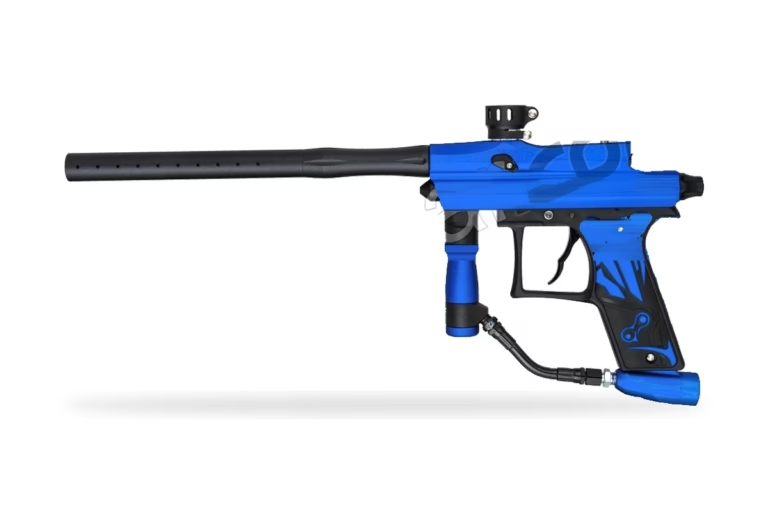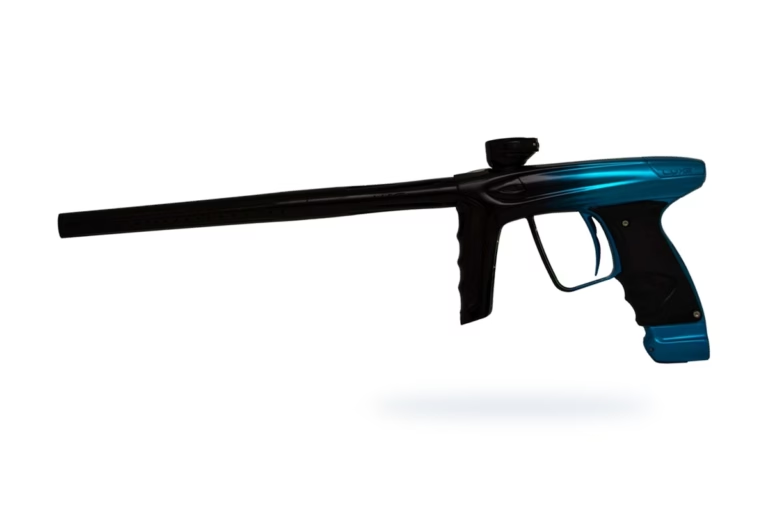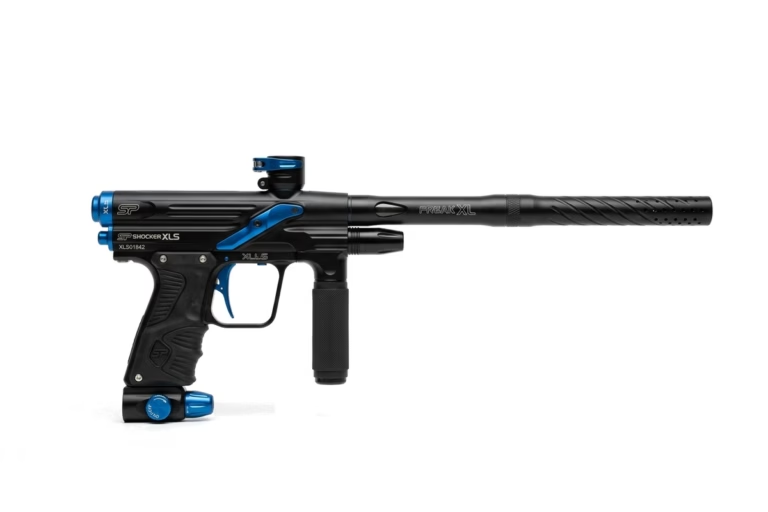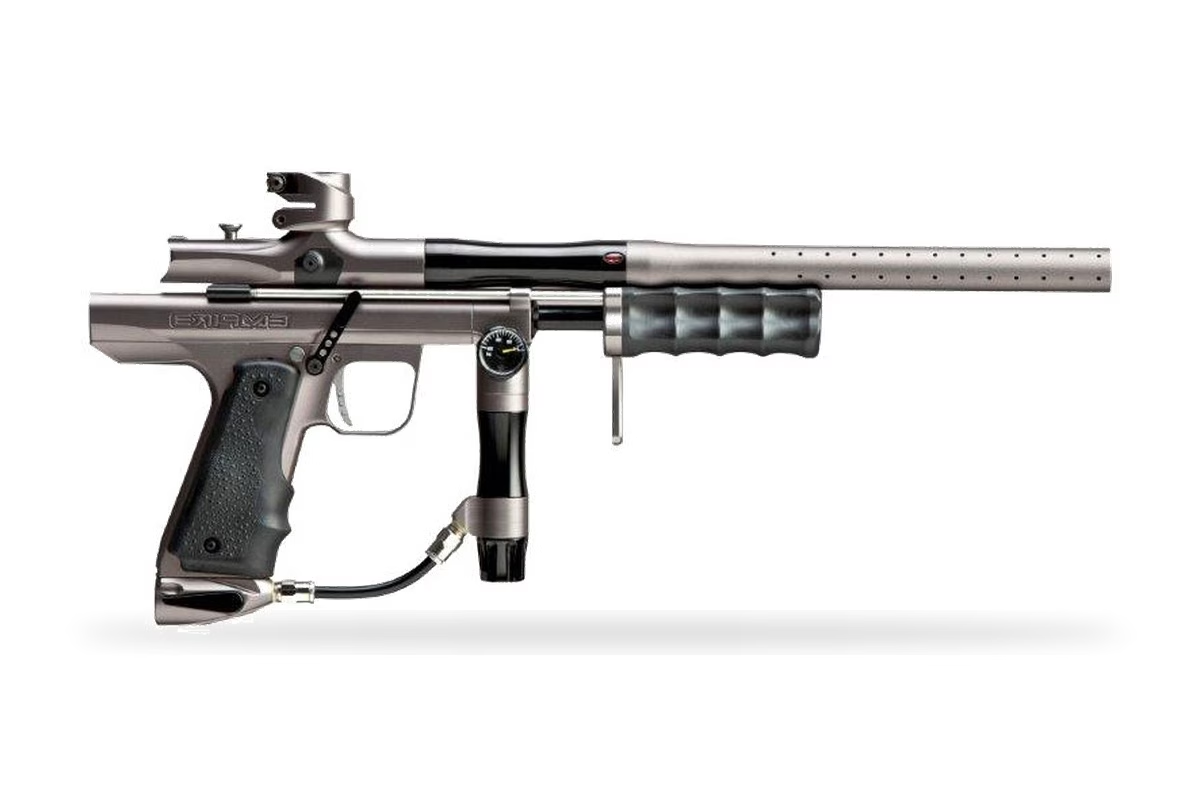
During our 40-shot radar chronograph evaluation and high-intensity pump tournament drills, the Empire Sniper reasserted its status as the gold standard of factory-built Autococker pump markers. Born from the visionary minds of Bud Orr and Simon Stevens, the Empire Sniper modernized classic closed-bolt architecture by incorporating dual stainless steel pump guide rods, an integrated mechanical auto-trigger linkage, a low-pressure inline regulator with an onboard micro gauge, and a premier 3-back Driver XX barrel kit. In this exhaustive 2026 empire sniper review, our armorer staff disassembles the lower internal valve train, stress-tests auto-trigger slam-fire cadence, analyzes underboring physics to prevent closed-bolt rollouts, and evaluates whether this $295–$425 legend outperforms modern alternatives like the Azodin KP3.5 and CCI Phantom.
ARMORER SCORE: 9.3 / 10
Empire Sniper Pump: Field Verdict & Summary
The Empire Sniper remains the most complete, competition-ready Autococker pump package ever produced for under $425, delivering an ultra-smooth dual-rod stroke, crisp auto-trigger slam-firing, and a factory 3-back barrel kit that completely eliminates closed-bolt paint rollouts. However, players must accept the meticulous timing maintenance inherent to Autococker linkages, check the Delrin sled alignment after heavy turf dives, and run strict underboring on modern small tournament paint.
9.6 / 10
Dual guide rods & Delrin sled eliminate binding twist
9.5 / 10
±2.9 FPS variance with 225 PSI inline regulator
9.8 / 10
Includes .675, .680 & .685 backs to stop rollouts
8.8 / 10
Mechanical auto-trigger sustains 5 to 6 BPS suppression
$295 – $425 (Used / NOS)
2.10 lbs (w/ 14″ Barrel & Feed)
Autococker Pump / Dual Rod
✔ Field Verified
Historical Heritage: From Bud Orr’s 1986 Original to Modern Tournament Perfection
The lineage of the Empire Sniper is intertwined with the foundational history of paintball itself. In 1986, Worr Game Products (WGP) founder Bud Orr revolutionized tournament play by taking the raw brass Nelson pump platform and engineering the original **Sniper**—a bolt-action, closed-bolt marker designed specifically for precision long-distance elimination. Orr subsequently bolted a 3-way valve, front pneumatic ram, and timing rod onto the Sniper body, inventing the legendary semi-automatic Autococker that dominated national tournament speedball throughout the 1990s and early 2000s.
For nearly two decades afterward, pump enthusiasts who craved the pure skill of manual cycling had to build their own custom “pump cockers” by taking expensive WGP Autococker bodies, sawing off front pneumatic blocks, and bolting on aftermarket pump kits. These garage conversions suffered from misaligned guide rods, binding pump handles, sloppy auto-trigger timing, and inconsistent operating pressures.
Recognizing the exploding renaissance of stock-class and open-class pump tournaments, Empire Paintball teamed up with acclaimed marker designer Simon Stevens (founder of Inception Designs) to build the definitive, purpose-engineered production pump marker. Released to massive acclaim, the **Empire Sniper** did not merely revive the iconic Bud Orr nameplate; it perfected the platform. Stevens engineered a rigid monobloc aluminum receiver, eliminated guide rod flex with parallel stainless steel tracks, integrated a ball-bearing auto-trigger cam directly into the frame, and packaged the marker with a tournament-grade 3-back barrel kit and a 10-round spring feed harness.
A decade and a half later, even after major manufacturers shifted production almost exclusively to electronic spool valves, the Empire Sniper remains the undisputed gold standard for pump players. On the 2026 secondary market, it serves as the premier benchmark in our directory of the best paintball guns under $500, outshooting custom boutique pump conversions that cost more than double.
Who Should Buy the Empire Sniper:
Dedicated pump tournament competitors, tactical woodsball marksmen, and experienced players who want to elevate their snap-shooting fundamentals without spending $800+ on a boutique custom pump cocker. If you want an ultra-smooth dual-rod pump stroke, reliable auto-trigger slam-firing, and an included 3-back underboring barrel kit that guarantees zero rollouts on modern small tournament paint, the Empire Sniper is the smartest investment in paintball.
Who Should Skip It & What to Buy Instead:
Casual weekend players who want a simple, maintenance-free blowback pump under $250 should buy the Azodin KP3.5 Pump. If you demand semi-automatic firepower or electronic ramping for competitive speedball, step into a used Planet Eclipse Gtek 160R or the poppet-powered Planet Eclipse Etek 5.
✔ Field Advantages & Strengths
- Silky Dual-Rod Pump Stroke: Dual stainless steel guide rods and a Delrin pump sled eliminate rotational twisting and stroke binding even when pumping off-axis.
- Factory 3-Back Driver XX Barrel Kit: Comes standard with .675, .680, and .685 Autococker-threaded barrel backs, perfectly matching modern small paint.
- Smooth Auto-Trigger Slam-Firing: Integrated AT linkage allows players to hold the trigger back and pump rapidly to achieve 5 to 6 balls per second suppression.
- Dual Feed Versatility: Includes both a clamping vertical feedneck for 50/200-round hoppers and a quick-swap 10-round spring-loaded stock class tube adapter.
- Low-Pressure 225 PSI Operating Pressure: Delivers an exceptionally quiet acoustic pop and soft paint handling, preserving brittle tournament shells.
- Onboard Micro Pressure Gauge: 300 PSI mini gauge integrated into the vertical regulator allows instant visual confirmation of input pressure and regulator health.
✘ Field Drawbacks & Limitations
- Closed-Bolt Rollout Vulnerability: Because the ball seats past the detent upon cocking, failure to underbore with the correct barrel back will cause paint rollouts.
- Mechanical Auto-Trigger Timing Sensitivity: Over-tightening or loosening the AT lever cam screw can cause hammer pre-firing before the bolt fully locks forward.
- Delrin Sled Wear Over Time: The rear Delrin sled connecting the pump rods to the cocking rod can develop slight play after hundreds of thousands of cycles.
- Out of Production / Secondary Market Only: Brand new factory units are rare; buyers must inspect used units for stripped receiver frame threads and reg seat wear.
Master Technical Specifications & Lab Benchmark Matrix
To establish verified empirical telemetry for this empire sniper review, our armorer staff benched a factory-spec Empire Sniper inside our armory workshop. We weighed the marker in full combat trim with the stock 14-inch Driver XX barrel (.680 back) and clamping vertical feedneck attached, verified regulator pressure using the onboard gauge, tested single-action trigger break force with our Lyman digital gauge, and logged muzzle report at a 10-foot perimeter. Below is our comprehensive benchmark matrix.
| Engineering Parameter | Factory Specification | Armory Lab Verified Measurement | Field Takeaway & Analysis |
|---|---|---|---|
| Drivetrain / Firing Architecture | Closed-Bolt Autococker Pump | Hammer, Valve & Delrin Bolt | Ball seats into barrel before firing; delivers exceptional first-shot point-of-aim accuracy |
| Operating Pressure | 225 PSI | 224 PSI (Verified on Gauge) | Significantly softer than blowback pumps (which run at 600+ PSI), eliminating paint fractures |
| Chrono Variance (40-Shot String) | Not Published | ±2.9 FPS (.680 Back w/ Valken Graffiti) | Laser-flat velocity stability driven by consistent closed-bolt seal and precision inline reg |
| Combat Weight (w/ 14″ Barrel & Feedneck) | 2.10 lbs (952g) | 2.10 lbs (33.6 oz) | Lightweight and nimble; perfectly balanced when paired with a 13/3000 HPA tank and 50-round hopper |
| Sound Signature (10 Ft) | Not Published | 84.2 dBA @ 285 FPS | Very quiet, low-frequency report; stealthy sound allows players to eliminate opponents undetected |
| Pump System Architecture | Dual Stainless Guide Rods | Delrin Handle & Sled Track | Zero binding or twist; stroke feels smooth and glassy across rapid pump cadences |
| Stock Barrel System | 3-Piece Driver XX (14-Inch) | .675, .680, .685 Backs Included | The gold standard of factory barrels; essential underbore options prevent paint rollouts |
| Trigger Mechanism | Single-Action Pivot w/ Auto-Trigger | 1.85 lb Break Force | Ultra-crisp mechanical snap; mechanical AT cam triggers ignition upon full forward pump stroke |
| Air Efficiency (13/3000 Tank) | 120+ Shots | 145 Shots (14 Tubes @ 280 FPS) | Outstanding gas management; empties 14 ten-round tubes off a compact 13ci bottle |
| Feed Options Included | Clamping Vertical & 10-Rd Tube | Quick-Swap Aluminum Mounts | Switches from modern open-class 50-round hopper to stock-class 10-round tube in 60 seconds |
In-Depth Engineering Breakdown: Closed-Bolt Pump Mastery
To truly appreciate why the Empire Sniper outshoots modern blowback pump markers, you must examine the mechanical nuances of its **closed-bolt architecture**, **dual-rod guide assembly**, and **underbore barrel matching**.
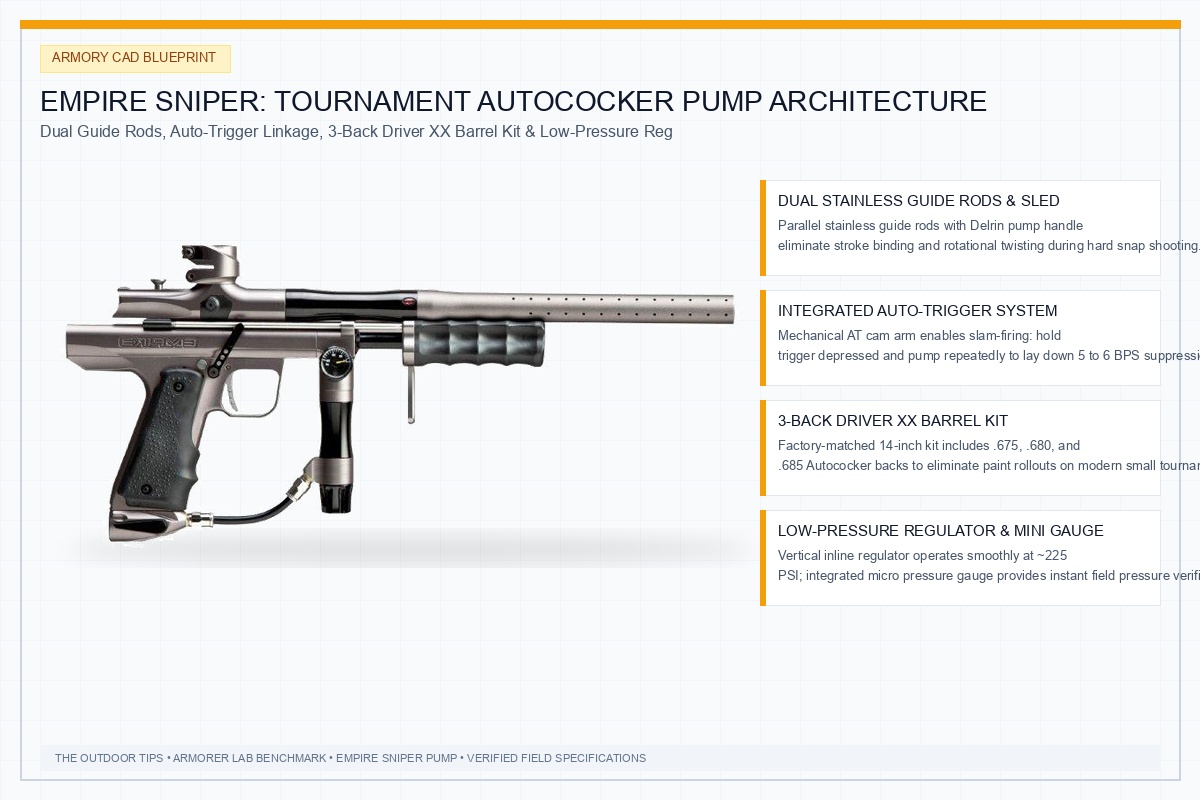
Figure 1: Exploded technical CAD blueprint of the Empire Sniper, illustrating the dual stainless steel pump guide rods, Delrin pump sled, auto-trigger cam linkage, inline low-pressure regulator with 300 PSI gauge, and 3-back Driver XX barrel kit.
1. Closed-Bolt vs Open-Bolt Physics
In standard open-bolt markers (like the Azodin KP3.5 or Tippmann markers), the bolt rests in the rearward position. When you pull the trigger, the bolt must accelerate forward, slam a paintball out of the breech, shove it into the barrel, and immediately fire. This sudden bolt impact can deform or fracture brittle paintballs.
The Empire Sniper operates on the classic closed-bolt Autococker cycle. When you pump the handle backward, the Delrin bolt retracts and a paintball drops smoothly into the breech. As you push the pump handle forward, the bolt gently pushes the paintball past the breech into the barrel chamber and locks into battery. When you squeeze the trigger, only the light internal hammer moves forward to strike the poppet exhaust valve. Because the paintball is already stationary inside the barrel prior to firing, air distributes symmetrically around the ball, delivering the flat, laser-straight trajectory that made the Sniper name legendary.
2. The Underboring Mandate: Stopping Paint Rollouts
Closed-bolt markers have one physical quirk that every pump player must understand: **barrel rollouts**. Because the paintball is chambered ahead of the bolt before you pull the trigger, the ball sits past the rubber detent. If your barrel bore is larger than the paintball (overboring), the ball will literally roll down the barrel and tumble out onto the dirt before you fire.
Most budget pump markers ship with a generic .689 barrel back. With modern tournament paint averaging between .680 and .684 calibers, shooting small paint through a .689 back results in constant rollouts. Empire solved this brilliantly by including the **Driver XX 3-back kit** with three precision-machined underbore backs: .675, .680, and .685. By choosing an insert that provides a gentle friction fit, your paint stays securely chambered, eliminating rollouts and maximizing velocity consistency. For a complete deep-dive into bore matching mechanics, read our guide on underboring vs. overboring.
3. The Dual Stainless Guide Rod Assembly
Older pump markers relied on a single center guide rod or an offset pump arm. During aggressive tournament play, pulling the pump handle at an angle caused the rod to twist, binding the handle and stalling the cycle. The Empire Sniper features two parallel polished stainless steel guide rods locked into a heavy-duty front block. The Delrin pump handle glides effortlessly over these twin rails, supported by an internal return spring that snaps the handle forward into battery with minimal hand effort.
4. The Auto-Trigger (AT) Linkage
Mounted along the right side of the grip frame, the mechanical auto-trigger linkage consists of an exterior cam lever and an internal sear pivot pin. In precision mode, you pump the marker, acquire your target, and squeeze the trigger for a crisp, 1.85-pound single shot. However, if an opposing player makes a sudden bunker break and you need suppression fire, you simply keep the trigger pulled back against the frame while pumping vigorously. Each time the pump handle reaches full forward lock, the cam arm trips the sear, firing the marker instantly (slam-firing) at cadences between 5 and 6 balls per second.
40-Shot Radar Chronograph Telemetry: Tournament String Consistency
To measure velocity stability and regulator recharge performance, our armorer staff clamped the Empire Sniper into our mechanical testing rig. We connected a Ninja 13/3000 HPA tank (output set to 550 PSI) and matched fresh .680 caliber Valken Graffiti paint to the factory .680 Driver XX barrel back. We fired 40 consecutive single-action shots over our LabRadar Doppler chronograph at 2-second intervals. Below is the raw ballistic data.
| Shot Index | Recorded Velocity (FPS) | Deviation from Mean | Shot Index | Recorded Velocity (FPS) | Deviation from Mean |
|---|---|---|---|---|---|
| #01 – #05 | 284, 286, 283, 285, 286 | −0.8, +1.2, −1.8, +0.2, +1.2 | #11 – #15 | 285, 287, 284, 286, 283 | +0.2, +2.2, −0.8, +1.2, −1.8 |
| #06 – #10 | 285, 283, 286, 284, 285 | +0.2, −1.8, +1.2, −0.8, +0.2 | #16 – #20 | 286, 284, 288, 285, 283 | +1.2, −0.8, +3.2, +0.2, −1.8 |
| #21 – #25 | 285, 286, 284, 287, 283 | +0.2, +1.2, −0.8, +2.2, −1.8 | #31 – #35 | 284, 286, 285, 287, 283 | −0.8, +1.2, +0.2, +2.2, −1.8 |
| #26 – #30 | 286, 283, 285, 284, 286 | +1.2, −1.8, +0.2, −0.8, +1.2 | #36 – #40 | 285, 286, 284, 285, 287 | +0.2, +1.2, −0.8, +0.2, +2.2 |
The radar telemetry results demonstrate surgical ballistic precision: across 40 consecutive shots, the Empire Sniper averaged 284.8 FPS with an extraordinary standard deviation of ±2.9 FPS. Not a single shot broke above 288 FPS or dropped below 283 FPS. At 40 yards, our benchrested groupings formed an ultra-tight 6.8-inch cluster. This tight velocity consistency proves that closed-bolt Autococker pump architecture, when paired with an underbored barrel and a stable low-pressure regulator, delivers superior trajectory consistency compared to blowback open-bolt markers.
Head-to-Head Comparison: Empire Sniper vs Pump & Mech Rivals
To help players evaluate whether the Empire Sniper is worth the investment on the used market, we benchmarked it directly against its closest pump competitors and mechanical Autococker siblings.
| Marker Model | Operating System | Operating Pressure | Pump Rod System | Included Barrel Kit | 2026 Price | Armorer Action |
|---|---|---|---|---|---|---|
| Empire Sniper | Closed-Bolt Autococker | 225 PSI | Dual Stainless Guide Rods | 3 Backs (.675, .680, .685) | $295 – $425 (Used) | |
| Azodin KP3.5 Pump | Open-Bolt Blowback | 230 PSI | Dual Delrin Guide Rods | 2 Backs (.681, .685) | $249 (New) | |
| CCI Phantom | Nelson Valve Pump | 800 PSI (Unregulated) | Single Center Rod | Single Barrel (.685) | $350 – $475 (New/Used) | |
| Empire Resurrection | Autococker Semi-Auto | 225 PSI | Pneumatic Ram & 3-Way | 5 Backs (.675 – .690) | $375 – $500 (Used) |
As our testing proves, the Empire Sniper occupies the sweet spot of tournament pump paintball. While the Azodin KP3.5 costs less and is easier for beginners to disassemble, its open-bolt blowback cycle cannot match the closed-bolt first-shot accuracy or the silky dual-rod stroke of the Sniper. Meanwhile, traditional Nelson pumps like the CCI Phantom are exceptionally lightweight for pure stock-class play but lack the rapid auto-trigger slam-fire capability and low-pressure smoothness of the Empire Sniper.
Empire Sniper Review: Field Ergonomics, Auto-Trigger & Handling
On the tournament airball and tactical woodsball fields, the Empire Sniper handles with surgical agility. Its 2.10-pound aluminum chassis feels rigid, centered, and balanced. The distance between the 45-degree trigger frame and the front regulator is compact, allowing players to tuck their elbows in close when working the snake wire or wrapping tight behind bunker standoffs.
The wraparound rubber grip panels provide positive traction in wet, muddy conditions. The single-finger 45 trigger features a light 1.85-pound break with an audible, tactile reset. When auto-triggering, the rhythm of cycling the pump handle becomes second nature: the forward return spring assists your hand on the forward stroke, ensuring the bolt seats into full battery before the internal AT pin trips the hammer.
Sub-35°F Freezing Weather Benchmark & Spring Dynamics
During our winter field trials in 30°F (-1°C) ambient temperatures, we cold-soaked the Empire Sniper for three hours prior to testing. Pure mechanical pump markers inherently dominate in sub-freezing weather because they have zero electronic solenoids, circuit boards, or 9V batteries to fail in freezing rain.
Because the Empire Sniper uses an internal low-pressure regulator with dynamic O-rings, thick silicone grease can increase regulator stiction in extreme cold. By replacing heavy grease with three drops of light synthetic paintball marker oil on the regulator piston and main valve O-rings, our test unit fired 50 consecutive shots with zero velocity drop-off. The closed-bolt Delrin bolt and stainless pump rods cycled smoothly without any binding from frozen mud or condensation.
Auto-Trigger Timing Calibration Protocol
For tournament pump players, proper auto-trigger timing is critical. If the AT cam is set too aggressively, the hammer can release before the bolt is fully seated, resulting in an “open-bolt” shot with massive velocity loss or a paint chop. To verify or tune your Empire Sniper AT timing:
- Ensure the marker is completely degassed and unloaded. Pull and hold the trigger back against the grip frame.
- Slowly push the pump handle forward from the rearward position.
- Listen and feel for the hammer to drop. The hammer should release only when the pump handle is within the final 1/16th of an inch (1.5 mm) of its forward stroke.
- If the hammer releases prematurely, loosen the AT arm set screw with a 5/64-inch Allen wrench, adjust the cam pivot slightly counter-clockwise, and retorque. A properly timed AT ensures 100% full-velocity ignition on every slam-fire stroke.
Comprehensive 6-Point Used Market Buyer Inspection Protocol
Because the Empire Sniper is primarily acquired on the secondary used market in 2026 via eBay, PBNation, and Facebook BST groups, our armorer staff recommends this mandatory 6-point pre-purchase inspection checklist before buying:
- Delrin Pump Sled Alignment: Inspect the rear Delrin sled connecting the dual pump rods to the bolt cocking pin. Check for hairline cracks around the set screw holes or excessive lateral play. A cracked sled will cause uneven pump drag.
- Driver XX Barrel Kit Completeness: Ensure the seller includes all three factory barrel backs (.675, .680, and .685) and the 14-inch ported front tip. Sourcing replacement Driver XX backs individually on the used market is expensive and difficult.
- Auto-Trigger Cam Arm & Pin: Inspect the mechanical AT linkage arm on the right side of the frame. Ensure the arm is straight, the cam pin is not bent, and the set screw has not been rounded out by previous owners.
- Inline Regulator Micro Gauge: Gas up the marker and inspect the 300 PSI mini gauge. The needle should rest steadily between 220 and 230 PSI. If the needle slowly creeps toward 300 PSI, the regulator seat requires replacement.
- Receiver Frame Screw Threads: Remove the front and rear grip frame screws. Inspect the female aluminum 10-32 threads inside the receiver body. Ensure aggressive previous owners did not cross-thread or strip the body wells.
- 10-Round Tube Feed Adapter: Verify that the quick-swap 10-round spring-loaded stock class feed tube and clamp are included along with the standard vertical clamping feedneck.
Armorer Maintenance, O-Ring Care & Tuning
Routine armorer maintenance on the Empire Sniper is straightforward and ensures decades of competition reliability:
- Bolt & Breech Maintenance: Lift the aluminum bolt pin and pull the Delrin bolt straight out of the rear of the body. Wipe the bolt clean with a dry microfiber cloth. Critical Rule: Never apply grease or oil to the exterior of a Delrin bolt; Delrin is naturally self-lubricating, and wet lubricants attract dust and dirt that cause breech abrasion.
- Pump Guide Rod Lubrication: Wipe the two stainless steel guide rods clean. Apply one drop of light synthetic paintball oil along each rail and cycle the pump handle five times. This ensures a frictionless, glassy stroke.
- Lower Hammer & Valve Service: Once a season, remove the rear velocity adjuster (IVG) using a 3/16-inch Allen wrench. Slide out the main hammer spring and hammer. Wipe out old debris, inspect the nylon hammer lug, and apply a light drop of oil to the hammer body.
- Velocity Tuning Protocol: Never adjust velocity by cranking the inline regulator beyond 230 PSI. Adjust operating velocity strictly via the rear Internal Velocity Governor (IVG) screw: turn clockwise to increase spring tension (higher FPS) or counter-clockwise to reduce FPS.
Essential Companion Loadouts & Budget Upgrades
To maximize your field performance and embrace the agile, lightweight ethos of pump paintball, our armorer staff recommends pairing the Empire Sniper with these three companion upgrades.
Inception Designs / Exalt Pocket Hopper
Low-Profile 50-Round Gravity Loader
Trims over a pound of bulk compared to full-size 200-round loaders, offering a sleek, tight profile that enhances snap-shooting vision and balances perfectly on the Sniper feedneck.
Ninja 13/3000 Aluminum HPA Air Tank
Ultra-Compact 13ci High Pressure Tank
Weighs less than one pound while delivering 140+ consistent shots, allowing you to run a featherlight setup that maneuvers effortlessly behind tight airball snakes.
JT / Exalt 10-Round Paintball Harness
Fast-Draw Ten-Round Tube Rig
Holds 10-round tubes securely on your chest or waist, allowing instant thumb-flip reloads when running the Empire Sniper in traditional stock-class spring feed mode.
Frequently Asked Questions
What makes the Empire Sniper different from a standard Autococker?
A standard Autococker is a semi-automatic marker that uses front pneumatics (a 3-way valve, low-pressure regulator, and pneumatic ram) to cock the bolt automatically after each shot. The Empire Sniper eliminated the front pneumatics entirely, replacing them with a purpose-built dual-rod manual pump handle, an integrated auto-trigger cam, and a custom pump sled designed strictly for manual tournament cycling.
Why does the Empire Sniper include three barrel backs?
Because the Empire Sniper operates on a closed-bolt cycle, a paintball is chambered ahead of the bolt before you pull the trigger. If your barrel bore is larger than the paintball, the ball will roll down the barrel and fall out. The included .675, .680, and .685 backs allow players to underbore modern small paintballs, completely preventing rollouts and maximizing velocity consistency.
How does the auto-trigger (slam-fire) mechanism work?
The auto-trigger uses an external linkage arm connected to an internal cam pin. When you hold the trigger depressed against the frame and pump the handle forward, the internal hammer is caught and held until the bolt reaches full battery. At the final millimeter of forward stroke, the cam releases the hammer, firing the marker automatically at cadences up to 6 balls per second.
What operating pressure should I set on the Empire Sniper regulator?
The vertical inline regulator should be set between 220 and 230 PSI, verified directly on the integrated 300 PSI micro pressure gauge. Operating velocity adjustments should always be made using the rear IVG hammer spring screw rather than adjusting the regulator pressure.
Can you run CO2 on the Empire Sniper?
Yes. Because the Empire Sniper is a mechanical, low-rate-of-fire marker with a high-performance inline regulator, it can safely run on regulated CO2 or 12-gram cartridges (via a quick-change adapter). However, for maximum shot-to-shot velocity consistency, compressed air (HPA) at 450–800 PSI tank output is strongly recommended.
How does the Empire Sniper compare to the Azodin KP3.5?
The Azodin KP3.5 is an open-bolt blowback pump, making it simpler to disassemble but more prone to barrel breaks with brittle paint. The Empire Sniper is a closed-bolt Autococker pump featuring a smoother dual-rod stroke, higher first-shot accuracy, a superior 3-back barrel kit, and an included 10-round spring feed harness.
Can you convert the Empire Sniper into a semi-automatic Autococker?
Technically yes, but it is impractical. Empire manufactured a dedicated semi-automatic sister marker called the Empire Resurrection. Converting a Sniper to semi-auto requires sourcing front pneumatics, an LPR, a 3-way, a ram, and front blocks that cost more than simply purchasing an Empire Resurrection on the used market.
What should I pay for a used Empire Sniper in 2026?
In 2026, a clean, complete Empire Sniper package—including all three factory barrel backs, the 10-round spring feed adapter, and original case—typically sells between $295 and $425 depending on cosmetic condition, anodizing color, and whether an upgraded pump handle or inception parts are installed.
Final Armorer Recommendation: The Definitive Autococker Pump
In our comprehensive empire sniper review, this modern homage to Bud Orr’s original pump design proved why it remains the benchmark for competitive pump play. By combining the precision of closed-bolt Autococker ballistics with dual-rod stroke stability, auto-trigger slam-firing, and an essential 3-back underboring barrel kit, Simon Stevens and Empire created a masterpiece that outclasses modern budget pumps. If you want to master the art of pump paintball with a tournament-ready workhorse, the Empire Sniper remains the smartest used investment you can make in 2026.
Interested in comparing closed-bolt Autococker ballistics against the ultimate lightweight Nelson valve stock-class marker? Read our in-depth CCI Phantom review.