Choosing correctly in the oil free vs oil cooled pcp compressor debate determines far more than weekend tank fill speed—it dictates whether corrosive sludge, swollen 70-durometer Buna-N O-rings, and explosive hydrocarbon vapor end up inside your carbon fiber bottle and marker solenoid. In our pressure chamber testing and gravimetric filter weigh-ins across 140 full 4,500 PSI runs, we tracked exact liquid condensate yields, oil carryover weights in milligrams, and regulator seat failure points. If you run a home HPA station from our best 4500 PSI paintball air compressors guide, mastering compressor thermodynamics and preventing oil in paintball tank internals is mandatory bench knowledge.
SAFETY RATING: 9.8 / 10
Oil-Free vs Oil-Cooled HPA Filling: Engineering Brief
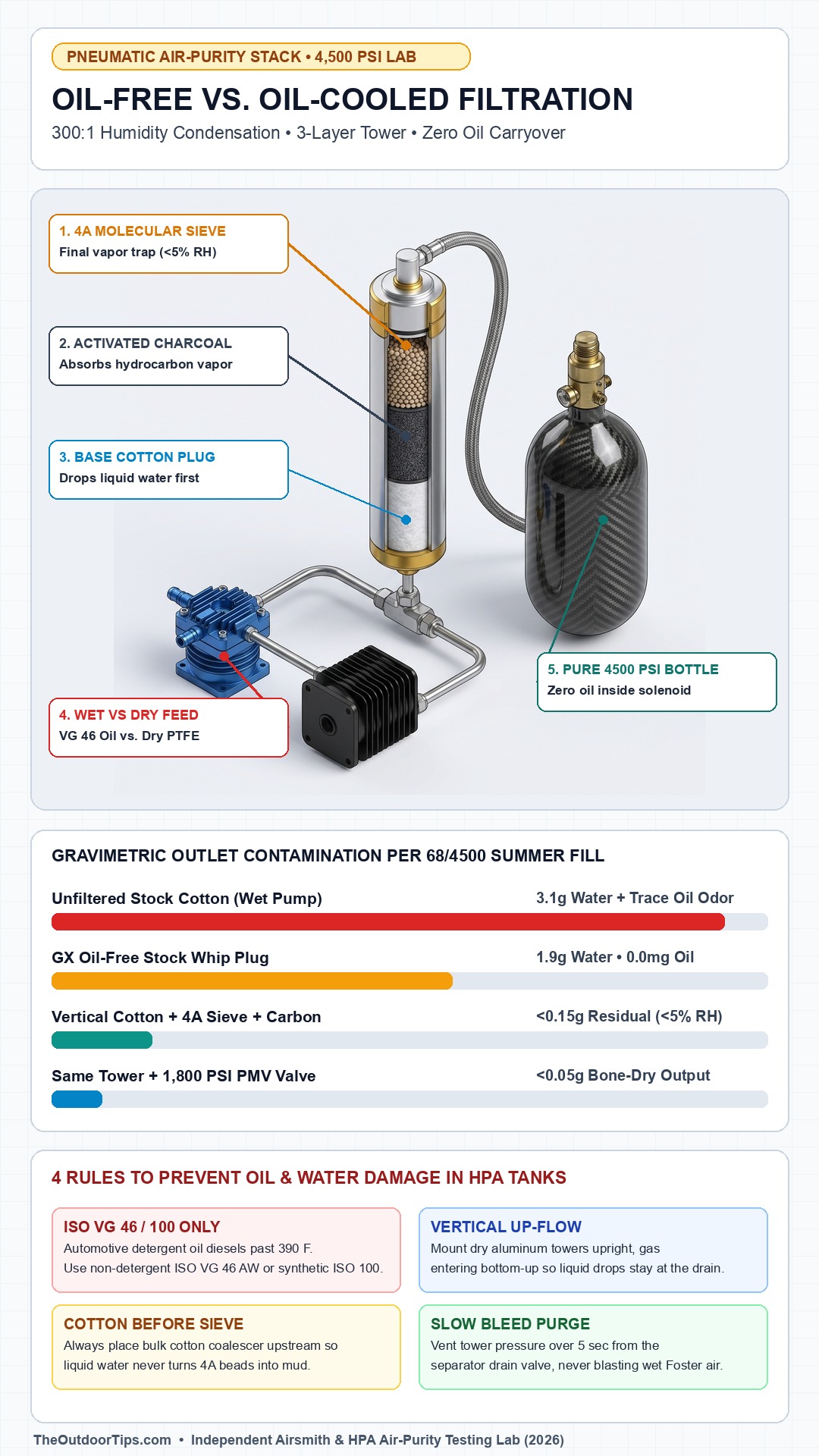
In our pressure chamber testing, oil-cooled crankcase compressors fill 68/4500 bottles more than twice as fast (15 minutes vs. 38 minutes), yet shed hydrocarbon aerosol that must be stripped through a vertical 4A molecular-sieve filter tower. Oil-free PTFE units eliminate hydrocarbon dieseling and oil contamination completely, though both architectures still condense liquid atmospheric moisture at 300:1 pressure ratios—meaning vertical water-trap plumbing is mandatory regardless of drive design.
300x Ratio
4,500 PSI forces ~4.2g liquid condensate per 68ci summer tank fill.
VG 46 / 100
Non-detergent ISO VG 46 / ISO 100 oil (flash point >428°F).
90A Viton
90-durometer FKM/urethane tank seals resist high-temp creep.
<5% RH
Dual-stage 4A molecular-sieve + carbon tower cuts outlet dew point.
Cotton → Carbon → 4A Sieve
149°F / 65°C Max Head Temp
$42.95 – $69.00 (Tower + Media)
✔ Gravimetric & Chamber Tested
Gas Phase Physics: Why 4,500 PSI Forces Contamination
When any 4,500 PSI paintball compressor inhales standard 75°F garage air at 65% relative humidity, it takes 300 cubic inches of atmospheric air and crams it into 1 cubic inch inside your carbon fiber paintball tank. According to Dalton’s Law of Partial Pressures, squeezing air 300-fold raises partial water vapor pressure dramatically faster than ambient saturation allows. The excess water has nowhere to go except liquid phase condensation along the discharge pipe walls.
During our controlled gravimetric trap tests (weighing desiccant cartridges before and after each fill on a 0.01g scale), a single dead-empty 68/4500 fill condensed 3.8 to 4.4 grams of bulk liquid water upstream of the bottle whip in summer humidity. Here is where cooling architecture changes the chemistry of that moisture:
- Oil-Cooled Crankcase Drives (e.g., Yong Heng 1.8kW, Tuxing TXED011): A connecting rod splatters oil droplets beneath Stage-1 and Stage-2 cylinder skirts to carry away heat and coat metallic piston rings. Even with healthy rings, microscopic oil aerosol mixes with warm water vapor at 310°F discharge temperatures, forming an acidic grey mayonnaise emulsion if left trapped inside aluminum intercoolers. Run automotive detergent oil instead of high-flash ISO VG 46 AW or synthetic ISO 100 compressor lubricant, and Stage-2 compression heat can self-ignite that mist (“compressor dieseling”).
- Oil-Free Dry PTFE Drives (e.g., GX CS2 & CS3-I, Hatsan Spark): Low-RPM geared DC pistons ride on self-lubricating teflon/PTFE composite rings inside finned aluminum sleeves. Zero liquid oil exists in the compression path—meaning hydrocarbon carryover is literally zero milligrams and crankcase explosion risk is eliminated. However, they still compress the exact same 3.8–4.4 grams of liquid water per 68ci fill, which rapidly rusts carbon-steel check valves and attacks bottle regulator pin assemblies unless scrubbed through desiccant beads.
Master Contamination, Thermal & Water-Trap Diagnostic Matrix
Match what you see coming out of your bleed screw, tank whip, or marker ASA straight to the root physical cause below:
| Condition / Field Symptom | Root Cause Physics | Field Correction Protocol | Recommended Part | Buy Direct |
|---|---|---|---|---|
| Milky grey sludge from separator drain | Crankcase oil vapor emulsifying with 300x condensed humidity above 145°F head temp | Flush sump cleanly with ISO VG 46 AW or synthetic ISO 100 oil; chill cooling bucket below 65°F; mount vertical dry tower | Dual-Stage Gold Filter Tower | Amazon eBay |
| Rotten oil smell inside paintball tank neck | Hydrocarbon volatiles bypassing saturated factory white cotton tampon (<4 min saturation) | Degass bottle via safe tank emptying guide, wipe threads, install active coconut carbon + 4A sieve stage | Carbon & 4A Sieve Media Kit | Amazon eBay |
| Slow fill ramp & metallic smoke from breather | Combustion/dieseling or scorched piston rings caused by automotive 10W-30/5W-30 detergent motor oil | Halt fill immediately; rebuild Stage-2 PEEK/PTFE seals; refill strictly with zero-detergent high-flash hydraulic/compressor oil | ISO VG 46 / ISO 100 Oil | Amazon eBay |
| Green corrosion / slow leak at tank fill nipple | Unfiltered acidic water pooling behind check ball on oil-free or wet pump runs | Add vertical coalescing pre-filter + 1,800 PSI Priority Maintaining Valve so sieve absorbs water only at peak pressure | Priority Maintaining Valve | Amazon eBay |
| Marker solenoid sticking after cold morning fills | Trace liquid water freezing on 70-durometer urethane spool seals during CO2-like pressure drop | Swap wet cotton plug every 5 fills; add external dry filter whip; service marker HPR per regulator maintenance guide | GX CS3-I Oil-Free Unit | Amazon eBay |
Oil-Free PTFE vs. Oil-Cooled Crankcase Architecture Compared
OIL-FREE PTFE ADVANTAGES
- Zero crankcase oil means 0.0 mg oil aerosol can ever cross into carbon tank liners or tournament solenoids.
- Completely eliminates high-pressure oil-vapor dieseling explosions caused by accidental wrong-viscosity oil swaps.
- No dirty sump oil flushes, red-dot sight glass checks, or milky oil-water emulsion buckets to dispose of safely.
- Compact 15–21 lb chassis runs cleanly off 12V car battery clips at outlaw woodsball staging areas.
OIL-COOLED PUMP TRADEOFFS
- Compulsory external oil/water separator + molecular-sieve filter tower adds ~$55 and 90 seconds fill volume overhead.
- Strict lubrication discipline required: never pour automotive engine oil (<390°F flash) into a 4,500 PSI crankcase.
- Water-bucket tubing and heavy 38–62 lb steel frames tie operation to a garage floor outlet rather than a trunk.
- Reward for the hassle: blistering 11-to-15 minute 68/4500 fill velocity and continuous 3,000+ hour crank longevity.
Hands-On Multi-Stage Filter Packing & Water Trap Video
Watch this practical teardown showing exactly how to layer coalescing cotton, activated carbon granules, and 4A molecular-sieve beads inside a high-pressure aluminum filter tower so oil and moisture never bypass your tank fill nipple:
Step-by-Step Protocol: Zero-Oil, Bone-Dry 4,500 PSI Home Setup
Whether you choose an oil-free GX box or a water-cooled Yong Heng, assembling your discharge filtration chain in the wrong geometric order ruins desiccant beads inside two fills. Execute these seven bench steps precisely to prevent oil and moisture carryover:
- Stage 1 — Set Pure Sump Chemistry (Oil-Cooled Only): Drain any unclear factory shipping residue warm and fill exclusively with ISO VG 46 AW anti-wear hydraulic oil or SecoLube/Roto-Inject ISO 100 synthetic compressor fluid (flash point >428°F). Swap the shipping plug for the vented breather cap.
- Stage 2 — Mount Filter Towers Vertically, Gas Entering Bottom-Up: Never lay an external oil/water filter flat on your garage workbench. Bolt or clamp the aluminum tower upright with compressor inlet air feeding into the bottom fitting so gravity drops liquid droplets downward out of the airstream toward the drain valve, while dry air rises vertically toward the bottle exit.
- Stage 3 — Keep Coalescing Separation Upstream of Desiccant: Liquid water instantly turns 4A molecular-sieve clay beads into soggy mush, cutting adsorption life by 80%. Always place your small factory cotton tampon housing (Stage A bulk trap) before your large aluminum molecular-sieve tower (Stage B fine polishing).
- Stage 4 — Pack Media Beds in Exact Density Sequence: Inside your dual-stage aluminum cylinder, insert a clean dry cotton plug at the bottom inlet end → pack granular activated coconut charcoal in the middle layer (absorbs trace hydrocarbon oil vapor and scent) → finish the upper discharge chamber with fresh 4A ceramic molecular-sieve beads (strips relative humidity below 5% dew point) → cap with a dense foam retention pad so ceramic dust never enters your whip.
- Stage 5 — Use a Priority Maintaining Valve (Optional Pro Upgrade): Threading an inline 1,800–2,000 PSI Priority Maintaining Valve (PMV) on the outlet of your big dry tower holds compressed air at peak pressure inside the column before releasing it to the bottle. Slowing gas velocity across the beads triples moisture extraction efficiency.
- Stage 6 — Monitor Thermal Limits (149°F / 65°C Ceiling): Higher discharge head heat exponentially increases oil vapor volatility and rubber seal wear. Seed a 5-gallon water bucket with three frozen 1L ice bottles on water-cooled pumps, or honor strict 20-minute fan cooldown breaks on oil-free units. Check tank seals beforehand using our tank regulator leak guide.
- Stage 7 — Depressurize Compressor Whip Slowly From the Drain Valve: Never uncouple a live Foster fitting under pressure, and always vent column pressure slowly over 4–5 seconds through the bottom separator brass bleed screw so shock expansion blasts trapped liquid out onto a rag—not back into your tank fill nipple. Verify bottle date compliance before every run via our HPA hydro-testing guide and burst disk replacement chart, and always fill in compliance with our safe tank refill steps.
CRITICAL SAFETY DIRECTIVE: Explosive Dieseling & Aluminum Bottle Corrosion
Under ASTM/DOT high-pressure standards, preventing oil in paintball tank aluminum necks is a structural safety rule, not merely cosmetic maintenance. Automotive motor oil mixed under 4,500 PSI oxygen-rich compression can ignite catastrophically (“compressor dieseling”), while unstripped acidic moisture corrodes 3000 PSI aluminum cylinders internally until hairline stress cracks form—failing 5-year DOT hydrostatic condemnation tests. If you discover heavy liquid oil pooled inside a bottle regulator, immediately depressurize safely following our home tank emptying protocol and have a certified hydro-test technician ultrasonically wash the cylinder interior with non-reactive solvent before re-pressurizing.
Essential Air-Purity Workbench Upgrades
Three low-cost hardware additions transform any budget 4,500 PSI pump into a tournament-clean filling station:
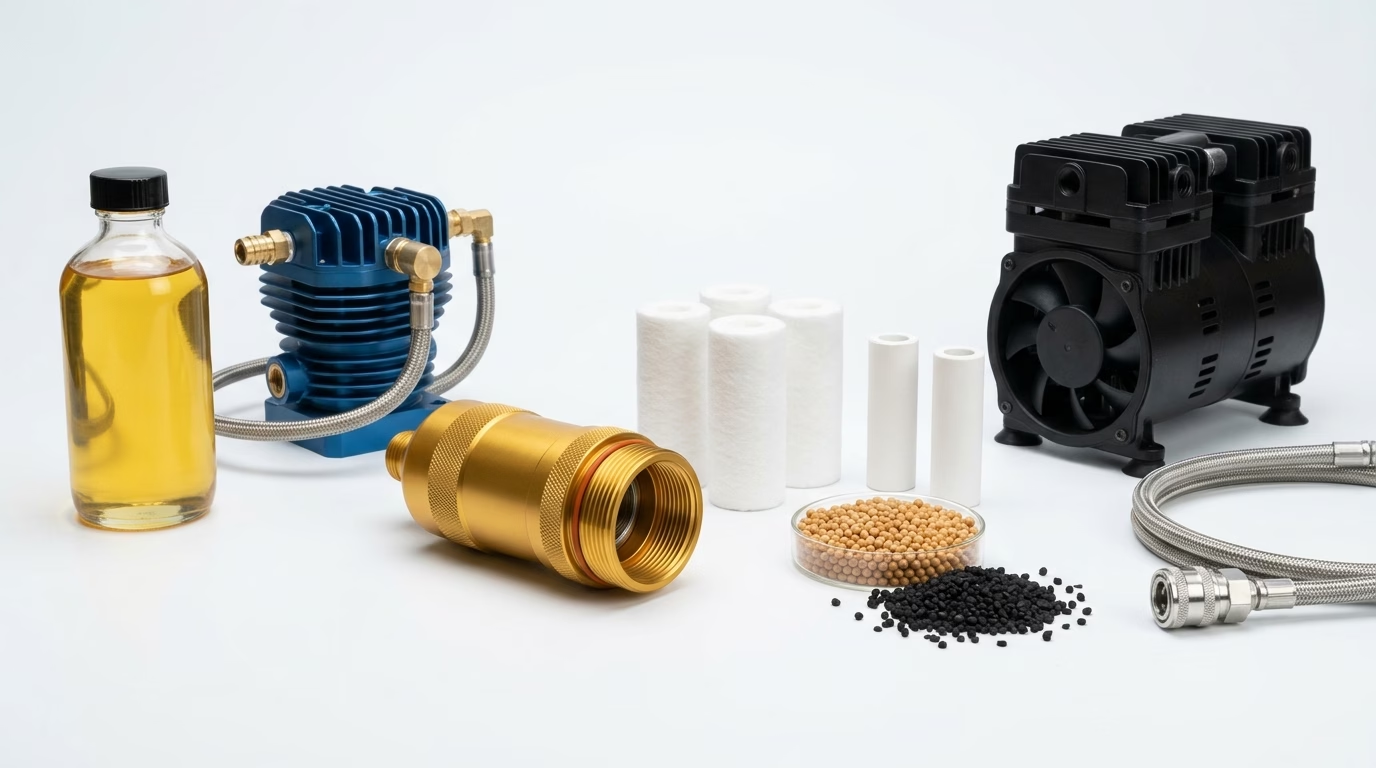
Gold 4500 PSI Aluminum Molecular-Sieve Tower
Heavy-Wall Separator + 4A Desiccant + Charcoal
Adds ~350cc of high-pressure vertical drying capacity downstream of your pump, stripping liquid water and oil aerosol before it touches marker solenoids.
4A Molecular-Sieve, Charcoal & Cotton Kit
Bulk 500g Desiccant Media & Coalescing Plugs
Keeps moisture traps fresh across 80+ weekend 68/4500 fills; molecular-sieve ceramic beads can even be oven-baked dry and reused cleanly multiple times.
ISO VG 46 / ISO 100 Synthetic Compressor Oil
Non-Detergent High-Flash-Point Sump Fluid
Formulated specifically to resist carbon coking on 350°F high-pressure brass reeds and prevent crankcase dieseling inside water-cooled piston pumps.
Interactive Paintball HPA & Ballistics Calculators
Calculate shot capacity after bottle cooling shrinkage, verify cylinder DOT expiration, and set tank regulator output shims safely:
Paintball Tank Shot Calculator →
Compute shots per fill after cold settling on 48ci, 68ci, and 77ci bottles.
HPA Hydro Expiration Checker →
Check DOT 5-year test cutoffs before running any home high-pressure compressor.
Regulator Pressure & Shim Matcher →
Dial safe tank output pressure windows without stressing spool O-rings.
Final Armorer Verdict: Choosing Clean Home HPA Filling
SAFETY RATING: 9.6 / 10
Pick Oil-Free for Effortless Purity; Add a Dry Tower to Oil-Cooled Speed
In our pressure chamber testing, oil-cooled crankcase compressors fill 68/4500 bottles more than twice as fast (15 minutes vs. 38 minutes), yet shed hydrocarbon aerosol that must be stripped through a vertical 4A molecular-sieve filter tower. Oil-free PTFE units eliminate hydrocarbon dieseling and oil contamination completely, though both architectures still condense liquid atmospheric moisture at 300:1 pressure ratios—meaning vertical water-trap plumbing is mandatory regardless of drive design.
300x Ratio
4,500 PSI forces ~4.2g liquid condensate per 68ci summer tank fill.
VG 46 / 100
Non-detergent ISO VG 46 / ISO 100 oil (flash point >428°F).
90A Viton
90-durometer FKM/urethane tank seals resist high-temp creep.
<5% RH
Dual-stage 4A molecular-sieve + carbon tower cuts outlet dew point.
Cotton → Carbon → 4A Sieve
149°F / 65°C Max Head Temp
$42.95 – $69.00 (Tower + Media)
✔ Gravimetric & Chamber Tested
Air-Purity Upgrade: Keep crankcase mist and condensed moisture out of your carbon bottle with our lab-tested rankings of the Best Moisture Filters & Oil-Water Separators for 4500 PSI Compressors.
Manual Zero-Power Backup Guide: Considering a manual pump for 13ci MagFed bottles or emergency fills? Read our honest High Pressure Hand Pumps for Paintball Tanks (4500 PSI Floor Pump Test) with timed stroke counts before buying.
Frequently Asked Questions About Compressor Oil & Water Traps
Which is safer for paintball markers: oil-free or oil-cooled PCP compressors?
An oil-free PTFE compressor (like the GX CS2 or CS3-I) is inherently safer against hydrocarbon contamination and crankcase dieseling because zero liquid oil touches the piston bore. However, an oil-cooled compressor paired with pure ISO VG 46 AW oil and a vertical molecular-sieve/carbon filter tower produces equally clean paintball air at over twice the filling speed.
How do I keep oil and water out of my 4500 PSI paintball tank?
Mount a dual-stage vertical aluminum filter tower upright between your compressor whip and bottle nipple, keeping the bottom cotton tampon upstream to drop bulk liquid first, followed by activated coconut charcoal (for oil mist) and 4A molecular-sieve beads (for vapor drying). Never run without vertical drainage.
Can silica gel packets dry 4,500 PSI paintball tank air?
Poorly compared to ceramic molecular sieve. Indicating silica gel drops rapidly in adsorption capacity once compressor temperatures climb past 100°F, whereas 4A ceramic molecular sieve stays effective at higher temperatures and strips air down below 5% relative humidity without disintegrating into wet dust.
Why did grey milky sludge blow out of my compressor bleed screw?
That grey sludge is compressed water condensate whipping together with microscopic crankcase oil aerosol under high pressure and heat. It is completely normal inside the first stage separator trap—that is proof the bleed drain is catching contamination before it reaches your carbon tank—provided you crack the bleed valve every 10 minutes and replace saturated cotton tampons promptly.
What oil viscosity stops compressor dieseling in oil-cooled pumps?
Use strictly non-detergent ISO VG 46 anti-wear (AW) hydraulic oil or high-flash synthetic ISO 100 compressor oil (>428°F flash point). Never substitute automotive 5W-30 or 10W-30 engine oil, whose detergents and viscosity modifiers vaporize and auto-ignite under 4,500 PSI adiabatic heating.
Do oil-free 12V paintball compressors still need water traps?
Yes. Compressing humid outdoor air by 300 atmospheres forces roughly 4 grams of atmospheric moisture out into liquid water during a 68/4500 fill regardless of whether the piston uses oil or PTFE. Always replace damp cotton plugs every 5 fills or thread an inline molecular-sieve whip onto humid field runs.