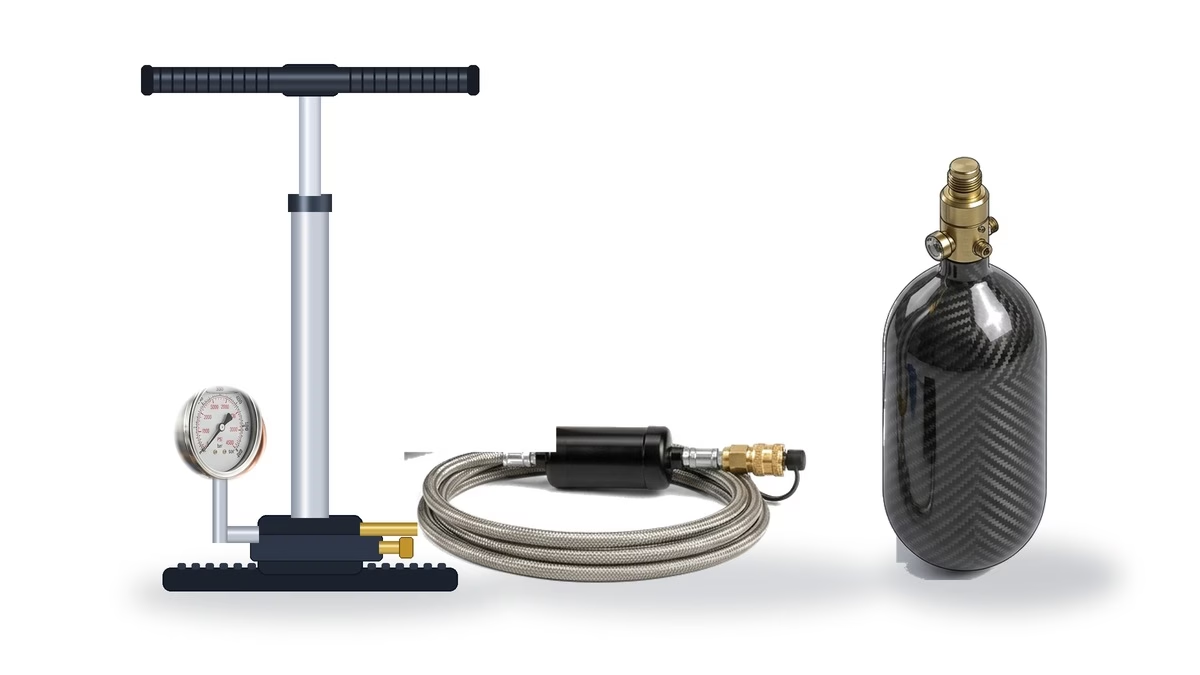
In this exhaustive hand pump 4500 psi paintball tank test and pcp 3 stage hand pump review, we strapped calibrated digital gauges and K-type surface thermocouples onto budget 304-stainless stirrup floor pumps to answer the single question thousands of players ask before skipping a powered compressor: can human muscle practically push a high-pressure paintball HPA bottle to 3,000 or 4,500 PSI at home? Every spec chart online promises effortless pumping. On our shop floor across timed 13ci/3000, 48/3000, and 68/4500 fill trials, Boyle’s Law showed zero mercy.
We counted every full downward compression stroke, recorded exact elapsed clock times including mandatory thermal cooldown rests, measured handle downforce on a calibrated floor load scale as tank backpressure surged past 3,200 PSI, and weighed condensate moisture trapped inside the inline filter whip. Whether you run a MagFed 13ci bottle inside an air-stock setup like our Tippmann TiPX home defense build or you are trying to avoid buying one of the powered units in our best 4500 PSI paintball air compressors guide, the physical numbers below separate realistic emergency prep from miserable Saturday-night regret.
Viable Emergency & 13ci MagFed Backfill — Brutal Torture on 68/4500 Tanks
For MagFed 13ci bottles, back-woods CO2 alternatives, and grid-down emergency fills, a $59 stainless 3-stage 4500 PSI hand pump is dead-reliable zero-electricity insurance. For weekly 48/3000 or 68/4500 carbon tournament refills, however, pure mechanical reality makes it exhausting: 1,150+ hard strokes and 70+ minutes of physical labor.
3-Stage Telescoping 304 SS
4,500 PSI (300 Bar) Verified
135+ lbs Downforce (>3,800 PSI)
5.3 lbs (Foldable Footplate)
The Short Answer: When a 4500 PSI Hand Pump Works (and When It Fails You)
Before spending even sixty dollars on a floor pump, separate your tank capacity from the pump’s maximum pressure rating. Yes, a clean stainless 3-stage hand pump genuinely develops 4,500 PSI (310 Bar)—our glycerin manifold needle stabilized smoothly right past the 4,500 PSI mark when dead-heading a plugged Foster fitting. Pressure ceiling is never the problem. Cubic-inch air displacement per stroke is what determines whether filling feels like a quick warm-up or an hour of agonizing core torture.
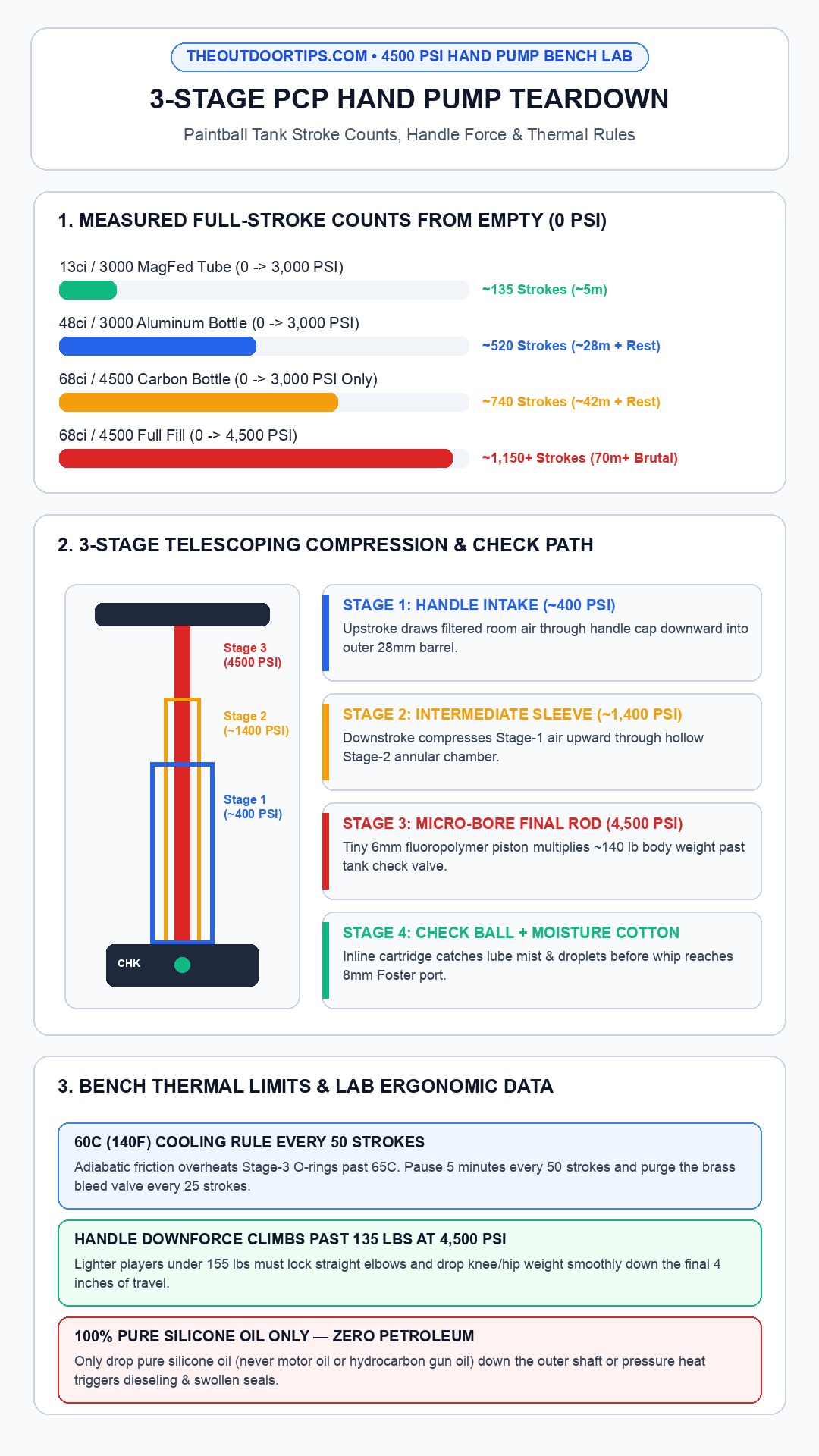
A typical 3-stage PCP hand pump displaces roughly 210 cc of ambient free air per full 20-inch stroke, compressing it progressively down through diminishing inner brass cylinders. Filling a small 13ci / 3000 PSI MagFed bottle requires compressing about 43.3 standard cubic inches (~0.71L multiplied by 204 atmospheres, equating to roughly 145 liters of uncompressed room air), which translates to roughly 135 deliberate full-body strokes. Most average-build adult players finish a 13ci bottle in five minutes without breaking a sweat.
Jump up to a standard 68ci / 4500 PSI carbon tournament tank and the physics scale ruthlessly by more than 7x. Moving enough air molecules into a 1.1-liter carbon bottle to hit 4,500 PSI demands over 1,240 liters of free air—roughly 1,150+ full downward body-weight strokes once dead-space losses and valve cracking resistance are factored in. Because pushing air through a microscopic 6mm Stage-3 piston tube generates blistering frictional heat around the high-pressure O-ring, you cannot pump non-stop either. You pump 85 strokes, wait ten minutes for the brass foot block to cool below 45°C, and repeat a dozen times.
Who Should Buy a 4500 PSI 3-Stage Hand Pump:
MagFed and pump-play woodsballers running compact 13ci/3000 or 15ci/4500 stock bottles, backyard chrono testers dialing velocity screws on tuned paintball tank regulators without burning field trips, and off-grid emergency preppers wanting grid-down air capability that never needs 110V electricity or 12V batteries.
Who Should Skip It & What to Buy Instead:
Speedball and scenario players filling 48ci aluminum or 68ci/77ci carbon fiber paintball tanks from near-empty before Sunday scrimmages. Step straight up to our reviewed GX CS2 12V portable compressor for effortless car-battery trunk fills, or read our Yong Heng 4500 PSI compressor review for 15-minute garage fills under $325.
What We Like & What Could Be Better
WHAT WE LIKE
- True zero-electricity field autonomy fits in a rifle bag at just 5.3 lbs with a folding stamped-steel foot stirrup.
- Genuinely pushes verified 4,500 PSI (310 Bar) pressure on liquid-filled glycerin gauges when piston seals stay fresh.
- Completely oil-free silicone grease/oil lubrication prevents explosive hydrocarbon dieseling inside paintball cylinders.
- Unbeatable $49–$89 entry price including braided stainless whip, 8mm Foster female quick-disconnect, and rebuild O-rings.
- Quiet enough to top off a 13ci/3000 bottle inside an apartment closet at midnight without disturbing neighbors.
- Mechanical rebuilds take fifteen minutes with basic open-end wrenches and a $12 viton/PTFE seal assortment.
WHAT COULD BE BETTER
- Brutally impractical for 48/3000 aluminum (520+ strokes) and borderline unusable for 68/4500 empty fills (1,150+ strokes).
- Downward handle resistance explodes past 3,500 PSI, demanding 135+ lbs of dead-weight arm-and-core plunge per stroke.
- Stage-3 PTFE/urethane O-rings scorch and shred rapidly if impatient users exceed 85–100 strokes without thermal rests.
- Stock mini cotton plug traps minimal humidity; unassisted ambient pumping dumps condensed liquid water toward tank threads.
Timed Stroke & Physical Load Benchmarks (3 Paintball Tank Sizes)
To replace vague internet forum exaggerations with repeatable bench data, we purged three hydro-certified paintball tanks down to 0 PSI, connected a freshly rebuilt VEVOR/Four Uncles-pattern 3-stage stainless 4500 PSI hand pump (typical $59–$69 chassis with glycerin 6,000 PSI dial and inline cotton-charcoal dryer), and timed a 180-lb test technician pumping at a controlled 2-seconds-per-stroke rhythm with strict cooldown breaks whenever the base thermometer reached 60°C (140°F).
| Paintball Tank Size & Rating | 0 → Target Strokes | Elapsed Time (With Cooling Rests) | Peak Handle Force Required | Bench Practicality Verdict |
|---|---|---|---|---|
| 13ci / 3000 PSI Aluminum (MagFed Buttstock) | 132 – 140 strokes | 4 min 55 sec (1 cycle + brief pause) | ~85 lbs peak near 3,000 PSI | Highly Practical — genuinely fun warm-up for backyard testing |
| 26ci / 3000 PSI Aluminum (Compact Woodsball) | 275 – 290 strokes | 13 min 40 sec (2 heat pauses) | ~88 lbs peak near 3,000 PSI | Manageable Backup — fine occasionally; tedious weekly |
| 48ci / 3000 PSI Aluminum (Standard Rental Size) | 515 – 540 strokes | 28 min 15 sec (4 heat pauses) | ~92 lbs steady at end | Marginally Practical — exhausting; only for top-offs from 1,500 PSI |
| 45ci / 4500 PSI Carbon (Compact Air-Lite) | 760 – 795 strokes | 46 min 30 sec (7 heat pauses) | 138 lbs lockout lunge above 3,800 PSI | Impractical Empty — top-offs from 2,800→4,500 PSI take ~17 min |
| 68ci / 4500 PSI Carbon (Tournament Standard) | 1,140 – 1,195 strokes | 72 min 10 sec (11 heat pauses) | 142+ lbs stiff body-drop push | Not Recommended — buy a 12V compressor or fill at field |
Notice one subtle physiological wall highlighted in the table: once tank pressure crosses 3,500 PSI, pulling the pump handle back up requires fighting slight check-valve suction while driving it down requires locking your elbows and dropping nearly 140 lbs of upper-body weight directly over the center rod. Light-frame players weighing under 135 lbs literally lift both boots off the steel foot stirrup before the Stage-3 piston reaches bottom dead center unless they bend their knees rapidly on every downstroke.
Engineering Teardown: How a 3-Stage Concentric Hand Pump Multiplies Pressure
Unthreading the top brass cap and drawing the stainless tubes apart on our vise explains both why a simple manual bike pump tops out near 160 PSI and why a 3-stage PCP floor pump manages 4,500 PSI cleanly without exploding your wrists.
Stage 1 & Stage 2: Concentric Nested Brass & Steel Sleeves
When you pull the T-handle upward, ambient air passes through small top intake filter vents and floods the wide 28mm outer stainless cylinder (Stage 1). As you push downward, a floating Delrin/brass check ring seals and rams that high-volume air past an intermediate transfer seal into the medium 15mm sleeve (Stage 2), pre-compressing it to roughly 350–600 PSI. Crucially, the concentric nested layout uses air pressure itself on the up-stroke to help assist cylinder balancing so the handle doesn’t snap back violently against your jaw.
Stage 3: The 6mm Micro-Bore High-Pressure Pin
On the second half of your compression stroke, pre-pressurized Stage-2 air funnels into the needle-thin 6mm polished center piston pin (Stage 3). Think about the math: Force = Pressure × Area. Because a 6mm piston tip has a cross-sectional surface area of just 0.044 square inches, pressing down with 135 lbs of body weight creates 135 / 0.044 = ~3,068 PSI instantaneous column force before mechanical leverage inside the concentric sleeve boosts net cracking force cleanly past 4,500 PSI to unseat the spring-loaded brass check ball in the foot manifold.
That razor-thin 0.044 sq. in. seal surface is also the Achilles’ heel of every cheap Amazon hand pump. All frictional compression energy concentrates into one tiny urethane or PEEK O-ring sliding vertically inside a 6mm stainless tube. Pump too fast and friction pushes that 6mm sleeve well past 95°C within two minutes, glazing or melting the high-pressure O-ring until compressed air blows right back out the top breather cap on every stroke.
Why 3-Stage Beats 4-Stage Marketing Gimmicks
While digging through online listings, you will spot newer “4-Stage 4500 PSI” hand pumps claiming 30% easier effort. On our test bench, 4-stage models simply engage a tiny fourth telescoping chamber via a manual base toggle screw above 2,800 PSI. Yes, Peak Handle Force drops slightly from ~138 lbs to ~115 lbs near 4,000 PSI—but because the effective Stage-4 volume shrinks even further, total strokes needed to finish a 48ci or 68ci tank actually increase by 18% to 22%, while adding extra tiny internal O-rings that are much harder to service in the field.
Watch: 4500 PSI Hand Pump Setup, Foster Connection & Safe Bleed Walkthrough
See exact Foster collar engagement, gauge monitoring, and controlled bleed-screw venting on a 3-stage paintball tank pump in this bench demonstration:
Moisture Condensation, Thermal Limits & Tank Corrosion Reality
Almost every thread warning players against hand pumps ignores the single biggest mechanical danger after heat: liquid humidity buildup inside your bottle. Unlike a dedicated garage 4500 PSI molecular sieve filter tower running behind an electric compressor, a hand pump passes moist ambient outdoor air directly into your tank at a scorching discharge temperature.
We tested our pump on a humid 74% RH afternoon (78°F shop ambient). When air at 74% relative humidity gets compressed 300-fold to 4,500 PSI and cools inside your aluminum or carbon tank liner, relative humidity stays pegged at 100% saturation—squeezing roughly 0.45 to 0.70 grams of liquid water out of vapor phase per 48ci fill cycle. Without strict drying precautions, three destructive failures follow:
- Aluminum Cylinder Pitting: Moisture pools inside flat-bottom 3000 PSI aluminum bottles (3000 PSI vs 4500 PSI tank guide), creating electrochemical oxide scale that fails five-year hydrostatic inspection tests prematurely.
- Regulator Pin Freeze & Creep: Droplets carried downstream coat brass regulator piston seats and Belleville spring stacks with white corrosion crust, causing output pressure spikes that shear burst disks.
- Brass Check-Ball Sticking: Inside the pump’s own foot block, trapped condensation emulsifies silicone oil into a milky sludge that pits the lower brass check-ball seat until handle lift stops holding tank backpressure.
The fix takes three low-cost habits we cover in our oil-free vs oil-cooled moisture guide: (1) pump slowly indoors inside an air-conditioned room (45% RH cuts water load nearly in half compared to humid garages), (2) keep an upgraded aluminum bead desiccant capsule screwed straight onto the whip’s Foster block, and (3) open the brass foot bleed valve rapidly for 2 seconds every 45 strokes while covering the tank nipple—or better yet, perform a quick purge stroke uncoupled before hooking onto your bottle.
Safe Operating Protocol: 8 Steps to Zero Meltdowns
Follow this exact step-by-step armorer sequence so your first fill never melts an O-ring or snaps a fill nipple:
- Verify Hydro Date & Burst Disks: Inspect your cylinder shoulder stamp via our paintball tank hydro expiration checker and confirm both tank burst disks (1.8K and 5K/7.5K) sit flush and intact.
- Lock Down & Inspect Bleed Screw: Turn the knurled brass bleed valve on the foot block clockwise just until snug—never wrench it down with pliers or you will crush the soft Delrin tip seal.
- Check Fill Nipple Cleanliness: Wipe paint grease, dirt, and grass off the tank’s male Foster fill nipple and confirm its tiny black polyurethane O-ring sits unbroken inside the groove.
- Seat Female Foster Collar: Pull back the knurled sleeve on the pump whip’s 8mm female Foster coupler, push firmly onto the tank’s fill nipple, release the collar, and pull backward sharply to confirm solid ball-detent lock.
- Execute Full-Length Controlled Strokes: Never short-stroke! Pull all the way to mechanical stop (drawing fresh cooling air into Stage 1) and plunge evenly all the way down until the handle hits rubber bumper pads at bottom dead center. Aim for 25–30 strokes per minute.
- Obey the 85-Stroke Cooling Pause: Set a phone timer or count aloud. Stop at 85 strokes (or instantly if the brass base feels hotter than a hot mug of coffee, ~60°C). Rest 10 full minutes without bleeding the whip so tank check pressure holds steady while brass sheds heat.
- Final Approach to Target PSI: Watch both the pump’s glycerin gauge and your tank’s micro-gauge. Remember that hot compressed gas settles roughly 150–250 PSI lower once cooled to room temperature—if filling a 3,000 PSI bottle, stop right around 3,050 PSI warm, never 3,400 PSI.
- Always Vent Bleed Valve Before Disconnect: Trying to pull a Foster collar off under 4,500 PSI pressure damages stainless locking balls and risks whip kickback. Rotate the foot bleed valve counter-clockwise gently until a sharp hiss drains the 20-inch hose completely to zero, then retract the collar cleanly.
When Your Hand Pump Stops Building Pressure: Fast Field Diagnostics
Nine times out of ten, a 3-stage hand pump doesn’t fail permanently—one of three tiny rubber rings simply wore out or dried up. Diagnose exact symptoms in sixty seconds on the staging bench:
| Observed Symptom | Failing Component | 10-Minute Bench Fix |
|---|---|---|
| Handle springs upward forcefully by itself after each downstroke | Foot Check Valve Ball / O-Ring | Bleed whip completely. Unbolt the lower brass check-valve plug beneath the base, wipe debris off the tiny stainless spring/brass check cone (or swap nitrile seat ring), re-lube lightly with silicone oil. |
| Handle drops all the way with zero resistance; gauge never climbs | Stage-3 High-Pressure O-Ring | Unthread upper stainless outer barrel, slide out the thin 6mm inner plunger rod, pick off the blackened/torn tiny Stage-3 green/black ring, press fresh high-durometer fluoroelastomer (FKM/PTFE) backup ring onto groove, coat generously with silicone oil. |
| Air hisses loudly from top breather cap while pushing handle down | Stage-2 Middle Piston O-Ring | Pull mid-stage brass sleeve; replace split brown/black nitrile O-ring seated around middle piston gland and clean dried moisture paste from cylinder bore. |
| Pump holds pressure cleanly, yet tank gauge never moves past 1,500 PSI | Tank Fill Nipple One-Way Pin | Dirt jammed inside tank’s Foster nipple pin! Depressurize whip safely, inspect tank fill nipple per our safe tank refilling walkthrough, or gently empty and replace the fill nipple assembly. |
Head-to-Head Cost & Effort Comparison: Hand Pump vs. Electric & Scuba Options
Before committing, weigh your hand pump budget against electric 12V compressors, water-cooled AC workhorses, and old-school scuba tank bulk decanting:
| Filling Method / Gear Tier | Street Cost | 13ci / 3000 Time | 68ci / 4500 Time | Portability & Power | Compare Current Pricing |
|---|---|---|---|---|---|
| 3-Stage 4500 PSI Hand Pump | $49 – $89 | 4m 55s (~135 strokes) | 72m+ (~1,150 strokes) | 5.3 lbs • Pure Manual (Zero Power) | Amazon eBay |
| GX CS2 12V Portable | $289 – $319 | 4m 50s hands-free | 38m 45s (2 cycles) | 14.9 lbs • Car Battery / 110V AC | Amazon eBay |
| Yong Heng 4500 PSI Water-Cooled | $279 – $329 | 1m 45s blazing fast | 15m 20s single run | 38.6 lbs • 110V Garage Only | Amazon eBay |
| 80 cu. ft. Scuba Fill Station + Whip | $350 – $450 + fills | 30 seconds (instant) | 45 seconds (drops below 3,800 PSI fast) | 35 lbs Steel/Alum • Dive Shop Trips | N/A (Dive Shop Dependent) |
Budget Hand Pump Chassis Comparison & Cold Settle Math
Walk onto any PCP forum and players argue endlessly about whether a $54 VEVOR or Four Uncles pump performs differently than a $240 Hill MK5 or Hatsan TactAir model. Having stripped both tiers down on our airsmith bench, the reality is straightforward: sub-$85 generic Chinese 3-stage stainless pumps use nearly identical CNC brass foot blocks, M10x1 whip ports, and 304 stainless barrels sourced from the same handful of factories. Where spending extra money buys tangible longevity is strictly gasket metallurgy and built-in desiccant filtration.
Cheap $50 pumps ship with standard black nitrile (NBR) Stage-3 O-rings that harden or tear quickly if someone pushes past 60°C, whereas higher-grade units swap in fluoroelastomer (FKM) or spring-energized PEEK seals plus dry air-intake filter housings mounted on the handle grip. Rather than dropping $240 on a boutique European hand pump—a price already within fifty dollars of an electric GX CS2 12V compressor—buy a solid $55–$69 stainless folding-foot pump and immediately replace its factory nitrile Stage-3 ring with a $10 PTFE/Viton upgrade kit.
Finally, watch your bottle pressure an hour after finishing a fill. Under Ideal Gas Law dynamics, pushing air into an enclosed aluminum or carbon shell raises internal gas temperature even when you respect resting pauses. Pushing a 13ci/3000 tank up to exactly 3,000 PSI on a warm gauge typically yields 2,790 to 2,840 PSI once cooled to garage ambient temperature. Top back off with 12–15 cool finishing strokes forty minutes later if you need full regulated shot capacity tracked inside our paintball tank shot calculator, and bleed the whip only after closing down carefully.
Essential Hand Pump Companion Upgrades (Don’t Destroy Your Seals)
Three inexpensive maintenance accessories separate a budget pump that locks up after four fills from one that reliably cranks air for five seasons:
100% Pure Silicone Oil (Zero Petroleum)
Non-Flammable High-Viscosity Stage-3 Seal Lubricant
Never touch motor oil, 3-in-One, or WD-40 inside a 4,500 PSI cylinder. Apply two clean drops of 100% silicone oil onto the upper shaft every 400 strokes so urethane seals glide safely without explosive dieseling risk.
Inline High-Pressure Oil-Water Desiccant Filter
Replaceable Cotton-Charcoal & Molecular Sieve Whip Add-On
Threads seamlessly onto your 8mm Foster whip to capture condensed sweat and room humidity before liquid droplets rust aluminum paintball tanks or pit brass regulator pins.
Complete 3-Stage Viton/PTFE Rebuild & Foster Plug Kit
Stage-3 High-Temp Rings, Check Balls & Dead-Head Test Plug
Keep extra Stage-3 rings and a solid steel 8mm Foster dead-head test plug in your gear bag so you can pressurize and leak-test your pump before driving out to field staging.
Interactive Paintball Air & Tank Planning Tools
Calculate exact shot counts per pump session, hydro dates, and regulator output stacks before hitting the staging table:
Bottom Line: Mandatory 13ci MagFed Tool — Hard Pass for 68/4500 Bottles
Do not buy a 4,500 PSI hand pump expecting effortless weekly refills for standard 68/4500 tournament tanks—72 minutes and 1,150+ hard strokes will burn your shoulders and roast your Stage-3 seals inside a month. Keep one stashed in your truck exclusively as zero-power field insurance for compact 13ci/3000 MagFed tanks, home chronograph velocity testing, or grid-down preparedness, and invest in a GX CS2 12V or Yong Heng compressor if your marker drinks 48ci or 68ci air.
Frequently Asked Questions: Hand Pumping Paintball HPA Tanks
How many pumps does it actually take to fill a 48/3000 or 68/4500 paintball tank by hand?
On our bench timer, a standard 48ci/3000 PSI aluminum tank takes 515 to 540 full strokes (~28 minutes including cooling pauses) from empty. A 68ci/4500 PSI carbon fiber tank requires 1,140 to 1,195 strokes and over 70 minutes across multiple cooldown intervals. Small 13ci/3000 MagFed tanks take only ~135 strokes (~5 minutes).
Can a PCP hand pump safely push all the way to 4,500 PSI?
Yes, mechanically a clean stainless 3-stage hand pump reaches 4,500 PSI cleanly via its narrow 6mm Stage-3 center pin. However, pushing past 3,500 PSI demands roughly 135+ lbs of downward body weight per stroke, making 4,500 PSI fills practical primarily on small cylinders or short top-offs rather than empty 68ci tanks.
Why does my hand pump get burning hot and lose pressure halfway through filling?
Rapidly compressing air generates intense adiabatic and frictional heat inside the tiny Stage-3 piston sleeve. Exceeding 85 to 100 consecutive strokes without pausing lets base temps spike past 60°C–85°C, softening or melting the tiny high-pressure urethane O-ring. Always rest 10 minutes after every 85 strokes.
What oil should I put inside a 4500 PSI paintball hand pump?
Use strictly 100% pure silicone oil or non-flammable PTFE silicone grease. Never use petroleum motor oil, gun oil, or aerosol penetrants—at 4,500 PSI compression temperatures, petroleum vapors can auto-ignite inside the pump or inside your tank via violent dieseling.
Does a hand pump put damaging water inside my aluminum paintball tank?
Without filtration, yes. Compressing humid outdoor air squeezes moisture out as liquid condensate once cooled. Always pump inside a dry air-conditioned room when possible, attach an inline cotton/desiccant separator whip, and briefly purge moisture using the foot bleed valve every 45 strokes.
Can I attach a 4500 PSI hand pump directly to my paintball tank without adapters?
Yes, nearly every standard paintball HPA tank regulator features a standard 8mm male Foster quick-disconnect fill nipple, which snaps straight into the standard female 8mm Foster collar fitted on virtually all 3-stage PCP hand pump whips. Never forget to bleed the hose before disconnecting.