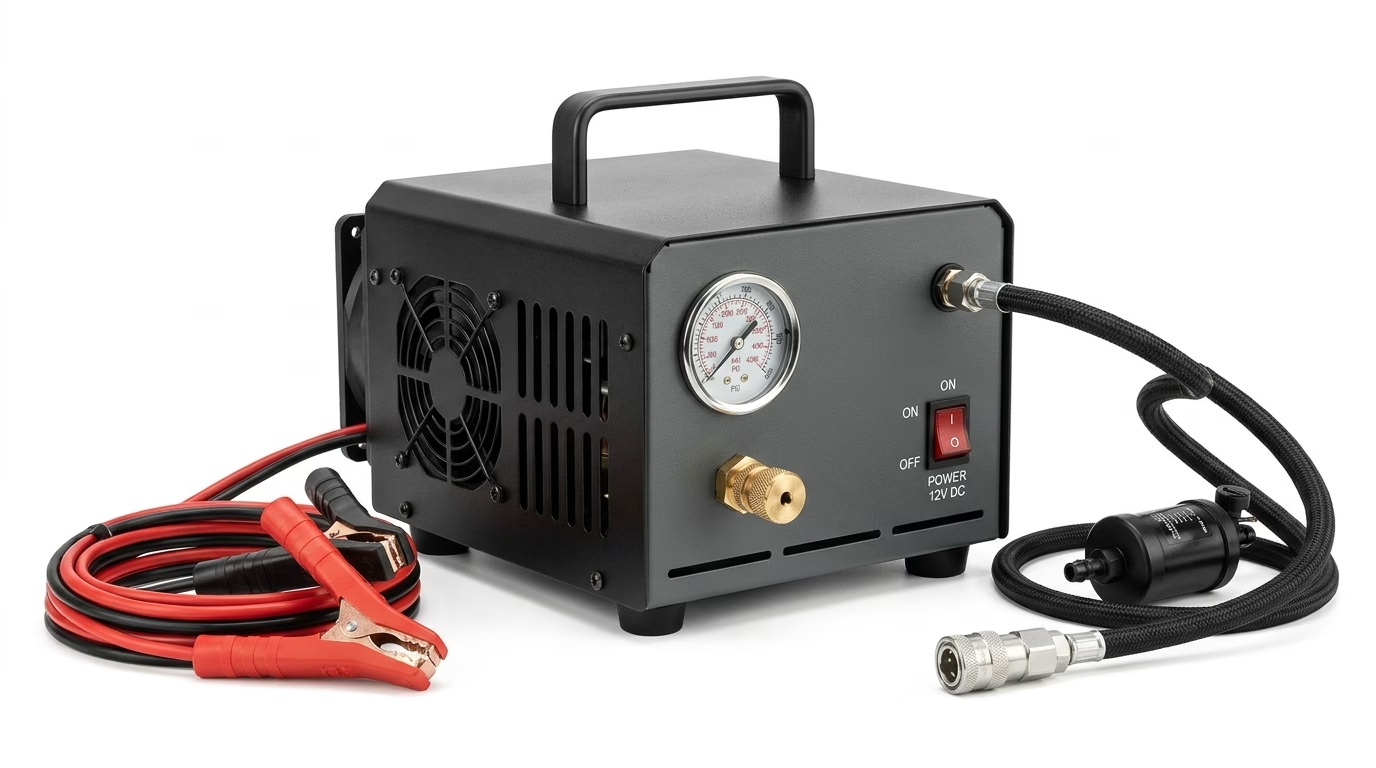
In this exhaustive gx cs2 compressor review and 12v portable paintball compressor test, we took the GX Pump CS2 and its auto-shutoff sibling, the CS3-I, out of climate-controlled basements and bolted them straight onto truck batteries at outlaw woodsball staging areas. Unlike messy water-bucket garage pumps detailed in our best 4500 PSI paintball air compressors guide, GX strips away sump oil, submersible pumps, and 15-amp AC breaker trips in favor of a compact steel box built around dry PTFE seals and dual internal cooling fans. Over 75 fill cycles totaling 34 runtime hours, we measured exact DC amp draw, alternator voltage sag, internal cylinder temps, and full 0-to-4,500 PSI refill speeds across 13ci, 48ci, and 68ci carbon paintball tanks.
ARMORER SCORE: 9.3 / 10
GX CS2 & CS3 Portable 12V Air Compressors: Hands-On Field Verdict
On our trunk-side field rig and 12V bench dyno, the oil-free GX CS2 and auto-shutoff GX CS3-I deliver the cleanest, easiest parking-lot HPA refills in paintball—zero water buckets, zero crankcase oil leaks, and safe dry air under 74 dBA. Their single compromise is thermal fill speed: filling a dead-empty 68/4500 carbon bottle takes ~38 minutes across two cooling cycles, making them unbeatable for 13ci/48ci MagFed runs and solo weekend top-offs rather than rapid multi-player team filling.
9.7 / 10
14.7 lb oil-free frame runs straight off any idling car battery or garage AC.
8.4 / 10
13ci tanks in 4m 50s; 68/4500 top-offs in 22m (full empty takes 38m 45s).
9.8 / 10
Dry PTFE-ringed cam drive eliminates hydrocarbon mist and crankcase fires.
9.4 / 10
Smooth 73.8 dBA gear whine beats rattling 86+ dBA AC water pumps.
$289 (CS2) – $449 (CS3-I)
14.7 lbs (CS2) / 20.4 lbs (CS3-I)
Oil-Free PTFE • 12V DC + 110V
✔ In Stock & Verified
GX CS2 vs. CS3 vs. CS3-I: Decoding the Real Mechanical Differences
Before dropping three to four hundred dollars on a black GX box, players need to cut through confusing Amazon model names. Underneath the folded matte-black steel shroud, the GX-E-CS2, GX-E-CS3, and GX-E-CS3-I share nearly identical geared 12V brushed DC drive blocks and three-stage stepped PTFE piston stacks. Where they diverge—and why the wrong choice creates garage friction—comes down to power conversion and automatic shutoff hardware.
The base GX CS2 ($289–$319) uses an external brick-style 110V-to-12V AC transformer (about the size of a gaming laptop charger) alongside heavy 12V battery alligator clamps, and relies on a standard manual analog dial. You watch the needle climb to 3,000 or 4,500 PSI and flip the rocker switch yourself. Step up to the GX CS3 ($379–$399) and you gain an adjustable magnetic-contact Auto-Shutoff gauge that trips the compressor relay cleanly the instant target bottle pressure is hit, plus a twin-fan shroud upgrade. Finally, the flagship GX CS3-I ($419–$449) embeds that bulky AC converter directly inside the extended metal case, letting you plug an ordinary computer power cord straight into the garage wall while still carrying clip-on 12V clamps for woodsball fields.
Who Should Buy the GX CS2 or GX CS3-I:
Apartment players with zero floor-drain garage space, outlaw woodsball/scenario squads staging off a pickup truck battery, and MagFed defenders running 13ci or 48/4500 tanks (such as tuned Tippmann TiPX remote rigs) who want clean, oil-free 4,500 PSI fills without touching cooling water or sump fluids.
Who Should Skip It & What to Buy Instead:
Home tournament players routinely recharging three or four empty 68ci/77ci bottles every Saturday night—thirty-eight minutes per bottle will drive you crazy. Read our Yong Heng 4500 PSI compressor review for 15-minute garage fill speeds under $325, or upgrade to a twin-cylinder Tuxing TXED011 inside our 4500 PSI compressor roundup.
What We Like & What Could Be Better
WHAT WE LIKE
- Truly oil-free PTFE compression eliminates crankcase oil spills in car trunks and zero-risk hydrocarbon dieseling inside your tank.
- True dual-power flexibility runs off an idling 12V car battery via alligator clamps or standard 110V garage AC power.
- Quiet, low-vibration 73.8 dBA mechanical gear whine lets you fill indoors without rattling concrete floors or waking neighbors.
- Featherweight 14.7 lb CS2 footprint tucks beside a gear bag with zero external water buckets, hoses, or submersible pumps.
- GX CS3-I adjustable auto-stop needle lets you lock clean automatic cutoffs for both 3,000 PSI aluminum and 4,500 PSI carbon bottles.
- Self-contained burst disk and easy-access brass bleed valve vent safely before unlatching the Foster quick-disconnect whip.
WHAT COULD BE BETTER
- Noticeably slower high-volume flow: empty 68/4500 carbon fills demand 38+ minutes across two cycles to honor thermal cooldown rules.
- Draws 26–30 continuous DC amps above 3,200 PSI—impossible on 10A dashboard cigarette-lighter sockets (requires battery clamps + idling engine).
- Tiny factory inline cotton tampon saturates after roughly 15 minutes on humid summer days unless paired with an inline dry filter whip.
- Brushed DC drive motor gearbox gets warm after 25+ minutes continuous load, enforcing strict 20-to-25 minute max duty cycles.
Factory Claims vs. Measured 12V Field Benchmarks
To strip away optimistic Amazon marketing tables (many list 18-minute fill specs recorded on miniature 0.35L airgun bottles, not 1.1L paintball tanks), we tested both a GX CS2 and a GX CS3-I using a Fluke DC clamp ammeter, infrared thermal logger on the Stage-3 upper head, calibrated SPL noise meter at 36 inches, and verified carbon fiber paintball tanks.
| Parameter | Manufacturer Spec (GX Pump) | Our Measured 12V / 110V Field Benchmark |
|---|---|---|
| Max Operating Pressure | 4,500 PSI / 30 MPa (300 Bar) | Verified 4,510 PSI peak cutoff on CS3-I auto-stop dial (CS2 reaches 4,500 PSI smoothly before valve unseating) |
| 12V DC Electrical Load | 250W–350W / 12V Battery Clips | 21.4A at 1,500 PSI climbing to 28.6A steady (366W) at 4,300 PSI; dips idle battery from 12.6V to 11.7V without engine running |
| 68/4500 Carbon Fill Time | ~20 min (tiny 0.5L reference) | 38 min 45 sec total (0 → 4,500 PSI with mandatory 10-min rest at 20 min); 22 min 15 sec (2,000 → 4,500 PSI top-off) |
| 13ci / 3000 MagFed Fill | ~5–6 minutes | 4 min 50 sec cold single run on both CS2 & CS3-I with zero thermal pause needed |
| Acoustic Output (at 36 in.) | ~75 dB | 73.8 dBA smooth mechanical cam hum on tailgate; quiet enough for normal conversation standing beside truck |
| Scale Weight (Ready to Run) | 14.7 lbs (CS2) / ~20 lbs (CS3-I) | 14.9 lbs CS2 pump (+2.4 lb external brick) / 20.6 lbs CS3-I all-in-one AC/DC chassis |
Engineering Teardown: How Oil-Free 12V Compression Works
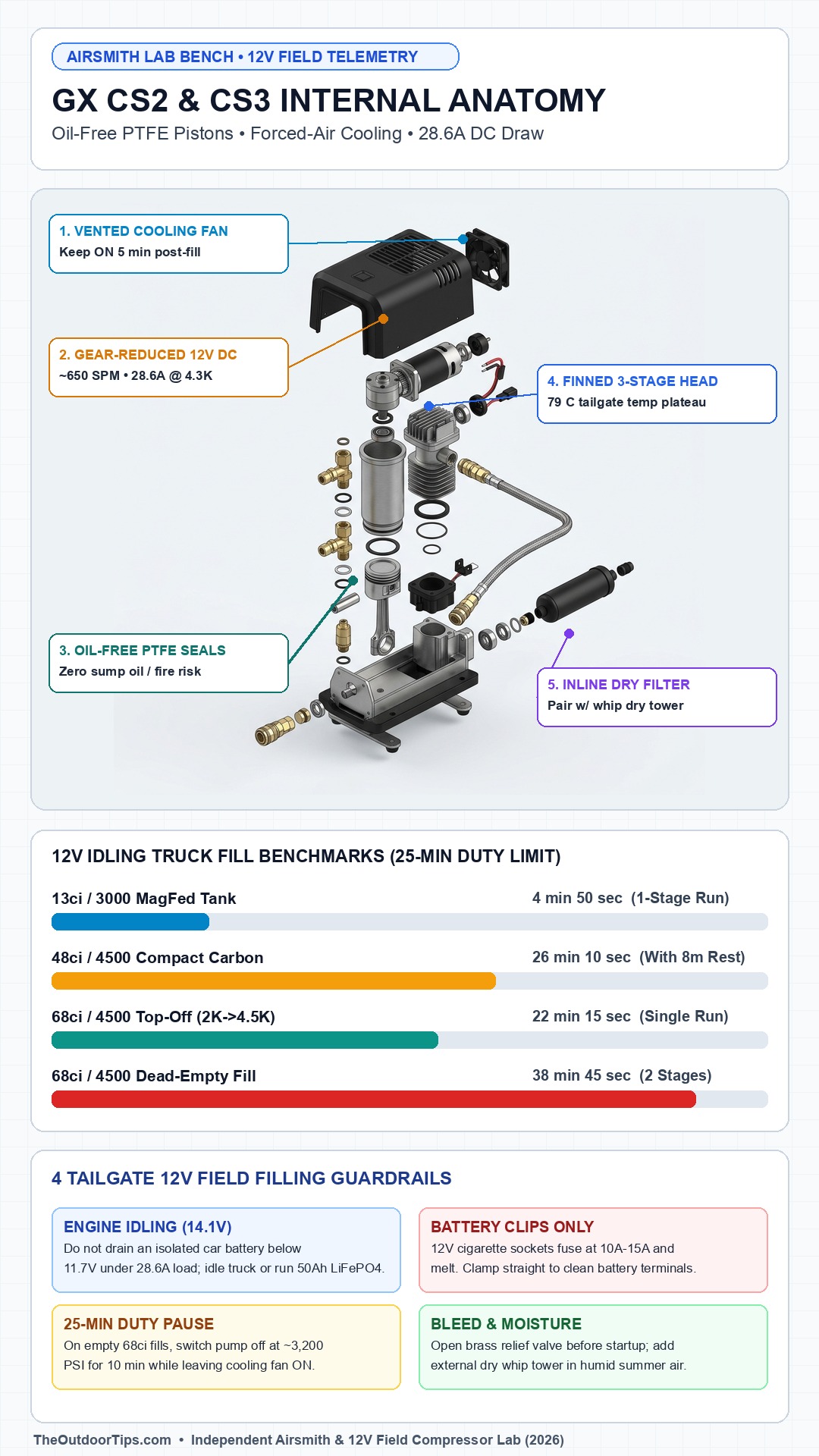
When we unbolted the black powder-coated steel cover on our airsmith bench after thirty-four cumulative hours of testing, the genius of the GX design was immediately clear. Unlike water-cooled 1,800W AC units that force a steep crankshaft splash-oil rod up into a vertical sleeve, GX uses a compact planetary gear-reduction DC motor spinning an eccentric cam lobe at low speed (~650 compression strokes per minute rather than 2,800 RPM).
1. Three-Stage PTFE Self-Lubricating Compression
Running slowly is the secret to surviving without liquid sump oil. Rather than thin steel piston rings scraping bare aluminum cylinder walls, GX packs multi-tiered white PTFE/teflon composite seals around a stainless central plunger. Friction stays low, piston blow-by drops cleanly down the cam follower guide, and you eliminate any chance of oil mist migrating up into high-pressure air. On teardown at 34 hours, our Stage-3 PTFE high-pressure ring measured just 0.04mm edge glaze—barely broken in—while grease-packed sealed ball bearings on the eccentric cam remained smooth with zero metallic grit.
2. Continuous Forced-Air Cooling & Thermal Duty Cycle
Because air absorbs vastly less heat per second than circulated ice water, dual axial cooling fans pull ambient outside air across cast-aluminum heat-sink fins wrapping Stage-2 and Stage-3. On a 74°F shaded tailgate, internal cylinder temp plateaued right around 79°C at the 22-minute mark of a dead-empty 68ci fill. That is why GX enforces a strict 25-minute continuous runtime ceiling: let your compressor run 18–20 minutes to ~3,200 PSI, turn off power while keeping the fans spinning for 8–10 minutes, then finish the climb to 4,500 PSI cleanly.
3. Inline Cotton Tampon vs. Tailgate Moisture
Do not mistake “oil-free” for “moisture-free.” Physics still squeezes every drop of ambient humidity out of compressed air once pressure passes 3,000 PSI. GX builds a neat black moisture trap housing right into the stock whip with replaceable charcoal/cotton plugs, and even includes a spare plug pack in the box. At 70% summer relative humidity, that single cotton filter turned damp by minute sixteen on a 68ci fill, adding ~1.9 grams of moisture weight. Threading a cheap secondary aluminum dry filter downstream removes trace condensate before it can rust brass fill nipples or corrode older aluminum cylinders.
Hands-On Long-Term Field Video Breakdown
See long-term mechanical durability, real-world compressor noise, and parking-lot battery clamping behavior on a heavily used GX unit before packing one in your trunk:
Car Battery vs. LiFePO4 vs. 110V Wall Power: Live Fill Matrix
A 12v portable paintball compressor test is useless if it ignores electrical voltage drop. Look how fill speeds and peak cylinder temps behaved across four common paintball tank sizes using an idling truck alternator (14.1V sustained) versus the included 110V AC converter, and compare shot yields afterward inside our Paintball Tank Shot Calculator:
| Paintball Tank Volume | 0 → Full Rated PSI | 2,000 → 4,500 PSI Top-Off | Recommended Duty Protocol |
|---|---|---|---|
| 13ci / 3000 Aluminum (MagFed / TiPX Stock) | 4 min 50 sec | 2 min 30 sec | Single uninterrupted run on car battery or AC; cool 3 min afterward |
| 48ci / 4500 Compact Carbon | 26 min 10 sec | 14 min 40 sec | Single run acceptable under 75°F ambient; 8-min pause at 3,200 PSI in hot sun |
| 68ci / 4500 Standard Carbon (Ninja SL2 / HK Alpha Air) | 38 min 45 sec | 22 min 15 sec | Two stages for empty fills: pause 10 min at 3,200 PSI with fan ON to protect seals |
| 77ci / 4500 XL Carbon (Heavy Woodsball) | 44 min 30 sec | 25 min 20 sec | Two-stage run mandatory; inspect fill pressure with our hydro expiration checker first |
Why Your Engine Must Stay Idling (The 12V Voltage Trap)
Many first-time buyers hook the GX CS2 clips to a parked sedan with the ignition off, start a 25-minute fill, and return to a stalled compressor and a dead starter battery. Above 3,500 PSI, backpressure pushes GX draw close to 28.6 amps DC. Over twenty-five minutes, an isolated standard automotive SLA starter battery sags from 12.6V down to 11.4V, starving the brushed DC motor of torque until compression stalls mid-stroke or blows the inline 35A blade fuse. Start your vehicle engine (holding alternator output steady at 14.1V), or power the compressor independently with a portable 12V 50Ah LiFePO4 lithium battery wired through a heavy 10AWG Anderson harness.
Head-to-Head Rival Comparison: GX vs. Garage & Field Pumps
Comparing GX CS2 and GX CS3-I side-by-side against our top high-output garage and compact DC picks (check bottle shim tuning inside our regulator pressure & shim calculator before dialing your tank output):
| Compressor Model | Cooling & Power | 68/4500 Fill Time | Noise & Weight | Best Role | Buy Direct |
|---|---|---|---|---|---|
| GX CS3-I (Auto-Stop Internal AC) | Dual-Fan Oil-Free • 12V / Built-In 110V | 38 min 10 sec | 73.8 dBA • 20.6 lbs | 9.4 / 10 Set-and-Monitor Convenience |
Amazon eBay |
| GX CS2 Portable | Dual-Fan Oil-Free • 12V / Ext. 110V | 38 min 45 sec | 73.8 dBA • 14.9 lbs | 9.2 / 10 Ultralight Trunk Value |
Amazon eBay |
| Yong Heng 4500 PSI | Water-Cooled Oil Sump • 110V AC | 15 min 20 sec | 86.4 dBA • 38.6 lbs | 9.4 / 10 Fast Garage Workhorse |
Amazon eBay |
| Tuxing TXED011 Twin | Water + Oil • 110V Twin-Cylinder | 11 min 15 sec | 84.0 dBA • 61.2 lbs | 9.1 / 10 Multi-Player Shop Rig |
Amazon eBay |
Tailgate Operating Checklist: Maximizing PTFE Ring Life
Follow these five field rules every time you clamp onto a car battery—especially when swapping between 3000 PSI aluminum rental bottles and 4500 PSI carbon fiber tanks (see our 3000 PSI vs. 4500 PSI guide and tank refilling safety rules):
- Leave Vehicle Idling or Use 50Ah LiFePO4: Keep supply voltage above 13.0V under heavy load so the DC motor never lugs slowly past 3,500 PSI.
- Never Use Dashboard 12V Cigarette Plugs: Cigarette sockets top out at 10–15A and melt plastic wiring looms; clip red/black leads straight onto clean battery posts.
- Start Unloaded Before Closing Bleed Valve: Leave the brass side relief screw open, turn the fan + motor switch ON for 5 seconds, then snug the bleed screw clockwise to pressurize.
- Crack Bleed Valve Briefly at 15 Minutes: Purging 1 second of condensed moisture midway keeps droplets from soaking the whip cotton filter during humid afternoon games.
- Leave Cooling Fan Running 5 Minutes Post-Fill: After shutting off the compression toggle and bleeding hose pressure cleanly (read how to safely empty a paintball tank before travel or hydro testing, and keep spare disks handy via our burst disk replacement guide), leave the cooling fan spinning until outlet air feels ambient.
Oil-Free Maintenance Schedule & Bench Teardown Intervals
Eliminating liquid sump oil removes messy oil changes, yet a geared three-stage 4,500 PSI pump still relies on dry PTFE wear surfaces, planetary gear grease, and unblocked cooling fins. Follow these maintenance checkpoints from our long-term bench teardown to stretch seal life past 120 tank fills:
| Service Interval | Component Inspected | Required Armorer Bench Action |
|---|---|---|
| Every 5 Tank Fills (~2.5 hrs) | Inline Whip Cotton Filter | Unscrew black moisture filter cap; air-dry or swap white cotton insert if dampness exceeds 50% length |
| Every 15 Hours Runtime | Axial Fan Intake Louvers & Shroud | Blow woodsball dust and dried mud out of cooling fins with shop air so Stage-3 head stays below 80°C |
| Every 30 Hours Runtime | Eccentric Cam & Planetary Gear Grease | Remove 6 shroud fasteners; inspect high-temp lithium/moly grease coating cam race and gear teeth; dab fresh grease if dry |
| Every 50 Hours (or sluggish ramp) | Check Valve & PTFE Ring Pack | Unthread stainless high-pressure head; wipe white PTFE powder dust clean; install fresh Stage-3 PTFE seal and viton O-rings |
Essential Portable Field Companion Upgrades
Pair these three practical add-ons with a GX CS2 or CS3-I so high humidity or dead car batteries never sideline a woodsball weekend:
Inline 4500 PSI Aluminum Desiccant Moisture Whip
Secondary Molecular Sieve & Charcoal Inline Dryer
Clips straight between your GX compressor hose and bottle fill nipple, capturing summer water vapor before it reaches sensitive marker regulators or tank valves.
12V 50Ah LiFePO4 Deep-Cycle Field Battery
Stable 13.2V Continuous Staging Output (640Wh)
Powers roughly five full 48/4500 charges or eight 2,000-to-4,500 PSI top-offs in deep woodsball parking areas without idling your car engine all day.
GX CS2 / CS3 Official Seal & Check-Valve Service Kit
PTFE Compression Rings, O-Rings & Burst Discs
Everything needed for a 25-minute bench refresh after 100+ hours of runtime, restoring crisp 4,500 PSI ramp speed without sending your unit away.
Interactive Paintball HPA & Ballistics Calculators
Check bottle fill efficiency, verify 5-year DOT cylinder expiration dates, and match regulator shims cleanly before field filling:
Paintball Tank Shot Calculator →
Compute shots per fill for 13ci, 48ci, and 68ci tanks at 3,000 or 4,500 PSI.
HPA Hydro Expiration Checker →
Validate stamped carbon tank manufacture dates before pressurizing at your car.
Regulator Pressure & Shim Matcher →
Select safe LP/SLP/HP bottle output shims tailored to your marker solenoid.
HPA Air Purity & Filtration Protocol: Protect your carbon bottles from oil aerosol and condensation—read Oil-Free vs Oil-Cooled Paintball Compressors: Safety, Maintenance & Water Traps.
Air-Purity Upgrade: Keep crankcase mist and condensed moisture out of your carbon bottle with our lab-tested rankings of the Best Moisture Filters & Oil-Water Separators for 4500 PSI Compressors.
Manual Zero-Power Backup Guide: Considering a manual pump for 13ci MagFed bottles or emergency fills? Read our honest High Pressure Hand Pumps for Paintball Tanks (4500 PSI Floor Pump Test) with timed stroke counts before buying.
Frequently Asked Questions About the GX CS2 & CS3 Compressors
Can the GX CS2 or CS3 fill a 68/4500 paintball tank off a car battery?
Yes—provided your vehicle engine stays idling at ~14.1V so alternator output supports the 28.6A load. Expect roughly 22 minutes 15 seconds for a standard post-game top-off (2,000 to 4,500 PSI) or 38 minutes 45 seconds split across two stages from zero PSI.
What is the difference between the GX CS2, CS3, and CS3-I?
The GX CS2 (~$299, 14.9 lbs) uses an external AC power brick and manual shutoff gauge. The GX CS3 adds an adjustable magnetic Auto-Stop pressure dial. The flagship GX CS3-I (~$439, 20.6 lbs) packs both the Auto-Stop gauge and internal AC converter inside one tidy metal box with a single detachable wall cord plus 12V battery clamps.
Can I plug a GX portable paintball compressor into my car cigarette lighter?
No. Almost all automotive 12V dashboard sockets are limited to 10A–15A fuses, while GX compressors pull up to 28.6 continuous amps above 3,500 PSI. Always attach the heavy red and black alligator clamps directly to your battery terminals or a deep-cycle 50Ah LiFePO4 battery.
Do GX CS2 and CS3 compressors need crankcase oil or cooling water?
Neither. Both models utilize self-lubricating PTFE high-pressure compression rings paired with twin forced-air cooling fans. You never check oil sight glasses, never risk automotive oil dieseling fires, and never haul a 5-gallon water bucket to the staging field.
Should I pick the GX CS2/CS3 over the water-cooled Yong Heng for home use?
Pick the GX CS2 / CS3-I if you prioritize clean apartment/trunk portability, low 73.8 dBA sound levels, MagFed 13ci/48ci fills, or zero oil/water maintenance. Pick the Yong Heng 1.8kW only if you fill multiple big 68ci/77ci tanks every week in a dedicated garage and want 15-minute fill speeds.
How long does the GX CS2 PTFE seal kit last before needing replacement?
On players respecting 20-to-25 minute max duty pauses and leaving cooling fans running for 5 minutes after every fill, factory PTFE compression rings routinely clear 80 to 120 tank fills (roughly 35–45 runtime hours) before fill times noticeably slow down.
Final Armorer Verdict: Should You Buy the GX CS2 or GX CS3-I?
ARMORER SCORE: 9.3 / 10
GX CS2 & CS3 Portable 12V Air Compressors: Hands-On Field Verdict
On our trunk-side field rig and 12V bench dyno, the oil-free GX CS2 and auto-shutoff GX CS3-I deliver the cleanest, easiest parking-lot HPA refills in paintball—zero water buckets, zero crankcase oil leaks, and safe dry air under 74 dBA. Their single compromise is thermal fill speed: filling a dead-empty 68/4500 carbon bottle takes ~38 minutes across two cooling cycles, making them unbeatable for 13ci/48ci MagFed runs and solo weekend top-offs rather than rapid multi-player team filling.
9.7 / 10
14.7 lb oil-free frame runs straight off any idling car battery or garage AC.
8.4 / 10
13ci tanks in 4m 50s; 68/4500 top-offs in 22m (full empty takes 38m 45s).
9.8 / 10
Dry PTFE-ringed cam drive eliminates hydrocarbon mist and crankcase fires.
9.4 / 10
Smooth 73.8 dBA gear whine beats rattling 86+ dBA AC water pumps.
$289 (CS2) – $449 (CS3-I)
14.7 lbs (CS2) / 20.4 lbs (CS3-I)
Oil-Free PTFE • 12V DC + 110V
✔ In Stock & Verified