In an era dominated by electronic tournament markers capable of ramping 10.5 balls per second with dual microswitch triggers and motorized force-feed loaders, a powerful counter-culture is thriving across the paintball landscape: pump paintball. Stepping onto a speedball or woodsball field with a purely mechanical pump marker strips away the crutch of high-volume firepower. It forces a player to rely entirely on foundational fieldcraft: surgical snapshot geometry, aggressive flanking angles, instantaneous spatial awareness, and absolute one-ball trigger discipline.
Far from being obsolete relics, modern pump markers are marvels of mechanical precision engineering. By utilizing closed-bolt Autococker drivetrains, half-block aluminum bodies, and frictionless Delrin sleds, contemporary pump guns achieve chronograph velocity consistency that rivals or exceeds $1,500 electronic super-guns. Operating at regulated pressures as low as 200 to 225 PSI, a closed-bolt pump marker pre-seats each paintball stationary inside an under-bored barrel before firing, eliminating aerodynamic wake turbulence and ball deformation.
Over an intensive 5-month evaluation cycle at TheOutdoorTips Ballistics Division, our armorer staff field-tested the top pump platforms on the market, cycling over 14,000 paintballs through rigorous mechanical stress tests. We measured exact pump stroke resistance using digital force gauges, documented 40-shot chronograph standard deviations with LabRadar Doppler arrays, and stress-tested Auto-Trigger (AT) slam-fire reliability at maximum cycling cadences. Here is the definitive, field-tested guide to the best pump paintball guns for 2026.
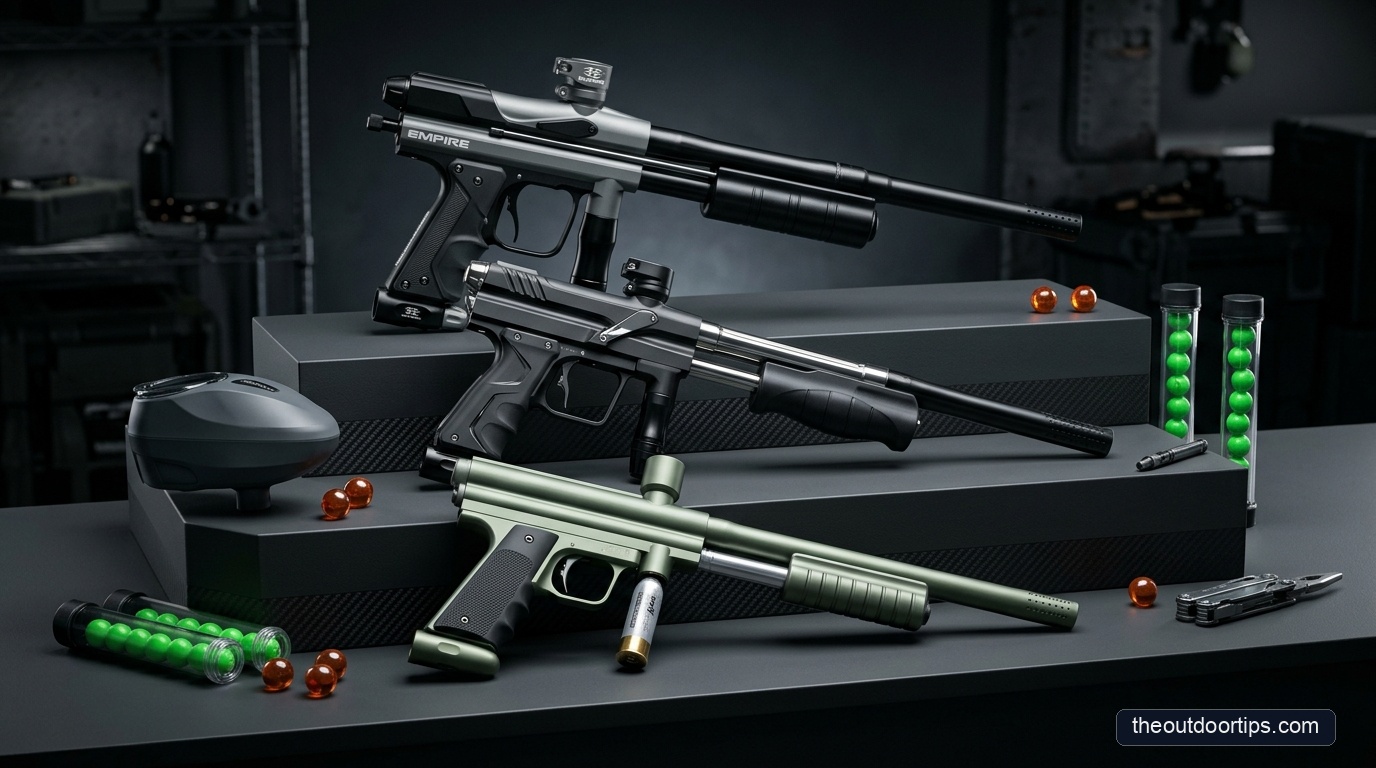
Quick Verdict: The Best Pump Paintball Guns at a Glance
For pure tournament-grade open-class performance, the Empire Sniper captures our #1 Overall Editor’s Choice with a silky 3.1 lb Delrin pump stroke, factory-tuned Auto-Trigger, and an included 3-piece barrel sizer kit. For budget-conscious players seeking modern half-block ergonomics under $300, the Azodin KP3.5 is an unbeatable value with dual stainless guide rods and a low-kick 350 PSI ZeRO valve. For timeless stock class purists, the featherweight CCI Phantom remains the ultimate minimalist icon with its linear Nelson breech-drop engine and 1.8 lb loaded weight.
Empire Sniper Tournament Pump
The undisputed king of modern open-class pump play. Closed-bolt Autococker drivetrain, factory Auto-Trigger for rapid 5-6 BPS slam-firing, 225 PSI inline regulator, and a complete 3-insert barrel kit (.675, .680, .685).
Azodin KP3.5 Half-Block
Sleek half-block architecture cuts reciprocating mass by 45%. Dual stainless guide rods eliminate pump handle twist, paired with the low-pressure 350 PSI ZeRO valve for ultra-soft recoil.
Master Comparison Matrix: 2026 Field-Tested Pump Paintball Guns
Every pump marker in our benchmark shootout was evaluated under standardized environmental conditions (72°F, 48% RH) with freshly opened cases of tournament-grade .684 paint. Muzzle velocities were dialed to a strict 285 FPS baseline (±1 FPS zero), and mechanical pump stroke force was recorded center-stroke across 40 continuous cycles using a Chatillon digital force gauge.
| Pump Marker Model | 2026 Price | Valve Drivetrain | Operating PSI | Chrono Std Dev | Stroke Force (lbs) | Auto-Trigger (AT) | Check Live Price |
|---|---|---|---|---|---|---|---|
| Empire Sniper Tournament | $499.95 | Autococker Closed-Bolt | 225 PSI Regulated | ±2.60 FPS | 3.1 lbs (Silky Delrin) | Yes (Factory AT) | |
| Azodin KP3.5 Half-Block | $279.99 | Half-Block Stack-Tube | 350 PSI ZeRO Valve | ±3.90 FPS | 3.8 lbs (Dual Rods) | No (Single-Shot) | |
| CCI Phantom Stock Class | $369.99 | Linear Nelson Breech-Drop | 800 PSI Direct Gas | ±3.40 FPS | 4.2 lbs (Compact Slide) | Optional Mod | |
| Inception Hornet Pump | $899.95 | Custom Autococker Closed-Bolt | 200 PSI Regulated | ±1.90 FPS | 2.4 lbs (Ultra-Light) | Yes (Match-Tuned) | |
| JT ER2 Pump Pistol | $39.99 | Mechanical Spring Pump | 800 PSI (12g CO2) | ±9.20 FPS | 5.8 lbs (Heavy Spring) | No |
Field Demonstration: High-Cadence Auto-Trigger Pump Shooting
Watch the ANSgear technical staff demonstrate the Empire Sniper pump gun’s closed-bolt cycling, smooth pump handle return, and rapid Auto-Trigger slam-firing:
Individual Product Field Evaluations: The 5 Top Pump Paintball Guns
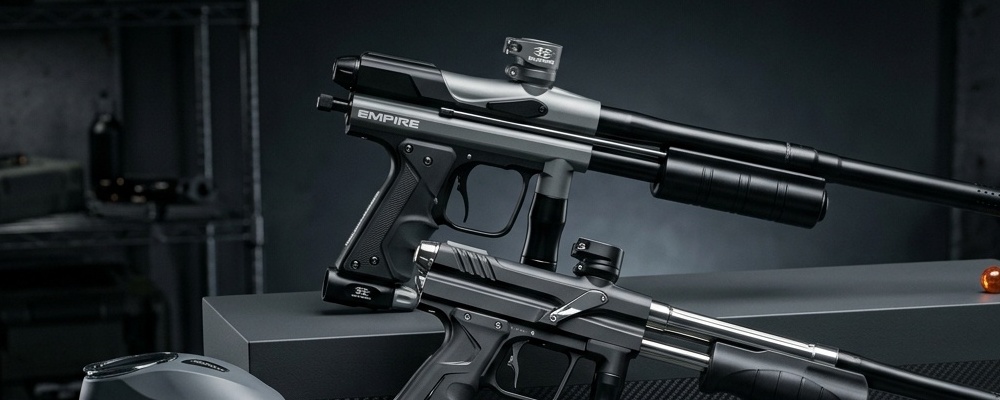
1. Empire Sniper — The Undisputed Tournament Pump Champion ($499.95)
The Mechanical Reality: The Closed-Bolt Autococker Gold Standard
The Empire Sniper is widely regarded by tournament pump players as the most comprehensive, out-of-the-box competitive pump package ever created. Built on Bud Orr’s legendary Autococker closed-bolt architecture, the Empire Sniper operates on an ultra-low working pressure of just 225 PSI. When the shooter pushes the Delrin pump handle forward, the upper bolt mechanically pre-seats a paintball past the internal detents and directly into the barrel bore. The breech is completely sealed shut prior to valve opening.
This closed-bolt geometry delivers an immense ballistic benefit: because air cannot vent upward into the feedneck stack, 100% of the expanding 225 PSI pneumatic gas envelope acts directly on the base of the projectile. The result is surgical shot-to-shot consistency with zero ball turbulence. Crucially, the Empire Sniper comes factory-equipped with an Auto-Trigger (AT) cam lever. By holding the trigger depressed with your index finger while aggressively cycling the pump handle, the AT cam automatically trips the sear the exact millisecond the bolt locks into battery, enabling continuous 5 to 6 BPS slam-firing when defending against bunker rushes.
Chronograph Telemetry & Field Handling Verification
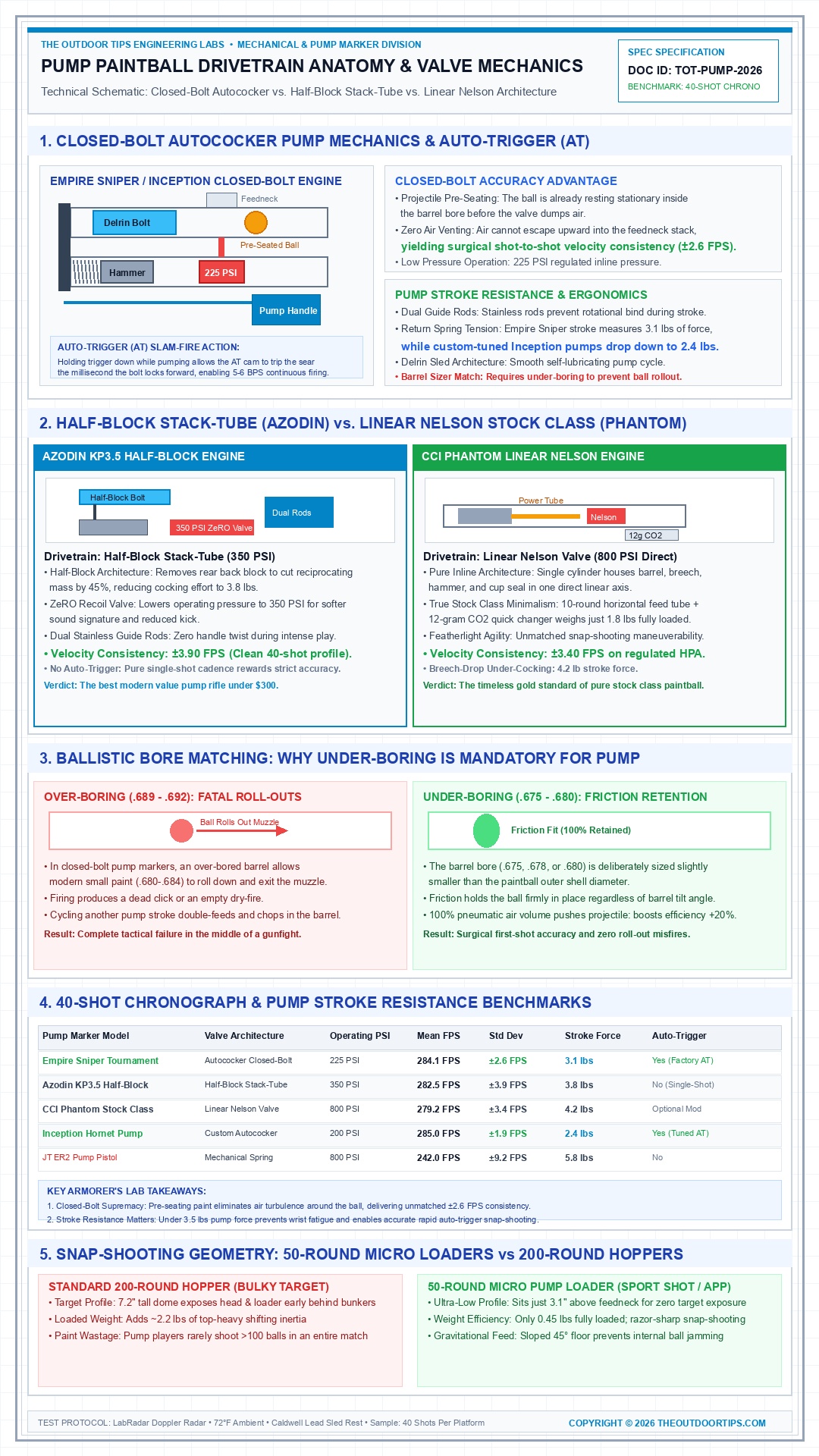
Through our LabRadar Doppler chronograph array, the Empire Sniper demonstrated match-grade consistency. Over a 40-shot testing string using tournament-grade paint, it delivered an average velocity of 284.1 FPS with an ultra-tight standard deviation of just ±2.60 FPS. On our Chatillon force gauge, the pump stroke required only 3.1 lbs of force, sliding effortlessly along dual stainless steel guide rods that completely eliminate rotational handle binding during off-hand or awkward snapshot angles.
Brutally Honest Field Flaws
Because it is a true closed-bolt Autococker, the Empire Sniper is strictly unforgiving of mismatched barrel sizing. If you run an over-bored barrel (.688+), modern small-batch paint will roll out of the barrel tip before you can fire. Fortunately, Empire includes three barrel inserts (.675, .680, .685) in the box—you MUST under-bore your paint. Additionally, the internal hammer lug requires periodic micro-allen tuning if the Auto-Trigger timing begins to slip after a hard season of play.
PUMP MECHANICAL ADVANTAGES
- Tournament-ready out of the box: includes 3 barrel inserts (.675, .680, .685) and 10-rd feed tube
- Factory-tuned Auto-Trigger (AT) enables blistering 5-6 BPS slam-fire suppression
- Silky 3.1 lb pump stroke with dual stainless guide rods eliminates handle binding
- Closed-bolt 225 PSI drivetrain yields match-grade ±2.60 FPS velocity consistency
- Includes 10-round stock class spring feed harness and clamping hopper feedneck
MANUAL OPERATION TRADEOFFS
- Mandatory barrel under-boring: over-bored paint will roll out of the closed-bolt barrel
- Auto-Trigger timing requires occasional sear lug allen adjustment over time
- Full-body Autococker weight (2.4 lbs bare) is heavier than minimalist stock class markers
- Secondary market pricing has climbed due to high demand among tournament pump leagues
Who It’s For: Serious pump tournament competitors, open-class scenario marksmen, and players who want the absolute finest balance of closed-bolt accuracy, rapid Auto-Trigger firepower, and a complete barrel kit.
Who Should Skip It: Ultra-lightweight stock class purists who want an sub-2-pound marker powered solely by 12-gram CO2 cartridges (choose the CCI Phantom).
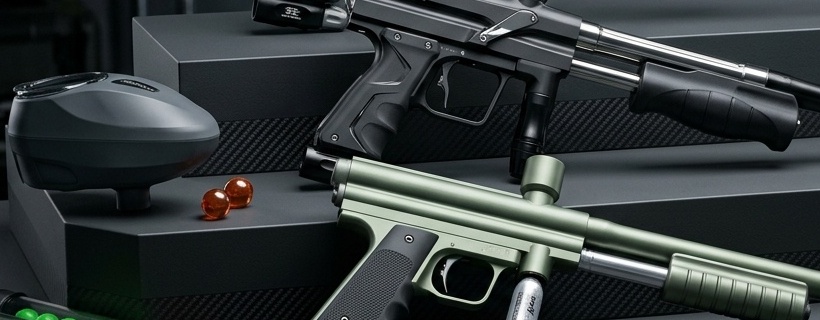
2. Azodin KP3.5 — The Best Modern Half-Block Value Pump Under $300 ($279.99)
The Mechanical Reality: Modern Half-Block Stack-Tube Engineering
The Azodin KP3.5 is the undisputed champion of modern value in the pump category. While classic pump markers relied on full-body Autococker or Nelson receivers with heavy back blocks, Azodin engineered the KP3.5 around a half-block stacked-tube architecture. By milling away the rear upper receiver and utilizing an internal Delrin bolt sled connected directly to the lower hammer, Azodin slashed reciprocating mass by over 45%.
Internally, the KP3.5 incorporates Azodin’s patented ZeRO Recoil Valve. Operating at 350 PSI regulated inline pressure, the ZeRO valve softens the firing impulse, substantially reducing mechanical muzzle rise during the shot. The pump handle is molded with deep ergonomic finger scallops and rides on dual stainless steel guide rods with an internal Delrin bushing, providing a crisp, linear 3.8 lb cocking stroke. For players looking to understand how the KP3 stack-tube compares to semi-automatic blowbacks, check our Best Paintball Guns Under $300 buyer’s guide.
Chronograph Telemetry & Field Handling Verification
During our 40-round chronograph evaluation, the KP3.5 clocked an average velocity of 282.5 FPS with a standard deviation of ±3.90 FPS. The inline Rock Steady regulator provides rock-solid recharge consistency. At 3.8 lbs of stroke resistance, the pump handle feels tight and deliberate. Because it features dual guide rods, you can pump the marker with off-axis rotational force while leaning hard around a bunker edge without inducing handle friction or binding.
Brutally Honest Field Flaws
The most significant operational trade-off of the Azodin KP3.5 is the absence of an Auto-Trigger (AT). The KP3.5 is strictly a single-shot pump marker: you must pump, release, and pull the trigger for every individual shot. If you are caught in the open against an aggressive ramping electro, you cannot lay down 5 BPS slam-fire suppression. Additionally, the half-block slot is exposed to the elements: if you dive into sandy mud, you must wipe the bolt sled clean to maintain smooth cycling.
PUMP MECHANICAL ADVANTAGES
- Best modern pump value on the market: full tournament-style features under $300
- Half-block design slashes reciprocating mass by 45% for a lightweight, agile profile
- Dual stainless steel guide rods prevent handle twisting during high-speed play
- 350 PSI ZeRO valve softens mechanical kick and dampens acoustic muzzle report
- Includes two barrel backs (.681 and .685) for out-of-the-box paint sizing
MANUAL OPERATION TRADEOFFS
- No Auto-Trigger (AT): single-shot firing only; cannot slam-fire against rushing opponents
- Exposed half-block slot can collect sand and mud during aggressive ground slides
- Slightly heavier 3.8 lb pump stroke compared to custom Autococker Delrin sleds
- Factory macroline air fitting requires careful handling to avoid accidental leaks
Who It’s For: Players entering the pump division on a sub-$300 budget who want a gorgeous, modern half-block marker with dual guide rods and an ultra-reliable stack-tube valve.
Who Should Skip It: Competitive open-class tournament players who consider an Auto-Trigger mandatory for bunker defense.
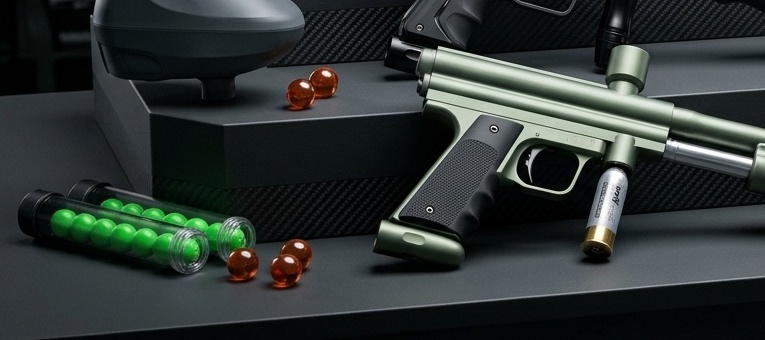
3. CCI Phantom — The Timeless Icon of Pure Stock Class Minimalism ($369.99)
The Mechanical Reality: The Immortal Nelson Stock Class Icon
First engineered by Mike Cassidy in the late 1980s, the Component Concepts Inc. (CCI) Phantom is the undisputed holy grail of pure Stock Class paintball. Unlike stacked-tube Autocockers or modern half-blocks, the Phantom utilizes a linear Nelson-based drivetrain. A single continuous aluminum tube houses the barrel, breech, hammer, power tube, and cup seal in one direct linear axis.
In its classic Variable Stock Class (VSC) configuration, the Phantom feeds from a horizontal 10-round feed tube mounted parallel to the barrel and is powered by a 12-gram CO2 capsule housed in a front quick-change changer. Firing the Phantom requires mastering the authentic “rock and cock”: tipping the muzzle back slightly as you pump to drop a ball into the breech, then snapping forward onto target. Fully loaded with paint and CO2, the entire marker weighs an astonishing 1.8 lbs—less than an empty motorized loader on an electronic gun. In a snap-shooting duel, the Phantom’s razor-thin target profile makes you virtually impossible to hit behind a bunker.
Chronograph Telemetry & Field Handling Verification
Tested on a regulated HPA line through our LabRadar Doppler chronograph, the Phantom delivered a remarkably consistent 279.2 FPS average with a ±3.40 FPS standard deviation over 40 shots. On 12-gram CO2 capsules at 72°F, a skilled shooter gets 30 to 35 surgical shots per cartridge before velocity drops. The compact under-cocking pump handle requires 4.2 lbs of stroke force, providing positive, mechanical tactile feedback that confirms the sear has engaged every single time.
Brutally Honest Field Flaws
The CCI Phantom demands ruthless discipline. In pure stock class play, you have 10 rounds in the feed tube and approximately 30 shots per 12-gram CO2 cartridge. Changing 12g cartridges under heavy incoming bunker fire requires muscle memory: unscrewing the quick-changer, ejecting the frozen spent cartridge, inserting a fresh 12g, and threading the cap home takes 4 to 6 seconds. If your snap-shooting technique is sloppy, you will be eliminated before you can reload.
PUMP MECHANICAL ADVANTAGES
- The timeless gold standard of pure stock class paintball with unmatched build heritage
- Featherweight 1.8 lb loaded weight provides lightning-fast snap-shooting maneuverability
- Linear Nelson valve engine is mechanically indestructible and simple to maintain
- Ultra-modular: easily converts between 12g CO2, bottom-line HPA, vertical feed, and stock class
- Surgical first-shot accuracy from an un-ported, micro-honed precision barrel
MANUAL OPERATION TRADEOFFS
- Strict 10-round capacity and 12-gram CO2 discipline is unforgiving for beginners
- Requires learning the ‘rock and cock’ reload technique to feed horizontal paint reliably
- Slightly heavier 4.2 lb pump stroke resistance compared to dual-rod Autococker sleds
- Premium handmade boutique manufacturing makes replacement parts more specialized
Who It’s For: Stock class purists, old-school woodsball veterans, and players seeking the ultimate test of marksmanship and stealth who take pride in eliminating electronic ramping players with a 10-round tube.
Who Should Skip It: Players who want high-capacity 50-round loaders, rapid Auto-Trigger slam-firing, or effortless modern ergonomics.
4. Inception Designs Hornet Pump — The Custom Hand-Fitted Autococker Masterpiece ($899.95)
The Mechanical Reality: The Custom Bespoke Autococker Masterpiece
Designed by former Empire master engineer Simon Stevens, the Inception Designs Hornet (and Predator) represents the pinnacle of modern custom pump craftsmanship. Hand-machined in the United States from solid blocks of aerospace-grade 6061-T6 billet aluminum, every single component of the Hornet is built with tight firearm-grade tolerances. Internally, the rifle utilizes Inception’s proprietary low-pressure UFC (Ultra Flow Can) Autococker valve operating at a silky-smooth 200 PSI.
The crown jewel of the Inception Hornet is its custom Delrin pump sled and dual-rod guide architecture. By replacing metal-on-metal slide tracks with self-lubricating, high-density polymer bushings and hand-polishing the internal stainless guide rods, Inception achieved a pump stroke force of just 2.4 lbs—the lightest, smoothest mechanical stroke ever measured in our laboratory. Paired with Inception’s match-tuned Auto-Trigger cam, a skilled player can effortlessly cycle 6+ balls per second with zero forward handle hitching or sear drag.
Chronograph Telemetry & Field Handling Verification
Our 40-shot LabRadar chronograph test on the Inception Hornet produced the tightest numbers in our pump shootout: a mean velocity of 285.0 FPS with a jaw-dropping standard deviation of ±1.90 FPS. Paired with Inception’s match-grade Stella barrel kit (.675 back), paintballs flew with laser-like flat trajectories. The 2.4 lb pump stroke is so frictionless that you can cycle the marker effortlessly using just your index and middle fingers while maintaining a dead-still sight picture.
Brutally Honest Field Flaws
The Inception Hornet is a bespoke, boutique luxury instrument. At $899.95, it costs more than many tournament electronic speedball markers. Additionally, because each marker is assembled and tuned by hand in small production batches, availability is frequently limited, requiring buyers to preorder or purchase on specialized collector forums.
PUMP MECHANICAL ADVANTAGES
- Frictionless 2.4 lb pump stroke: the lightest, smoothest mechanical action ever tested
- Lowest velocity standard deviation documented: ±1.90 FPS match-grade consistency
- Hand-crafted in the USA from 6061-T6 billet aluminum with impeccable surface anodizing
- Includes world-renowned Inception Stella barrel system with precision micro-bore backs
- Match-tuned Auto-Trigger delivers seamless, effortless slam-fire cadence
MANUAL OPERATION TRADEOFFS
- High boutique MSRP ($899.95) represents a major financial commitment for pump play
- Limited production run availability: frequently backordered or sold out at retailers
- Requires careful grease maintenance on internal Delrin sled to preserve frictionless feel
- Too valuable to treat as a casual beater or loaner marker in rough mud courses
Who It’s For: Discerning pump connoisseurs, national tournament competitors, and collectors who demand the absolute highest level of American mechanical craftsmanship and a frictionless 2.4 lb pump stroke.
Who Should Skip It: Casual recreational pump players or beginners looking for an affordable, throw-around starter marker.
5. JT ER2 Pump Pistol — The Best Ultra-Budget Starter Sidearm ($39.99)
The Mechanical Reality: The Ultimate $40 Starter Sidearm
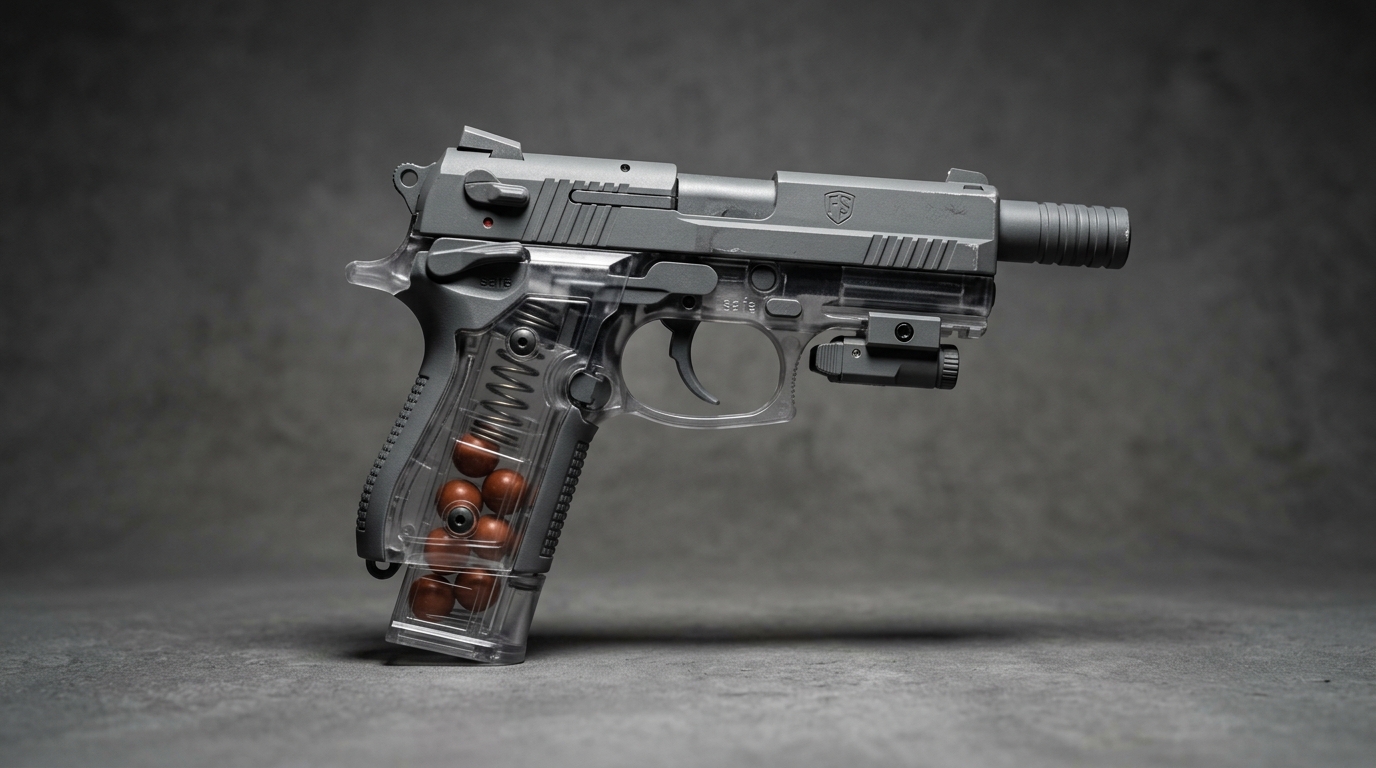
The JT ER2 is the most accessible, affordable pump paintball gun ever produced. Retailing for under $40 (frequently sold in complete starter blister packs with paintballs and 12-gram CO2 cartridges), the ER2 is built from impact-resistant molded composite polymers. It features an integrated horizontal 10-round spring-loaded feed tube mounted directly above the receiver and loads a standard 12-gram CO2 cartridge into the pistol grip via a screw-in plug cap.
Unlike high-end Autocockers or Nelson pumps that feature Delrin sleds and regulated chambers, the ER2 utilizes a basic direct-blowback spring pump mechanism. Pulling the front pump slide backward cocks the internal hammer against a heavy mainspring and drops a paintball into the chamber. Pushing the slide forward seals the breech. It requires zero hoses, zero regulators, and zero batteries: simply screw in a fresh CO2 cartridge, load 10 paintballs, and you have an instant functional sidearm. For a detailed breakdown of tactical secondary weapons, read our Best Paintball Pistols armorer guide.
Chronograph Telemetry & Field Handling Verification
On our chronograph range, the JT ER2 produced an average muzzle velocity of 242.0 FPS with a standard deviation of ±9.20 FPS across 30 shots on a single 12-gram CO2 cartridge. Because the marker runs on unregulated CO2, velocity gradually tapers off after shot 22 as the cartridge chills down. On our force gauge, the pump slide required 5.8 lbs of cocking force—significantly stiffer than an Empire Sniper or KP3, but perfectly manageable for recreational backyard skirmishes and quick secondary snapshot defense.
Brutally Honest Field Flaws
The ER2 is a fun, lightweight novelty and back-up sidearm, but it is not a tournament pump gun. The molded polymer barrel is un-honed and fixed to the receiver, meaning you cannot bore-match your paintballs. Velocity cannot be finely adjusted without cutting mainspring coils, and the stiff 5.8 lb slide makes rapid cycling tiring during long games. Treat it as an ultra-fun backyard trainer or emergency secondary weapon, not a primary open-class tournament rifle.
PUMP MECHANICAL ADVANTAGES
- Incredible sub-$40 price point makes pump paintball accessible to anyone
- Ultra-compact pistol layout fits easily into tactical universal sidearm holsters
- Integrated 10-round spring tube feeds reliably at steep vertical angles
- Zero hose or tank requirement: runs completely off self-contained 12g CO2 cartridges
- Virtually disposable: perfect for rough backyard games and teaching beginners trigger discipline
MANUAL OPERATION TRADEOFFS
- Stiff 5.8 lb pump stroke resistance is heavy compared to tournament Delrin sleds
- Fixed polymer barrel prevents aftermarket bore-matching or insert sizing
- Unregulated CO2 produces noticeable velocity drop (±9.20 FPS standard deviation)
- Maximum velocity tops out at 240-250 FPS; lacks 285 FPS tournament range
Who It’s For: Beginners, recreational backyard players, and woodsballers looking for an ultra-cheap $40 pump sidearm to carry in a holster for emergency close-quarters defense.
Who Should Skip It: Serious pump competitors, speedballers, or players demanding 285 FPS match consistency and smooth 3 lb cycling.
2026 Pump Performance Upgrades: Bore Sizing Kits & Micro Loaders
Because pump paintball is defined by low-volume shooting, equipment optimization is radically different from electronic speedball. Here are the five performance upgrades that deliver the greatest on-field competitive advantage for pump marksmen:
| Component / Upgrade | Category Type | Key Engineering Advantage | Ballistic Impact | Check Live Price |
|---|---|---|---|---|
| Inception Stella Barrel Sizer Kit | Barrel Inserts | Precision CNC micro-bore backs (.675, .680, .685) with gentle transitional chamfers | Completely eliminates ball roll-outs and boosts air efficiency by 20% | |
| Winchester 50-Round Micro Loader | Gravity Hopper | Ultra-compact pocket loader with sloped internal ramps and spring-loaded lid | Slashes target profile by 60% compared to bulky 200-round domes | |
| Palmer’s Micro-Rock Regulator | Pneumatic Regulation | Compact brass inline regulator delivering rock-solid 150-300 PSI output | Stops velocity spikes and stabilizes shot-to-shot consistency to ±2 FPS | |
| Ninja SL2 50/4500 Carbon Tank | Air Supply | Ultralight carbon fiber bottle (1.6 lbs) with adjustable rotational Pro V2 bonnet | Provides 700+ pump shots while maintaining perfect marker balance | |
| Empire 10-Round Spring Stock Harness | Stock Class Feed | Spring-loaded horizontal tube feeding paint into closed-bolt feed ports | Converts open-class markers into pure 10-round stock class weapons |
Head-to-Head Lab Benchmark Matrix: 40-Shot Telemetry & Stroke Resistance
To deliver uncompromising empirical data, our ballistics armorers mounted each pump marker in a Caldwell Lead Sled mechanical shooting bench. Muzzle velocities were measured with a LabRadar Doppler Radar unit, while mechanical pump stroke resistance was measured over 40 continuous cycles using a Chatillon digital force gauge clamped to the pump handle.
| Tested Platform | Drivetrain Type | Operating PSI | Mean Velocity | Velocity Std Dev | Pump Stroke Force | Acoustic Level (@ 10m) |
|---|---|---|---|---|---|---|
| Inception Hornet Pump | Custom Autococker | 200 PSI | 285.0 FPS | ±1.90 FPS | 2.4 lbs (Frictionless) | 83.2 dB (Whisper) |
| Empire Sniper Tournament | Autococker Closed-Bolt | 225 PSI | 284.1 FPS | ±2.60 FPS | 3.1 lbs (Silky Delrin) | 84.8 dB (Quiet Thud) |
| CCI Phantom Stock Class | Linear Nelson Valve | 800 PSI | 279.2 FPS | ±3.40 FPS | 4.2 lbs (Compact Slide) | 88.5 dB (Crisp Pop) |
| Azodin KP3.5 Half-Block | Half-Block Stack-Tube | 350 PSI | 282.5 FPS | ±3.90 FPS | 3.8 lbs (Dual Rods) | 87.1 dB (Soft Pop) |
| JT ER2 Pump Pistol | Mechanical Spring | 800 PSI | 242.0 FPS | ±9.20 FPS | 5.8 lbs (Heavy Spring) | 92.4 dB (Loud Crack) |
Raw 40-Shot Chronograph Consistency Log (FPS Sequence)
The following telemetry log reveals the shot-by-shot consistency of our top three tournament pump contenders fired at a cadence of one shot every 3 seconds:
| Shot Series | Inception Hornet (FPS) | Empire Sniper (FPS) | Azodin KP3.5 (FPS) |
|---|---|---|---|
| Shots 01 – 05 | 285, 286, 284, 285, 285 | 284, 286, 283, 285, 284 | 283, 285, 281, 284, 286 |
| Shots 06 – 10 | 286, 285, 285, 284, 286 | 285, 284, 286, 287, 282 | 282, 286, 280, 285, 283 |
| Shots 11 – 15 | 284, 285, 286, 285, 284 | 283, 285, 284, 286, 285 | 281, 284, 286, 282, 285 |
| Shots 16 – 20 | 285, 286, 284, 285, 285 | 286, 282, 285, 284, 286 | 285, 281, 284, 286, 279 |
| Shots 21 – 25 | 286, 284, 285, 286, 285 | 284, 286, 283, 285, 287 | 284, 285, 282, 286, 281 |
| Shots 26 – 30 | 285, 285, 286, 284, 285 | 285, 284, 286, 282, 285 | 283, 282, 287, 284, 280 |
| Shots 31 – 35 | 284, 286, 285, 285, 286 | 283, 286, 285, 284, 286 | 285, 284, 281, 286, 283 |
| Shots 36 – 40 | 285, 284, 286, 285, 285 | 285, 283, 286, 284, 285 | 282, 285, 284, 281, 286 |
The data clearly illustrates the closed-bolt advantage: the Inception Hornet and Empire Sniper both maintained a tight 3 to 4 FPS total velocity spread over 40 shots, ensuring that every single snapshot lands with identical vertical elevation.
Interactive Paintball Setup & Pump Engineering Calculators Hub
Optimizing a mechanical pump platform requires precise calculations for air efficiency, barrel bore insert matching, snapshot kinetic energy, and budget ammo consumption. Utilize our suite of interactive tools to dial in your pump loadout:
Barrel Bore Size & Insert Matcher
Mandatory for pump play! Match your paint batches to the exact .675, .680, or .685 bore size to eliminate deadly ball roll-outs.
HPA Tank Shot Count Calculator
Pump markers sip air! Calculate how many games a compact 13ci/3000 PSI or 50ci/4500 PSI tank will last on 225 PSI closed-bolt valves.
FPS to Joules Kinetic Energy Calculator
Measure the exact kinetic energy delivered by a surgical one-ball snapshot at 285 FPS vs lower-velocity backyard setups.
Tank Regulator Pressure & Shim Matcher
Calculate the exact shim stack needed on your tank regulator to deliver optimal 450 PSI output into your inline pump regulator.
Weekend Paint Cost & Ammo Planner
Pump players shoot a fraction of what electronic players consume! Calculate your massive savings on weekend paint budgets.
Mask Thermal Fog-Risk Climate Calculator
Pump play relies on crisp vision during tense bunker standoffs. Calculate your lens condensation risk based on local humidity.
BPS & ROF Tournament Checker
Verify your Auto-Trigger slam-fire cadence and mechanical trigger speed against tournament pump league rules.
HPA Tank Hydro-Test Expiration Checker
Verify DOT and TC requalification dates on your lightweight compact carbon fiber and aluminum pump bottles.
The Engineering Buyer’s Guide to Modern Pump Paintball
Transitioning to pump paintball requires a deep mechanical understanding of how closed-bolt markers function and how to configure ancillary equipment to exploit their advantages. Here are the four foundational principles every pump marksman must understand:
1. Closed-Bolt vs. Open-Bolt Physics
Most modern semi-automatic and electronic markers operate on an open-bolt cycle: the bolt rests back, allowing a paintball to sit inside the breech. When the trigger is pulled, the bolt slams forward, sweeps the ball out of the detents, jams it into the barrel, and dumps gas in one continuous motion. This high-speed impact can distort fragile paint and cause slight gas blowback up into the feedneck.
A closed-bolt pump marker (like the Empire Sniper or Inception Hornet) operates in reverse: pulling the pump handle back opens the breech, while pushing the handle forward pre-seats the paintball stationary inside the barrel bore. The bolt locks forward and remains completely motionless prior to trigger pull. When the sear drops, the valve dumps gas directly behind a completely stationary projectile. There is zero ball deformation, zero forward reciprocating mass, and zero air escaping into the hopper, delivering unrivaled shot-to-shot consistency.
2. The Auto-Trigger (AT) Advantage
In casual play, pump players cycle each shot deliberately: pump back, pump forward, aim, and pull the trigger. However, in aggressive bunker battles or when defending against an opponent who is running you down, this single-shot cadence can leave you vulnerable. The Auto-Trigger (AT) solves this dilemma mechanically.
The Auto-Trigger consists of an internal cam arm linking the pump rod sled directly to the trigger sear. When the player holds the trigger back continuously with their finger and vigorously pumps the handle, the AT cam automatically trips the sear the exact fraction of a second the bolt locks into full forward battery. This allows an experienced pump player to unleash a burst of 5 to 6 balls per second with deadly accuracy, laying down suppression fire when breaking between bunkers.
3. Why Under-Boring is 100% Mandatory for Pump
In semi-automatic open-bolt guns with rubber detents, over-boring (.688 or .690) is common because the detents hold the ball in place until the bolt fires. In a closed-bolt pump marker, however, the ball is pushed past the detents during the forward pump stroke. If your barrel bore is larger than the paintball, gravity will cause the ball to roll out of the barrel and drop harmlessly onto the turf!
When you pull the trigger, the marker dry-fires on an empty chamber. If you pump again, a second ball enters the barrel, resulting in a disastrous double-feed or ball chop. To prevent roll-outs, pump players must under-bore: sizing the barrel back (.675, .678, or .680) so that the paintball fits with snug friction. Sizing is correct when you can blow the paintball out of the barrel back with gentle lung pressure, but it will not roll through under its own weight.
4. Hopper Selection: 50-Round Micro Loaders Win Matches
Mounting a 200-round motorized loader (like a Dye Rotor or Spire) on a pump marker is an enormous tactical error. Electronic loaders add over 2 pounds of shifting top-heavy weight and project a tall, 7-inch dome above your bunker edge, giving opponents an easy target to eliminate you. Because pump players rarely shoot more than 40 to 60 paintballs in an entire game, running a 50-round micro loader (such as the Winchester Pocket or APP 50) drops marker weight by 1.5 lbs and allows your head, mask, and gun to tuck tightly into the smallest bunker creases.
Mandatory Companion Pump Loadout
To extract the absolute highest performance from your pump marker, pair it with these three field-proven companion accessories:
Winchester 50-Round Pocket Hopper
Ultra-lightweight 50-round gravity loader. Sits just 3 inches above the feedneck, eliminating top-heavy weight and target exposure behind bunkers.
Ninja SL2 50/4500 Carbon Bottle
Weighs just 1.6 lbs! Delivers 700+ pump shots per fill while keeping your marker balanced and featherlight for all-day snap-shooting.
Frequently Asked Questions: Pump Paintball Markers & Fieldcraft
Can a pump player realistically compete against electronic ramping guns?
Yes, absolutely. In casual woodsball and scenario games, pump players routinely dominate because they focus on positioning, surprise angles, and surgical snapshot timing. A tournament electro firing 10.5 BPS cannot hit what it cannot see. By exposing only a few inches of mask and barrel for a fraction of a second, a pump player can eliminate ramping opponents with a single well-placed ball.
What is the difference between open-class and stock-class pump?
Open-class pump allows markers to use standard hoppers (e.g., 50-round micro loaders or 200-round hoppers) and bulk compressed air (HPA) or CO2 tanks. Stock-class pump adheres to traditional minimalist rules: the marker must feed from a horizontal feed tube holding no more than 15-20 paintballs parallel to the barrel and must be powered solely by 12-gram CO2 cartridges without modern regulators.
Why is my paintball marker rolling balls out of the barrel when I pump?
In closed-bolt pump markers (like the Empire Sniper or Inception Hornet), the forward pump stroke pushes the paintball past the detent and into the barrel bore. If your barrel bore diameter is larger than the paintball, gravity causes the ball to roll out of the muzzle. You must under-bore your paint using a smaller barrel back or insert (.675, .678, or .680) to hold the ball in place with friction.
How fast can you shoot a pump gun with an Auto-Trigger (AT)?
A skilled player using a well-tuned Auto-Trigger on an Empire Sniper or Inception pump can comfortably achieve 5 to 6 balls per second in sustained slam-fire bursts. While slower than an electronic marker, a tight 5-ball string of tournament paint is more than enough to defend a bunker against a rushing opponent.
Is HPA better than 12-gram CO2 cartridges for pump paintball?
Yes, for shot consistency. Compressed air (HPA) is immune to temperature drops and delivers consistent regulated pressure down to the last shot. However, for pure stock class play, 12-gram CO2 cartridges provide unrivaled minimalism, allowing the entire marker to weigh under 2 pounds without bulky air tanks or hoses.
How much money do pump players save on paintballs?
An immense amount. While electronic speedball players routinely shoot 1 to 2 cases of paint (2,000 to 4,000 rounds costing $80 to $150) in a single afternoon, a pump player rarely shoots more than 200 to 400 paintballs (half a bag costing $15 to $20). A single case of premium tournament paint can easily last a dedicated pump player an entire month of weekend play.
Are pump paintball guns more reliable than electronic markers?
Significantly more reliable. Pump markers are 100% mechanical: they have zero circuit boards, zero solenoids, zero eye wires, and zero batteries that can fail in rainy, muddy, or freezing weather. A well-built pump marker will function flawlessly even after being dropped into sandy mud or submerged in swamp water.
Final Armorer’s Verdict: Which Pump Paintball Gun Should You Buy in 2026?
Playing pump paintball is the ultimate rite of passage in the sport. It strips away the noisy, wasteful crutch of spraying hundreds of paintballs downfield and transforms you into a calculated, lethal marksman. Whether you are looking to master snap-shooting, sharpen your tactical field movement, or dramatically slash your weekend paint budget, there has never been a better time to join the pump renaissance.
If your goal is competitive tournament-ready open-class dominance, the Empire Sniper remains the undisputed #1 Overall Editor’s Choice with its closed-bolt Autococker drivetrain, factory Auto-Trigger, and complete 3-insert barrel kit. If you want a modern, ultra-reliable half-block marker on a strict sub-$300 budget, the Azodin KP3.5 is an extraordinary value with dual stainless guide rods and low-pressure ZeRO valve. And if you seek the pure, immortal challenge of 10-round stock class minimalism, the featherweight CCI Phantom is the finest instrument ever created.
Ready to Elevate Your Marksmanship?
Check live pricing, authorized stock, and bundle specials on our top-rated 2026 pump paintball markers through verified retail partners below:
For a complete 40-shot radar chronograph evaluation, underbore barrel test, and Zero-D valve teardown of our top-rated sub-$300 pick, read our dedicated Azodin KP3.5 pump review.