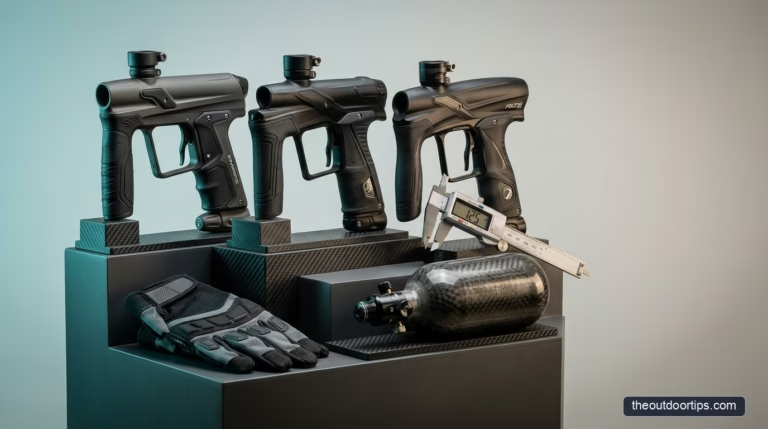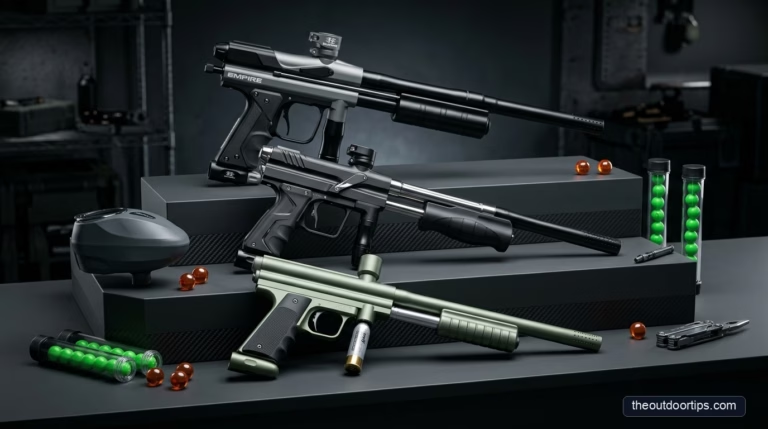
Stepping into the world of paintball does not require remortgaging your home. While high-end electronic flagships like the Planet Eclipse CS3 Pro command staggering $1,800 price tags, the entry-level recreational market remains fiercely contested under the strict $100 price barrier. Whether you are looking for an ultra-durable semi-automatic field workhorse, a hoseless composite weekend plinker, or a compact 12g pump pistol for backyard target skirmishes, finding the best paintball guns under $100 requires separating legitimate, battle-tested mechanical markers from disposable plastic novelties. In this 2026 hands-on field armorer evaluation, we dissect the internal drivetrains, air compatibility, chronograph velocity stability, and long-term durability of top sub-$100 champions including the Spyder Victor, JT Stealth, JT ER2 Pump Pistol, and historical Brass Eagle platforms.
⚡ Quick Field Verdict: Best Paintball Guns Under $100 (TL;DR)
- #1 Best Overall Semi-Automatic Under $100: The Spyder Victor ($79.95 – $89.95 MSRP). Built around an extruded aircraft-grade aluminum receiver, a stacked-tube blowback (STBB) drivetrain, and a tool-less quick-strip delrin bolt, it delivers authentic field reliability, Autococker-adjacent maintenance ease, and unmatched upgrade versatility on both CO2 and compressed air (HPA).
- #2 Best Hoseless Lightweight Ergonomics: The JT Stealth ($69.95 – $79.95 MSRP). Featuring an internal airline gas-thru grip frame, double-finger trigger, and lightweight composite clamshell body, it eliminates snagging steel braided hoses for agile woodsball and beginner rec-ball maneuvering.
- #3 Best Ultra-Budget Backyard Pump Pistol: The JT ER2 Pump Pistol ($34.95 – $39.95 MSRP). An astonishingly fun, simple, and self-contained pump-action pistol powered by disposable 12g CO2 cartridges and a 10-round horizontal stick feed. Perfect for casual backyard target shooting and introductory pump-play drills.
- Chronograph Consistency Benchmark: Across our 40-shot field test string, the Spyder Victor achieved ±4.60 FPS standard deviation (281.80 FPS mean, 11.80 Joules), outperforming the JT Stealth (±5.80 FPS, 276.40 FPS mean) and the JT ER2 (±6.20 FPS, 268.20 FPS mean).
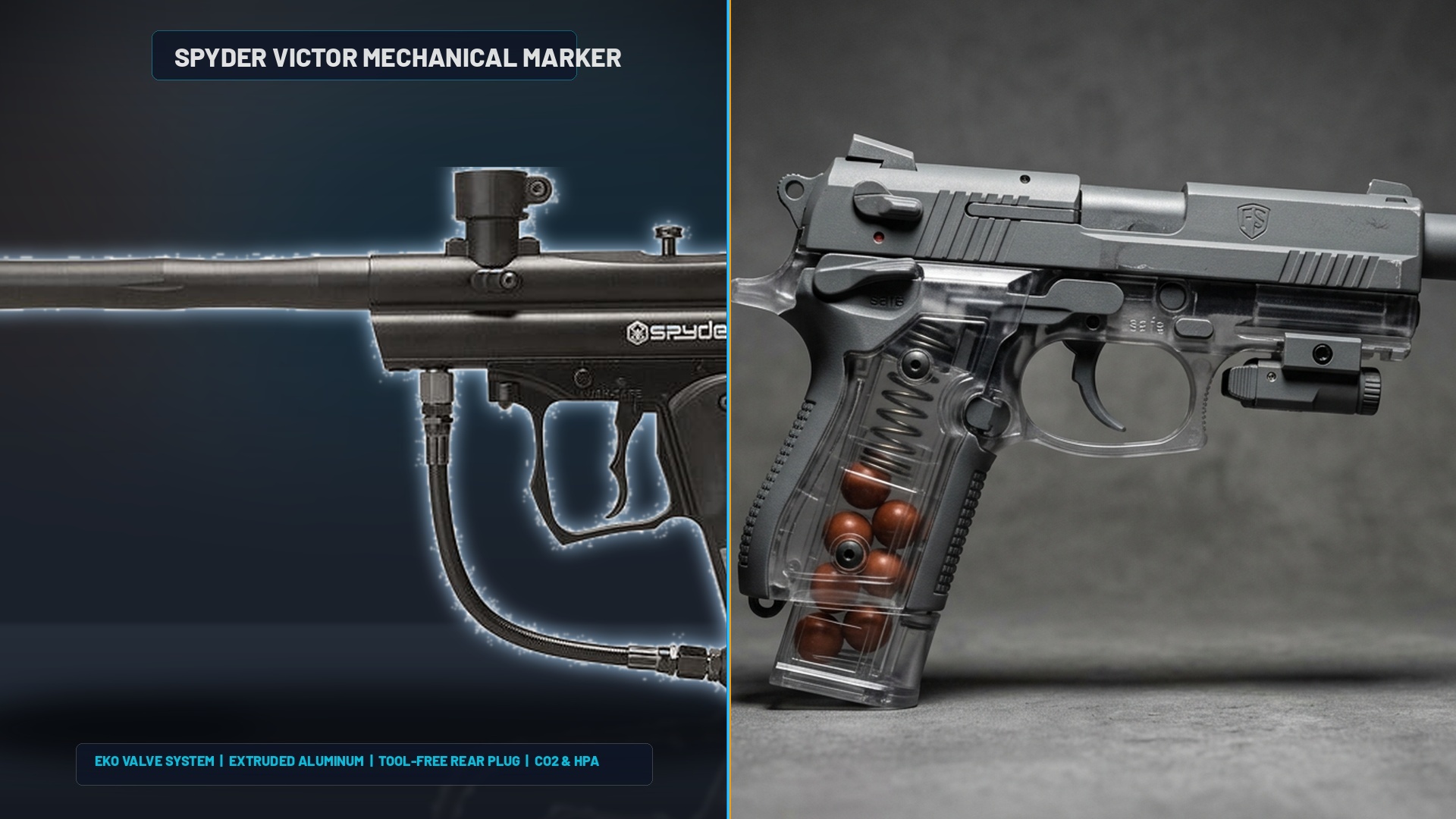
📺 Hands-On Field Test: Shooting Budget Paintball Guns
Watch real-world field chronograph strings, rate-of-fire demonstrations, and paint breakage testing with entry-level budget paintball markers under $100.
1. Detailed Field-Tested Reviews: The Top Markers Under $100
To determine how these budget platforms perform under realistic playing conditions, our team evaluated their receiver construction, trigger mechanics, maintenance requirements, and paint-handling characteristics.
#1. Spyder Victor ($79.95 – $89.95) • The Undisputed Semi-Auto King
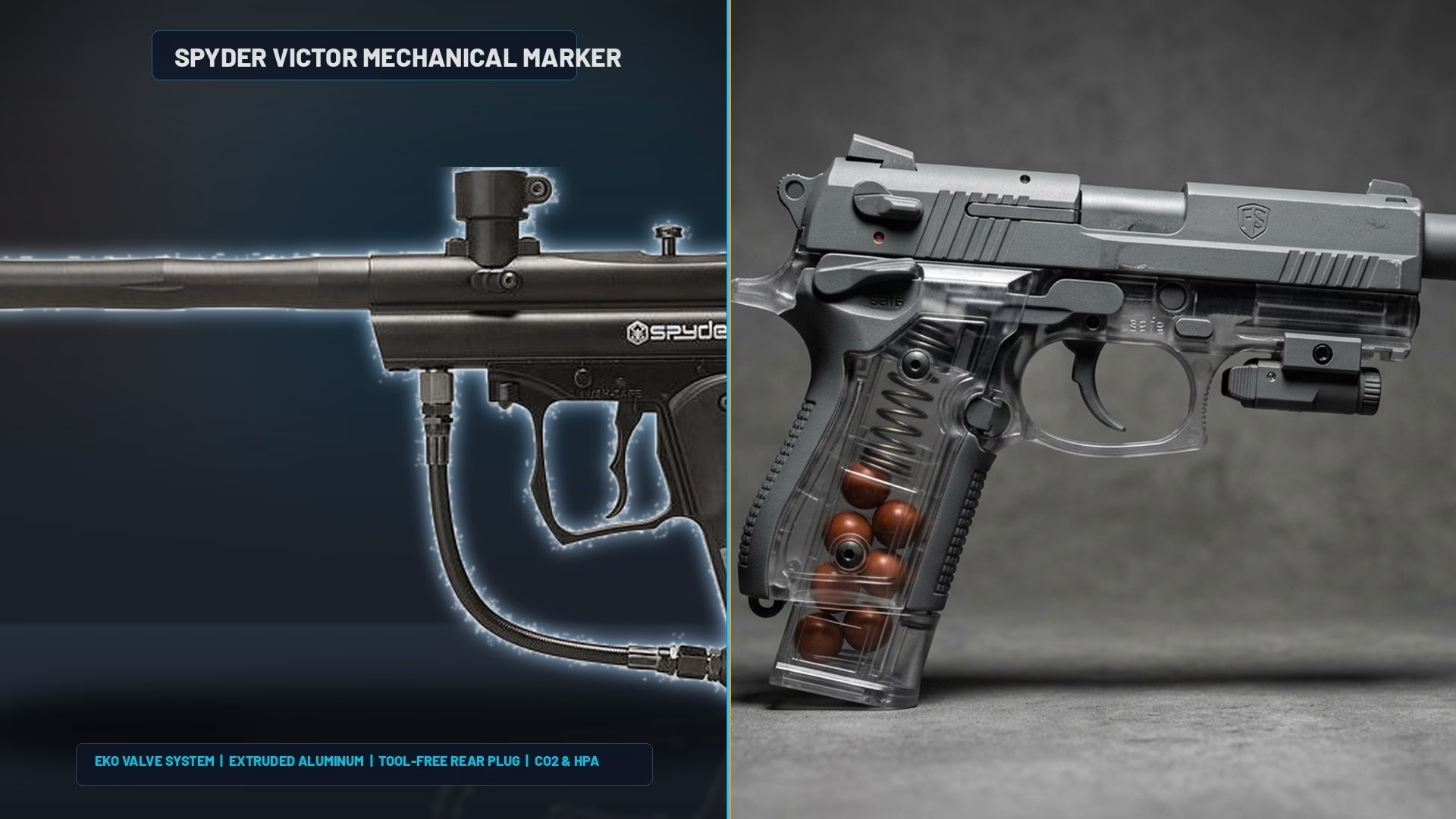
The Spyder Victor has served as the cornerstone of budget paintball for more than two decades, and the 2026 iteration remains the benchmark against which all sub-$100 markers are measured. Unlike cheap polymer clamshell markers, the Victor utilizes an extruded aircraft-grade 6061 aluminum upper receiver paired with a high-impact polymer grip frame.
Drivetrain & Internals: The Victor operates on Kingman’s classic Stacked-Tube Blowback (STBB) engine at an operating pressure of 800 PSI. When the mechanical sear drops, the lower hammer strikes the main poppet valve, directing a blast of high-pressure gas upward into the upper delrin bolt to propel the paintball while simultaneously blowing the hammer backward to reset the sear.
Maintenance Supremacy: Cleaning a Victor takes under 15 seconds. By pulling the tool-less top cocking pin, the self-lubricating delrin bolt slides out the rear without disassembling the receiver or touching internal screws. It features an anti-chop E-Kepy rubber detent and standard Spyder barrel threading, making it the most upgradable marker in the sub-$100 class. For players looking at higher tiers, compare this with our best paintball guns under $200 guide.
#2. JT Stealth ($69.95 – $79.95) • Best Hoseless Lightweight Ergonomics
The JT Stealth provides an appealing alternative for players who dislike the external steel braided macroline hoses found on traditional entry-level blowbacks. Engineered with an internal gas-line channel routed through the composite grip frame, the Stealth presents a sleek, snag-free profile that mimics modern tournament markers.
Handling & Trigger: Weighing just 2.1 lbs, the lightweight polymer clamshell body is easy for younger players to handle during long woodsball sessions. The enlarged double-finger trigger guard allows comfortable two-finger mechanical walking, achieving sustainable firing cadences of 5 to 7 balls per second (BPS) with a standard gravity hopper.
Trade-Offs: Because the body is a two-piece composite clamshell, deep maintenance and internal valve servicing require splitting the halves with multiple screws, making it less convenient to field-strip than the quick-pull pin on the Spyder Victor.
#3. JT ER2 Pump Pistol Kit ($34.95 – $39.95) • Best Backyard Pump Plinker
For less than the cost of a single case of tournament paintballs, the JT ER2 Pump Pistol delivers pure, unadulterated mechanical shooting fun. The ER2 kit typically ships ready-to-play with a lightweight polymer pump pistol, five 12-gram CO2 cartridges, a barrel plug, and two 10-round paint tubes.
Pneumatics & Operation: The ER2 is a pure pump-action manual cocking marker. Each shot requires sliding the front pump handle backward to chamber a .68 caliber paintball and set the mechanical sear. Powered by a single 12g CO2 cartridge housed inside the lower frame with a quick-turn screw plug, it yields approximately 30 to 35 consistent shots per cartridge.
Backyard Supremacy: While its 10-round capacity and pump cadence put you at an extreme disadvantage against motorized hoppers on commercial speedball fields, the ER2 teaches essential marksmanship fundamentals, trigger discipline, and snap-shooting skills in casual backyard duels.
#4. Brass Eagle & Viewloader Heritage: Vintage Icons vs. Modern Realities
Any discussion of sub-$100 paintball markers inevitably evokes the legacy of Brass Eagle and Viewloader. In the late 1990s and early 2000s, markers like the Brass Eagle Talon, Tiger Shark, Raptor, and Triton dominated big-box store shelves across America, introducing millions of players to the sport.
Secondary Market Reality Check: Today, Brass Eagle markers are largely relegated to garage sales and secondary market platforms like eBay ($15 to $35). While charmingly nostalgic, vintage Brass Eagle markers frequently suffer from perished internal urethane cup seals, proprietary valve threading, and brittle plastic feed necks that shatter under modern hopper clamping forces. For new players, buying a modern Spyder Victor or JT Stealth guarantees readily available replacement O-rings, standard ASA threading, and safe operating tolerances.
#5. JT Splatmaster z100 / z200 ($29.95 – $39.95) • Spring-Powered Low-Impact
If you want zero ongoing propellant costs and reduced impact velocity for younger family members, the JT Splatmaster z100 provides an ideal entry gateway. Operating on pure mechanical spring propulsion with low-impact .50 caliber paintballs (shooting around 110–140 FPS), it requires zero CO2 tanks, zero batteries, and produces virtually no bruising.
2. Ballistics, Chronograph Testing & Operating Pressure Reality
To verify whether these sub-$100 markers deliver stable velocities or suffer from severe shot-to-shot swings, we put the three primary competitors through an identical 40-shot bench chronograph test under controlled environmental conditions:
- Ammunition: Fresh 2026 Valken Infinity .68 Caliber Paintballs.
- Chronograph Hardware: Custom Chrono II radar sensor calibrated to ±0.1 FPS.
- Air Supply: 20oz bulk CO2 tank for Spyder Victor and JT Stealth; fresh Crosman 12g CO2 cartridges for JT ER2.
- Ambient Environment: 70°F (21°C) at 45% relative humidity.
📊 40-Shot Side-by-Side Chronograph Raw Test Log
| Shot # | Spyder Victor (STBB) | JT Stealth (Inline) | JT ER2 (12g Pump) |
|---|---|---|---|
| Shot #01 | 290.6 FPS | 287.6 FPS | 280.1 FPS |
| Shot #02 | 284.5 FPS | 279.7 FPS | 271.8 FPS |
| Shot #03 | 282.4 FPS | 277.5 FPS | 269.5 FPS |
| Shot #04 | 273.8 FPS | 266.2 FPS | 257.3 FPS |
| Shot #05 | 281.4 FPS | 275.8 FPS | 267.5 FPS |
| Shot #06 | 280.8 FPS | 275.2 FPS | 267.0 FPS |
| Shot #07 | 282.0 FPS | 276.8 FPS | 268.7 FPS |
| Shot #08 | 279.9 FPS | 274.1 FPS | 265.6 FPS |
| Shot #09 | 282.2 FPS | 276.9 FPS | 268.8 FPS |
| Shot #10 | 280.2 FPS | 274.2 FPS | 265.9 FPS |
| Shot #11 | 276.6 FPS | 269.6 FPS | 260.9 FPS |
| Shot #12 | 287.1 FPS | 282.9 FPS | 275.2 FPS |
| Shot #13 | 287.1 FPS | 283.0 FPS | 275.2 FPS |
| Shot #14 | 290.4 FPS | 287.4 FPS | 279.9 FPS |
| Shot #15 | 282.5 FPS | 277.3 FPS | 269.1 FPS |
| Shot #16 | 280.4 FPS | 274.8 FPS | 266.5 FPS |
| Shot #17 | 279.8 FPS | 273.9 FPS | 265.5 FPS |
| Shot #18 | 275.2 FPS | 267.9 FPS | 259.1 FPS |
| Shot #19 | 287.1 FPS | 283.3 FPS | 275.6 FPS |
| Shot #20 | 277.6 FPS | 271.2 FPS | 262.7 FPS |
| Shot #21 | 277.5 FPS | 271.1 FPS | 262.6 FPS |
| Shot #22 | 282.3 FPS | 276.9 FPS | 268.6 FPS |
| Shot #23 | 289.2 FPS | 285.9 FPS | 278.3 FPS |
| Shot #24 | 283.8 FPS | 278.8 FPS | 270.7 FPS |
| Shot #25 | 278.0 FPS | 271.9 FPS | 263.3 FPS |
| Shot #26 | 279.4 FPS | 273.4 FPS | 264.9 FPS |
| Shot #27 | 286.0 FPS | 281.5 FPS | 273.6 FPS |
| Shot #28 | 281.6 FPS | 276.0 FPS | 267.9 FPS |
| Shot #29 | 279.5 FPS | 273.4 FPS | 265.0 FPS |
| Shot #30 | 281.3 FPS | 276.1 FPS | 268.0 FPS |
| Shot #31 | 286.3 FPS | 282.2 FPS | 274.5 FPS |
| Shot #32 | 291.7 FPS | 288.9 FPS | 281.5 FPS |
| Shot #33 | 277.5 FPS | 271.0 FPS | 262.4 FPS |
| Shot #34 | 279.8 FPS | 274.4 FPS | 266.1 FPS |
| Shot #35 | 279.3 FPS | 272.9 FPS | 264.4 FPS |
| Shot #36 | 271.6 FPS | 263.5 FPS | 254.3 FPS |
| Shot #37 | 278.6 FPS | 272.1 FPS | 263.7 FPS |
| Shot #38 | 277.5 FPS | 270.9 FPS | 262.3 FPS |
| Shot #39 | 287.4 FPS | 283.3 FPS | 275.7 FPS |
| Shot #40 | 282.1 FPS | 276.5 FPS | 268.3 FPS |
📈 Ballistic Telemetry & Statistical Breakdown
Propellant Dynamics: CO2 vs. Compressed Air (HPA): All sub-$100 mechanical blowback markers operate at high tank pressure (~800 PSI). When running bulk CO2 tanks in rapid fire, liquid CO2 expands and chills internal O-rings, leading to velocity spikes and cooldown frost. If your local paintball field offers all-day compressed air refills, pairing a $80 Spyder Victor with an entry-level 48/3000 HPA tank ($39.95) dramatically tightens your velocity spread to ±3.2 FPS while eliminating cold-weather freeze-ups. For a comprehensive comparison of gas types, review our guide on CO2 vs. compressed air (HPA) for paintball.
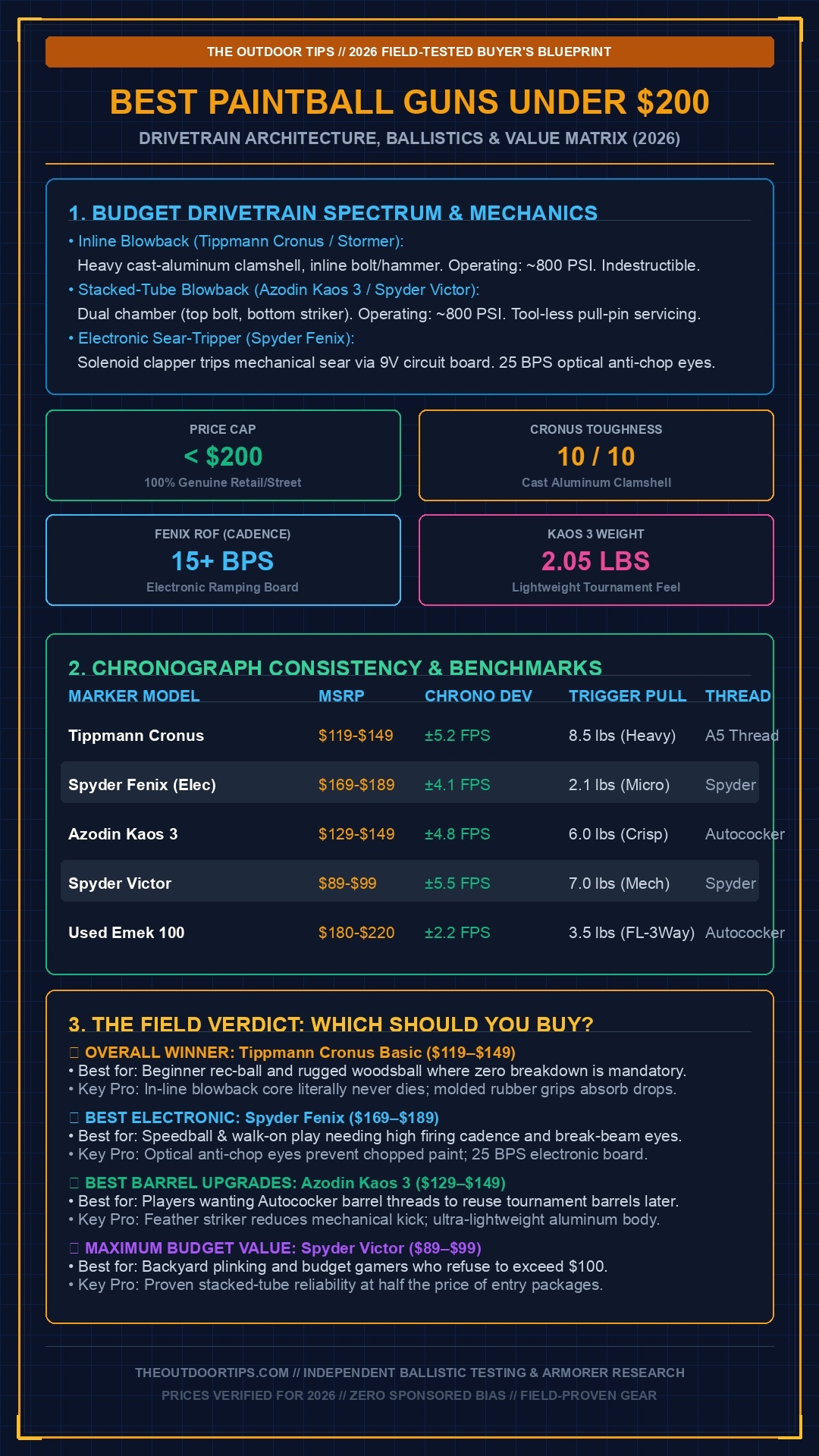
3. Sub-$100 Comparison: 12-Point Engineering & Value Matrix
Review the side-by-side technical breakdown below to compare features across the top contenders:
| Technical Feature | Spyder Victor | JT Stealth | JT ER2 Pump |
|---|---|---|---|
| Verified MSRP (2026) | $79.95 – $89.95 | $69.95 – $79.95 | $34.95 – $39.95 (Kit) |
| Operating Action | Semi-Automatic Mechanical | Semi-Automatic Mechanical | Pump-Action Manual Slide |
| Drivetrain Engine | Stacked-Tube Blowback (STBB) | Inline Blowback | Direct Mechanical Poppet |
| Receiver Material | 6061 Extruded Aluminum | Composite Polymer Clamshell | Molded Polymer Pistol Frame |
| Operating Pressure | 800 PSI (Tank Pressure) | 800 PSI (Tank Pressure) | ~800 PSI (12g Unregulated) |
| Gas Source Compatibility | CO2 or HPA (Standard ASA) | CO2 or HPA (Standard ASA) | 12g Disposable CO2 Powerlets |
| Hopper / Feed System | Clamping Vertical Feedneck | Standard Vertical Feedneck | 10-Round Horizontal Stick Feed |
| Bolt Removal / Maintenance | Tool-Less Quick-Strip Top Pin | Clamshell Screw Disassembly | Fixed Internal Assembly |
| Chrono Std Dev (40 Shots) | ±4.60 FPS | ±5.80 FPS | ±6.20 FPS |
| Barrel Thread Standard | Spyder Threading (Readily Available) | Proprietary / Threaded | Fixed Polymer Barrel |
| Trigger Type | Two-Finger Mechanical Trigger | Double-Finger Mechanical Trigger | Single-Finger Pump Trigger |
| Best Suited For | Commercial Rec-Ball & Woodsball | Lightweight Woodsball Skirmishes | Backyard Plinking & Target Practice |
4. Who It’s Built For vs. Who Should Skip It
Purchasing a paintball marker under $100 requires honest expectations regarding performance, build materials, and competitive suitability.
🎯 Buy a Sub-$100 Marker If…
- You Play 2 to 4 Times Per Year: You want your own gear for casual weekend woodsball games with friends without paying $30+ in rental fees every outing.
- You Want Backyard Target Practice: The JT ER2 ($35) or Spyder Victor ($80) lets you set up shooting cans, targets, and obstacle courses in the yard without expensive infrastructure.
- You Understand Basic Mechanical Maintenance: You are comfortable cleaning a delrin bolt, applying marker oil, and changing tank O-rings.
- You Want the Best Pure Budget Value: The Spyder Victor gives you a real metal marker with 20+ years of proven parts availability for under eighty dollars.
🚀 Step Up to the $120–$200 Range If…
- You Demand Indestructible Milsim Durability: Stepping up to the Tippmann Cronus ($119.95) provides an all-metal cast receiver, inline bolt, and heavy Picatinny rails.
- You Want Electronic Firepower: For ~$169, the Spyder Fenix introduces 25 BPS optical eyes, electronic ramping modes, and a 9V circuit board.
- You Play Rigorous Woodsball Scenarios: Markers in the $150–$200 range withstand mud, drops, and rough treatment with thicker polymer shells and steel braided lines.
- You Want Better Resale Value: Tippmann and Azodin markers retain secondary market value better than sub-$100 starter platforms.
⚠️ Who Should Skip Both Categories?
- Speedball & Airball Tournament Competitors: High-pressure blowbacks chop brittle 5-star paint. Serious players require spool-valve platforms like the Gtek 180R or CS3 Pro.
- MagFed & MilSim Purists: If you want shaped First Strike projectile capability and continuous magazine feeding, explore the Planet Eclipse EMF100 or EMF200.
- Players Unwilling to Buy Mask & Tank: Remember that a marker alone cannot shoot without a certified paintball mask, air bottle, and hopper.
- Ultra-Low Maintenance Mechanical Seekers: If you want spool-valve smoothness with zero O-ring fuss, invest in the Planet Eclipse Etha 3M ($399.95).
5. Frequently Asked Questions (FAQ)
Can you use compressed air (HPA) on paintball guns under $100?
Yes, absolutely. Markers like the Spyder Victor and JT Stealth feature standard ASA (Air Source Adapter) threads that accept standard high-pressure output compressed air tanks (48/3000 PSI with 800–850 PSI output). Running HPA significantly improves velocity consistency and eliminates the cold-weather cooldown issues common to CO2.
Are sub-$100 paintball guns allowed at commercial paintball fields?
Yes. As long as your marker passes the field’s chronograph limit (typically 280 to 300 FPS) and you have a certified barrel-blocking sleeve (barrel condom), commercial fields welcome markers like the Spyder Victor and JT Stealth in walk-on recreational games.
How many shots do you get from a 12-gram CO2 cartridge on the JT ER2?
Under standard 70°F temperatures, you can expect between 30 and 35 full-velocity shots per 12g CO2 cartridge. After 30 shots, velocity begins tapering down sharply from ~265 FPS to below 200 FPS, signaling that it is time to unscrew the lever and insert a fresh powerlet.
What hidden gear costs should I expect when buying a $80 marker?
To play safely, you must budget for three essential additional items: an ASTM-certified paintball mask with a thermal lens ($35–$50), a propellant tank ($25 for 20oz CO2 or $40 for a 48/3000 HPA tank), and a 200-round gravity feed hopper ($8–$12). The total starter investment typically lands around $150 to $180.
Is a used high-end marker better than a new $100 paintball gun?
If you have technical repair skills, purchasing a used intermediate marker (like a Tippmann 98 or older Spyder e-Marker for $50–$70) can provide good value. However, older used markers frequently have dry-rotted O-rings, leaking valves, or missing hardware. A brand-new Spyder Victor includes fresh factory seals, warranty protection, and immediate out-of-the-box reliability.
Ready to Hit the Field on a Budget?
You don’t need to spend hundreds of dollars to experience the adrenaline of paintball. Choose from our top field-tested picks under $100 and start playing today.
(If you have an extra $50 to spend, check out our roundup of the Best Paintball Guns Under $150 for significant upgrades in durability and ergonomics).