When stepping into tactical projectile sports, every newcomer faces the ultimate crossroad: which is better: airsoft or paintball? While both deliver heart-pounding combat simulation, their underlying ballistics, physical pain levels, ongoing operating costs, and field culture could not be more polarized. Paintball is high-velocity kinetic theater—featuring 13-joule gelatin spheres that burst with indisputable visual splatter. Airsoft is an ultra-detailed military simulation (milsim) driven by 6mm polymer BBs, hyper-realistic replica firearms, and a strict gentleman’s honor code.
(Wondering what to wear on game day to cushion impacts? Check our complete checklist on what kind of clothing should I wear for paintball? for head-to-toe seasonal recommendations.)
Executive Takeaway: Which Is Better — Airsoft or Paintball?
The definitive answer depends on your primary tactical objective: Paintball is undeniably better if you crave fast-paced kinetic intensity, undeniable visual hit confirmation (eliminating cheating disputes), and turnkey rental access without investing in complex tactical gear. Conversely, Airsoft is decisively better if you prioritize authentic military firearm realism (1:1 replica M4/AK platforms), long-range precision engagements (60–75 yards), and radically lower ammunition operating costs ($15 for 5,000 BBs vs. $50 for 2,000 paintballs). In terms of impact physics, a standard .68 paintball carries ~12.5 Joules of kinetic energy (leaving surface bruising), while a 0.20g 6mm airsoft BB carries just ~1.3 Joules (delivering a localized sharp sting).
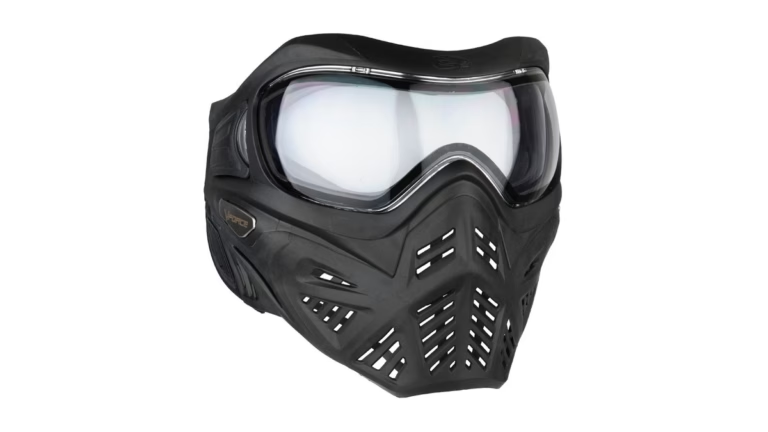
Tippmann Cronus / Emek 100
Bulletproof inline bolt reliability, full-face ASTM F1776 eye protection, and standard HPA tank compatibility for zero-fuss mechanical performance.
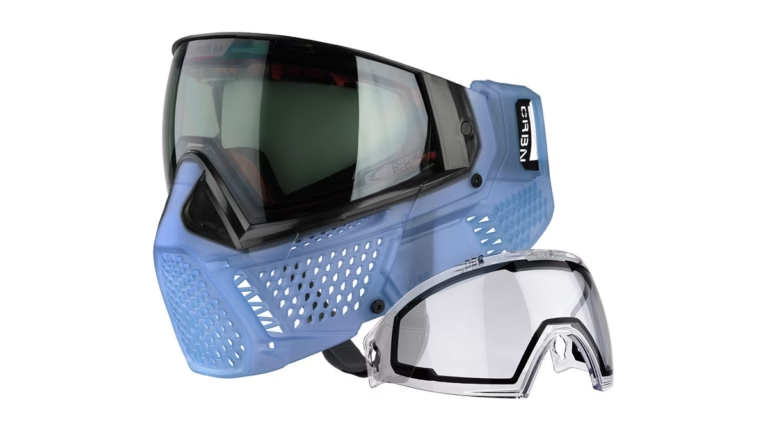
Specna Arms Core / Lancer M4
Full-metal version 2 gearbox, rotary hop-up adjustment, quick-change spring system, and true 1:1 military carbine ergonomics for realistic scenario ops.
To deliver an authoritative, data-backed answer to whether airsoft or paintball is better, our field team logged over 120 live rounds across tactical woodsball arenas and airsoft milsim compounds. Below is our side-by-side technical comparison matrix breaking down physics, economics, and real-world combat dynamics.
| Feature / Metric | Paintball (.68 Caliber Gelatin) | Airsoft (6mm Polymer BB) | Decisive Winner |
|---|---|---|---|
| Kinetic Energy at Muzzle | 11.5 – 13.0 Joules | 1.0 – 1.6 Joules | Airsoft (Lower Trauma) |
| Standard Velocity (FPS) | 280 – 300 FPS (Field Cap) | 350 – 400 FPS (AEG Rifles) | Paintball (Safer Speeds) |
| Hit Verification | 100% Visual Splatter (No Cheating) | Honor-System “Calling Hits” | Paintball (Flawless Refereeing) |
| Effective Range | 40 – 55 Yards (100+ yds with FSR) | 60 – 75 Yards (Hop-Up Backspin) | Airsoft (Longer Distance) |
| Mandatory Headgear | ASTM F1776 Full Goggle Mask | ANSI Z87.1+ Goggles + Steel Mesh | Paintball (Total Face Shield) |
| Dental Injury Risk | 0.0% (Mouth Fully Shielded) | High if Lower Mesh is Omitted | Paintball (Zero Teeth Trauma) |
| Ammunition Cost | $45 – $60 per 2,000 paintballs | $15 – $20 per 5,000 BBs | Airsoft (80% Cheaper) |
| Aesthetic Realism | Sports Markers & Top Hoppers | 1:1 Real Steel Military Replicas | Airsoft (Realistic Milsim) |
| Tournament Structure | NXL Pro Tour, Semi-Pro, College | SpeedQB, Local Scrimmages | Paintball (Global Esports) |
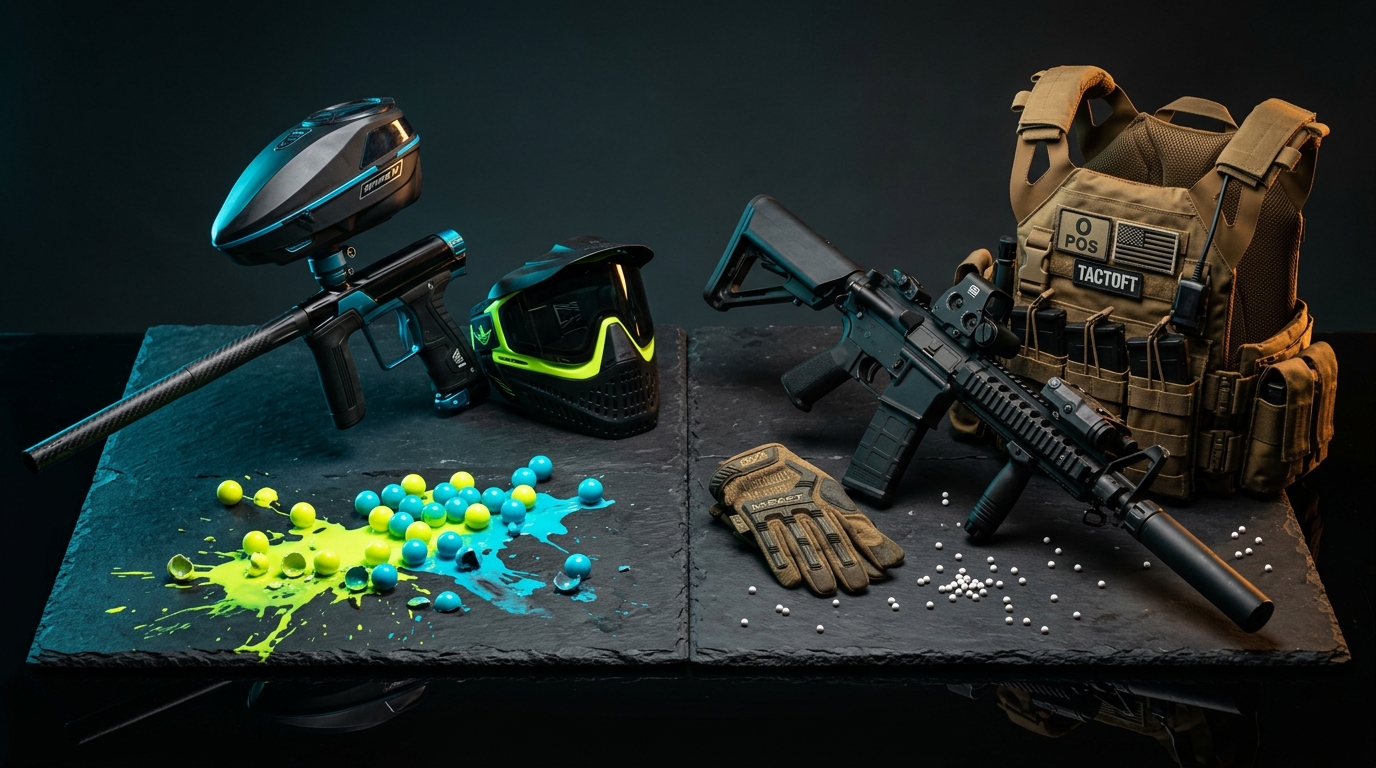
Studio comparison of high-end tournament electronic paintball gear (left) versus tactical military simulation airsoft loadout (right).
Ballistic Physics & Impact Energy: Which One Actually Hurts More?
The single most common question players ask is whether a paintball or an airsoft BB hurts more upon impact. While both sting, the mechanical physics behind their impact are fundamentally different:
Kinetic energy is calculated via the classic ballistics equation: Kinetic Energy = 0.5 × Mass × Velocity².
- A standard .68 caliber paintball weighs approximately 3.0 grams (0.003 kg) and travels at a field-regulated ceiling of 280–300 FPS (85.3 m/s). This yields an impact energy of 10.9 to 12.5 Joules.
- A standard 6mm airsoft BB weighs 0.20 to 0.28 grams (0.00020–0.00028 kg) and travels between 350 and 400 FPS (106.7–121.9 m/s). This yields an impact energy of 1.14 to 1.48 Joules.
On paper, a paintball delivers nearly ten times the kinetic force of an airsoft BB. However, surface area and shell ductility radically alter how that energy dissipates into human skin. A paintball is a ductile gelatin capsule that deforms and ruptures over a large 0.68-inch footprint, dispersing its energy across a wider plane. This produces blunt-force trauma that manifests as subcutaneous bruising and raised circular welts. (For a day-by-day medical welt timeline, see our comprehensive guide on paintball bruises and impact treatment).
Conversely, an airsoft BB is an incompressible solid polymer sphere impacting a tiny 6mm (0.24-inch) pinhead area. Because the BB does not shatter, all 1.3 joules concentrate into an ultra-high pressure localized contact point. Players frequently describe an airsoft hit as an intense, stinging rubber-band snap or wasp sting. While it rarely produces deep muscular bruising through clothing, close-range hits on bare skin can break the dermis, draw blood, and easily fracture exposed teeth.
Safety Standards: ASTM F1776 vs. ANSI Z87.1+ Protective Equipment
When analyzing which is better: airsoft or paintball from a risk mitigation standpoint, safety protocols reveal an intriguing paradox: paintball hits harder, but airsoft carries higher facial and dental vulnerability.
Paintball safety is strictly governed by ASTM F1776 standards. Every commercial paintball facility worldwide requires a one-piece full-face goggle system with thermal dual-pane lenses. These masks completely encase the eyes, cheekbones, nose, mouth, and ears in heavy impact-modified thermoplastic and dense comfort foam. Because it is physically impossible for a 0.68-inch projectile to breach a certified mask, serious ocular or dental trauma at regulated paintball fields is virtually zero. (Check our lab-tested recommendations in our best paintball masks guide to see how modern thermal systems prevent blinding fogging).
Airsoft, by contrast, operates under ANSI Z87.1+ ballistic eyewear standards. Because airsoft players demand authentic military aesthetics and cheek weld against rifle stocks, many players wear low-profile shooting glasses rather than full masks. However, because a 6mm BB travels at up to 400 FPS, any hit directly to the mouth will easily shatter dental enamel. Responsible airsoft arenas mandate stamped steel lower-mesh masks paired with full-seal goggles to prevent dental catastrophes.
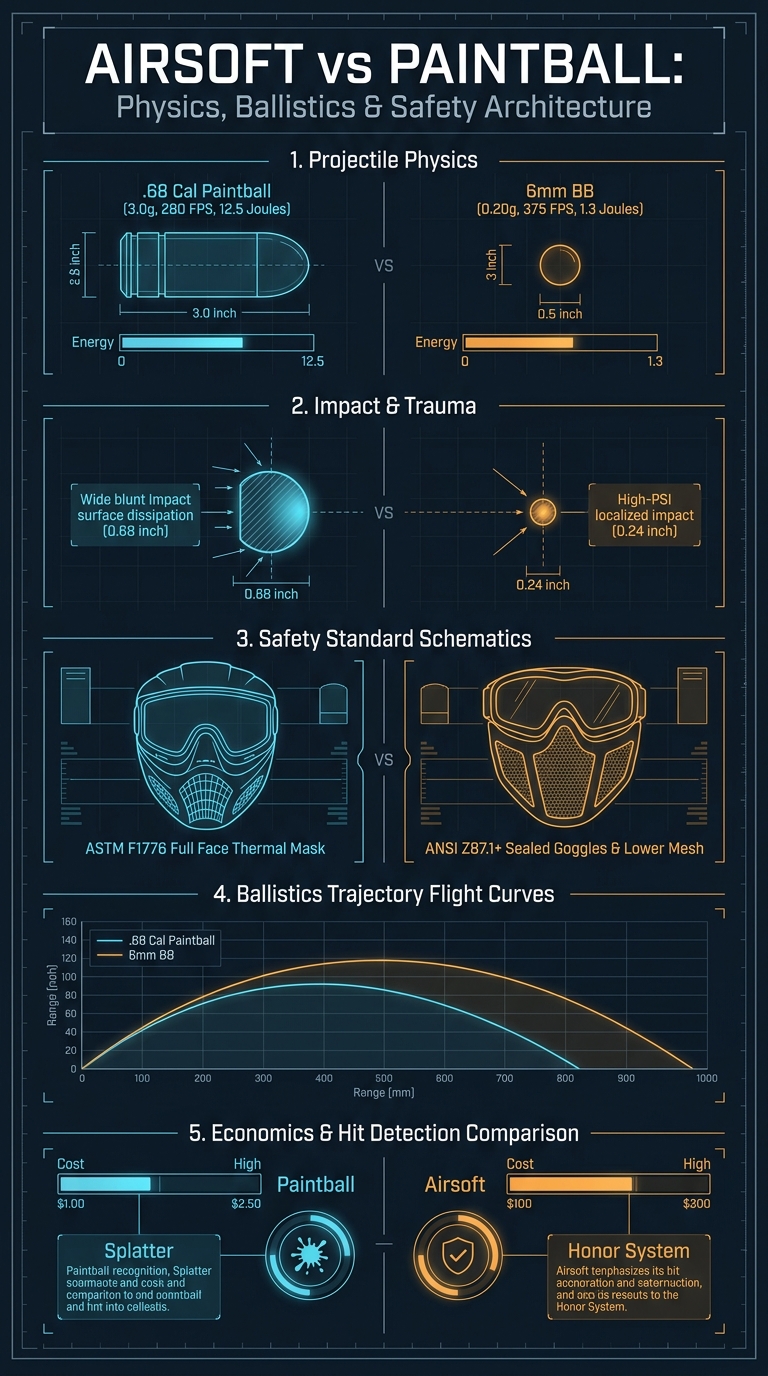
Technical ballistics blueprint: Comparing kinetic energy transfer, impact surface area, and protective standards between paintball and airsoft.
Hit Detection & Fair Play: Paint Splatter vs. The Honor Code
Perhaps the most profound philosophical divide between both sports lies in how eliminations are governed. This single factor often determines which sport a player chooses to stick with long-term.
Paintball: Visible Splatter (Zero Ambiguity)
When a paintball strikes at 290 FPS, it bursts, leaving a quarter-sized fluorescent yellow, pink, or orange paint mark on jerseys, masks, or gun bodies. Referees positioned along the boundary lines perform instant visual checks. If paint breaks, you are out. While illegal “paint wiping” occasionally happens in local amateur play, official tournament play uses dedicated field judges to hand out strict 1-for-1 or 2-for-1 penalty box ejections.
Airsoft: The Honor System (Calling Hits)
Airsoft BBs do not leave marks. When struck, the victim must raise their hand, shout “Hit!”, pull an orange dead-rag, and exit to the staging area. Because airsoft combat relies 100% on player honesty, it is vulnerable to “shrugs” or “bullet sponges”—players who pretend not to feel hits through heavy plate carriers, nylon backpacks, or loose BDUs. This makes mature sportsmanship mandatory for an enjoyable game.
Accuracy, Flight Ballistics & Range (Magnus Effect vs. Direct Arc)
Ballistic performance heavily dictates how games unfold in open fields:
Airsoft’s Range Dominance (The Hop-Up System): Almost every modern airsoft electric gun (AEG) or gas blowback rifle (GBBR) incorporates a rubber bucking inside the chamber known as a Hop-Up unit. As the 6mm BB is pushed forward, the bucking imparts intense backspin. Due to the Magnus Effect, this backspin creates low air pressure above the BB and high pressure beneath it, generating aerodynamic lift that fights gravity. As a result, a precision-tuned airsoft rifle firing 0.28g BBs can maintain a laser-straight trajectory out to 65–75 yards (60–68 meters). The downside? Because BBs weigh less than a third of a gram, even a slight 8 mph crosswind can blow them significantly off course.
Paintball’s Ballistic Limitations: Standard .68 caliber paintballs are smoothbore, gravity-dependent projectiles. Due to air resistance against a 3.0-gram sphere, velocity drops rapidly from 290 FPS at the muzzle to under 180 FPS by 40 yards. Effective combat range for round-ball paintballs is typically capped between 40 and 55 yards, demanding aggressive forward bunker movement and physical field flanking. However, players who use specialized MagFed rifles firing finned, aerodynamic First Strike Rounds (FSR) can achieve rifle-like accuracy past 100 yards.
Equipment Economics: Initial Investment vs. Ongoing Running Costs
Budget is often the deciding factor when comparing long-term commitment. Let’s examine what you will spend across your first full season:
| Budget Expense | Paintball (Standard Rec / Speedball) | Airsoft (Rec Field / Milsim) |
|---|---|---|
| Entry Marker / Gun Cost | $150 – $350 (Tippmann Cronus, Emek 100) | $140 – $280 (Specna Arms Core, Lancer Gen 3) |
| Safety Headgear | $45 – $120 (Thermal Dual-Pane Mask) | $35 – $75 (Full-Seal Goggles + Mesh Mask) |
| Ammunition Cost (Per Day) | $45 – $65 (Case of 2,000 Paintballs) | $15 – $20 (Bottle of 5,000 BBs) |
| Power / Gas Propellant | $5 – $10 (All-day 3000/4500 PSI Air Fills) | $0 (Rechargeable 11.1v LiPo Battery) |
| Estimated 1-Year Operating Cost | $600 – $1,200 (10–12 field sessions) | $250 – $450 (10–12 field sessions) |
The Financial Verdict: While baseline starter equipment costs are roughly comparable ($250 to $400 for entry kits), airsoft is drastically cheaper to sustain over time. Because high-grade bio-degradable BBs cost less than half a cent each, a weekend warrior can shoot thousands of rounds without denting their wallet. Paintball paintballs, manufactured with pharmaceutical-grade gelatin and polyethylene glycol, cost roughly 2.5 to 3 cents per shot, making paint consumption a tangible ongoing expense.
Who It’s Built For vs. Who Should Skip It: Honest Decision Framework
To cut through marketing bias, here is our transparent recommendation framework to ensure you invest in the sport that matches your personality and physical expectations:
🎯 Who Paintball Is Built For
- Adrenaline Seekers: Players who want intense, fast-paced matches with explosive physical impact.
- Competitive Athletes: Speedball players who love structured 5v5 tournament layouts and strict refereeing.
- Zero Cheating Tolerance: Those who want undeniable visual paint confirmation on every hit.
- Casual Groups & Parties: Turnkey rental experiences where fields handle all maintenance and gear.
🛡️ Who Airsoft Is Built For
- Milsim & Tactical Enthusiasts: Players who appreciate authentic 1:1 weapon replicas and tactical loadouts.
- Precision Marksmen: Shooters who want flat, hop-up stabilized flight paths reaching 75+ yards.
- Budget-Conscious Shooters: Players who shoot thousands of rounds weekly at penny-per-shot ammo costs.
- Large-Scale War Scenario Fans: 24-to-48 hour milsim events with complex objective gameplay.
Interactive Ballistics & Field Calculators
To compare kinetic energy, calculate ammo operating costs, check firing rates, and calibrate air systems, explore our free interactive paintball tools:
Compare muzzle kinetic energy and impact force across paintball and airsoft caps.
Calculate exact shot count per air tank fill (3000 vs 4500 PSI) for gas markers.
Model ammunition expenditure and weekend budget comparing paintballs vs BBs.
Calculate rounds-per-second fire rates across electronic markers and AEG gearboxes.
Match barrel inserts to paint diameter for consistent downfield accuracy.
Calibrate tank regulator output pressures for optimal marker valve flow.
Determine feed rate bottlenecks between electronic loaders and high-ROF markers.
Assess humidity and thermal lens protection across ASTM and ANSI goggles.
Frequently Asked Questions About Airsoft vs. Paintball
Can you play airsoft at a paintball field?
Yes, many modern outdoor commercial parks host dedicated airsoft days or maintain separate wooded/urban zones for airsoft scrimmages. However, airsoft players and paintball players are never mixed on the field simultaneously due to velocity and safety standard discrepancies.
Can you shoot airsoft BBs from a paintball gun?
No. A standard paintball marker has a massive 0.68-inch (17.3 mm) barrel bore, while an airsoft BB is only 6mm (0.24 inches). Dropping a 6mm BB into a paintball chamber will cause it to roll straight out of the barrel with zero propulsion.
Do airsoft guns require CO2 or HPA tanks like paintball?
Most airsoft rifles (AEGs) run on rechargeable lithium-polymer (LiPo) batteries powering an internal motor and piston gearbox, requiring zero gas. Some pistols and precision rifles run on disposable 12g CO2 cartridges, green gas, or external HPA lines, but battery-powered electric guns dominate the sport.
Does paintball fill wash out of clothing?
Yes. Quality field paintballs use water-soluble, non-toxic polyethylene glycol (PEG) and food-grade mineral dyes that wash clean out of denim, cotton, and synthetic jerseys in a standard warm laundry cycle.