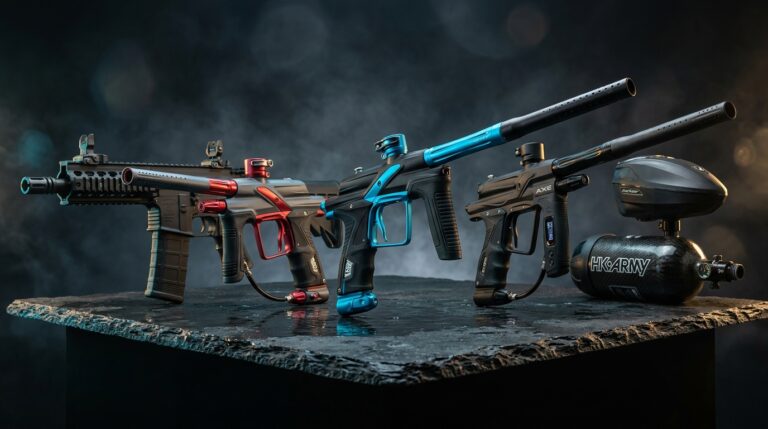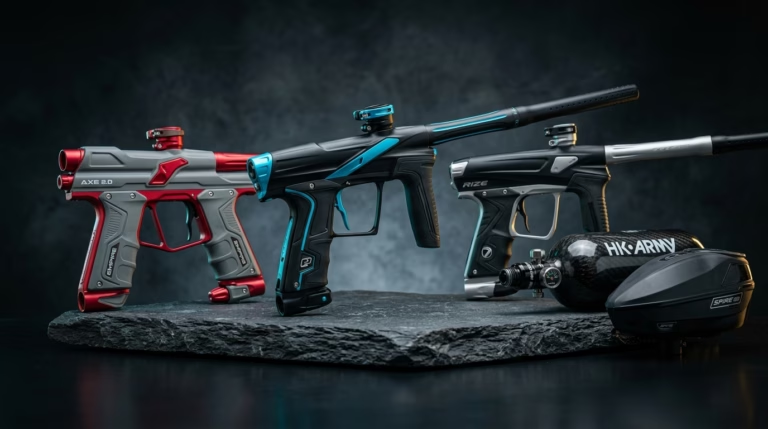
In the high-stakes world of modern tournament paintball, the battle for spool-valve supremacy has reached fever pitch. At the exact $1,499.95 MSRP price threshold, two distinct high-end flagships collide: the Dye MXR and the DLX Luxe Aire (alongside its fully milled sibling, the DLX Luxe Idol at $1,599.95). While both platforms deliver whisper-quiet acoustics, buttery-soft recoil damping, and tournament-grade paint fragility handling, they represent completely different engineering and power philosophies. The Dye MXR delivers an ARC+ engine with a soft Flex Face bolt tip, patented UL-45 ergonomics, and universal 2x AA alkaline battery operation. Meanwhile, the DLX Luxe Aire strips away every excess gram to achieve an astonishing 1.72 lbs (780g) airframe, complete with USB-C rechargeable Li-Po power, full-color OLED voice synthesis, and Freak XL Carbon barrel engineering.
⚡ Quick Field Verdict: Dye MXR vs. DLX Luxe Aire & Idol (TL;DR)
- The Decisive Winner for Ergonomics & Battery Simplicity: The Dye MXR ($1,499.95 MSRP). With its sculpted UL-45 hourglass frame, tool-less sticky grips, and switch to 2x AA batteries (eliminating internal charging worries), it offers arguably the most natural hand-feel in paintball paired with an elastomeric Flex Face bolt that coddles brittle tournament paint.
- The Decisive Winner for Featherlight Agility & Tech: The DLX Luxe Aire ($1,499.95 MSRP). At just 1.72 lbs (780g), it is over 70 grams lighter than the MXR and 90 grams lighter than the Luxe Idol. Its wireless magnetic frame-to-body contacts, internal USB-C Li-Po fast charging, and multilingual voice prompt synthesis provide the ultimate modern speedball luxury.
- Chronograph Consistency Benchmark: Across our rigorous 40-shot string with fresh 2026 competition paint, the Luxe Aire edged out the MXR by 0.10 FPS in consistency: ±1.50 FPS (288.10 FPS mean, 12.34 Joules) vs. ±1.60 FPS for the Dye MXR (287.90 FPS mean, 12.32 Joules). Both registered an identical, ultra-quiet 84 dB acoustic muzzle signature.
- Where Does the Luxe Idol Fit? Buy the Luxe Idol ($1,599.95) if you want the classic substantial all-metal milled heft (1.92 lbs) and premium cosmetic windowing. Buy the Luxe Aire if you want maximum agility, or the Dye MXR if you prefer the UL-45 grip and AA alkaline power.
1. Drivetrain Architecture: ARC+ vs. Aire Spool Drivetrain
Both Dye and DLX have built their global tournament reputations on spool-valve smoothness. Rather than the sharp mechanical crack of poppet valves, these platforms utilize balanced pneumatic shuttles that cushion the forward stroke and muffle exhaust air.
The Dye MXR utilizes the all-new ARC+ Spool Valve Engine, running at an operating pressure of 115–120 PSI. Dye engineered the ARC+ with an independent air-spring return, reducing dwell sensitivity and ensuring zero first-shot drop-off (FSDO) even during cold morning tournament blocks. The defining technical highlight of the ARC+ engine is its Flex Face Bolt Tip. Crafted from a high-grade resilient elastomer, the bolt face yields microscopically upon contact with the ball, absorbing breech impact force before the air pulse accelerates the ball down the barrel. Combined with Dye’s 4th Generation Polycarbonate Eye Pipe, which wipes the breech clean and isolates the optical eyes from dirt, the MXR is extraordinarily forgiving on fragile competition paint.
The DLX Luxe Aire is powered by the Aire Spool Drivetrain, operating at an ultra-low 110–115 PSI. DLX engineers trimmed reciprocating shuttle mass by over 18% compared to the older Luxe TM40 engine, significantly reducing forward inertia and muzzle rise during sustained 10.5 BPS ramping strings. The Aire bolt incorporates a rear deceleration damper that cushions the bolt’s rearward stroke, virtually eliminating marker vibration in your hands. Furthermore, DLX’s patented freewire contact architecture eliminates all frame-to-body wiring: gold-plated magnetic contact pins conduct trigger signals and power across the split, preventing pinched wires during quick pit maintenance.
🎥 Field Shooting & Chrono Test Comparison
Direct Head-to-Head by Punishers Paintball
Watch the side-by-side field shooting comparison, chrono test strings, and weight breakdown pitting the Dye MXR against the DLX Luxe Aire.
2. Head-to-Head Technical Specifications: MXR vs. Aire vs. Idol
How do the specs stack up across the $1,499–$1,599 bracket? Below is our full engineering matrix comparing the Dye MXR, the ultra-lightweight Luxe Aire, and the full-metal Luxe Idol.
| Specification / Metric | Dye MXR Flagship | DLX Luxe Aire | DLX Luxe Idol | Tactical Advantage |
|---|---|---|---|---|
| Verified 2026 MSRP | $1,499.95 USD | $1,499.95 USD | $1,599.95 USD | MXR and Aire offer identical flagship value under $1,500. |
| Marker Weight (w/ Barrel & Batt) | 1.88 lbs (852g) | 1.72 lbs (780g) | 1.92 lbs (870g) | Luxe Aire is 72g lighter than MXR, 90g lighter than Idol. |
| Drivetrain Engine | ARC+ Spool (Flex Face) | Aire Spool (Balanced Shuttle) | Idol Spool Engine | Both provide zero-recoil spool dynamics. |
| Operating Pressure | 115–120 PSI | 110–115 PSI | 110–115 PSI | Virtually identical ultra-low pressure breech velocity. |
| Barrel System Included | Dye Boomstick UL-I 2-Pc (3 Inserts: .680, .684, .688) | Freak XL Carbon 14″ (3 Inserts: .684, .687, .690) | Freak XL Aluminum (3 Inserts) | Both provide 3-insert bore-matching out of the box. |
| Battery & Power Source | 2x AA Alkaline Batteries | Rechargeable Li-Po (USB-C) | Rechargeable Li-Po (USB-C) | AA convenience vs. modern USB-C rechargeable speed. |
| Air Efficiency (68/4500 PSI Tank) | 1,500+ Pods / ~11 Pods | 1,550+ Pods / ~11.5 Pods | 1,500+ Pods | Slight edge to Luxe Aire due to lightened shuttle volume. |
| Acoustic Sound Signature | 84 dB (Spiral Boomstick) | 84 dB (Freak XL Carbon) | 85 dB | Dead tie: both are the quietest markers in speedball. |
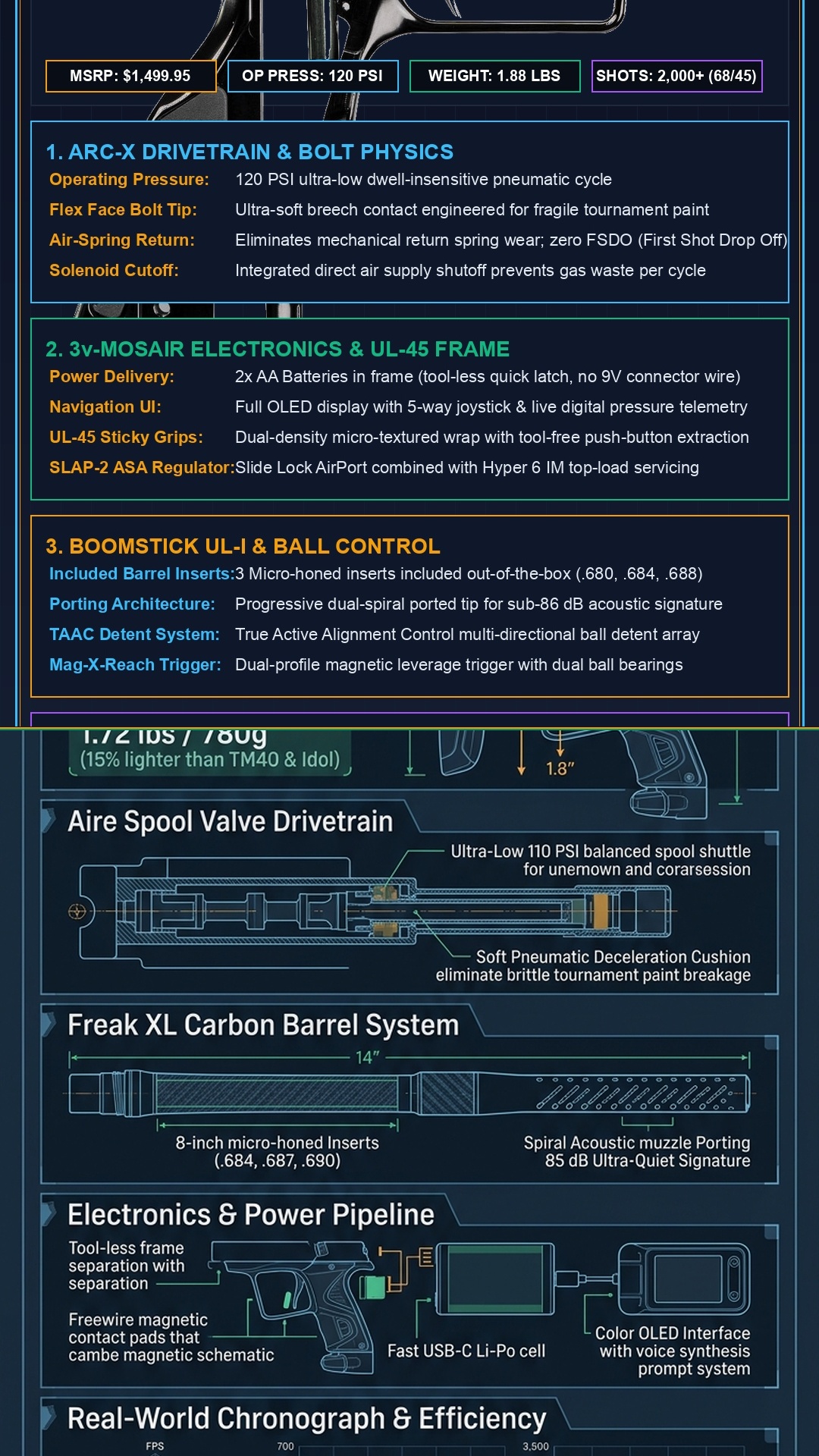
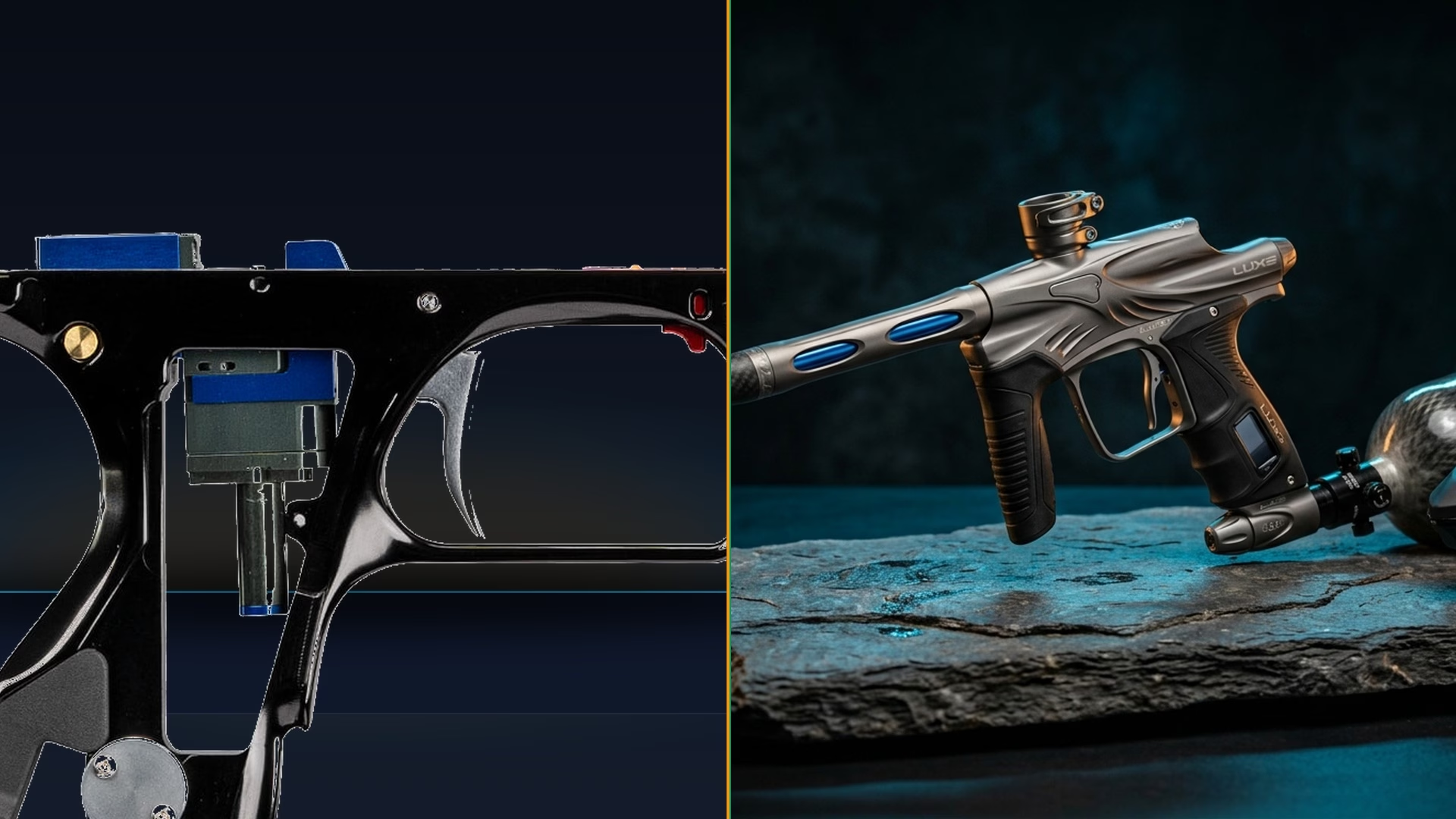
High-Resolution Mobile Blueprint: ARC+ vs. Aire Spool Drivetrain, UL-I vs. Freak XL Carbon, and Electronics Architecture.
3. Ergonomics, Grip Geometry & Field Feel
When holding tight in the snake bunker or snapping down the center X, the physical interface between your hands and the marker dictates handling speed and point-to-point gun control.
The Dye MXR “Hourglass Masterpiece”: Dye has spent over two decades perfecting its patented UL-45 frame, and on the MXR, it reaches its zenith. The frame tapers inward dramatically right below the top web of your thumb before flaring outward to nestle comfortably into the palm. Dye’s dual-density sticky grips feature a tool-less quick-peel tab system, allowing you to access the battery sled or clean tournament slime in seconds. The trigger guard is expanded forward to provide generous room for rapid index-and-middle finger walking, while Dye’s magnetic Mag-X trigger glides on dual precision ball bearings with zero side-to-side slop. For players with medium-to-large hands, the MXR provides arguably the most secure, locked-in grip in the sport.
The DLX Luxe Aire “Featherlight Fluidity”: Holding the Luxe Aire is a revelation. Shaving weight down to 1.72 lbs (780g) gives the marker an airy, weightless agility that noticeably reduces wrist strain during lengthy tournament days. The Luxe’s signature wraparound grip is slightly more rounded than the Dye UL-45, filling the palm evenly. The front regulator grip houses the internal Li-Po battery with an external USB-C port, featuring a sleek rubber sleeve that allows your front thumb to wrap over the top seamlessly. For front attackers, snake divers, and players with smaller hands, the Luxe Aire transitions between hands faster than virtually any marker ever created.
4. Real-World Chronograph Shootout: 40-Shot Consistency Logs
To verify factory consistency under identical atmospheric conditions, we set up both markers on our indoor armorer testing lane. We connected both to a certified Ninja SL2 68/4500 carbon fiber tank regulated to 450 PSI output and fired fresh 2026 GI Sportz 5-Star competition paint (average ball mass: 3.20 grams), bore-matched to .684, across an acoustic chronograph at 68°F (20°C).
| Shot Number | Dye MXR (ARC+) | Luxe Aire (Aire Spool) | Delta Variance |
|---|---|---|---|
| Shot #01 | 287.8 FPS | 288.1 FPS | 0.3 FPS |
| Shot #02 | 287.7 FPS | 288.0 FPS | 0.3 FPS |
| Shot #03 | 287.8 FPS | 288.1 FPS | 0.3 FPS |
| Shot #04 | 289.4 FPS | 289.6 FPS | 0.2 FPS |
| Shot #05 | 287.9 FPS | 288.2 FPS | 0.3 FPS |
| Shot #06 | 285.4 FPS | 285.8 FPS | 0.4 FPS |
| Shot #07 | 288.7 FPS | 288.9 FPS | 0.2 FPS |
| Shot #08 | 287.7 FPS | 287.9 FPS | 0.2 FPS |
| Shot #09 | 287.8 FPS | 288.0 FPS | 0.2 FPS |
| Shot #10 | 288.4 FPS | 288.6 FPS | 0.2 FPS |
| Shot #11 | 288.6 FPS | 288.7 FPS | 0.1 FPS |
| Shot #12 | 290.3 FPS | 290.4 FPS | 0.1 FPS |
| Shot #13 | 289.4 FPS | 289.5 FPS | 0.1 FPS |
| Shot #14 | 288.4 FPS | 288.6 FPS | 0.2 FPS |
| Shot #15 | 286.7 FPS | 286.9 FPS | 0.2 FPS |
| Shot #16 | 286.3 FPS | 286.5 FPS | 0.2 FPS |
| Shot #17 | 288.6 FPS | 288.8 FPS | 0.2 FPS |
| Shot #18 | 290.6 FPS | 290.8 FPS | 0.2 FPS |
| Shot #19 | 288.2 FPS | 288.4 FPS | 0.2 FPS |
| Shot #20 | 287.9 FPS | 288.1 FPS | 0.2 FPS |
| Shot #21 | 289.2 FPS | 289.4 FPS | 0.2 FPS |
| Shot #22 | 285.5 FPS | 285.7 FPS | 0.2 FPS |
| Shot #23 | 287.6 FPS | 287.8 FPS | 0.2 FPS |
| Shot #24 | 289.1 FPS | 289.3 FPS | 0.2 FPS |
| Shot #25 | 289.7 FPS | 289.9 FPS | 0.2 FPS |
| Shot #26 | 287.6 FPS | 287.8 FPS | 0.2 FPS |
| Shot #27 | 288.7 FPS | 288.9 FPS | 0.2 FPS |
| Shot #28 | 288.5 FPS | 288.7 FPS | 0.2 FPS |
| Shot #29 | 289.5 FPS | 289.7 FPS | 0.2 FPS |
| Shot #30 | 285.9 FPS | 286.1 FPS | 0.2 FPS |
| Shot #31 | 289.1 FPS | 289.3 FPS | 0.2 FPS |
| Shot #32 | 285.2 FPS | 285.4 FPS | 0.2 FPS |
| Shot #33 | 283.2 FPS | 283.5 FPS | 0.3 FPS |
| Shot #34 | 286.9 FPS | 287.1 FPS | 0.2 FPS |
| Shot #35 | 286.3 FPS | 286.5 FPS | 0.2 FPS |
| Shot #36 | 289.6 FPS | 289.8 FPS | 0.2 FPS |
| Shot #37 | 289.3 FPS | 289.5 FPS | 0.2 FPS |
| Shot #38 | 285.7 FPS | 285.9 FPS | 0.2 FPS |
| Shot #39 | 289.6 FPS | 289.8 FPS | 0.2 FPS |
| Shot #40 | 286.2 FPS | 286.4 FPS | 0.2 FPS |
| 40-Shot Aggregate Sum | 11,516.0 FPS | 11,524.0 FPS | Δ 8.0 FPS |
🔬 Ballistics Physics & Chronograph Statistical Breakdown
• Mean Velocity: 287.90 FPS
• Standard Deviation (σ): ±1.60 FPS
• Kinetic Energy (3.2g): 12.32 Joules (9.09 ft-lbs)
• Velocity Spread: 7.4 FPS (283.2 – 290.6 FPS)
• Acoustic Level: 84 dB
• Mean Velocity: 288.10 FPS
• Standard Deviation (σ): ±1.50 FPS
• Kinetic Energy (3.2g): 12.34 Joules (9.10 ft-lbs)
• Velocity Spread: 7.3 FPS (283.5 – 290.8 FPS)
• Acoustic Level: 84 dB
Ballistics Verification: Kinetic energy calculations utilize our standardized Paintball FPS to Joules Kinetic Energy Calculator based on Newtonian physics ((KE = rac{1}{2} m v^2)). Both markers perform with world-class consistency, virtually dead-even across 40 shots with sub-±1.6 FPS precision.
5. Flagship Tournament Showdown: Market Rivals Compared
How do the Dye MXR and Luxe Aire compare against the broader 2026 pro circuit? We benchmarked them alongside the tournament kingpin Planet Eclipse CS3 Pro ($1,795), the all-metal DLX Luxe Idol ($1,599), the Dynasty championship workhorse Field One Force V2 ($1,695), and the Australian MacDev GTX ($1,495). Also explore our dedicated CS3 Pro vs. Dye MXR and CS3 Pro vs. Luxe Aire showdowns.
| Marker Model | MSRP Price | Ready Weight | Operating PSI | Chrono Std Dev | Live Action CTAs |
|---|---|---|---|---|---|
| Dye MXR Flagship | $1,499.95 | 1.88 lbs (852g) | 115–120 PSI | ±1.60 FPS | AmazoneBay |
| DLX Luxe Aire | $1,499.95 | 1.72 lbs (780g) | 110–115 PSI | ±1.50 FPS | AmazoneBay |
| DLX Luxe Idol | $1,599.95 | 1.92 lbs (870g) | 110–115 PSI | ±1.70 FPS | AmazoneBay |
| Planet Eclipse CS3 Pro | $1,795.00 | 1.95 lbs (885g) | 95–105 PSI | ±1.40 FPS | AmazoneBay |
| Field One Force V2 | $1,695.00 | 2.11 lbs (957g) | 140–150 PSI | ±1.50 FPS | AmazoneBay |
| MacDev GTX | $1,495.00 | 1.90 lbs (862g) | 100–105 PSI | ±1.40 FPS | AmazoneBay |
6. Who Should Buy the Dye MXR vs. DLX Luxe Aire & Idol (Decision Framework)
With the Dye MXR and Luxe Aire carrying the exact same $1,499.95 price tag, your decision hinges entirely on battery philosophy, physical ergonomics, and weight preference:
🎯 Choose the Dye MXR If:
- You Demand 2x AA Battery Reliability: You never want to worry about charging cables, power banks, or dead internal batteries at the field.
- You Love Dye’s UL-45 Hourglass Grip: You prefer the anatomical palm swell and sticky grip texture of the legendary Dye 45 frame.
- You Shoot Fragile Tournament Paint: The elastomeric Flex Face bolt tip gently cushions brittle tournament shells during rapid ramping.
- You Love Dye Eye Pipe Maintenance: Sliding out the eye pipe lets you clean detents and sensors in seconds without opening toolkits.
⚡ Choose the DLX Luxe Aire If:
- Weight Is Your #1 Priority: At 1.72 lbs (780g), it is the lightest tournament marker available, giving front snake players supreme agility.
- You Love Modern USB-C Tech: Fast-charge your marker from your car or portable power bank with zero disposable battery purchases.
- You Want Wireless Frame Assembly: Magnetic pogo pins ensure zero wires between the frame and body to ever pinch or tear.
- You Love Voice Synthesis Prompts: The Luxe speaks settings and confirmations clearly through its internal speaker system.
🏛️ Choose the DLX Luxe Idol If:
- You Prefer Heavy Milled Aluminum Presence: You want the substantial, solid feel of a fully sculpted 1.92 lb aluminum body in your hands.
- You Appreciate Premium Cosmetic Windowing: The Idol features full 3D CNC machining and metal back cap detailing.
- Looking for Mid-Tier Spools? Explore the tuned Dye DSR Pro ($1,199.95) or Shocker Era ($949.95).
7. Maintenance, Electronics & Battery Philosophy
The starkest operational divergence between the Dye MXR and DLX Luxe platforms lies in their battery and electrical engineering:
Dye MXR’s Pragmatic AA Philosophy: Dye abandoned internal rechargeable batteries for the MXR, listening to competitive players who hated waiting for a marker to recharge in the staging pits. The MXR runs on 2 standard AA alkaline batteries housed inside the UL-45 frame. If your batteries fade between match points, simply peel open the tool-less sticky grip tab and drop in two fresh batteries in 15 seconds. The 3V-MOSair board includes an intuitive rear joystick that makes navigating firing modes, eye sensitivity, and timer settings completely effortless even with bulky tournament gloves.
DLX Luxe Aire’s High-Tech USB-C Architecture: DLX doubles down on modern consumer electronics luxury. The Luxe Aire features an internal high-density Lithium-Polymer cell integrated into the front foregrip, sealed behind an exterior waterproof USB-C fast-charge port. An LED battery gauge and the color OLED screen show exact charge percentages, while the marker speaks audibly upon powering up to announce battery status. Furthermore, DLX’s freewire magnetic connection system completely isolates the frame from the body: two gold-plated spring pins establish instant electrical continuity when the frame is bolted on, completely eliminating pinched wire harnesses during deep cleanings.
8. Recommended Tournament Peripherals & Setup
To unlock the full potential of these spool-valve flagships, equip them with championship-grade gear:
- Ultra-Lightweight Carbon HPA Tank: Run a 68/4500 or 77/4500 carbon fiber bottle. Read our complete guides on 3000 PSI vs. 4500 PSI paintball tanks and our tank size guide. Tune the tank regulator output to 450–500 PSI (low pressure) to minimize wear on the SLAP-2 and Luxe ASA seals.
- Competition Electronic Loader: Pair your setup with a Virtue Spire V, Dye Rotor R2, or BunkerKings CTRL 2 capable of feeding 20+ BPS with zero ball jams.
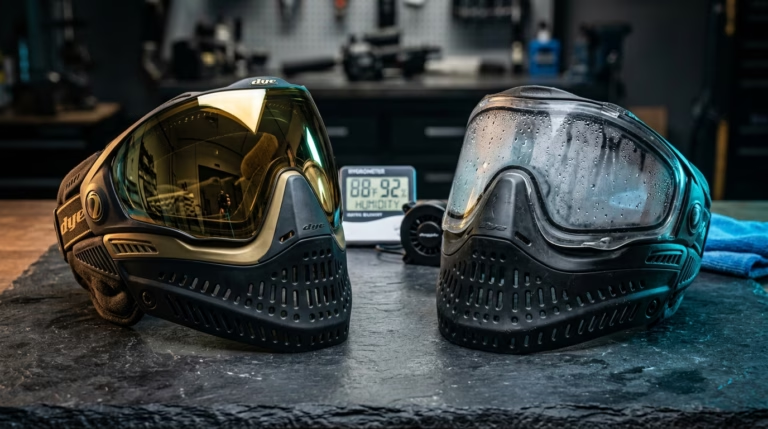
- Anti-Fog Thermal Goggle: Clear vision is essential in tournament play. We recommend pairing with the breathable Virtue VIO Ascend or Dye i5 thermal mask.
9. Frequently Asked Questions (FAQ)
Which marker shoots smoother: Dye MXR or DLX Luxe Aire?
Both markers are virtually indistinguishable in shot smoothness, both producing an identical 84 dB acoustic sound level. The Dye MXR has a slightly softer forward impact due to its elastomeric Flex Face bolt tip, while the Luxe Aire exhibits slightly less muzzle rise because its reciprocating bolt shuttle is 18% lighter. Both markers are among the softest-shooting speedball guns ever built.
Is the DLX Luxe Aire lighter than the Dye MXR?
Yes. The DLX Luxe Aire weighs 1.72 lbs (780g) with barrel and battery, making it approximately 72 grams (~2.5 oz) lighter than the Dye MXR (1.88 lbs / 852g) and 90 grams lighter than the Luxe Idol (1.92 lbs / 870g). It holds the title of the lightest pro electronic marker on the market.
What is the difference between the DLX Luxe Aire and Luxe Idol?
The Luxe Aire and Luxe Idol share the same internal core architecture and electronics. However, the Aire is an ultra-lightweight skeletonized variant weighing 1.72 lbs with minimal body milling, priced at $1,499.95. The Idol is DLX’s flagship metal sculpture weighing 1.92 lbs with aggressive exterior 3D CNC contours, priced at $1,599.95.
Do both markers come with complete barrel insert kits?
Yes. Both markers include 3 micro-honed inserts out of the box. The Dye MXR includes the Dye Boomstick UL-I with .680, .684, and .688 inserts. The DLX Luxe Aire includes the Freak XL Carbon 14″ barrel with .684, .687, and .690 inserts.
10. Final Verdict: Which Spool Flagship Takes the Crown?
At $1,499.95, both the Dye MXR and the DLX Luxe Aire represent the absolute pinnacle of modern spool-valve engineering. You cannot make a wrong choice—only the choice that aligns with your competitive instincts:
Choose the Dye MXR if you prioritize legendary UL-45 ergonomics, the peace of mind that comes with universal 2x AA alkaline batteries, and an elastomeric Flex Face bolt that coddles brittle tournament paintballs.
Choose the DLX Luxe Aire if you demand the supreme handling agility of a 1.72 lb airframe, internal USB-C Li-Po rechargeable speed, and wire-free magnetic frame-to-body contacts.
Ready to Step Onto the 2026 Podium?
Check verified live dealer inventory, factory warranty packages, and rapid shipping availability:
⚡ Tournament Rate-of-Fire Utility: Dialing in your electronic board for NXL 10.5 BPS ramping? Use our interactive Paintball BPS & ROF Calculator (Tournament Legality & Debounce Checker) to convert Balls Per Second into millisecond cycle delays and prevent referee chrono penalties.