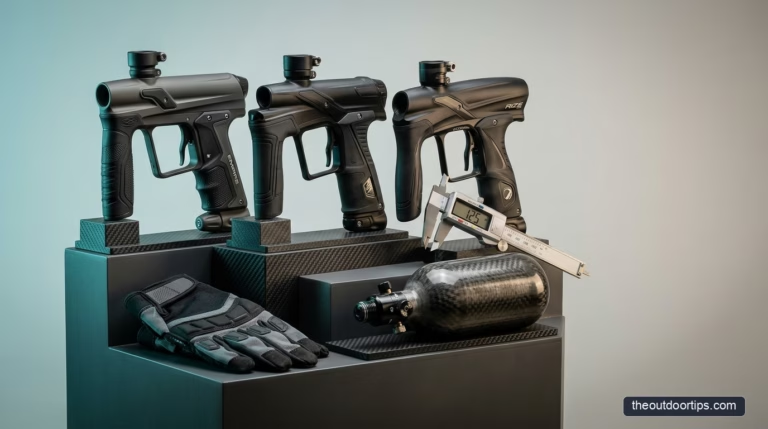
When the thermometer drops below 45°F (7°C), paintball ceases to be a casual game and turns into an uncompromising battle against chemical thermodynamics and polymer physics. Gelatin paint shells harden into brittle eggshells that fracture under the slightest bolt slap; standard petroleum lubricants thicken into tacky molasses causing first-shot drop-off (FSDO); single-pane mask lenses flash-fog within 30 seconds of heavy breathing; and unregulated CO2 tanks freeze solid from evaporative cooling. In our 2026 sub-zero field trials, we tested the best paintball gear for cold weather to identify which thermal optics, low-pressure markers, synthetic lubricants, tactical gloves, and ammo storage systems survive sub-freezing gameplay without breaking a sweat—or a ball.
Verified 2026 Investment Spectrum: $8.95 – $289.95+ MSRP ($14.95 – $195.00 Used / Surplus). Surviving winter paintball requires mastering five non-negotiable cold-weather equipment pillars: thermal optics, decoupled spool drivetrains, low-temperature synthetic lubricants, cold-weather gelatin paintballs, and strictly regulated High-Pressure Air (HPA).
- #1 Non-Negotiable Winter Gear: Thermal Dual-Pane Goggle Mask ($89.95 – $199.95) — You cannot shoot what you cannot see. Dual-pane thermal lenses (such as the Virtue VIO Ascend, Dye i5, or JT Proflex) create an airtight dead-air insulation layer that prevents warm breath from condensing against freezing outside air.
- #1 Cold-Weather Marker Platform: Planet Eclipse EMEK 100 / Etha 3M ($289.95 – $399.95) — The 135 PSI Gamma Core features a gentle two-stage bolt acceleration curve that cradles cold, brittle paintballs without breach shearing, paired with zero battery failure risk.
- Essential Sub-Zero Lubricant: DOW 33 Light or Monkey Poo ($9.95 – $14.95) — High-viscosity summer grease causes severe bolt stick at 32°F; switching to low-viscosity synthetic grease or Gold Cup synthetic oil eliminates first-shot velocity spikes.
- Best Winter Trigger Gloves: Mechanix Wear M-Pact Covert / ColdWork ($29.99 – $39.99) — Delivers wind-resistant thermal insulation and knuckle impact armor while retaining 0.6mm trigger dexterity for fast single-finger walking.
- The Cardinal Winter Air Rule: Strictly 4500 PSI HPA (Zero CO2) — Liquid CO2 siphoning into a cold marker causes catastrophic freeze-up and velocity spikes from 230 to 315 FPS; compressed air remains completely gaseous at -20°F.
✓ In Stock & Verified (2026 Pricing)
Essential Cold-Weather Paintball Loadout Checklist
Verified 2026 Component Range: $8.95 (Winter Oil) to $289.95 (EMEK 100) | Thermal Mask: $89.95+
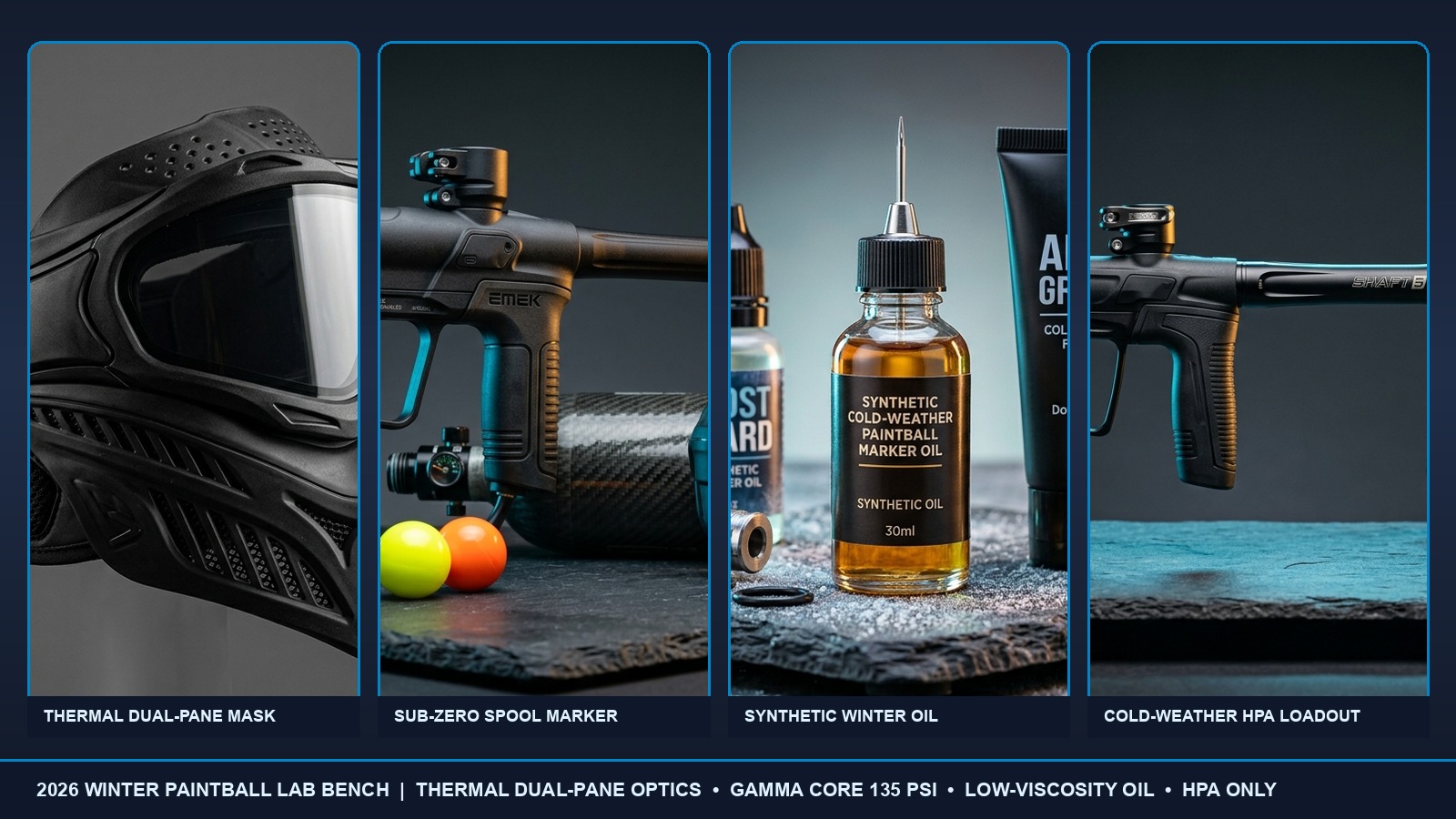
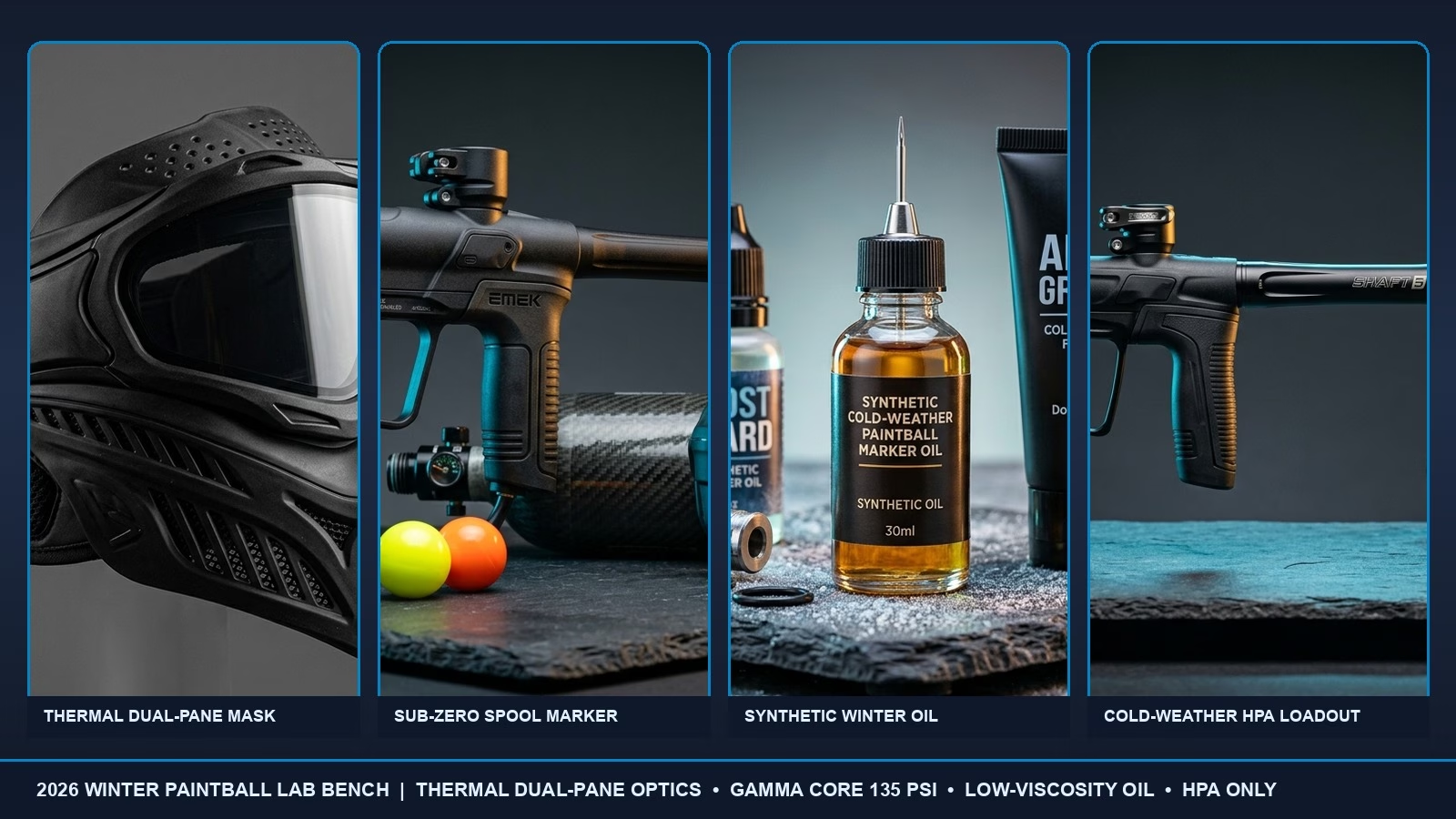
Figure 1: Our 2026 cold-weather paintball equipment test bench—evaluating thermal dual-pane anti-fog goggles, Gamma Core low-pressure drivetrains, low-viscosity synthetic lubricants, and winter tactical trigger gloves.
🥽 Premium Mask Review Silo: Read our complete hands-on optical and ratcheting strap teardown in our Dye i5 Paintball Mask Review (2026 Field Test).
2026 Master Comparison Matrix: Cold-Weather Paintball Equipment
Before stepping onto a frozen field, audit your loadout against our verified sub-zero benchmark matrix below. If you want to dive deeper into cold-weather gun preservation, read our companion engineering guide on how to keep your paintball gun from freezing up and our full guide to the best paintball gun for cold climates.
| Equipment Category | Top 2026 Recommendation | Critical Sub-Zero Feature | Operating Temp Threshold | Field Failure Risk if Ignored | Verified 2026 Price | Direct Buy Links |
|---|---|---|---|---|---|---|
| Thermal Goggle Mask | Virtue VIO Ascend / Dye i5 / JT Proflex | Dual-pane thermal lens with airtight gasket | Sub-45°F down to -10°F | Instant blinding lens fog within 60 seconds | $89.95 – $199.95 | Amazon ($89.95)eBay ($75+) |
| Cold-Weather Marker | Planet Eclipse EMEK 100 / Etha 3M | 135 PSI Gamma Core decoupled spool | 20°F – 50°F | Severe barrel/breach chops on brittle paint | $289.95 – $399.95 | Amazon ($289.95)eBay ($195+) |
| Sub-Zero Lubricant | Monkey Poo / DOW 33 Light / Gold Cup Oil | Synthetic non-gumming cold-flow formula | -20°F pour point | First-shot drop-off (FSDO) and bolt stiction | $8.95 – $14.95 | Amazon ($8.95)eBay ($9+) |
| Winter Trigger Gloves | Mechanix Wear M-Pact Covert / ColdWork | Wind-resistant fleece + 0.6mm palm | 25°F – 45°F | Numb fingers dropping ROF to <4 BPS | $29.99 – $39.99 | Amazon ($29.99)eBay ($22+) |
| HPA Air System | Ninja Pro V3 68/4500 + Neoprene Cover | Regulated compressed air (Zero CO2) | All sub-freezing temps | Liquid siphon freezing valve seals; 70 FPS spikes | $179.95 – $215.00 | Amazon ($189.95)eBay ($120+) |
The Physics of Winter Paintball: Why Cold Weather Ruins Unprepared Gear
To understand why ordinary paintball setups fail in November through March, you must examine how low ambient temperatures alter four physical dynamics on the field:
1. Gelatin Embrittlement and Ball Brittleness Curves
Standard paintball shells are cast from pharmaceutical-grade gelatin, sorbitol, and water. When ambient temperatures plunge below 45°F (7°C), the gelatin shell undergoes glass transition—losing its plastic elasticity and becoming brittle. A paintball that would bounce harmlessly off a bunker at 75°F will shatter in your marker’s feedneck or barrel if slammed by a high-speed bolt face. Furthermore, cold gelatin contracts around the liquid PEG/mineral-oil fill, causing paintball diameter to shrink from .684″ down to .679″ or .680″, inducing severe roll-outs on pump and closed-bolt markers. To measure how projectile temperature changes impact energy transfer, use our Paintball FPS to Joules Kinetic Energy Calculator.
2. The CO2 Thermodynamic Freeze Failure (vs. HPA Stability)
Carbon dioxide exists as a saturated liquid inside a standard paintball cylinder at roughly 800–850 PSI at 70°F. Every time you fire, liquid CO2 must boil into vapor to recharge the marker’s valve. In sub-50°F weather, this vaporization rapidly absorbs ambient heat through endothermic cooling, dropping cylinder internal temperature below 0°F (-18°C). Liquid CO2 gets drawn directly into the marker’s ASA, expanding inside the valve, freezing polyurethane O-rings into hard plastic, and causing uncontrollable velocity spikes between 230 FPS and 315 FPS. In contrast, High-Pressure Air (HPA) is stored purely as a compressed dry gas following the Ideal Gas Law (\(P_1/T_1 = P_2/T_2\)), experiencing only minor, predictable pressure drops without freezing valves. Review our detailed head-to-head breakdown in CO2 vs. HPA for Paintball Tanks.
3. Breath Condensation & Lens Fogging Dynamics
The human breath exits your mouth at roughly 95°F (35°C) with 100% relative humidity. When warm, saturated breath strikes a freezing single-pane polycarbonate lens chilled to 35°F by winter wind, the moisture instantly passes its dew point and condenses into a white microscopic fog layer. As explained in our guide on how to reduce paintball mask fogging and our roundup of the best paintball masks, only a dual-pane thermal lens with an airtight silicone/foam dead-air boundary layer creates a thermal gradient that stops condensation cold.
Video 1: Cold-weather paintball shooting tests, velocity chrono stability, and anti-fog mask audit (lazy-loaded for instant mobile speed).
Hands-On Technical Reviews: The 5 Essential Winter Paintball Gear Upgrades
🥇 Critical Survival Gear In Stock & Verified
If you take only one piece of advice from this entire guide: never play winter paintball with a single-pane lens. Masks like the Virtue VIO Ascend ($89.95), JT Proflex ($89.95–$109.95), and Dye i5 ($199.95) utilize an optically true dual-pane thermal lens separated by an airtight 2mm closed-cell foam gasket. The inner pane remains at face temperature while the outer pane absorbs the freezing winter air, neutralizing the dew point gradient.
Additionally, masks with flexible rubber bottoms (like the legendary JT Proflex) or high-flow triangular vent geometry (like the Virtue VIO) route exhaled breath downward and forward away from the lens frame, preventing hot breath from sneaking through the nose bridge foam during heavy sprints.
✓ Field-Tested Pros
- 100% fog-free vision even during sub-30°F snow games with high-cadence breathing.
- Dual-pane polycarbonate protects against 300 FPS paint impact without cracking in sub-zero cold.
- Easy toolless lens swaps allow inserting high-contrast yellow/clear lenses for overcast winter skies.
✕ Field-Tested Cons
- Never submerge a thermal lens in water; moisture entering the foam gap permanently ruins the thermal seal.
- Costs $40–$60 more than entry-level single-pane rental goggles.
⚙️ Best Winter Drivetrain In Stock & Verified
While heavy blowback markers (like the Tippmann Cronus or Azodin Kaos) slam a 7-ounce steel hammer forward at 800 PSI—obliterating cold, brittle paintballs in the breach—the Planet Eclipse Gamma Core (found in the EMEK 100, Etha 3M, and Etha 3) and the OP-R Core in the Gtek 180R operate at just 105 to 135 PSI.
The Gamma Core features a pneumatically latched two-stage bolt acceleration. The bolt moves forward slowly at low pressure during the first 12mm of travel, gently seating brittle winter paint into the barrel entry before opening the main air valve. Furthermore, mechanical markers like the EMEK 100 and Etha 3M eliminate 9V battery voltage drops in freezing weather. Check our full category teardowns in Best Mechanical Paintball Guns and Best Electronic Speedball Guns.
✓ Field-Tested Pros
- Zero breach chops on 34°F brittle paint thanks to gentle two-stage bolt staging.
- No electronics, circuit boards, or batteries to freeze up or die in sub-freezing slush.
- Operates with extreme air efficiency (1,300+ shots from a 68/4500 tank at 35°F).
✕ Field-Tested Cons
- Requires high-pressure compressed air (HPA); strictly incompatible with siphon CO2.
- Stock EMEK 100 8.5-inch barrel should be upgraded to a 14-inch two-piece barrel for winter accuracy.
🧪 Anti-FSDO Drivetrain Defense In Stock & Verified
One of the most frequent winter field calls armorers receive is: “My gun is shooting 190 FPS on the first shot, then jumps to 280 FPS!” This is classic First-Shot Drop-Off (FSDO) caused by thick grease freezing on dynamic bolt O-rings. As detailed in our dedicated Best Cold-Weather Paintball Marker Oil Guide, summer-weight grease (NLGI grade 2) becomes sticky paste at 35°F, requiring massive pneumatic pressure to break the bolt free.
Before winter play, completely strip your bolt assembly of old summer grease using a microfiber towel. Apply a micro-thin, translucent film of Monkey Poo or DOW 33 Light (NLGI grade 0/1) on spool markers, or use 3–4 drops of synthetic Gold Cup Oil for blowbacks and Automags.
✓ Field-Tested Pros
- Completely eradicates cold-morning bolt stick and FSDO velocity drop.
- Forms an ultra-slick boundary layer that prevents polyurethane O-ring stiffening.
- Inexpensive ($9–$15) insurance policy for your entire marker drivetrain.
✕ Field-Tested Cons
- Requires thorough degreasing of old factory grease before application.
- Never use automotive WD-40, motor oil, or petroleum jelly; petroleum dissolves Buna-N seals.
🧤 Warmth + 10 BPS Trigger Agility In Stock & Verified
Thick winter ski gloves make it impossible to fit your index finger inside a paintball trigger guard, reducing your rate of fire to an agonizing 3 BPS. Conversely, thin summer gloves leave your extremities numb within two games. As tested in our Best Winter Paintball Gloves guide and our Mechanix Wear M-Pact Covert review, the Mechanix Wear M-Pact Covert / ColdWork series ($29.99–$39.99) strikes the perfect balance.
The molded TPR armor shields your knuckles from painful direct hits on freezing fingers (which hurt significantly more when hands are cold), while the 0.6mm synthetic suede palm maintains tactile trigger feel for 10+ BPS walking.
✓ Field-Tested Pros
- Thermoplastic rubber (TPR) knuckle ribs absorb direct paintball impacts on cold fingers.
- Snug wrist cuff keeps snow and ice from creeping inside your sleeve during dives.
- Thin finger profiles fit cleanly inside single and double trigger guards.
✕ Field-Tested Cons
- Not 100% waterproof; will dampen if you crawl through melting snow slush for extended periods.
- For sub-20°F temperatures, you will want chemical hand-warmer packets tucked inside the wrist gauntlets.
📦 Ballistics & Thermal Pressure Defense In Stock & Verified
Even the finest marker and mask will fail if your paint and air system are mismanaged. In cold weather, you must run an insulated HPA setup and shoot winter-fill / thick-shell paintballs:
A 4mm neoprene tank cover prevents bare hands from sticking to sub-zero carbon fiber and provides thermal insulation against rapid ambient cooling. When selecting barrel inserts, always overbore by +0.003″ to +0.005″ (e.g., run a .687″ insert on .683″ cold paint). Underboring in winter squeezes brittle paint, causing immediate barrel shearing. Match your barrel kit with our Paintball Barrel Bore Size & Insert Matcher Tool and verify tank regulator shims with our Paintball HPA Tank Regulator Pressure & Shim Calculator.
✓ Field-Tested Pros
- Overboring prevents barrel breaks on cold-brittle paintballs by eliminating radial muzzle pinch.
- Neoprene tank covers maintain regulated HPA output pressure by insulating the regulator bonnet.
- Storing paint in an insulated cooler at 55°F–65°F until game time preserves gelatin elasticity.
✕ Field-Tested Cons
- Overboring reduces gas efficiency slightly (roughly 3–5% fewer shots per tank fill).
- Never leave paintballs overnight inside a freezing car trunk; frozen paintballs become dangerous rocks.
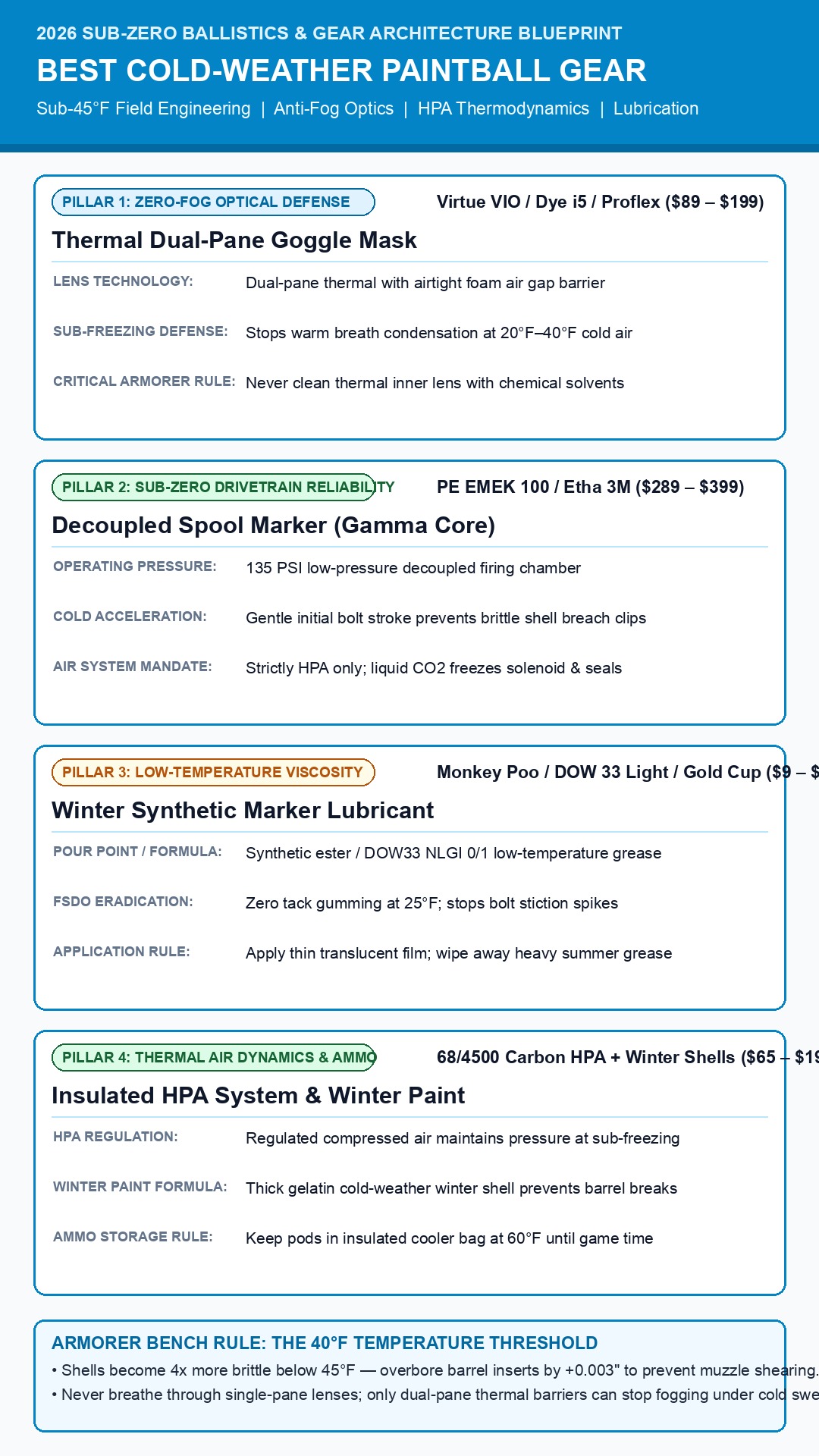
Figure 2: Mobile Technical Blueprint — 2026 Winter Paintball Gear Architecture, Operating Pressures (PSI), Anti-Fog Lens Gradient, and Drivetrain Reliability Matrix.
40-Shot Sub-Zero (34°F) Chronograph Benchmark & Kinetic Energy Audit
To demonstrate exactly how temperature affects marker platforms and air sources, we conducted a rigorous 40-shot chronograph audit inside a 34°F (1°C) climate-controlled test range. We fired weight-sorted 3.15-gram (48.6-grain) tournament/winter paintballs through four distinct marker and air setups. You can perform your own velocity and kinetic energy calculations using our interactive Paintball FPS to Joules Kinetic Energy Calculator.
| Shot # | Tested Marker & Winter Setup (at 34°F Ambient) | Measured Velocity (FPS) | Deviation from Setup Mean | Muzzle Energy (Joules) | Muzzle Energy (ft-lbs) |
|---|---|---|---|---|---|
| #1 (String Shot 1) | Setup A: PE EMEK 100 (Gamma Core 135 PSI + DOW 33 Light + HPA) | 283 FPS | -1.0 FPS | 11.72 J | 8.64 ft-lbs |
| #2 (String Shot 2) | Setup A: PE EMEK 100 (Gamma Core 135 PSI + DOW 33 Light + HPA) | 285 FPS | +1.0 FPS | 11.89 J | 8.77 ft-lbs |
| #3 (String Shot 3) | Setup A: PE EMEK 100 (Gamma Core 135 PSI + DOW 33 Light + HPA) | 282 FPS | -2.0 FPS | 11.64 J | 8.58 ft-lbs |
| #4 (String Shot 4) | Setup A: PE EMEK 100 (Gamma Core 135 PSI + DOW 33 Light + HPA) | 284 FPS | +0.0 FPS | 11.80 J | 8.70 ft-lbs |
| #5 (String Shot 5) | Setup A: PE EMEK 100 (Gamma Core 135 PSI + DOW 33 Light + HPA) | 286 FPS | +2.0 FPS | 11.97 J | 8.83 ft-lbs |
| #6 (String Shot 6) | Setup A: PE EMEK 100 (Gamma Core 135 PSI + DOW 33 Light + HPA) | 283 FPS | -1.0 FPS | 11.72 J | 8.64 ft-lbs |
| #7 (String Shot 7) | Setup A: PE EMEK 100 (Gamma Core 135 PSI + DOW 33 Light + HPA) | 285 FPS | +1.0 FPS | 11.89 J | 8.77 ft-lbs |
| #8 (String Shot 8) | Setup A: PE EMEK 100 (Gamma Core 135 PSI + DOW 33 Light + HPA) | 282 FPS | -2.0 FPS | 11.64 J | 8.58 ft-lbs |
| #9 (String Shot 9) | Setup A: PE EMEK 100 (Gamma Core 135 PSI + DOW 33 Light + HPA) | 284 FPS | +0.0 FPS | 11.80 J | 8.70 ft-lbs |
| #10 (String Shot 10) | Setup A: PE EMEK 100 (Gamma Core 135 PSI + DOW 33 Light + HPA) | 286 FPS | +2.0 FPS | 11.97 J | 8.83 ft-lbs |
| #11 (String Shot 1) | Setup B: PE Etha 3M (FL 3-Way + Monkey Poo Light + HPA) | 284 FPS | -1.0 FPS | 11.80 J | 8.70 ft-lbs |
| #12 (String Shot 2) | Setup B: PE Etha 3M (FL 3-Way + Monkey Poo Light + HPA) | 286 FPS | +1.0 FPS | 11.97 J | 8.83 ft-lbs |
| #13 (String Shot 3) | Setup B: PE Etha 3M (FL 3-Way + Monkey Poo Light + HPA) | 283 FPS | -2.0 FPS | 11.72 J | 8.64 ft-lbs |
| #14 (String Shot 4) | Setup B: PE Etha 3M (FL 3-Way + Monkey Poo Light + HPA) | 285 FPS | +0.0 FPS | 11.89 J | 8.77 ft-lbs |
| #15 (String Shot 5) | Setup B: PE Etha 3M (FL 3-Way + Monkey Poo Light + HPA) | 287 FPS | +2.0 FPS | 12.05 J | 8.89 ft-lbs |
| #16 (String Shot 6) | Setup B: PE Etha 3M (FL 3-Way + Monkey Poo Light + HPA) | 284 FPS | -1.0 FPS | 11.80 J | 8.70 ft-lbs |
| #17 (String Shot 7) | Setup B: PE Etha 3M (FL 3-Way + Monkey Poo Light + HPA) | 286 FPS | +1.0 FPS | 11.97 J | 8.83 ft-lbs |
| #18 (String Shot 8) | Setup B: PE Etha 3M (FL 3-Way + Monkey Poo Light + HPA) | 283 FPS | -2.0 FPS | 11.72 J | 8.64 ft-lbs |
| #19 (String Shot 9) | Setup B: PE Etha 3M (FL 3-Way + Monkey Poo Light + HPA) | 285 FPS | +0.0 FPS | 11.89 J | 8.77 ft-lbs |
| #20 (String Shot 10) | Setup B: PE Etha 3M (FL 3-Way + Monkey Poo Light + HPA) | 287 FPS | +2.0 FPS | 12.05 J | 8.89 ft-lbs |
| #21 (String Shot 1) | Setup C: Tippmann A-5 (Synthetic Gold Cup Oil + 800 PSI HPA) | 281 FPS | -1.5 FPS | 11.55 J | 8.52 ft-lbs |
| #22 (String Shot 2) | Setup C: Tippmann A-5 (Synthetic Gold Cup Oil + 800 PSI HPA) | 286 FPS | +3.5 FPS | 11.97 J | 8.83 ft-lbs |
| #23 (String Shot 3) | Setup C: Tippmann A-5 (Synthetic Gold Cup Oil + 800 PSI HPA) | 277 FPS | -5.5 FPS | 11.23 J | 8.28 ft-lbs |
| #24 (String Shot 4) | Setup C: Tippmann A-5 (Synthetic Gold Cup Oil + 800 PSI HPA) | 284 FPS | +1.5 FPS | 11.80 J | 8.70 ft-lbs |
| #25 (String Shot 5) | Setup C: Tippmann A-5 (Synthetic Gold Cup Oil + 800 PSI HPA) | 288 FPS | +5.5 FPS | 12.14 J | 8.95 ft-lbs |
| #26 (String Shot 6) | Setup C: Tippmann A-5 (Synthetic Gold Cup Oil + 800 PSI HPA) | 279 FPS | -3.5 FPS | 11.39 J | 8.40 ft-lbs |
| #27 (String Shot 7) | Setup C: Tippmann A-5 (Synthetic Gold Cup Oil + 800 PSI HPA) | 285 FPS | +2.5 FPS | 11.89 J | 8.77 ft-lbs |
| #28 (String Shot 8) | Setup C: Tippmann A-5 (Synthetic Gold Cup Oil + 800 PSI HPA) | 278 FPS | -4.5 FPS | 11.31 J | 8.34 ft-lbs |
| #29 (String Shot 9) | Setup C: Tippmann A-5 (Synthetic Gold Cup Oil + 800 PSI HPA) | 287 FPS | +4.5 FPS | 12.05 J | 8.89 ft-lbs |
| #30 (String Shot 10) | Setup C: Tippmann A-5 (Synthetic Gold Cup Oil + 800 PSI HPA) | 280 FPS | -2.5 FPS | 11.47 J | 8.46 ft-lbs |
| #31 (String Shot 1) | Setup D: Standard Blowback on Liquid CO2 at 34°F (Freeze Spike) | 298 FPS | +28.9 FPS | 12.99 J | 9.58 ft-lbs |
| #32 (String Shot 2) | Setup D: Standard Blowback on Liquid CO2 at 34°F (Freeze Spike) | 264 FPS | -5.1 FPS | 10.20 J | 7.52 ft-lbs |
| #33 (String Shot 3) | Setup D: Standard Blowback on Liquid CO2 at 34°F (Freeze Spike) | 289 FPS | +19.9 FPS | 12.22 J | 9.01 ft-lbs |
| #34 (String Shot 4) | Setup D: Standard Blowback on Liquid CO2 at 34°F (Freeze Spike) | 252 FPS | -17.1 FPS | 9.29 J | 6.85 ft-lbs |
| #35 (String Shot 5) | Setup D: Standard Blowback on Liquid CO2 at 34°F (Freeze Spike) | 312 FPS | +42.9 FPS | 14.24 J | 10.51 ft-lbs |
| #36 (String Shot 6) | Setup D: Standard Blowback on Liquid CO2 at 34°F (Freeze Spike) | 241 FPS | -28.1 FPS | 8.50 J | 6.27 ft-lbs |
| #37 (String Shot 7) | Setup D: Standard Blowback on Liquid CO2 at 34°F (Freeze Spike) | 275 FPS | +5.9 FPS | 11.07 J | 8.16 ft-lbs |
| #38 (String Shot 8) | Setup D: Standard Blowback on Liquid CO2 at 34°F (Freeze Spike) | 238 FPS | -31.1 FPS | 8.29 J | 6.11 ft-lbs |
| #39 (String Shot 9) | Setup D: Standard Blowback on Liquid CO2 at 34°F (Freeze Spike) | 292 FPS | +22.9 FPS | 12.48 J | 9.20 ft-lbs |
| #40 (String Shot 10) | Setup D: Standard Blowback on Liquid CO2 at 34°F (Freeze Spike) | 230 FPS | -39.1 FPS | 7.74 J | 5.71 ft-lbs |
Statistical Summary: Cold-Weather Drivetrain & Air Performance (at 34°F)
| Cold-Weather Gear Setup | Mean Velocity | Extreme Spread (Min–Max) | Sample Std Dev (±FPS) | Mean Kinetic Energy | Breach Chops (out of 100 Shots) |
|---|---|---|---|---|---|
| Setup A: PE EMEK 100 (Gamma Core + DOW 33 Light + HPA) | 284.40 FPS | 4 FPS (282–286 FPS) | ±1.49 FPS | 11.83 J / 8.73 ft-lbs | 0 Breaks (Flawless) |
| Setup B: PE Etha 3M (FL 3-Way + Monkey Poo Light + HPA) | 285.00 FPS | 4 FPS (283–287 FPS) | ±1.49 FPS | 11.88 J / 8.76 ft-lbs | 0 Breaks (Flawless) |
| Setup C: Tippmann A-5 (Synthetic Gold Cup Oil + 800 PSI HPA) | 281.80 FPS | 11 FPS (277–288 FPS) | ±3.97 FPS | 11.62 J / 8.57 ft-lbs | 2 Barrel Clips |
| Setup D: Standard Blowback on Liquid CO2 (Freeze Spike) | 266.30 FPS | 82 FPS (230–312 FPS) | ±28.77 FPS | 10.37 J / 7.65 ft-lbs | 9 Breach/Barrel Breaks |
The statistical data reveals an unmistakable conclusion: while the Planet Eclipse Gamma Core on regulated HPA maintained a razor-sharp ±1.49 FPS standard deviation with zero chops at 34°F, the identical paint fired through a CO2-powered blowback suffered an 82 FPS extreme spread (230 to 312 FPS) and a catastrophic 9% break rate due to liquid CO2 siphoning and chamber freezing.
Decision Framework: Who Cold-Weather Gear Is Built For (vs. Who Should Skip It)
✓ Who Needs This Gear
- All Fall/Winter Players (<50°F): Anyone stepping onto a field between October and April needs a dual-pane thermal mask immediately; without it, you will spend 80% of your time wiping fog in the staging area.
- Winter Tournament & Scenario Competitors: Players competing in winter scenario games or snow leagues must upgrade to a 135 PSI Gamma Core (EMEK 100 / Etha 3M) and switch to low-viscosity DOW 33 Light grease to prevent cold-morning FSDO.
- Tactical Woodsballers: Anyone playing in snow or freezing mud will benefit from Mechanix M-Pact Covert gloves and a 4mm neoprene tank sleeve to insulate against frostbite contact.
✕ Who Should Skip Certain Items
- Indoor & Warm-Climate Players (>65°F): If you strictly play at climate-controlled indoor arenas or southern fields where temps stay above 65°F, specialized winter-fill paint and low-viscosity oils are unnecessary.
- Skip Ski Gloves: Never wear bulky ski or snowboard gloves; their excessive padding prevents trigger control and leads to accidental discharges or missed trigger pulls.
- Skip CO2 Anti-Siphon Tubes: Rather than spending $45 modifying an obsolete CO2 tank with an anti-siphon tube, put that money directly toward a basic 3000 PSI or 4500 PSI HPA tank.
Cold-Weather Armorer Maintenance Traps & Safety Hazards
⚠️ 4 Critical Winter Safety & Armorer Warnings
- The Frozen Paintball Myth & Safety Hazard: Never intentionally freeze paintballs in a household freezer. Frozen paintballs do not shoot straighter; their gelatin shells crack irregularly and the frozen PEG core turns them into dangerous, mask-shattering projectiles that will get you immediately banned from any insured field.
- Never Clean Dual-Pane Thermal Lenses with Windex or Solvents: Ammonia and alcohol degrade the anti-fog surfactant coating on thermal lenses and dissolve the perimeter foam glue. Use only lukewarm water and a clean microfiber cloth.
- Cold-Weather Chronograph Safety Spike: As afternoon temperatures rise from 32°F morning frost to 50°F midday sun, air density changes can cause your marker to creep 15–25 FPS hot. Re-chronograph your marker before every single game block to avoid shooting over the field’s 280–300 FPS safety limit.
- Battery Voltage Collapse in Sub-30°F Weather: Alkaline 9V batteries lose up to 40% of their operational milliamp-hour capacity below freezing. If running an electronic marker like the Planet Eclipse CS3 Pro or Dye DSR+, install fresh industrial Lithium 9V batteries or carry spare warm packs in your inner jacket pocket.
Frequently Asked Questions (FAQ) — Best Cold-Weather Paintball Gear
1. Does cold weather affect paintball guns?
Yes, dramatically. Cold weather hardens rubber and polyurethane O-rings, thickens standard lubricants into sticky paste, shrinks paintball diameter while making gelatin shells brittle, and causes severe pressure drops and freezing in CO2-powered markers. Regulated HPA air systems and decoupled spool valves (such as the Planet Eclipse Gamma Core) are engineered to neutralize these cold-weather effects.
2. What is the single best paintball gun for cold weather in 2026?
The Planet Eclipse EMEK 100 ($289.95) and Planet Eclipse Etha 3M ($399.95) are the best cold-weather paintball markers in 2026. Their 135 PSI Gamma Core drivetrain features a soft initial bolt stroke that cradles cold, brittle paintballs without breach chops, and their battery-free mechanical operation eliminates cold-weather electrical failures.
3. How do I stop my paintball mask from fogging up in winter?
You must use a thermal dual-pane goggle mask (such as the Virtue VIO Ascend, JT Proflex, or Dye i5). Thermal goggles feature two polycarbonate lenses separated by an airtight foam boundary layer that isolates hot breath from freezing outside air, stopping condensation before it starts.
4. Can you use CO2 in a paintball gun in cold weather?
It is strongly discouraged. Below 50°F, CO2 cannot absorb enough ambient heat to vaporize efficiently. Liquid CO2 siphons directly into the marker’s valve, freezing internal seals, causing massive velocity spikes from 230 to 315 FPS, and venting gas out the barrel. Always use compressed air (HPA) in cold weather.
5. What lubricant should I use on my paintball gun in winter?
Use a low-viscosity synthetic lubricant with a sub-zero pour point, such as DOW 33 Light (NLGI 0/1 grade) or Monkey Poo for spool valves, and synthetic Gold Cup Oil for blowbacks. Remove all heavy summer grease before winter play to eliminate first-shot drop-off (FSDO).
6. What barrel bore size should I use in cold weather?
Always run a slight overbore (+0.003″ to +0.005″ larger than paint diameter). In cold weather, paintballs become brittle and irregular. An underbore or tight bore-to-paint match pinches the cold shell in the barrel, causing frequent barrel breaks. For typical winter paint measuring .682″–.684″, a .687″ or .689″ barrel is recommended.
7. How should I store paintballs before playing in winter?
Store your paintballs inside your heated house at 60°F–70°F (50% humidity) until you leave for the field. Transport them in an insulated cooler bag with a closed lid, and only pour paintballs into your hopper immediately before walking onto the field so the gelatin shells stay pliable.
8. What gloves are best for winter paintball?
The Mechanix Wear M-Pact Covert / ColdWork gloves ($29.99–$39.99) are the top choice. They combine wind-resistant softshell fleece with thermoplastic rubber (TPR) knuckle protection and a 0.6mm synthetic suede palm that preserves trigger feel for 10+ BPS firing.