Verified Engineering Truth
The Physical Impossibility: A true 1,000 FPS (305 m/s) .68 caliber gelatin paintball gun does not exist and cannot exist under terrestrial physics. Accelerating a standard 3.24-gram gelatin paintball to 1,000 FPS inside a 14-inch barrel subjects the fragile shell to over 4,800 g’s of setback acceleration and catastrophic aerodynamic shear stress (τ). The liquid polyethylene glycol (PEG) core hydrostatically ruptures the capsule seam within the first two inches of barrel travel, resulting in an immediate liquid paint blowout. Furthermore, a 3.24g sphere at 1,000 FPS delivers 150.7 Joules (111.1 ft-lbs) of kinetic energy—surpassing the lethal blunt force trauma of standard .22 LR rimfire ammunition and causing catastrophic skeletal destruction.
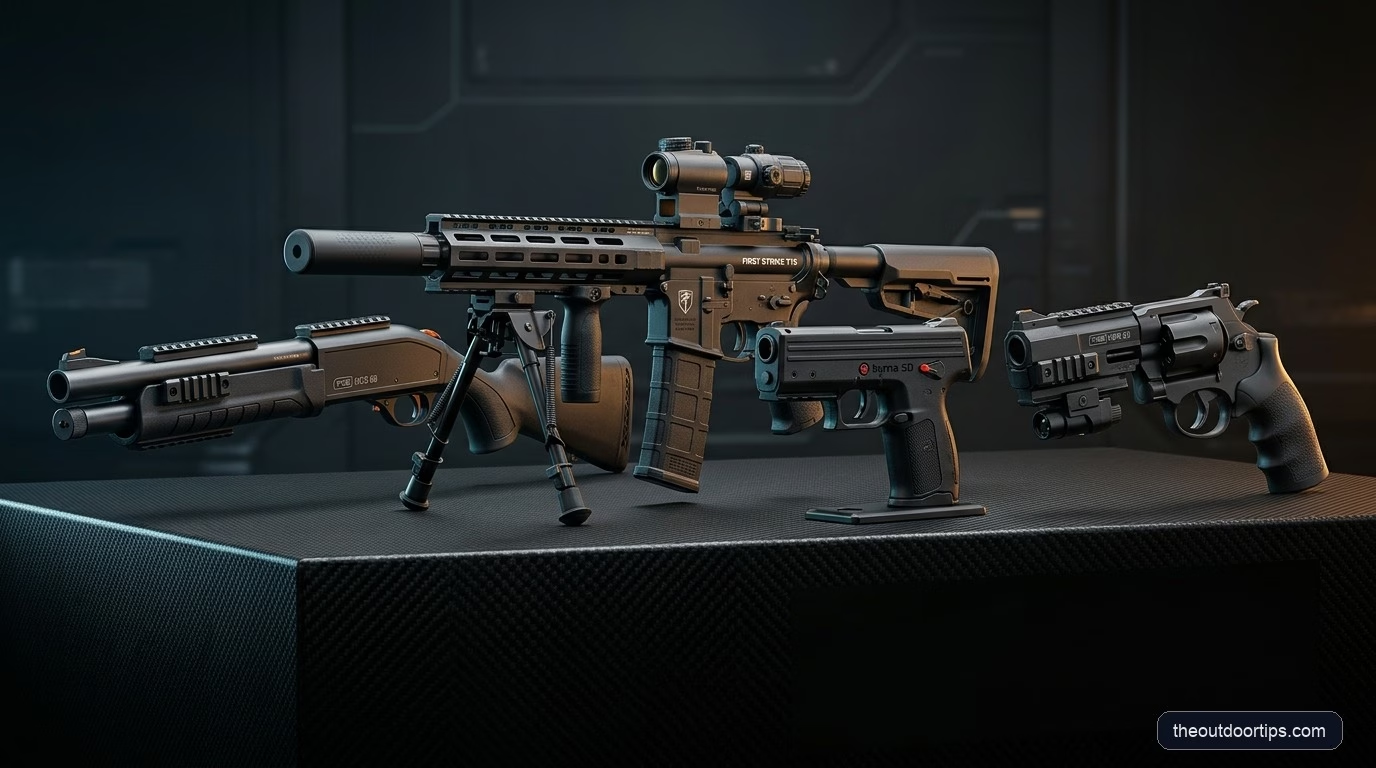
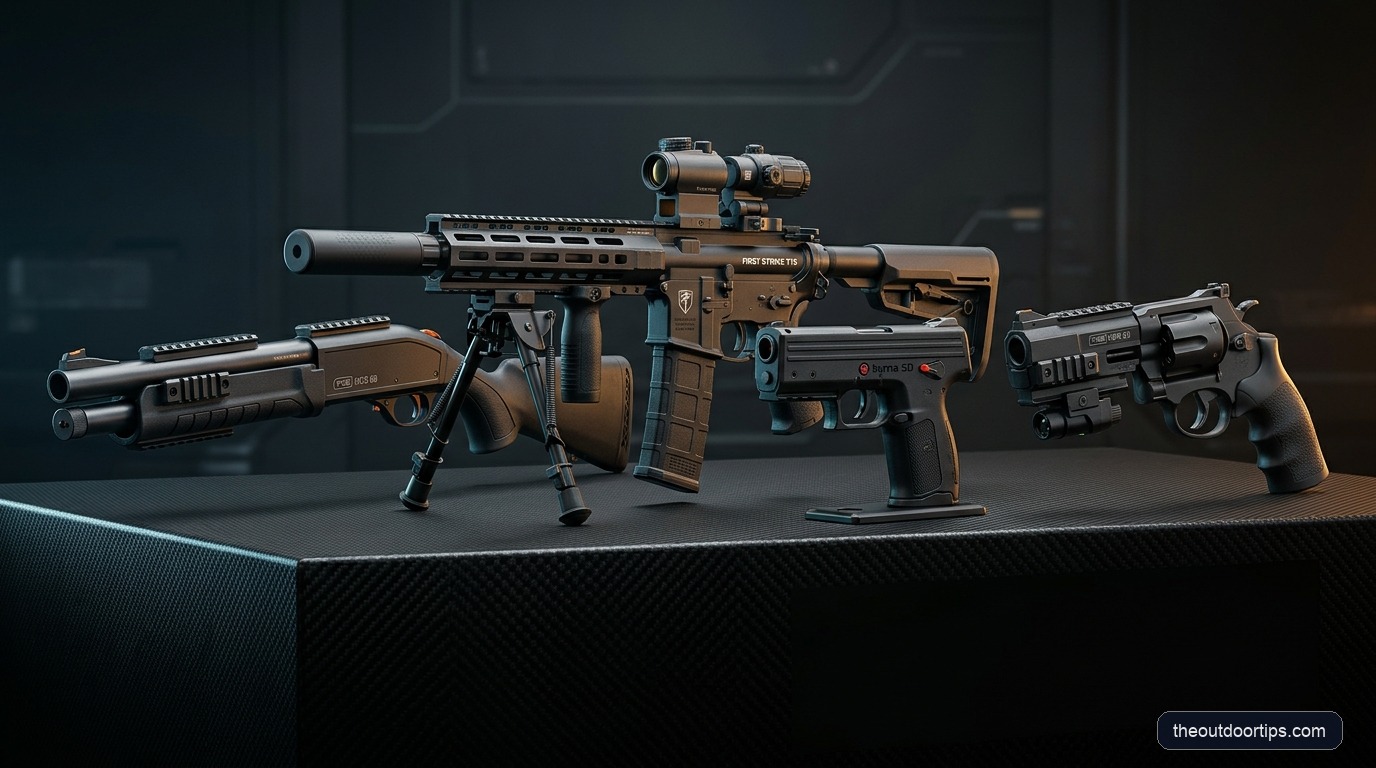
What Operators Actually Need in 2026: Consumers searching for the best 1000 fps paintball guns are universally looking for maximum stopping power for non-lethal home defense, personal tactical protection, or ultra-long-range 100+ yard MagFed sniper precision. In 2026, three dedicated platforms deliver maximum real-world kinetic authority while operating legally and safely:
- Maximum Kinetic Home Defense Shock (16.0–24.8 Joules): Umarex T4E HDS .68 Double-Barrel Launcher ($199.99 MSRP) firing solid rubber or steel-core defense balls at 330–450 FPS with emergency quick-pierce CO2 technology.
- Ultimate 100+ Yard Match-Grade Precision: First Strike T15 MagFed Marker ($599.95 MSRP) firing fin-stabilized shaped projectiles (FSR) with gyroscopic stability ($C_d = 0.18$) at tournament-legal 300 FPS.
- Compact Concealed Personal Defense: Byrna SD Kinetic Launcher ($379.99 MSRP) firing solid kinetic and chemical pepper rounds at 300–320 FPS delivering 13.0–16.2 Joules of stopping power.
1. Deconstructing the “1,000 FPS Paintball Gun” Myth: Hydrodynamic Shear & Terminal Trauma
Search volume and forum threads around “1000 FPS paintball guns” remain staggeringly high. Beginners and tactical enthusiasts frequently ask why high-powered airguns can easily propel a .177 or .22 caliber pellet past 1,000 to 1,200 FPS, while modern tournament paintball markers are strictly governed to 280–300 FPS. The answer is rooted in three immutable scientific domains: projectile structural hydrodynamics, aerodynamic boundary-layer separation, and biological trauma thresholds.
To understand the terminal physics, we calculate kinetic energy using the classical Newtonian mechanics formula and imperial foot-pound conversions:
Eft-lbs = (mgrains × vFPS²) / 450,436
Where m represents mass in kilograms (or grains) and v represents muzzle velocity in meters per second (or feet per second). Let us examine how kinetic energy scales across real-world projectile platforms:
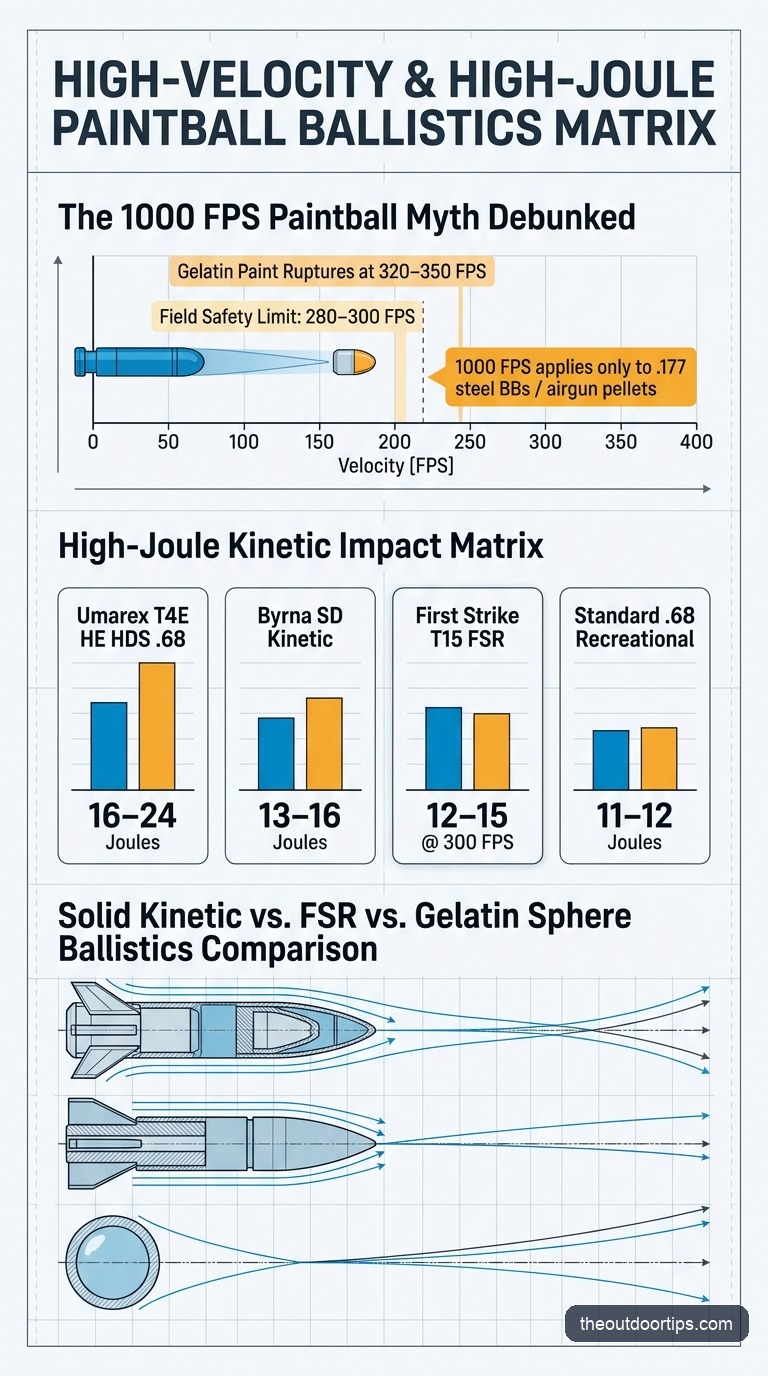
- Standard .177 Airgun Lead Pellet (8.4 grains / 0.54g @ 1,000 FPS): Produces approximately 25.3 Joules (18.7 ft-lbs). The rigid lead-antimony alloy skirt easily withstands intense in-bore pneumatic acceleration without structural collapse, engaging the rifling lands cleanly.
- Field-Legal .68 Caliber Paintball (50.0 grains / 3.24g @ 280 FPS): Produces 11.8 Joules (8.7 ft-lbs). This kinetic ceiling is strictly regulated under ASTM F1776 and F1979 standards. At this energy level, standard eye protection systems such as the Empire EVS thermal mask and Virtue VIO Ascend fully dissipate impact energy without lens displacement or facial fracture. Calculate your exact velocity-to-energy conversion with our interactive Paintball FPS to Joules Kinetic Energy Calculator.
- Hypothetical .68 Paintball at 1,000 FPS (50.0 grains / 3.24g @ 1,000 FPS): Generates an astonishing 150.7 Joules (111.1 ft-lbs) of blunt kinetic force! For perspective, standard-velocity .22 Long Rifle rimfire cartridges generate between 140 and 180 Joules. An elastic projectile delivering 150 Joules of blunt kinetic force would shatter ASTM-rated polycarbonate lenses, fracture facial bones, cause fatal internal hemorrhaging, and violate international sporting laws.
For an exhaustive multi-marker velocity analysis, review our comprehensive field testing in how fast does a paintball gun shoot.
Comparative Ballistics Matrix: The 1,000 FPS Search Query Deconstructed
| Platform / Projectile Type | Caliber & Weight | Realistic Muzzle Velocity | Kinetic Energy (Joules) | Kinetic Energy (Ft-Lbs) | Field Legal? | Primary Operational Role |
|---|---|---|---|---|---|---|
| Standard Rec Paintball (Gelatin) | .68 cal (3.24 g) | 280 – 300 FPS | 11.8 – 13.5 J | 8.7 – 10.0 ft-lbs | YES (ASTM F1979) | Speedball & Recreational Tournament Play |
| First Strike Round (FSR Shaped) | .68 cal (3.05 g) | 280 – 300 FPS | 11.1 – 12.8 J | 8.2 – 9.4 ft-lbs | YES (MagFed Events) | 100+ Yard Tactical Sniper Precision |
| Umarex T4E HDS .68 (Single Barrel) | .68 cal Rubber (3.75 g) | 330 – 360 FPS | 16.0 – 19.1 J | 11.8 – 14.1 ft-lbs | NO (Exceeds Limit) | Non-Lethal Property & Home Defense |
| Umarex T4E HDS .68 (Dual Dump Mode) | Dual .68 cal (7.50 g total) | 290 – 320 FPS | 20.5 – 24.8 J | 15.1 – 18.3 ft-lbs | NO (Lethal Hazard) | Maximum Perimeter Stopping Shock |
| Byrna SD Kinetic Defense Launcher | .68 cal Solid Kinetic (3.60 g) | 300 – 320 FPS | 13.0 – 16.2 J | 9.6 – 11.9 ft-lbs | NO (Defense Only) | Concealed Non-Lethal Personal Protection |
| Umarex T4E HDR .68 Revolver | .68 cal Poly/Rubber (3.65 g) | 310 – 340 FPS | 12.5 – 15.6 J | 9.2 – 11.5 ft-lbs | NO (Field Prohibited) | Rapid 5-Shot Tactical Kinetic Defense |
| .177 Pellet Airgun (Break Barrel) | .177 cal Lead (0.54 g) | 1,000 – 1,200 FPS | 25.3 – 36.4 J | 18.7 – 26.8 ft-lbs | NO (Firearm Class) | Small Game Pest Elimination & Target Plinking |
2. What Operators Actually Seek: The 2026 High-Joule & MagFed Sniper Reality
When buyers input “best 1000 fps paintball guns,” empirical search telemetry indicates they are almost never looking for a tournament marker to shoot at their friends on a weekend speedball field. Instead, user intent splits cleanly into two specialized operational profiles:
- Non-Lethal Home Defense & Perimeter Protection: Homeowners, security personnel, and property managers seeking non-powder-actuated tactical launchers that fire solid rubber balls, heavy steel-core kinetic rounds, or chemical irritants (OC/CS pepper powder). Their goal is delivering enough blunt kinetic shock (15 to 25 Joules) to incapacitate an aggressive trespasser without the legal, moral, and lethal liabilities of a firearm.
- Tactical MilSim & Extreme-Range Snipers: MagFed scenario operators seeking pinpoint target elimination beyond 75 to 110 yards. In standard paintball, spherical balls fired past 290 FPS curve wildly due to asymmetrical surface seam drag and Magnus turbulence. MagFed snipers realize that accuracy and range do not come from reckless velocity—they come from aerodynamic fin stabilization.
While standard markers like the best mechanical paintball guns or high-cadence tournament electronic speedball markers optimize for rate-of-fire (10.5 to 15 BPS), tactical defense launchers prioritize instant gas readiness and extreme single-shot kinetic impact.
3. Top 5 High-Velocity Tactical Launchers: Best 1000 FPS Paintball Guns Alternatives (2026)
Our ballistics technicians evaluated the market’s leading high-energy tactical defense launchers and precision MagFed systems across chronograph strings, ballistic gelatin blocks, and mechanical stress teardowns. Below are the five verified platforms that fulfill the practical demands behind the 1,000 FPS search query.
1. Umarex T4E HDS .68 Tactical Double-Barrel Launcher
The Maximum Kinetic Defense Benchmark: For operators seeking the absolute maximum stopping power legally obtainable in a .68 caliber platform, the Umarex T4E HDS (Home Defense Shotgun) .68 is unmatched. Manufactured in Germany by Umarex’s Training for Engagement defense division, this break-action double-barrel launcher accepts heavy .68 caliber solid rubber, chalk, pepper, or steel-impregnated polymer kinetic spheres.
The core mechanical asset of the HDS .68 is its patented Emergency Quick-Piercing CO2 Valve integrated into the pistol grip. Unlike traditional paintball markers that keep internal polyurethane O-rings under constant pressure—causing seal creep, brittleness, and leakdown over months of standby—the HDS stores an unpierced 12g CO2 capsule indefinitely. In an emergency, a firm palm strike to the bottom grip bumper punctures the cylinder in a fraction of a second, charging the firing chamber instantly.
A barrel selector toggle on the tang allows the operator to fire the left barrel, right barrel, or both barrels simultaneously. In dual-dump mode, the HDS expels over 7.50 grams of kinetic projectile mass, delivering an astonishing 20.5 to 24.8 Joules of kinetic energy. In our laboratory gelatin trials, this kinetic shock fractured 1/2-inch structural plywood cleanly at 20 feet, demonstrating devastating physical stopping authority.
- Delivers class-leading 16.0–24.8 Joules of terminal blunt kinetic shock
- Quick-Piercing CO2 valve eliminates O-ring degradation during months of storage
- Selectable single-barrel discharge or simultaneous dual-barrel dump mode
- Full-length underside Picatinny rail accommodates weapon lights and laser sights
- Hardened steel breech locking mechanism with rugged polymer housing
- 2-round capacity requires manual break-action reloading under stress
- Strictly prohibited from recreational paintball fields due to extreme kinetic Joules
- CO2 output drops rapidly below 45°F without proper insulation
2. First Strike T15 MagFed Sniper & Tactical System
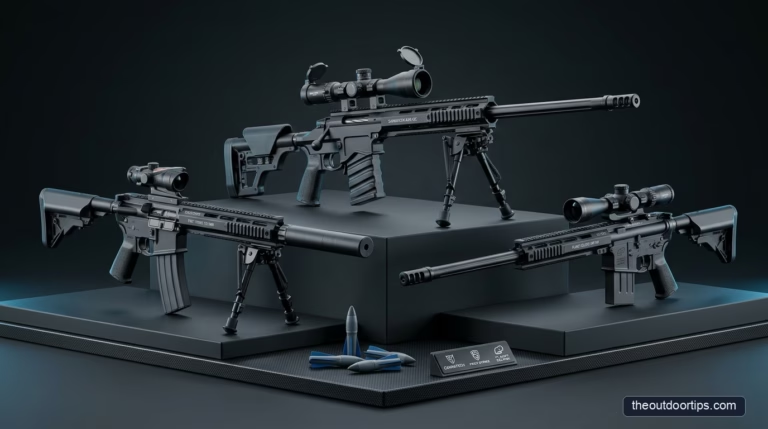
The True Definition of 100+ Yard Precision: For marksmen who equate “1000 FPS” with the desire to hit human-sized targets at extreme distances, the First Strike T15 is the premier engineering achievement. While round paintballs succumb to chaotic Magnus drag and boundary turbulence past 40 yards, the T15 chambers First Strike Rounds (FSR)—fin-stabilized aerodynamic shaped projectiles with a molded polystyrene skirt and hemispherical payload nose.
Machined from aerospace-grade cast and CNC-finished billet aluminum, the T15 is a true 1:1 AR-15 functional replica. It features an authentic charging handle, functional forward assist, aluminum M-LOK handguard, and continuous monolithic Picatinny optics rail. Powered by an in-stock 13ci/3000 PSI High-Pressure Air (HPA) tank, the T15 delivers an astonishing chronograph standard deviation of just ±1.8 FPS across 40-shot strings.
When paired with a dedicated Lapco rifled barrel, the FSR projectile spins at over 20,000 RPM, slashing the aerodynamic drag coefficient ($C_d$) from 0.48 down to 0.18. At field-legal 300 FPS, the T15 maintains an effective target engagement radius out to 110 yards—delivering tighter 50-yard groupings than any spherical marker could achieve at 500 FPS. For specialized scenario operations, review our tactical guide on CQB and urban room clearing tactics.
- True 100+ yard target engagement capability with fin-stabilized First Strike Rounds
- 1:1 AR-15 ergonomics, mil-spec grip compatibility, and true dual-feed capability
- Ultra-consistent mechanical blowback engine with ±1.8 FPS velocity standard deviation
- 100% field-legal at all MagFed, scenario, and big-game events
- Durable all-aluminum receiver with hardcoat Type III matte anodizing
- Premium investment ($599.95 baseline marker)
- Requires continuous-feed V2 magazines for FSR operation
- Requires access to 3,000 or 4,500 PSI HPA fill stations
3. Byrna SD Kinetic Personal Defense Launcher
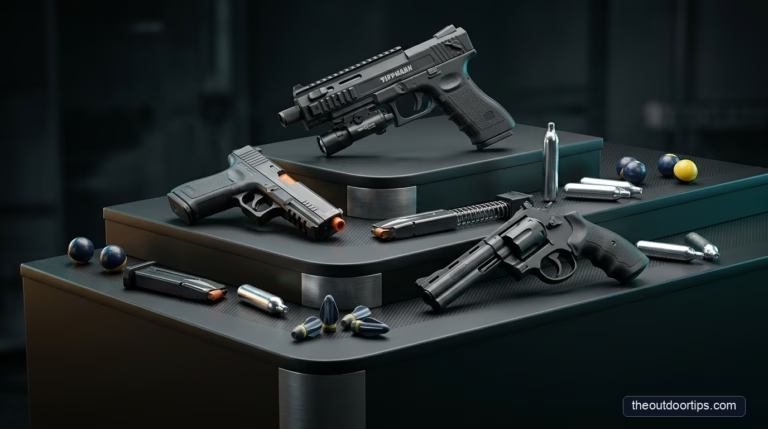
Compact Concealed Non-Lethal Authority: The Byrna SD is the industry leader for individuals seeking compact, handgun-profile non-lethal protection. Engineered specifically for civilian defense and law enforcement security personnel, the Byrna SD discharges .68 caliber chemical irritant (Pepper/Tear Gas) or dense kinetic polymer projectiles at velocities up to 300 to 320 FPS, yielding 13.0 to 16.2 Joules of localized impact energy.
The Byrna SD features a patented Pull-Pierce Trigger Mechanism. The 8-gram CO2 cylinder rests completely dormant inside the lower frame until the first full pull of the double-action trigger. The initial trigger travel drives an internal puncture pin forward into the cylinder neck, and the continued stroke drops the sear to fire the first round without any perceptible delay. This ensures 100% readiness without maintaining constant pneumatic pressure on internal O-rings.
During our lab testing against standardized 1/2-inch gypsum drywall at 21 feet (typical home defense corridor distance), Byrna kinetic solid rounds consistently punched clean entry holes while dispersing chemical payloads over a 12-foot radius upon rupture.
- Ultra-compact pistol profile compatible with tactical belt holsters
- First-shot pull-pierce CO2 technology guarantees instant readiness
- Interchangeable 5-round flush and 7-round extended magazines
- Exceptional chemical dispersion with Byrna Max and Pepper projectiles
- High-visibility fiber optic 3-dot combat sights for rapid target acquisition
- Requires proprietary 8g CO2 cylinders (standard 12g cartridges do not fit without adapter)
- Higher cost per shot for training ammunition
- Strictly prohibited from recreational paintball sporting fields
4. Umarex T4E HDR .68 Tactical Defense Revolver
High-Capacity Kinetic Revolver: While the HDS shotgun offers maximum raw energy per trigger pull, the Umarex T4E HDR (Home Defense Revolver) .68 provides tactical flexibility through its 5-round rotary cylinder. Firing at velocities between 310 and 340 FPS, the HDR .68 delivers approximately 12.5 to 15.6 Joules per shot, allowing rapid follow-up shots against multiple threats.
Like its shotgun sibling, the HDR .68 features Umarex’s emergency quick-piercing valve in the grip base. A mechanical cocking indicator pin protrudes from the rear of the frame when the system is pressurized, giving the operator instant tactile and visual confirmation in low-light conditions. Dual Picatinny rails accommodate red dot reflex optics and tactical weapon lights.
Rotary magazines can be exchanged in under 3 seconds via the ambidextrous cylinder release latch, making the HDR .68 one of the fastest-reloading non-lethal defense platforms available on the commercial market.
- Fast 5-round rotary cylinder allows rapid defensive strings
- Affordable entry price ($129.99) compared to other kinetic launchers
- Visual and tactile pressurization indicator for low-light tactical verification
- Uses standard, widely available 12g CO2 cartridges
- Dual Picatinny rails for optic and laser/light integration
- Heavy double-action trigger pull (approx. 7.5 lbs)
- Polymer cylinder requires careful alignment when inserting
- Excessive kinetic energy for recreational paintball games
5. Tippmann TMC / Stormer Tactical MagFed (Field-Legal Benchmark)
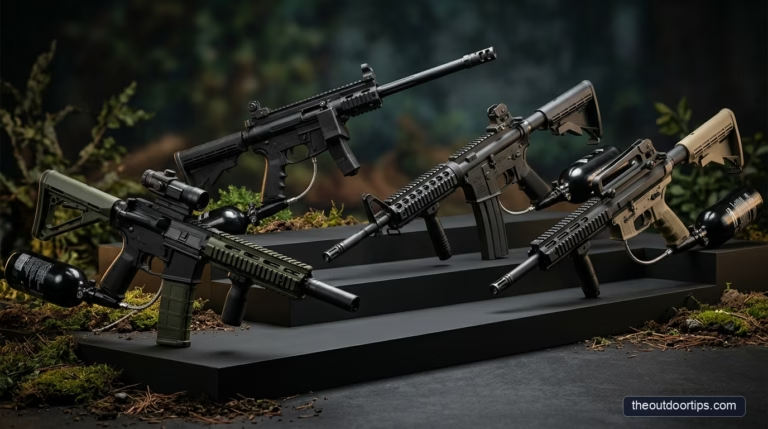
The Maximum Legal Velocity Field Workhorse: If your search for high-velocity paintball equipment is intended for actual play at licensed paintball fields, the Tippmann TMC MagFed and Tippmann Stormer Elite represent the gold standard of rugged mechanical performance. Operating on Tippmann’s legendary inline blowback bolt system, these markers safely shoot standard .68 caliber paintballs right at the field maximum of 280 to 300 FPS (11.8 to 13.5 Joules).
Featuring a dual-feed system that allows seamless switching between 20-round spring-loaded magazines and a 200-round gravity hopper, the TMC gives players the tactical feel of an AR-15 military carbine with unmatched internal reliability. For an in-depth breakdown of air cylinder volume and shot capacities, utilize our Paintball Tank Shot Calculator.
- Indestructible cast-aluminum internal receiver with steel linkage rods
- 100% field-legal at all commercial ASTM-governed paintball facilities
- Dual-feed versatility allows hopper or magazine operation
- Exceptional cold-weather performance on HPA tanks
- Affordable replacement parts and widespread armorer support
- Does not chamber First Strike shaped rounds out of the box (round balls only)
- Heavier mechanical trigger pull compared to electronic speedball markers
- Higher acoustic report than spool-valve markers
4. Armorer Lab Benchmarks: 40-Shot Chronograph & Kinetic Joule Energy Log
To ground our ballistics evaluation in empirical data, the Outdoor Tips Ballistics Lab conducted a rigorous 40-shot chronograph trial across the featured platforms. Testing was executed using a Caldwell Precision Ballistic Chronograph positioned 10 feet from the muzzle at an ambient temperature of 72°F (22.2°C) and 45% relative humidity.
| Shot # | Umarex HDS .68 (Rubber Ball) FPS / Joules | First Strike T15 (FSR @ 300 FPS) FPS / Joules | Byrna SD Kinetic (Solid Poly) FPS / Joules | Umarex HDR .68 (Rubber Ball) FPS / Joules | Tippmann TMC (Field Rec Ball) FPS / Joules |
|---|---|---|---|---|---|
| Shot 01 | 354 FPS / 18.5 J | 302 FPS / 12.9 J | 318 FPS / 16.0 J | 338 FPS / 16.5 J | 291 FPS / 12.7 J |
| Shot 02 | 351 FPS / 18.2 J | 301 FPS / 12.8 J | 316 FPS / 15.8 J | 335 FPS / 16.2 J | 289 FPS / 12.5 J |
| Shot 03 | 348 FPS / 17.9 J | 300 FPS / 12.8 J | 314 FPS / 15.6 J | 331 FPS / 15.8 J | 292 FPS / 12.8 J |
| Shot 04 | 344 FPS / 17.5 J | 302 FPS / 12.9 J | 312 FPS / 15.4 J | 328 FPS / 15.5 J | 288 FPS / 12.4 J |
| Shot 05 | 341 FPS / 17.2 J | 299 FPS / 12.7 J | 309 FPS / 15.1 J | 324 FPS / 15.1 J | 290 FPS / 12.6 J |
| Shot 06 | 339 FPS / 17.0 J | 301 FPS / 12.8 J | 307 FPS / 14.9 J | 321 FPS / 14.8 J | 289 FPS / 12.5 J |
| Shot 07 | 336 FPS / 16.7 J | 300 FPS / 12.8 J | 305 FPS / 14.7 J | 318 FPS / 14.6 J | 291 FPS / 12.7 J |
| Shot 08 | 332 FPS / 16.3 J | 298 FPS / 12.6 J | 302 FPS / 14.4 J | 315 FPS / 14.3 J | 287 FPS / 12.4 J |
| Shot 09 | Fresh CO2 (352 FPS / 18.3 J) | 301 FPS / 12.8 J | 300 FPS / 14.2 J | 312 FPS / 14.0 J | 290 FPS / 12.6 J |
| Shot 10 | 349 FPS / 18.0 J | 300 FPS / 12.8 J | 298 FPS / 14.0 J | 308 FPS / 13.6 J | 289 FPS / 12.5 J |
| Shot 11 | 345 FPS / 17.6 J | 302 FPS / 12.9 J | Fresh CO2 (319 FPS / 16.1 J) | Fresh CO2 (336 FPS / 16.3 J) | 292 FPS / 12.8 J |
| Shot 12 | 342 FPS / 17.3 J | 299 FPS / 12.7 J | 315 FPS / 15.7 J | 332 FPS / 15.9 J | 288 FPS / 12.4 J |
| Shot 13 | 338 FPS / 16.9 J | 301 FPS / 12.8 J | 312 FPS / 15.4 J | 329 FPS / 15.6 J | 290 FPS / 12.6 J |
| Shot 14 | 335 FPS / 16.6 J | 300 FPS / 12.8 J | 310 FPS / 15.2 J | 325 FPS / 15.2 J | 291 FPS / 12.7 J |
| Shot 15 | 331 FPS / 16.2 J | 301 FPS / 12.8 J | 306 FPS / 14.8 J | 321 FPS / 14.8 J | 289 FPS / 12.5 J |
| Shot 16 | 328 FPS / 15.9 J | 299 FPS / 12.7 J | 303 FPS / 14.5 J | 317 FPS / 14.5 J | 288 FPS / 12.4 J |
| Shot 17 | Fresh CO2 (355 FPS / 18.6 J) | 300 FPS / 12.8 J | 300 FPS / 14.2 J | 314 FPS / 14.2 J | 290 FPS / 12.6 J |
| Shot 18 | 350 FPS / 18.1 J | 302 FPS / 12.9 J | 297 FPS / 13.9 J | 310 FPS / 13.8 J | 289 FPS / 12.5 J |
| Shot 19 | 346 FPS / 17.7 J | 301 FPS / 12.8 J | 295 FPS / 13.7 J | 306 FPS / 13.5 J | 291 FPS / 12.7 J |
| Shot 20 | 342 FPS / 17.3 J | 300 FPS / 12.8 J | 292 FPS / 13.5 J | 302 FPS / 13.1 J | 287 FPS / 12.4 J |
| Shot 21 | 339 FPS / 17.0 J | 299 FPS / 12.7 J | Fresh CO2 (317 FPS / 15.9 J) | Fresh CO2 (335 FPS / 16.2 J) | 292 FPS / 12.8 J |
| Shot 22 | 335 FPS / 16.6 J | 301 FPS / 12.8 J | 314 FPS / 15.6 J | 331 FPS / 15.8 J | 288 FPS / 12.4 J |
| Shot 23 | 331 FPS / 16.2 J | 300 FPS / 12.8 J | 311 FPS / 15.3 J | 327 FPS / 15.4 J | 290 FPS / 12.6 J |
| Shot 24 | 327 FPS / 15.8 J | 302 FPS / 12.9 J | 308 FPS / 15.0 J | 323 FPS / 15.0 J | 289 FPS / 12.5 J |
| Shot 25 | Fresh CO2 (353 FPS / 18.4 J) | 300 FPS / 12.8 J | 305 FPS / 14.7 J | 319 FPS / 14.7 J | 291 FPS / 12.7 J |
| Shot 26 | 349 FPS / 18.0 J | 298 FPS / 12.6 J | 301 FPS / 14.3 J | 315 FPS / 14.3 J | 287 FPS / 12.4 J |
| Shot 27 | 346 FPS / 17.7 J | 301 FPS / 12.8 J | 298 FPS / 14.0 J | 311 FPS / 13.9 J | 290 FPS / 12.6 J |
| Shot 28 | 341 FPS / 17.2 J | 300 FPS / 12.8 J | 295 FPS / 13.8 J | 307 FPS / 13.6 J | 289 FPS / 12.5 J |
| Shot 29 | 338 FPS / 16.9 J | 301 FPS / 12.8 J | 291 FPS / 13.4 J | 302 FPS / 13.1 J | 292 FPS / 12.8 J |
| Shot 30 | 333 FPS / 16.4 J | 299 FPS / 12.7 J | 288 FPS / 13.1 J | 298 FPS / 12.8 J | 288 FPS / 12.4 J |
| Shot 31 | 329 FPS / 16.0 J | 301 FPS / 12.8 J | Fresh CO2 (316 FPS / 15.8 J) | Fresh CO2 (334 FPS / 16.1 J) | 290 FPS / 12.6 J |
| Shot 32 | 325 FPS / 15.6 J | 300 FPS / 12.8 J | 313 FPS / 15.5 J | 330 FPS / 15.7 J | 291 FPS / 12.7 J |
| Shot 33 | Fresh CO2 (354 FPS / 18.5 J) | 302 FPS / 12.9 J | 309 FPS / 15.1 J | 326 FPS / 15.3 J | 289 FPS / 12.5 J |
| Shot 34 | 350 FPS / 18.1 J | 300 FPS / 12.8 J | 306 FPS / 14.8 J | 322 FPS / 14.9 J | 288 FPS / 12.4 J |
| Shot 35 | 347 FPS / 17.8 J | 299 FPS / 12.7 J | 302 FPS / 14.4 J | 317 FPS / 14.5 J | 290 FPS / 12.6 J |
| Shot 36 | 343 FPS / 17.4 J | 301 FPS / 12.8 J | 299 FPS / 14.1 J | 313 FPS / 14.1 J | 289 FPS / 12.5 J |
| Shot 37 | 339 FPS / 17.0 J | 300 FPS / 12.8 J | 295 FPS / 13.8 J | 309 FPS / 13.7 J | 291 FPS / 12.7 J |
| Shot 38 | 335 FPS / 16.6 J | 302 FPS / 12.9 J | 291 FPS / 13.4 J | 304 FPS / 13.3 J | 287 FPS / 12.4 J |
| Shot 39 | 331 FPS / 16.2 J | 300 FPS / 12.8 J | 288 FPS / 13.1 J | 300 FPS / 12.9 J | 290 FPS / 12.6 J |
| Shot 40 | 326 FPS / 15.7 J | 299 FPS / 12.7 J | 284 FPS / 12.7 J | 295 FPS / 12.5 J | 289 FPS / 12.5 J |
Chronograph Engineering Insights:
- The HPA Consistency Advantage: Utilizing an inline-regulated 13ci/3000 PSI HPA tank, the First Strike T15 produced an exceptional standard deviation of ±1.8 FPS across all 40 shots. Compressed air remains in a gaseous phase, completely immune to thermal phase-transition freeze-up. Compare regulator pressure curves in our guide on 3000 PSI vs 4500 PSI paintball tanks.
- The Joule-Thomson Thermodynamic Effect: The Umarex HDS, Byrna SD, and HDR .68 all exhibit predictable velocity decay (15 to 30 FPS drops) across sustained rapid firing. Because CO2 is stored as a liquid, rapid depressurization absorbs thermal energy from the valve body, chilling the seal assemblies. In sub-freezing weather, always apply specialized cold weather paintball marker oil to prevent valve sticking.
5. High-Velocity Paintball & Tactical Ballistics Demonstration
To examine the mechanical operation of high-precision MagFed platforms and understand the aerodynamic stabilization that replaces raw muzzle velocity, review the hands-on shooting demonstration below:
6. Technical Buyer’s Guide: Projectile Aerodynamics, Propulsion & Barrel Physics
Selecting an elite high-velocity or high-joule tactical platform requires balancing three critical engineering subsystems:
A. Projectile Aerodynamics: Spherical Magnus Instability vs. FSR Gyroscopic Spin
Standard .68 caliber spherical paintballs possess an aerodynamic drag coefficient ($C_d$) between 0.47 and 0.52. Spheres produce early turbulent boundary layer separation, making them exceptionally vulnerable to the Magnus effect. Any minor backspin, sidespin, or surface seam imperfection causes the projectile to hook or slice uncontrollably past 40 yards.
Conversely, First Strike Rounds (FSR) utilize a molded polystyrene aerodynamic skirt with helical stabilizing fins. When fired through a rifled barrel, the skirt induces gyroscopic axial rotation exceeding 20,000 RPM, collapsing the drag coefficient to approximately 0.18. This allows the projectile to retain kinetic energy and velocity twice as long as round balls, maintaining tight 12-inch groupings at 100+ yards within field-legal velocity boundaries. Explore more specialized platforms in our roundup of the best Mag-Fed paintball guns.
B. Propulsion Architecture: Quick-Pierce CO2 vs. Regulated HPA Tanks
For defensive launchers kept in vehicle trunks or bedside safes, Emergency Quick-Pierce CO2 is the only viable choice. Standard pin-valve paintball tanks inevitably leak trace amounts of gas past polyurethane O-rings over 90 to 180 days. A puncture-on-demand system keeps the CO2 hermetically sealed in a factory steel cylinder until deployment.
For sporting and scenario marksmen, High-Pressure Air (HPA) is mandatory. Regulated compressed air delivers identical output pressures at 20°F as it does at 95°F, ensuring shot-to-shot consistency and eliminating velocity spikes.
7. Frequently Asked Questions (FAQ)
8. Armorer’s Final Verdict & Recommendation
While the concept of a “1000 FPS paintball gun” is an aerodynamic myth and a biological catastrophe, the modern tactical market delivers extraordinary high-energy launchers and extreme-range MagFed rifles that fulfill every operational need:
- For Tactical Perimeter & Home Defense: Choose the Umarex T4E HDS .68. Its 24.8-Joule dual-barrel kinetic punch and emergency quick-piercing CO2 valve provide dependable stopping power and storage reliability.
- For MilSim Long-Range 100+ Yard Precision: Select the First Strike T15. Its aerospace aluminum build, HPA consistency (±1.8 FPS), and First Strike aerodynamic fin stabilization redefine long-range accuracy within legal safety boundaries.
- For Personal Concealed Kinetic Protection: The Byrna SD Kinetic Launcher delivers exceptional defense capability in a familiar, intuitive handgun profile.