You pull an old gear bag out of your garage closet on a Friday night, inspect your high-pressure air bottle, and ask yourself a life-or-death armorer question: is my paintball tank expired? In our field tests and match clinics across two decades of tournament competition, pressurized cylinders holding 3,000 to 4,500 PSI store enough kinetic energy to level a staging tent if structural integrity fails. Determining cylinder airworthiness is not a guessing game: the Department of Transportation (DOT) and Transport Canada (TC) enforce strict statutory timelines governing hydro retests and mandatory condemned lifespans. Below is our definitive armorer guide to decoding tank born-on stamps, identifying the 15-year carbon fiber expiration ceiling, applying the federal 2×2 aluminum exemption, and performing complete visual shell triage. (If retiring or recycling an expired vessel, follow our protocol on how to safely empty a paintball tank at home first.)
Key Technical Takeaways (TL;DR)
To answer is my paintball tank expired, distinguish between the 5-year hydrostatic retest cycle and the permanent 15-year maximum lifespan. All carbon-fiber wrapped HPA cylinders must be decommissioned exactly 15 years from their manufacture date with zero extensions, while solid aluminum bottles can be retested every 5 years indefinitely (with small aluminum tanks under 2″ × 2 feet enjoying a permanent federal hydro exemption). (If retiring or recycling an expired vessel, follow our protocol on how to safely empty a paintball tank at home first.)
15 Years Max
DOT-SP Strict Expiration Ceiling
Every 5 Years
60-Month Recertification Clock
< 2″ OD × < 24″ L
49 CFR § 180.209(g) Hydro-Free
Infinite / Indefinite
DOT-3AL Valid If Passes Hydro
- The 15-Year Death Sentence: A carbon fiber tank manufactured in April 2011 expired permanently on April 30, 2026. It cannot be legally filled or retested anywhere in North America under federal law.
- Out of Hydro vs. Expired: If your tank is 8 years old and its last 5-year hydro decal has lapsed, it is merely “out of hydro”—not permanently expired. A $35 certified hydrostatic test restores field airworthiness for another 5 years.
- Fatal Safety Error: Never attempt to fill a carbon fiber tank with deep gouges, exposed dry fibers, or chemical resin delamination, even if the born-on date is still legally within its 5-year window.
The Federal Physics & Regulations Behind Tank Expiration
To safely evaluate whether is my paintball tank expired, you must understand the tremendous physical stresses operating inside a high-pressure cylinder. When filled to 4,500 PSI, an average 68 cubic inch carbon fiber bottle withstands over 140,000 pounds of total outward radial tensile force along its cylinder walls. (If retiring or recycling an expired vessel, follow our protocol on how to safely empty a paintball tank at home first.)
Under Title 49 of the Code of Federal Regulations (49 CFR § 180.209), the United States Department of Transportation (DOT) and Pipeline and Hazardous Materials Safety Administration (PHMSA) categorize paintball vessels into two distinct metallurgy and composite classifications: (If retiring or recycling an expired vessel, follow our protocol on how to safely empty a paintball tank at home first.)
• σ_hoop = Circumferential tensile stress on the cylinder shell (PSI)
• P_internal = Internal compressed gas pressure (up to 4,500 PSI service / 7,500 PSI hydro test)
• r_internal = Internal radius of the aluminum liner (approx. 2.15 inches)
• t_wall = Composite wall thickness (liner aluminum + structural carbon fiber wrap)
• SF = Safety Factor (federally mandated 3.0x burst threshold: 13,500+ PSI burst rating)
Every time you fill and shoot your tank, the cylinder expands and contracts like a mechanical lung. Over thousands of pressure cycles, microscopic fatigue builds up in the aluminum inner liner, and the epoxy matrix bonding the carbon fiber tow undergoes micro-strain aging. This is why federal safety laws enforce strict expiration milestones. (If retiring or recycling an expired vessel, follow our protocol on how to safely empty a paintball tank at home first.)
1. The 15-Year Hard Expiration Rule (Carbon Fiber DOT-SP / DOT-E)
All composite carbon-fiber wrapped paintball tanks are manufactured under a special permit from the DOT (such as DOT-SP 14387, DOT-SP 14003, or older DOT-E exemptions). Under these special permits, composite cylinders have an immutable, non-negotiable 15-year maximum service lifespan. Once 15 years (180 months) have elapsed from the month and year of original manufacture, the cylinder is condemned by law. It cannot be hydrotested, it cannot be legally filled at any commercial compressor, and it must be permanently decommissioned. If you ask yourself is my paintball tank expired and discover a born-on date older than 15 years, the tank is scrap metal. (If retiring or recycling an expired vessel, follow our protocol on how to safely empty a paintball tank at home first.)
2. The 5-Year Hydrostatic Retest Cycle
Both carbon fiber tanks and standard aluminum tanks must be hydrostatically re-tested every 5 years (60 months). Hydrostatic testing involves submerging the unvalved cylinder in a water jacket, pressurizing it to 5/3 of its rated working pressure (7,500 PSI test pressure for a 4,500 PSI bottle; 5,000 PSI test pressure for a 3,000 PSI bottle), and measuring elastic versus permanent volumetric expansion. If the permanent expansion exceeds strict percentage limits, the cylinder is condemned. If it passes, a certified testing facility applies a new hydrostatic decal or metal stamp with their Registered Inspector Number (RIN), granting another 5 years of airworthiness (until the 15-year carbon cap is reached). (If retiring or recycling an expired vessel, follow our protocol on how to safely empty a paintball tank at home first.)
3. The Federal 2×2 Exemption (Small Aluminum Tanks)
Under 49 CFR § 180.209(g), solid aluminum cylinders (DOT-3AL) that measure less than 2 inches in outside diameter and less than 2 feet in length are completely exempt from hydrostatic retesting. Popular 13ci/3000 PSI and 22ci/3000 PSI aluminum tanks frequently used in pump, pistol, and magfed loadouts fall under this federal exemption. These small aluminum tanks never expire and never require a 5-year hydro test, provided they show no external corrosion, thread damage, or physical dents. (If retiring or recycling an expired vessel, follow our protocol on how to safely empty a paintball tank at home first.)
Master Tank Type & Expiration Diagnostic Lookup Matrix
Compare your bottle against our armorer lookup table to determine its exact legal status and testing requirements: (If retiring or recycling an expired vessel, follow our protocol on how to safely empty a paintball tank at home first.)
Step-by-Step Diagnostic Flowchart
Follow our structured field triage flowchart below to rapidly answer is my paintball tank expired, needs hydrostatic recertification, or is 100% field legal to fill: (If retiring or recycling an expired vessel, follow our protocol on how to safely empty a paintball tank at home first.)
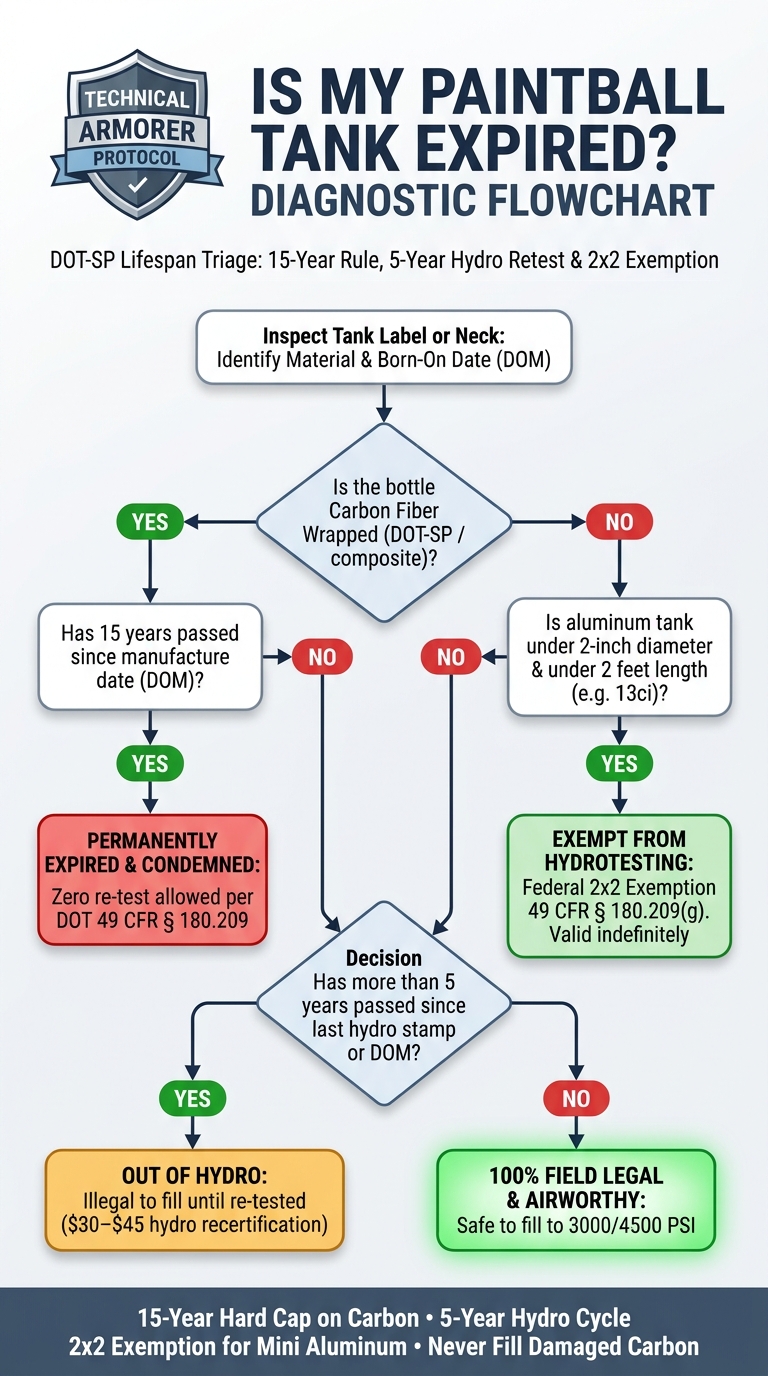
Figure 1: Certified armorer decision tree for diagnosing paintball tank expiration dates, 5-year hydrostatic testing cycles, and federal exemptions. (If retiring or recycling an expired vessel, follow our protocol on how to safely empty a paintball tank at home first.)
5-Phase Armorer Protocol to Determine Paintball Tank Expiration
When assessing whether is my paintball tank expired, follow our 5-phase inspection protocol used across major tournament chronograph stations: (If retiring or recycling an expired vessel, follow our protocol on how to safely empty a paintball tank at home first.)
Phase 1: Locating the Original Date of Manufacture (DOM)
Every paintball cylinder carries an original born-on date that establishes the core baseline for answering is my paintball tank expired: (If retiring or recycling an expired vessel, follow our protocol on how to safely empty a paintball tank at home first.)
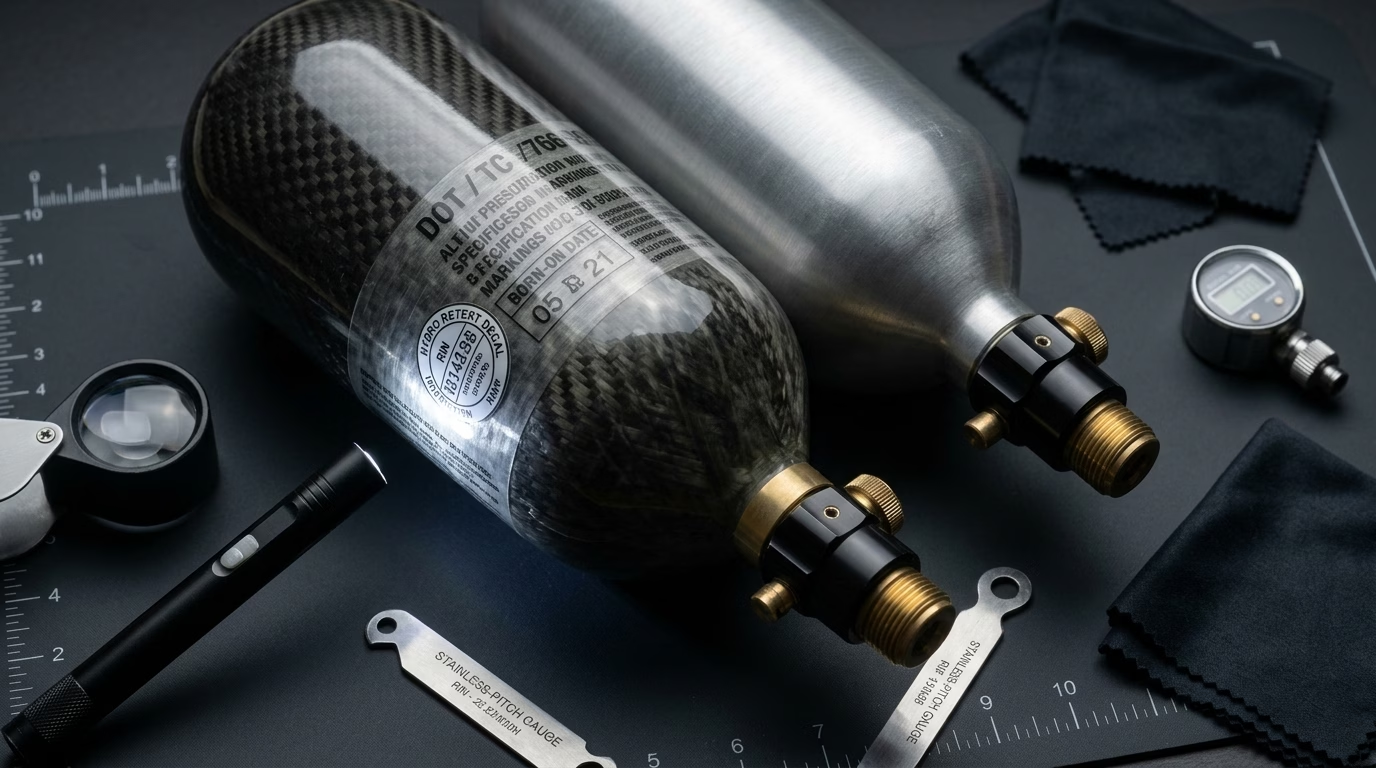
- Carbon Fiber Wrapped Tanks: The DOM is printed on the large manufacturer label sealed permanently beneath the clear epoxy gel-coat. Look near the center or bottom of the label for the format
MM Ꙫ YYorMM / YY(e.g.,05 Ꙫ 21indicates May 2021). The symbol in the middle is typically the manufacturer’s inspection mark. - Solid Aluminum Tanks: The DOM is stamped directly into the curved shoulder metal near the neck. Look for stamped numbers such as
08 A 20(August 2020), where the letter represents the authorized testing facility inspector stamp. - Calculate 15-Year Expiration: If the tank is carbon fiber, add exactly 15 years to the DOM month. For example, a tank born in
06/11expired on June 30, 2026. If the 15-year date has passed, the tank is permanently expired.
Phase 2: Searching for Hydrostatic Recertification Decals
If the cylinder is under 15 years old, check whether its 5-year operating window is current: (If retiring or recycling an expired vessel, follow our protocol on how to safely empty a paintball tank at home first.)
- Inspect for Secondary Hydro Stickers: After a tank undergoes a retest, certified hydro stations apply a circular or square laminated decal over the cylinder body.
- Read the Retest Date & RIN: The decal will display a new month and year, along with the facility’s Registered Inspector Number (e.g.,
RIN A123). If the decal reads03 / 22, the cylinder is field legal until March 31, 2027 (5 years from the test date). - Distinguish Between Out of Hydro vs. Expired: If the hydro date is older than 5 years (e.g.,
04 / 19), but the original DOM is only 9 years old, the tank is NOT expired! It is simply “out of hydro.” You can send it to a certified hydro station, pass an inspection, and receive a fresh 5-year decal. Review our comprehensive paintball tank hydro testing guide for testing logistics.
Phase 3: Measuring for the Federal 2×2 Aluminum Exemption
Do not waste money hydrotesting small aluminum bottles that are federally exempt: (If retiring or recycling an expired vessel, follow our protocol on how to safely empty a paintball tank at home first.)
- Measure Outside Diameter (OD): Use a digital caliper or flexible tape. If the bottle’s outer diameter is less than 2.0 inches (50.8 mm), it passes the first half of the exemption.
- Measure Cylinder Length: Measure from the base of the tank to the start of the neck threads. If total length is under 24.0 inches, the tank qualifies under 49 CFR § 180.209(g).
- Verify DOT-3AL Stamp: Confirm the neck reads
DOT-3AL 3000. Standard 13ci/3000 PSI cylinders meet this criteria and can be filled indefinitely without hydro stamps.
Phase 4: Physical Shell Integrity & Damage Triage
A tank that is within its 5-year date can still be instantly condemned due to physical shell damage: (If retiring or recycling an expired vessel, follow our protocol on how to safely empty a paintball tank at home first.)
- Level 1 Clear-Coat Scratches (Acceptable): Light surface scuffs on the glossy epoxy that do not penetrate into the black woven carbon fibers are purely cosmetic and safe.
- Level 2 Fiber Gouging (Condemned): If an impact dent or concrete scrape cuts into the carbon fiber filaments—visible as frayed, white, or fuzzy fiber strands—the pressure containment boundary is compromised. The tank must be condemned immediately.
- Chemical Delamination & Thermal Blistering: Paintball tanks exposed to harsh solvents, automotive oils, or excessive trunk heat develop cloudy white blisters or peeling epoxy layers. Delaminated composite bottles are unsafe for high-pressure service.
- Neck Thread Cross-Threading: Inspect the top 0.825″-14 NGO threads. If female ASA binding has stripped the aluminum neck, the bottle cannot safely retain a regulator under pressure (see our guide on paintball tank thread fixes).
Phase 5: Regulator & Burst Disk Inspection
Even if the bottle is legally certified, verify that the attached regulator is airworthy (and review our repair guide if your paintball on off asa stuck lever refuses to degas): (If retiring or recycling an expired vessel, follow our protocol on how to safely empty a paintball tank at home first.)
- Inspect Dual Safety Burst Disks: Verify that the regulator retains factory-rated burst disks: a 1.8K burst disk on the low-pressure output side, and a 5K or 7.5K burst disk on the high-pressure tank side. Never play with bypassed or oversized burst disks! Review our detailed guide on paintball tank burst disk replacement.
- Check for Dynamic Regulator Leaks: Listen for air hissing from the bonnet bonnet seam, fill nipple, or gauge face upon filling. If the regulator leaks, service the internal Belleville shims and piston seals (follow our instructions on how to fix paintball tank regulator leaks).
If a carbon fiber tank reaches its 15-year expiration date or fails hydrostatic expansion testing, federal regulations mandate that it must be permanently decommissioned. Never attempt to sell or give away an expired 4,500 PSI cylinder. Armorers render condemned cylinders safe by completely discharging all pressure, removing the regulator, and drilling a 1/2-inch hole through the shoulder to prevent accidental high-pressure refilling.
(If retiring or recycling an expired vessel, follow our protocol on how to safely empty a paintball tank at home first.)
Essential Armorer Workbench Gear for Tank Inspection & Maintenance
To inspect tank certifications, protect cylinder threads, and determine whether is my paintball tank expired at home, keep these armorer tools in your gear bag: (If retiring or recycling an expired vessel, follow our protocol on how to safely empty a paintball tank at home first.)
Ninja Paintball 68/4500 Carbon Fiber HPA Tank
Freshly manufactured tournament-grade carbon fiber bottle with full 15-year service life and 5-year initial hydro certification. Features the ultra-reliable Ninja Pro V2 adjustable regulator. (If retiring or recycling an expired vessel, follow our protocol on how to safely empty a paintball tank at home first.)
HK Army Heavy-Duty Silicone Tank Cover
High-grip elastomer protective skin that cushions carbon fiber bottles against rock gouges, bunker abrasions, and catastrophic fiber damage that condemns expensive tanks. (If retiring or recycling an expired vessel, follow our protocol on how to safely empty a paintball tank at home first.)
Aluminum Thread Saver & Cap Protector
CNC-machined aluminum caps that screw over regulator bonnets to protect delicate 0.825″-14 NGO threads from trunk impact dents and staging dirt contamination. (If retiring or recycling an expired vessel, follow our protocol on how to safely empty a paintball tank at home first.)
Armorer LED Magnifier & Inspection Penlight
High-intensity focused LED light and 10x optical magnifier for reading faded born-on date stamps, verifying hydro decals, and inspecting fiber weaves for delamination. (If retiring or recycling an expired vessel, follow our protocol on how to safely empty a paintball tank at home first.)
Video Walkthrough: Understanding Paintball Tank Dates & Hydro Rules
Watch this practical technical demonstration showing the exact procedure for reading born-on dates, finding hydro retest stamps, and understanding cylinder lifespan rules: (If retiring or recycling an expired vessel, follow our protocol on how to safely empty a paintball tank at home first.)
Final Armorer Verdict: Cylinder Safety & Legal Compliance
When determining is my paintball tank expired, precision inspection protects both your wallet and your physical safety. If your carbon fiber bottle is approaching its 15th anniversary, celebrate its service and decommission it safely—no certified testing facility will re-hydro an aged composite vessel. If it is simply past its 5-year retest mark, invest $35 in a certified hydrostatic test to restore legal airworthiness. Keep bottles protected inside heavy silicone skins, protect regulator threads with aluminum thread savers, and never compromise on high-pressure air containment.
(If retiring or recycling an expired vessel, follow our protocol on how to safely empty a paintball tank at home first.)
Frequently Asked Questions
How can I tell: is my paintball tank expired or just out of hydro?
Check the original Date of Manufacture (DOM) printed on the label. If the tank is carbon fiber and more than 15 years have passed since that born-on date, the tank is permanently expired and cannot be retested. If less than 15 years have passed, but more than 5 years have elapsed since the last hydro test date (or born-on date), the tank is not expired; it is merely out of hydro and can be recertified for another 5-year cycle. (If retiring or recycling an expired vessel, follow our protocol on how to safely empty a paintball tank at home first.)
Do aluminum paintball tanks ever expire?
Solid aluminum cylinders (DOT-3AL) do not have a 15-year maximum lifespan cap. As long as a standard aluminum bottle passes its 5-year hydrostatic pressure test and visual interior inspection, it can legally remain in service indefinitely for decades. Small aluminum cylinders under 2″ in diameter (such as 13ci tanks) never require hydrotesting at all under the federal 2×2 exemption. (If retiring or recycling an expired vessel, follow our protocol on how to safely empty a paintball tank at home first.)
What happens if I try to fill an expired paintball tank at a field?
Commercial paintball fields, pro shops, and scuba fill stations are required by federal law and commercial liability insurance to inspect tank dates before connecting fill whips. If a tank is past its 15-year lifespan or out of its 5-year hydro window, staff will refuse to fill it. Refilling an uncertified cylinder risks catastrophic burst rupture under 3,000 to 4,500 PSI pressure. (If retiring or recycling an expired vessel, follow our protocol on how to safely empty a paintball tank at home first.)
How much does it cost to re-hydrotest a paintball tank?
A certified hydrostatic test typically costs between $30 and $45, including return shipping or local scuba shop fees. For an expensive $200+ carbon fiber tank with years of remaining service life, retesting is highly economical. For a budget $45 aluminum tank, purchasing a brand-new bottle is often more cost-effective than paying for hydro recertification. (If retiring or recycling an expired vessel, follow our protocol on how to safely empty a paintball tank at home first.)
Can I keep and reuse the regulator from an expired carbon fiber tank?
Yes! Regulators do not have a 15-year expiration cap. When your carbon fiber bottle reaches its 15-year expiration date, discharge all air, unscrew the regulator bonnet assembly, inspect the Belleville shims and threads, and thread it onto a fresh replacement bottle to save $50 to $100 on your new setup. (If retiring or recycling an expired vessel, follow our protocol on how to safely empty a paintball tank at home first.)
What does the symbol between the month and year mean?
On a stamped or printed born-on date (such as 04 Ꙫ 21), the symbol or letter between the month and year is the official inspector mark or logo of the certified testing facility or manufacturer registered with the Department of Transportation. On re-hydro decals, this appears as an official Registered Inspector Number (RIN). (If retiring or recycling an expired vessel, follow our protocol on how to safely empty a paintball tank at home first.)