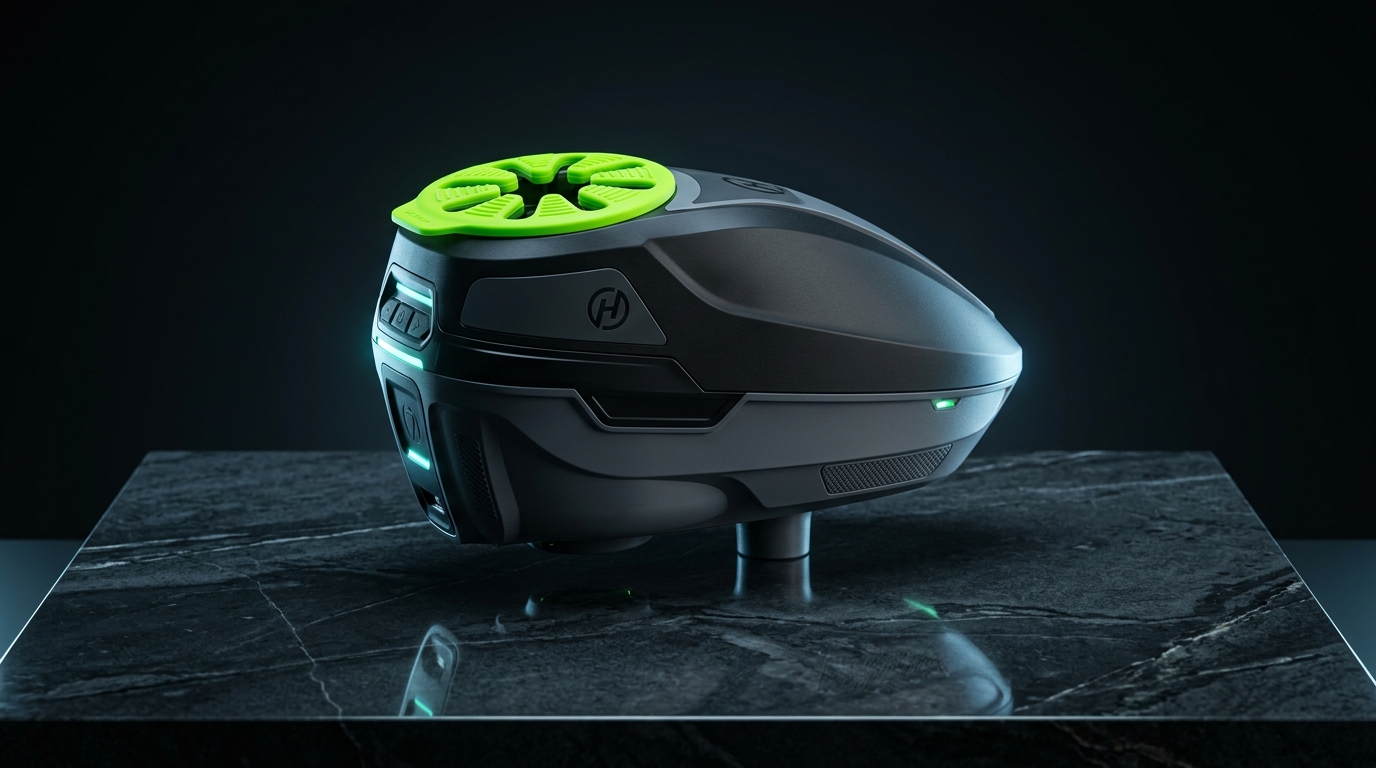
The paintball hopper—also known as the loader—is often treated as an afterthought by beginner and intermediate players who pour all their budget into their marker. But ask any tournament player, scenario veteran, or field technician, and they will tell you an undeniable truth: your paintball gun is only as fast and reliable as the loader sitting on top of its feedneck.
When you are deciding whether to upgrade from a $15 plastic gravity shaker to a $110–$250 electronic force-feed system, the question isn’t just about saving money. It’s about matching mechanical ball-feed rates to your marker’s firing cycle, eliminating catastrophic breach chops, and preventing your marker’s electronic eyes from throttling your fire rate down to a crawl.
⚡ Quick Verdict: Do I Need a High-End Hopper? Understanding the Importance and Benefits
The short answer: If you shoot an electronic marker (firing 10+ balls per second on NXL ramping or semi-auto) or a fast mechanical spool-valve marker like the Planet Eclipse Etha 3M, yes, an electronic force-feed hopper is 100% mandatory. A gravity hopper cannot keep up with high cycle speeds, leading to empty chambers, chopped paint, and fouled barrels that destroy your accuracy.
However, if you shoot an entry-level mechanical blowback marker (see our paintball marker guide for beginners) like the Tippmann Cronus, 98 Custom, or Spyder Victor firing 4–6 BPS, spending $200 on an elite tournament hopper is unnecessary. A simple shelf-assisted gravity loader like the Proto Primo ($20) or a pneumatic Planet Eclipse PAL ($25) will handle your rate of fire perfectly. If you want the ultimate balance of tournament-grade speed and reliability without spending $250, get the Dye Rotor LT-R ($110) or Virtue Spire IR2 ($115).
The Physics of Feeding: Gravity vs. Electronic Force-Feed
To understand why a high-end loader changes your game, you have to examine the ballistics and physical constraints of feeding a gelatin capsule into an open aluminum breach.
A standard 200-round gravity-fed hopper relies entirely on earth’s gravitational acceleration (\(9.8\text{ m/s}^2\)) to drop a 0.68 caliber paintball down a vertical feed tube. In ideal laboratory conditions, free-fall gravity can deliver approximately 7 to 9 balls per second (BPS). But on a dynamic paintball field—where you are sprinting, diving into snake bunkers, tilting your marker sideways to snapshoot, and absorbing the recoil shockwaves of each shot—free-fall completely fails.
Two critical physical phenomena destroy gravity-fed performance:
- The Funnel Arch (Staking Effect): When multiple paintballs rattle downward simultaneously toward the feedneck opening, their curved surfaces wedge against each other across the funnel aperture. This creates a mechanical arch that suspends the ball stack above the breach. The only way to break this arch is to violently shake the marker—costing you precious seconds during a firefight.
- Breach Starvation & Bolt Chops: Modern electronic markers (such as the Planet Eclipse Etha 3 or Proto Rize) cycle their bolt in less than 40 milliseconds. If a paintball is only halfway into the chamber when the bolt strokes forward, the bolt shears the gelatin shell in half. This coats your bolt, detents, and barrel in sticky paint, ruining trajectory for every subsequent shot.
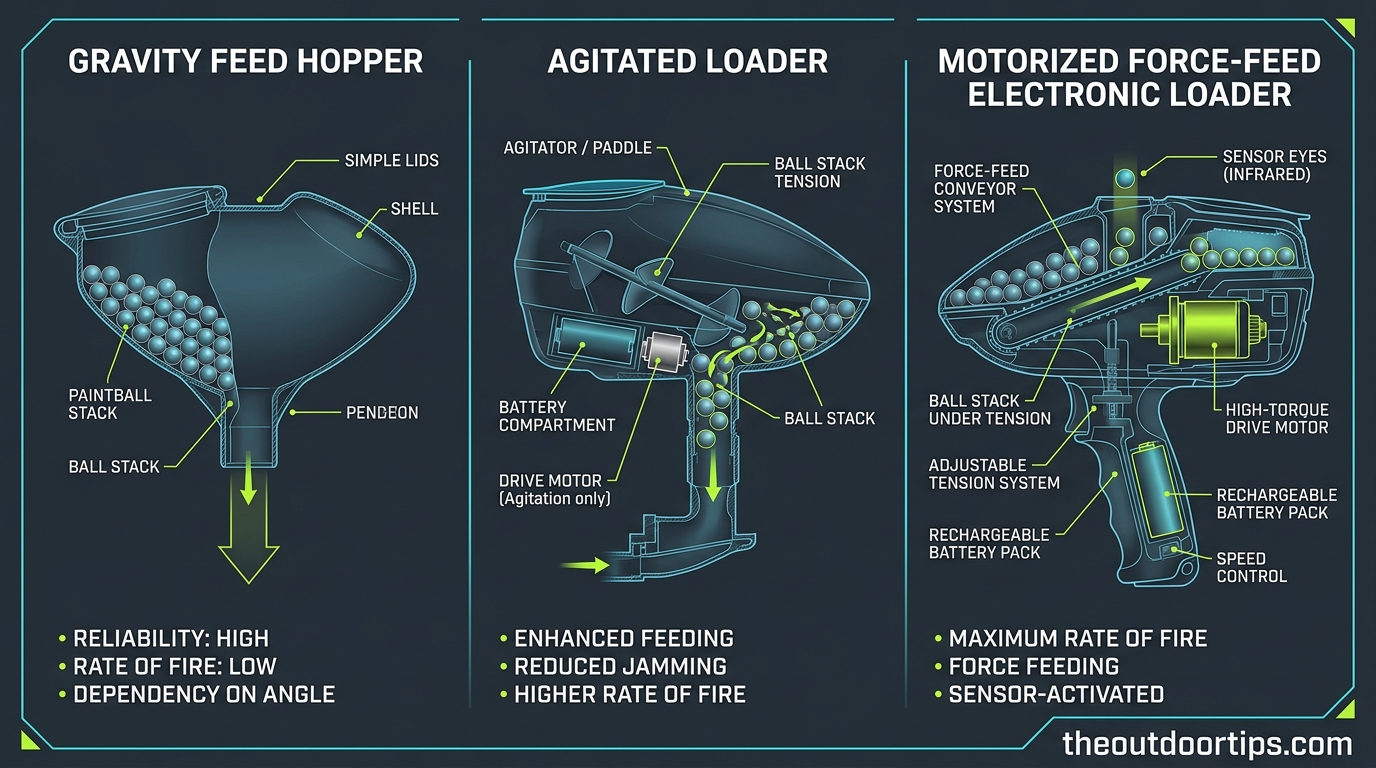
Figure 1: Architectural comparison of Gravity Feed, Agitated, and Motorized Force-Feed systems under dynamic field conditions.
Technical Drivetrain Breakdown: How Modern Loaders Work
Modern high-end electronic hoppers eliminate gravity’s limitations by using motorized drivetrains that actively manage the ball stack. When considering do I need a high-end hopper? understanding the importance and benefits requires looking at the three major engineering architectures:
1. Continuous Spring-Tension Force-Feed (e.g., Dye Rotor System)
The Dye Rotor drivetrain utilizes a high-torque DC motor connected to a spring-loaded carousel tray. The motor winds the spring, which applies constant rotational pressure against a rotating drive arm. This pushes paintballs into a single-file spiral queue and forces them directly down the feedneck under positive mechanical tension.
- Feed Rate: 30+ BPS (the fastest feeding system in paintball history).
- Advantage: Instantaneous response; zero sensor lag; can shoot completely upside-down.
- Drawback: Constant stack tension can dimple or crack ultra-brittle tournament paintballs in humid summer heat.
2. Sensor-Driven Pulse Drive (e.g., Virtue Spire IR2 & Spire V)
Rather than maintaining constant tension on the paintballs, sensor-driven loaders use optical infrared (IR) beam sensors or 3-axis accelerometer G-force sensors to detect when the marker fires. When a ball leaves the stack or recoil is registered, flexible rubber drive fingers pulse forward just enough to index the next paintball into the breach.
- Feed Rate: 15–20 BPS (comfortably exceeds the official 10.5 BPS tournament NXL cap).
- Advantage: Extremely gentle on brittle paint; soft elastomeric fingers flex rather than crushing imperfect paint; virtually impossible to jam.
- Drawback: Slower absolute maximum BPS than the mechanical Rotor drivetrain.
3. Pneumatically Assisted Mechanical (e.g., Planet Eclipse PAL)
For players running mechanical markers like the Emek 100 or Etha 3M who refuse to deal with 9V batteries, Planet Eclipse engineered the PAL (Pneumatic Agitation Loader). An internal piston tapping into the marker’s exhaust gas pulses a shuttle plate inside the hopper with each trigger pull, mechanically agitating the ball stack to prevent bridging.
- Feed Rate: 10–12 BPS reliably without batteries.
- Advantage: Zero electronics to drown in rain; no battery drain.
- Drawback: Only functions on markers equipped with a PAL-compatible receiver neck.
Marker Drivetrain & Operating Pressure Matching
One of the most overlooked technical factors in hopper selection is how your marker’s internal operating pressure impacts loader dynamics. Many beginners mistakenly assume that electronic hoppers are only about speed, but the interaction between your marker’s bolt drivetrain and air system dictates your feeding reliability.
For a detailed breakdown of pneumatic systems, read our comprehensive guide on CO2 vs. HPA for Paintball Tanks and our analysis of Electronic vs. Mechanical Paintball Guns.
The “Eye Delay” Myth on Electronic Markers
Many intermediate players ask: “My electronic marker has anti-chop break-beam eyes, so why do I need a high-end hopper? Won’t the eyes stop the bolt from chopping paint?”
Yes, your electronic eyes will stop the bolt from slicing an unseated paintball. However, they do this by delaying the firing cycle. When you pull the trigger at 10.5 BPS with a gravity loader, the marker detects an empty breach and delays the solenoid until a ball finally tumbles down into place. As a result, your $500 tournament marker is throttled down to 3–5 BPS, sputtering and stuttering every time you attempt a sustained lane rope.
Furthermore, if dirt, paint residue, or grease dims your optical eye sensors during a match, your board enters “eye fault” bypass mode—capping your marker or firing blindly, which instantly leads to massive breach chops.
2026 High-End Paintball Hopper Comparison Table
Below is our direct head-to-head benchmarking of the top paintball hoppers available today, ranging from ultra-budget gravity options to professional tournament force-feed systems:
Field Tested: The Best High-End Paintball Hoppers for 2026
1. Dye Rotor LT-R – The Unstoppable Feed Speed Champion
If your primary priority is absolute feed speed, battery longevity, and rock-solid durability, the Dye Rotor LT-R remains the undisputed king of value in the electronic hopper world. Powered by the same patented Rotor technology found in Dye’s original $200 flagships, the LT-R feeds at a blistering 30+ balls per second on just 3 AA batteries.
In our chronograph and rapid-fire testing with markers like the Planet Eclipse CS3 and Dye M3+, the LT-R delivered uninterrupted ball streams with zero skips. Its toolless button breakdown allows you to split the shell into its primary components in under 15 seconds to clean paint breaks.
- Pros: Phenomenal 30+ BPS feed rate; industry-leading battery efficiency (up to 80,000 shots on 3 AAs); low-profile aerodynamic profile; spring-loaded floor ramp included.
- Cons: Constant stack tension can jam swollen or out-of-round field paint (though the underside shark-fin manual pull trigger clears jams instantly).
2. Virtue Spire IR2 – The Jam-Proof Tournament Workhorse
If you play tournament paintball, deal with fragile 4-star/5-star tournament paint, or frequently play in damp, humid conditions where paintballs swell, the Virtue Spire IR2 is the smart choice. Instead of forcing balls under continuous spring pressure, the Spire IR2 utilizes a proactive 3-eye infrared optical system.
The soft elastomer rubber drive fingers flex smoothly around fragile paintballs. In 20+ cases of paint through our test unit, the Spire IR2 suffered exactly zero mechanical jams—even when intentionally loaded with dimpled, imperfect paintballs that would choke other force-feed systems.
- Pros: 100% jam-proof design; treats brittle tournament paint with unmatched gentleness; toolless tray access; CrownSF II speed feed compatibility; durable nylon-infused shell.
- Cons: Capped around 18 BPS (which is more than enough for tournament play, but slower than the Rotor).
3. Virtue Spire V / Bunkerkings CTRL – Elite Tier Tournament Luxury
For national tournament players competing in the NXL or regional leagues where every gram of weight and millisecond of profile advantage matters, the Virtue Spire V ($255) and Bunkerkings CTRL ($230) represent the pinnacle of engineering.
They feature dual-sensor architecture combining optical infrared eyes with internal 3-axis accelerometer sensors. The drive logic anticipates the marker’s recoil impulse, spinning the lightweight drive cone before the ball stack even drops. Their center of gravity sits nearly 0.75 inches lower than traditional hoppers, significantly reducing your marker’s vertical silhouette when playing tight against bunker edges.
- Pros: Lowest profile and center of gravity in paintball; dual G-force and optical sensing; ultra-lightweight glass-filled nylon; integrated smart LED reload indicators.
- Cons: Premium price tag ($230–$260); performance margin over a $115 Spire IR2 is noticeable only in competitive tournament play.
4. Proto Primo – The Best Budget Gravity Alternative
If you’re not ready to drop $110 on an electronic loader and shoot a mechanical marker like a Tippmann or Azodin, do not use a generic $5 rental hopper. Buy the Proto Primo ($20). The Primo features a molded positive-shelf interior that separates the weight of the ball stack from the feedneck aperture.
This simple physical baffle reduces funnel jams by over 80% compared to flat-walled gravity hoppers, allowing you to sustain 8–10 BPS on mechanical markers with gentle trigger agitation.
The Definitive Hopper Decision Matrix: What Should You Buy?
To cut through marketing hype and make the exact right purchase for your budget, use our field decision matrix:
🎯 Scenario A: You Shoot a Mechanical Blowback (Tippmann Cronus, 98 Custom, Spyder Victor)
Verdict: Do NOT buy a high-end electronic hopper. Your mechanical sear cannot fire faster than 5–6 BPS reliably. Invest $20 in a Proto Primo and spend the remaining $90 on a high-pressure 48/3000 HPA tank or thermal anti-fog goggle.
🎯 Scenario B: You Shoot a High-End Mechanical Spool (Planet Eclipse Emek 100, Etha 3M)
Verdict: Get an Electronic Force-Feed Loader or PAL. With a modified trigger valve (such as the Secret Pin or Bang Switch), mechanical spool markers can hit 12–15 BPS. A gravity hopper will result in severe ball chopping. A Dye Rotor LT-R ($110) transforms an Etha 3M into an absolute tournament-level woodsball machine.
🎯 Scenario C: You Shoot Any Electronic Marker (Empire Mini GS, Dye Rize, Etha 3, CS3)
Verdict: A high-end electronic hopper is 100% mandatory. Running a gravity loader on an electronic marker completely cripples your investment. Buy either the Dye Rotor LT-R ($110) for maximum feed speed or the Virtue Spire IR2 ($115) for gentle paint handling and zero jams.
For more options and detailed buying strategies across all budgets, check our comprehensive companion review: What Hopper Should I Buy? Complete Paintball Loader Guide and our roundup of the Best Paintball Guns Under $300.
Frequently Asked Questions (FAQ)
Will an electronic hopper make my mechanical gun shoot faster?
An electronic hopper does not alter your marker’s mechanical trigger pull weight or sear cycle. However, it guarantees that every single time you pull the trigger, a paintball is already indexed perfectly in the chamber. This eliminates “blank dry fires,” making your effective rate of fire noticeably smoother and faster.
Why does my electronic hopper keep breaking paint inside the tray?
Internal hopper breaks usually occur for three reasons: (1) using brittle tournament-grade paint in a high-tension spring loader like the Dye Rotor without loosening the tension screw, (2) dirty or greasy drive trays that catch ball seams, or (3) swollen, moisture-deformed paintballs from playing in high humidity. For brittle paint, sensor-pulsed loaders like the Virtue Spire IR2 are far superior.
Speed feed vs. rain lid: which should I use?
For speedball and competitive play, a speed feed (flexible rubber or plastic fingers) is essential because it cuts reload time from 4 seconds down to 1 second without opening a latch. However, during heavy rain or muddy woodsball games, rain dripping through speed feed fingers will melt gelatin paintballs inside your loader into a mushy paste. Always carry both a speed feed and a quick-snap rain lid in your gear bag.
How many pods do batteries last in an electronic loader?
Quality force-feed loaders like the Dye Rotor LT-R can cycle over 50,000 to 80,000 paintballs (approx. 350 to 500 pods) on a fresh set of 3 AA alkaline batteries. Optical sensor loaders like the Virtue Spire IR2 yield approximately 20 to 30 cases (40,000 to 60,000 shots). In sub-freezing winter temperatures, switch to Energizer Ultimate Lithium AA batteries to prevent cold-induced voltage drops.