In our summer river drift logs anchoring heavy no-roll rigs along the Connecticut River’s deep Chesterfield scour holes and drifting nightcrawler harnesses through Hooksett’s weed edges on the Merrimack, New Hampshire delivers an unexpectedly fierce warmwater catfishing scene. While granite peaks and cold mountain brook trout claim the state’s tourism brochures, the Granite State’s major river valleys quietly harbor trophy-caliber channel catfish pushing past 17 pounds and dense populations of native brown bullheads (locally prized as “horned pout”).
We logged dam tailrace generation schedules, mapped concrete boat launches with shoreline bank access across eight premier watersheds, and cross-referenced 2026 New Hampshire Fish and Game Department fishing digests—including mandatory lead tackle restrictions—so you can target high-percentage catfish holding seams with complete confidence.
New Hampshire Catfishing At a Glance: Top Waters & Winning Rigs
- #1 Trophy Waterway: Connecticut River (Chesterfield & Hinsdale pool, targeting
12–35 ftgravel trenches; produced NH’s official17 lb 14.72 ozstate-record Channel Catfish) - Peak Bite Window: May–June pre-spawn staging at
58°F–68°F& July–September nocturnal river current feeding at68°F–78°F - 2026 NH F&G Bag & Size Limit: 25 horned pout (bullhead) daily limit (within a
50-fishaggregate panfish possession limit); open year-round with NO minimum length limit. Note: Lead sinkers & jigs≤ 1 ozare strictly banned in NH freshwaters! - Primary Winning Setup: Ugly Stik Catfish Special + Abu Garcia Ambassadeur C3 6500 / Penn Battle IV 5000 + 50–65 lb PE Braid + Santee Cooper Slip Rig
Best Catfish Fishing Spots in New Hampshire: Top 8 Waters & GPS Access Matrix
Catfishing in New Hampshire divides into two distinct operational patterns: heavy-current river bottom fishing for trophy channel catfish along the lower Connecticut and Merrimack rivers, and traditional night shoreline fishing for chunky horned pout (brown bullhead) in warm Taconic oxbows, flood-control impoundments, and sheltered bays of the Lakes Region. Use this GPS access matrix to align boat ramps with your preferred presentation.
| Lake / River Section | Primary Target Species | Key Structure / Dam Tailrace | Best Bait / Lure | Public Ramp / Bank Access |
|---|---|---|---|---|
| Connecticut River: Chesterfield & Hinsdale (Cheshire County) |
Trophy Channel Catfish (8–18+ lb) & Bullhead | Vernon Dam tailrace pool, Hinsdale Setback mud flats & gravel dredge holes (12–35 ft) |
Fresh cut white sucker, dead herring, chicken liver | Hinsdale Setback Boat Launch • 📍 Google Maps |
| Merrimack River: Hooksett & Garvins Falls (Merrimack County) |
State-Record Brown Bullhead & Channel Catfish | Garvins Falls hydro plunge, sandbar drop-offs & Hooksett pool weedlines (8–24 ft) |
Large nightcrawlers, cut yellow perch, shrimp | Kiwanis River Park Launch • 📍 Google Maps |
| Merrimack River: Manchester to Nashua (Hillsborough County) |
Channel Catfish & Horned Pout | Amoskeag Falls plunge pool, granite railway riprap & Nashua River confluence (10–28 ft) |
Cut shiners, marinated chicken breast, stink bait | Arms Park Boat Launch • 📍 Google Maps |
| Lake Winnipesaukee: Alton Bay & Lee’s Mills (Belknap & Carroll Co.) |
Heavy Brown Bullhead (Horned Pout) | Sheltered muddy coves, shallow weed-edge transitions & boathouse docks (6–18 ft) |
Worms under lighted slip bobbers, canned corn, cut bait | Alton Bay Public Boat Ramp • 📍 Google Maps |
| Great Bay Estuary & Squamscott River (Rockingham County) |
White Catfish, Channel Cat & Bullhead | Brackish tidal confluence, Chapman’s Landing mud shelf & railway bridge pilings (8–22 ft) |
Raw market shrimp, cut menhaden/alewife, nightcrawlers | Chapman’s Landing Launch • 📍 Google Maps |
| Contoocook River: Hopkinton-Everett Reach (Merrimack County) |
Abundant Horned Pout & Bullhead | Elm Brook flood-control oxbows, sunken timber flats & slow marsh seams (6–16 ft) |
Dill-scented nightcrawlers, chicken liver, redworms | Elm Brook Park Boat Ramp • 📍 Google Maps |
| Piscataquog River & Glen Lake (Hillsborough County) |
Brown Bullhead & River Channel Cats | Greggs Falls Dam tailrace, submerged logs & steep gravel points (8–24 ft) |
Cut shiners, live earthworms, hot dog chunks | Glen Lake Public Boat Ramp • 📍 Google Maps |
| Connecticut River: Walpole & Bellows Pool (Cheshire & Sullivan Co.) |
Trophy Channel Catfish (6–16 lb) & Bullhead | Cold River confluence mouth, agricultural silt bends & bridge abutments (10–30 ft) |
Cut fallfish/sucker, whole nightcrawlers, shrimp | Walpole Route 12 Boat Launch • 📍 Google Maps |
1. Connecticut River — Chesterfield & Hinsdale Reach (Cheshire County)
The lower stretch of the Connecticut River along New Hampshire’s southwestern border represents the undisputed heavyweight champion of Granite State catfishing. In August 2023, angler Edwin Severance hauled a massive 17-pound, 14.72-ounce state-record Channel Catfish from this exact Chesterfield waterbody, validating the trophy potential of the deep silt trenches carved between the Vernon Dam impoundment and the Hinsdale Setback.
When hydro-generation releases create steady river flow, channel cats stack along the downstream edge of underwater gravel bars in 14 to 28 feet of water. Launch at the state-maintained Hinsdale Setback ramp on Route 119 and anchor upstream of deep river bends, dropping heavy slip rigs with tungsten or steel weights (remembering New Hampshire’s lead restriction). Calculate river current drag on your line before spooling up using our Catfish Sinker Weight & River Current Calculator.
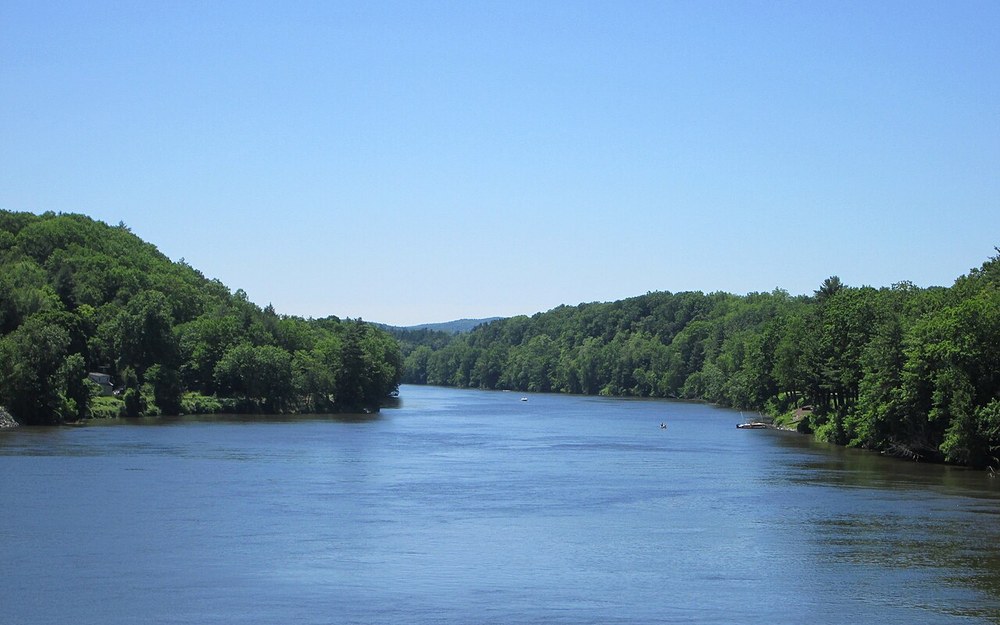
Photo: Connecticut River wide hydro pool looking south near the Hinsdale Setback and Chesterfield reach in Cheshire County, NH (Wikimedia Commons / CC BY-SA 4.0).
📍 Hinsdale Setback & Chesterfield Boat Launch, Hinsdale (GPS: 42.8124, -72.5028)
2. Merrimack River — Hooksett & Garvins Falls Reach (Merrimack County)
While the Connecticut River delivers trophy channel catfish, the Merrimack River holds New Hampshire’s benchmark for monstrous brown bullhead—including Donald Robbins’ long-standing 3-pound, 4.8-ounce state record landed in August 2005. Between the hydro tailrace at Garvins Falls in Bow and the sweeping sandbars of Hooksett, the Merrimack balances deep moving water with quiet eddy pockets loaded with crawlers, hellgrammites, and emerald shiners.
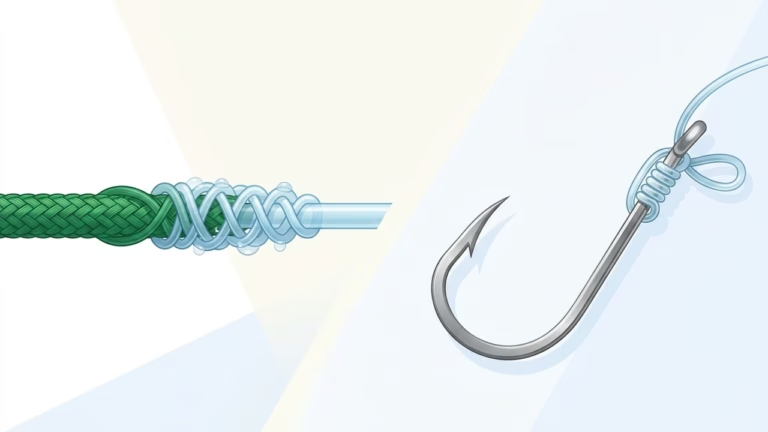
Launching from Kiwanis River Park in Hooksett gives you instant access to sandy channel drop-offs where bullhead roam in packs as soon as the sun dips below the tree line. Ensure your mainline and leader connections are tied to lab-tested breaking strength with our Fishing Knot Strength & Line Matcher Tool before winching heavy bottom fish through submerged timber.
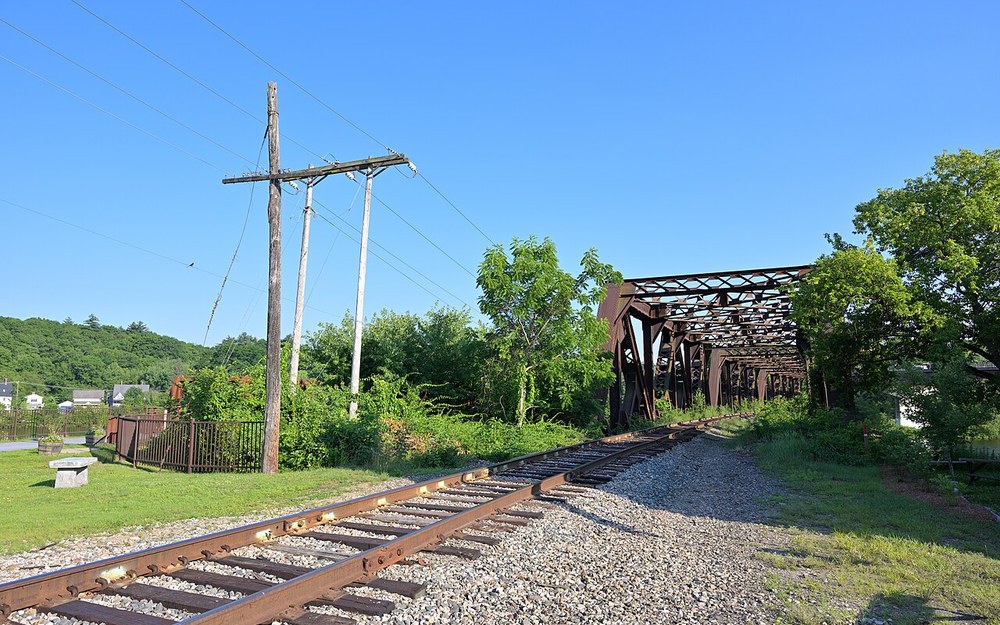
Photo: Merrimack River calm channel bend and railway crossing in Hooksett, Merrimack County, NH (Wikimedia Commons / CC BY 4.0).
📍 Kiwanis River Park Launch & Hooksett Pool, Hooksett (GPS: 43.1042, -71.4682)
3. Merrimack River — Manchester to Nashua Reach (Hillsborough County)
Downstream through New Hampshire’s urban industrial heartland, the Merrimack River plunges over Amoskeag Falls in Manchester, creating an oxygen-rich gorge lined with granite boulders and concrete riprap. Channel catfish and bullhead thrive in the turbulent boils below Arms Park, where current breaks provide resting lanes directly beside high-speed baitfish runs.
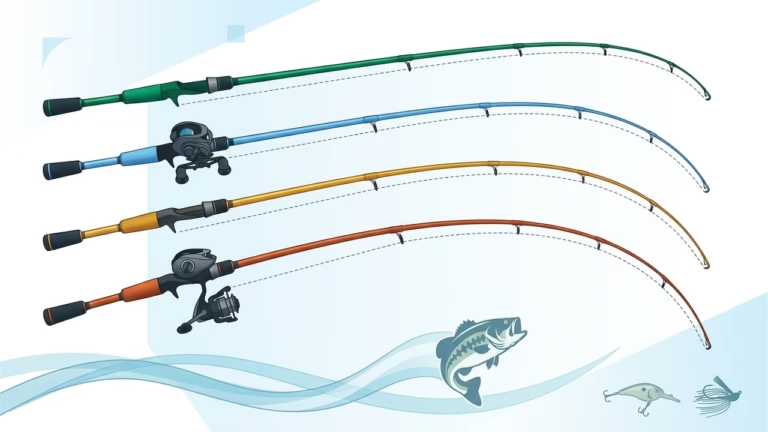
Shoreline anglers casting from the riverwalk or the railroad embankments near Moore’s Crossing score consistent action by lobbing 2 to 3 oz flat sinkers baited with marinated chicken breast or cut shiners into the slack seams between 10 and 22 feet. Dial in rod power and tip responsiveness with our interactive Fishing Rod Power & Action Matcher Quiz.
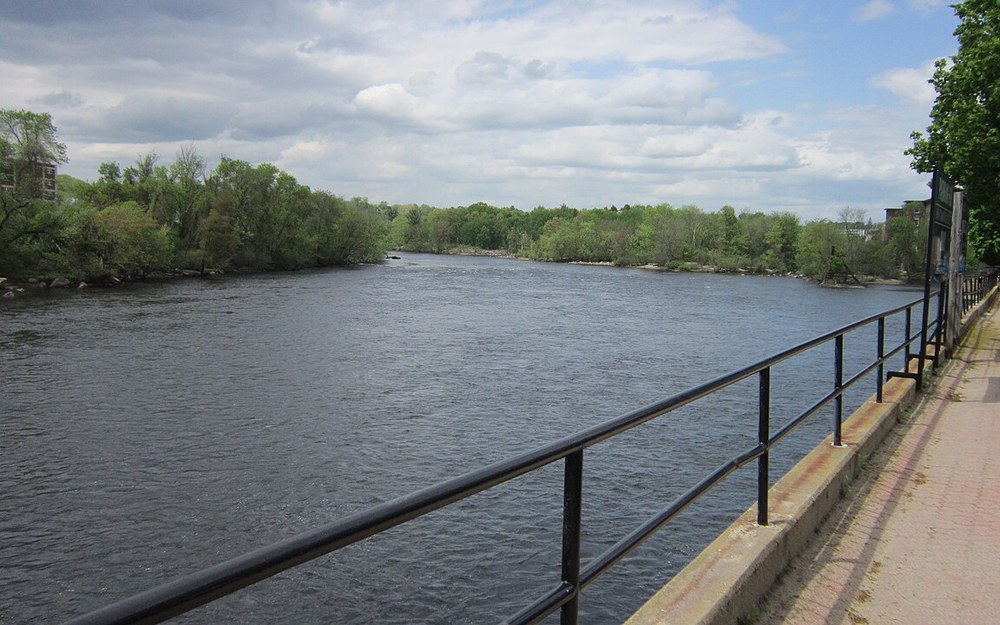
Photo: Merrimack River granite riprap banks and turbulent tailrace waters below Amoskeag Falls in Manchester, NH (Wikimedia Commons / CC BY-SA 4.0).
📍 Arms Park Launch below Amoskeag Falls, Manchester (GPS: 42.9965, -71.4688)
4. Lake Winnipesaukee — Alton Bay & Lee’s Mills (Belknap & Carroll County)
New Hampshire’s crown jewel lake is internationally celebrated for smallmouth bass and landlocked salmon, but local anglers in the know head to Winnipesaukee’s muddy backwater arms for classic summer horned pout harvests. Shallow, weed-choked bays like Alton Bay, Lee’s Mills, and Center Harbor warm up weeks ahead of the main broad lake, drawing thousands of post-spawn bullheads into 6 to 14 feet of water.
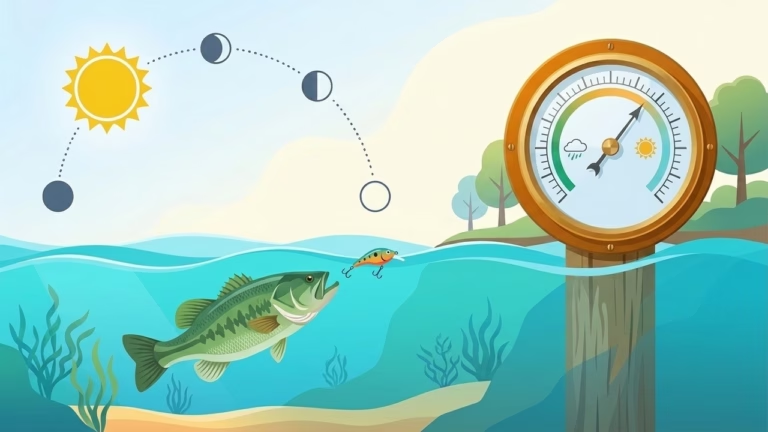
Bank fishing from the Alton Bay public dock or small skiff drifts along the marsh edges using lighted slip bobbers with nightcrawlers offer action-packed night outings. Monitor evening barometric pressure drops and solunar feeding spikes using our Solunar Fishing Bite Times & Barometric Pressure Forecaster to hit peak bite windows.
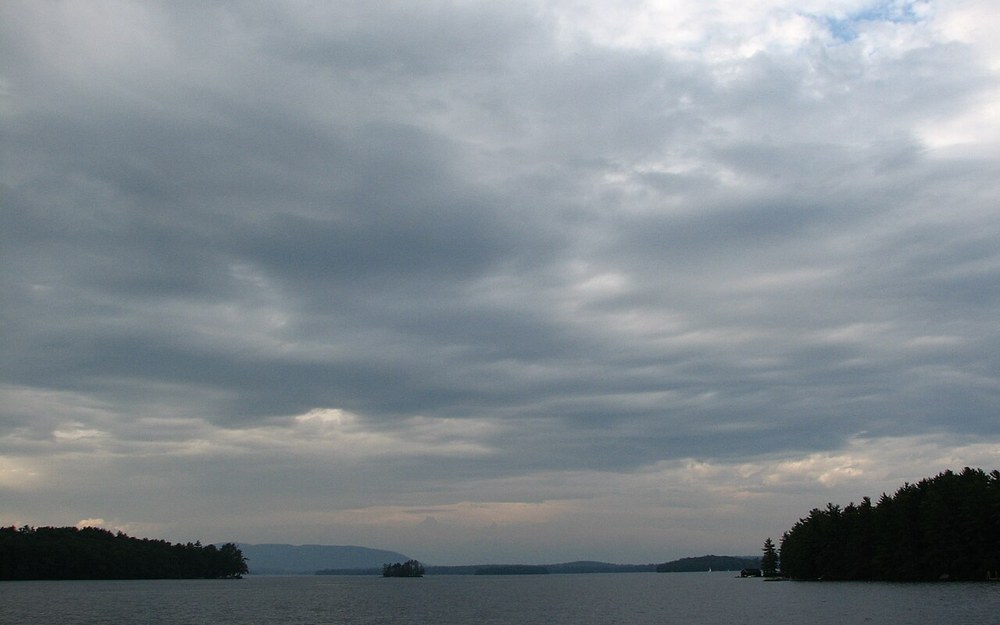
Photo: Lake Winnipesaukee sheltered island channels and forested shoreline in Belknap County, NH (Wikimedia Commons / CC BY-SA 4.0).
📍 Alton Bay Public Boat Ramp, Lake Winnipesaukee (GPS: 43.5186, -71.2422)
5. Great Bay Estuary — Squamscott & Exeter River Confluence (Rockingham County)
Near the Seacoast, New Hampshire’s massive saltwater estuary system transitions into fertile brackish estuaries where the Squamscott River meets Great Bay at Stratham. This nutrient-dense mixing zone supports an unusual and productive fishery where native brown bullhead mingle with salt-tolerant white catfish and river channel cats.
Launching at Chapman’s Landing on Route 108 gives anglers easy tidal access to deep mud holes along the railroad trestle. Fish the incoming tide when fresh water pushes back over the flats, and rig raw market shrimp or oily cut menhaden on circle hooks to handle strong tidal current pulls.
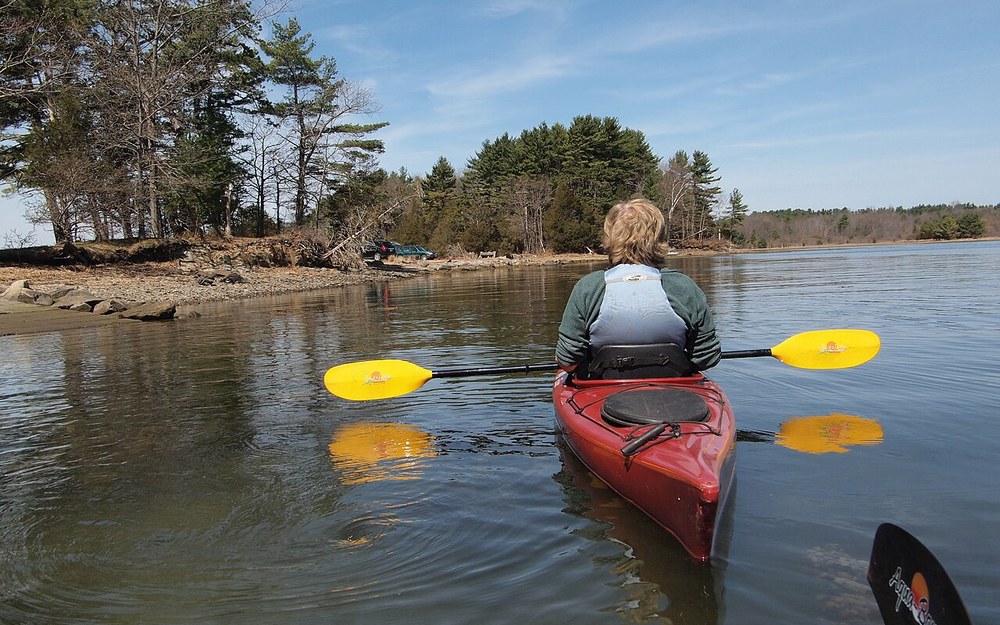
Photo: Great Bay tidal estuary shoreline and saltmarsh channel confluence at Adam’s Point near Stratham, NH (Wikimedia Commons / CC BY 2.0).
📍 Chapman’s Landing Boat Launch, Squamscott River / Great Bay (GPS: 43.0361, -70.9254)
6. Contoocook River — Hopkinton-Everett Flood Control Reach (Merrimack County)
Winding northward through southern New Hampshire before meeting the Merrimack, the Contoocook River widens into the sprawling Hopkinton-Everett flood control basin. The lazy current around Elm Brook Park creates extensive timber-strewn oxbows and shallow weed flats where horned pout feed unmolested throughout May and June.
This is prime paddlecraft water: slip a canoe or kayak into the backwaters at dusk, anchor near submerged hardwood stumps in 6 to 12 feet, and drop simple double-hook nightcrawler rigs straight down into the silt. Check reel line capacity and backing requirements before river trips using our Fishing Reel Line Capacity & Backing Calculator.
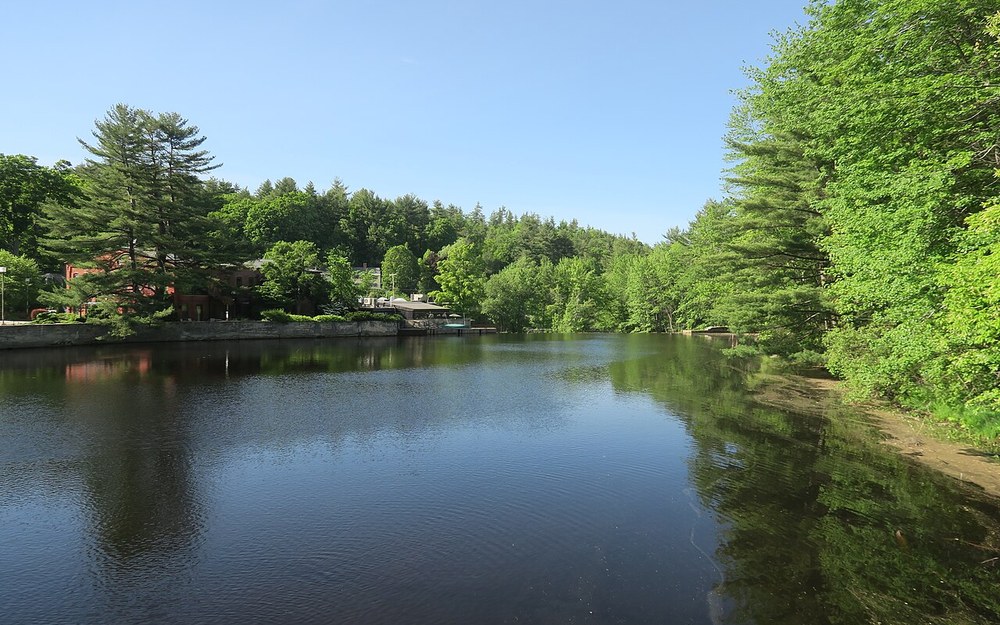
Photo: Contoocook River slow forested oxbow bend framed by pine woodlands in southern New Hampshire (Wikimedia Commons / CC BY-SA 4.0).
📍 Elm Brook Park Boat Launch, Contoocook River Oxbow (GPS: 43.1952, -71.7428)
7. Piscataquog River — Greggs Falls & Glen Lake (Goffstown, Hillsborough County)
Feeding into the Merrimack at Manchester, the Piscataquog River features an exceptional warmwater impoundment at Glen Lake in Goffstown. Backed by the Greggs Falls hydro dam, this steep-sided reservoir offers deep channel troughs (12 to 24 feet), rocky drop-offs, and sunken timber shelves loaded with chunky bullheads and expanding channel cats.
The town boat ramp off Route 114 provides easy access. Night anglers anchored along the old river channel edge just above the dam intake land steady limits of 1- to 2-pound horned pout on nightcrawlers and cut bait.
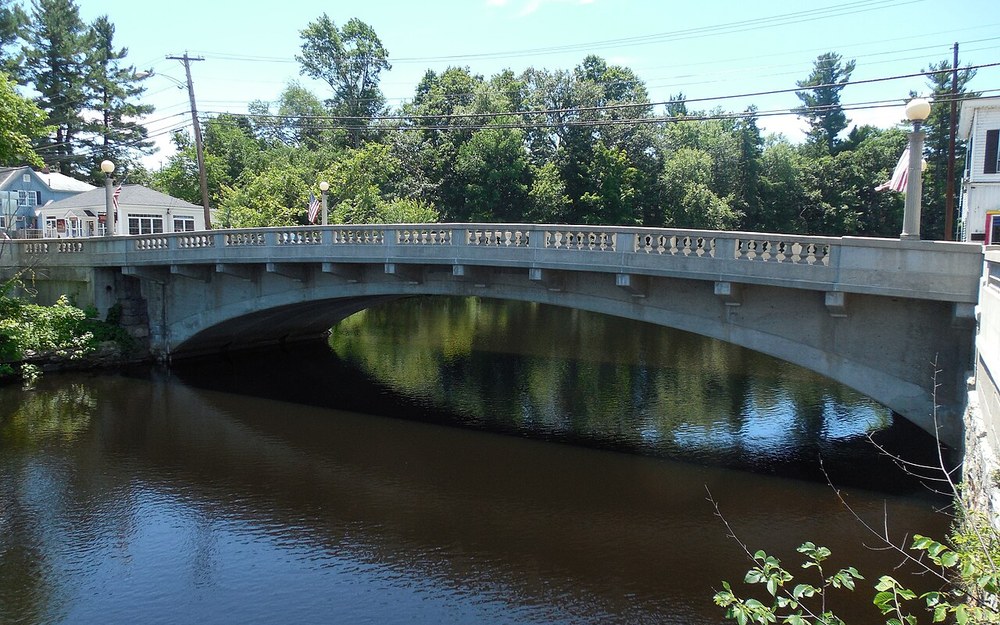
Photo: Piscataquog River scenic impoundment and concrete bridge crossing in Goffstown, NH (Wikimedia Commons / CC BY 4.0).
📍 Glen Lake Public Boat Launch & Greggs Falls Reach, Goffstown (GPS: 43.0188, -71.5835)
8. Connecticut River — Walpole & Bellows Falls Pool (Cheshire & Sullivan County)
Spanning the border between Walpole, New Hampshire, and Bellows Falls, Vermont, this broad river pool benefits from deep agricultural silt flats and cold-water tributary confluences like the Cold River. Channel catfish congregate in the deeper outside river bends below the historic Cornish-Windsor Covered Bridge corridor, feeding on forage washed down from upstream rapids.
Launch from the public ramp off Route 12 in Walpole and drift cut suckers or fallfish steaks along the 18 to 30 ft channel breaks. Remember that under reciprocal border-water agreements, a valid New Hampshire or Vermont freshwater license allows you to fish the Connecticut River main stem between state lines.
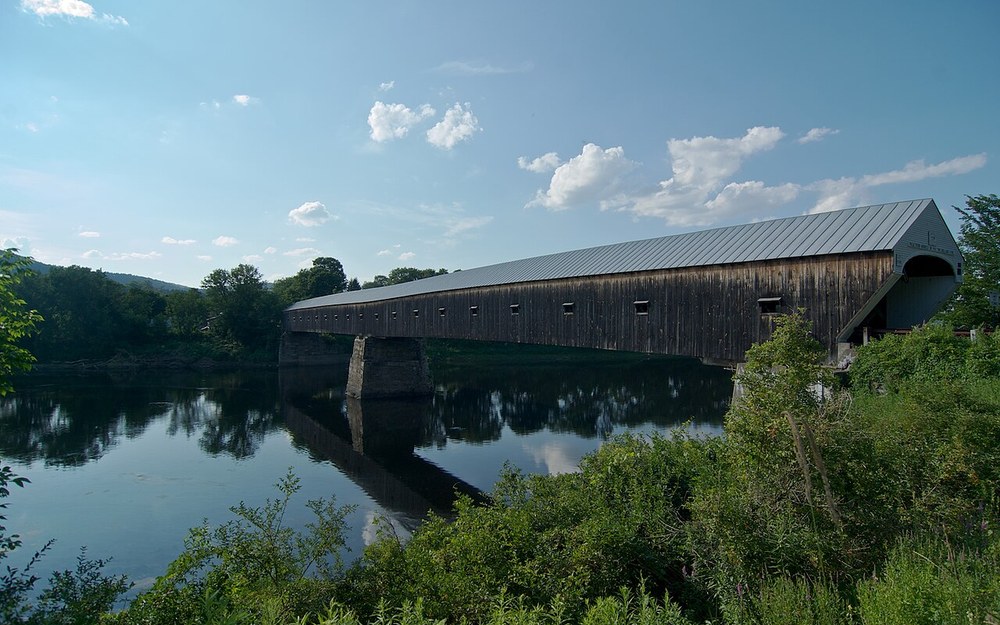
Photo: Connecticut River main stem corridor framed by the historic covered bridge and lush riverside timber linking NH and VT (Wikimedia Commons / CC BY-SA 2.0).
📍 Cornish-Windsor Covered Bridge & Walpole Pool, Connecticut River (GPS: 43.0812, -72.4415)
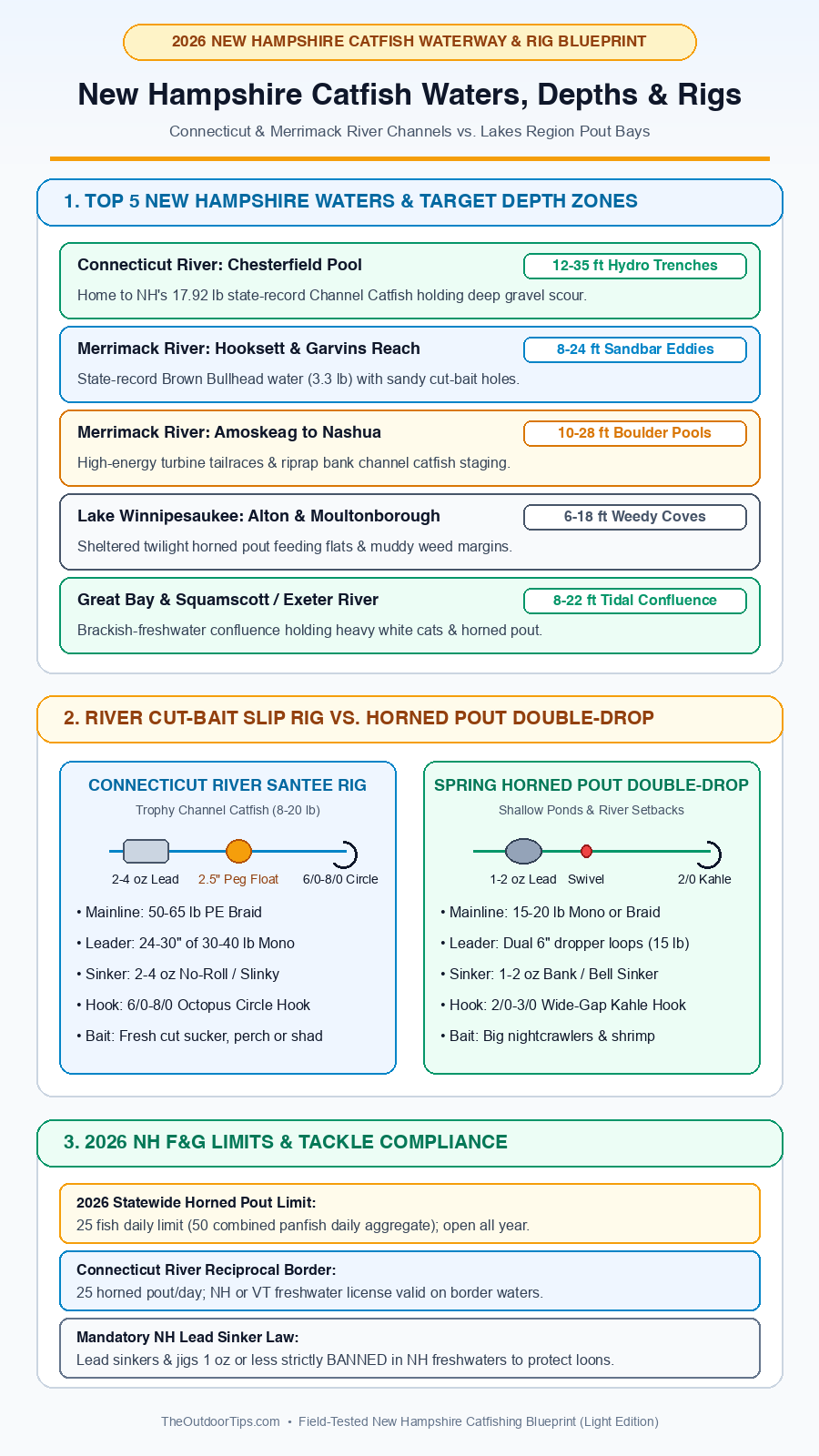
Field-tested New Hampshire catfishing blueprint detailing top target depths, Santee slip rigs vs. horned pout setups, and 2026 NH F&G rules.
Recommended New Hampshire Catfish Tackle & Rig Loadout
Tackling New Hampshire waters requires matching your gear to the target species: stout 7′6″–8′0″ medium-heavy casting or spinning rods for wrenching 15+ lb Connecticut River channel cats out of boulder snags, and sensitive 6′6″–7′0″ medium rods for detecting light nighttime horned pout bites in quiet ponds.
| Gear Component | Recommended Model | Exact Spec (Power / Ratio / LB) | Why It Works Here | Check Live Price |
|---|---|---|---|---|
| All-Around River Rod | Ugly Stik Catfish Special | 7′6″–8′0″ MH / Mod-Fast | Clear Tip telegraphs light pout nibbles while composite blank easily handles 4 oz river leads. | |
| High-Sensitivity Drift Rod | St. Croix Mojo Cat | 7′6″ Medium-Heavy / Fast (15–40 lb) | SCII carbon blank detects gravel ticks and subtle current pickups in deep Connecticut River holes. | |
| River Baitcast Reel | Abu Garcia Ambassadeur C3 6500 | 5.3:1 Ratio | 255 yd / 17 lb | Bait Clicker | Loud bait clicker alerts you immediately during night drifts when a big channel cat takes off downriver. | |
| Tailrace Spinning Reel | Penn Battle IV 5000 | 5.6:1 Ratio | Full Metal Body | 25 lb HT-100 Drag | Bombs heavy rigs across Amoskeag Falls current seams and winches catfish out of riprap boulders. | |
| Abrasion-Proof Mainline | PowerPro / Sufix 832 PE Braid | 50–65 lb Braid + 30 lb Mono Shock Leader | Zero-stretch braid cuts through heavy Merrimack current while mono leader resists sharp granite abrasion. | |
| Circle Hooks & Heavy Sinker Pack | Gamakatsu Circle Hooks + Slinky Leads | 6/0–8/0 Circle Hooks + 2–4 oz Slinky/No-Roll | Hooks corner catfish jaws cleanly; weights over 1 oz remain 100% legal under NH loon protection laws. |
Hands-On Granite State Rigging & Lead-Free Compliance
When rigging for New Hampshire catfish, two factors dictate your success: current management and strict environmental compliance. Under New Hampshire RSA 211:13-b, lead sinkers and lead jigs weighing 1 ounce or less are strictly prohibited in all freshwater lakes, ponds, and rivers to prevent lead poisoning in common loons. For heavy river current on the Connecticut and Merrimack, catfishermen use non-lead steel, bismuth, or tungsten weights for light work, or step up to legal 2 oz to 4 oz no-roll leads that hold bottom cleanly without drifting into snaggy granite fissures.
For trophy river channel cats, tie a Santee Cooper rig featuring a 2.5-inch high-buoyancy peg float positioned three inches ahead of a 6/0 Gamakatsu circle hook to elevate cut sucker or herring steaks above bottom silt. For spring horned pout in shallow bays, switch to a double-dropper loop rig loaded with plump nightcrawlers. Explore rod blank recommendations in our best bank catfishing rods test, complete catfish rod comparison, and Ugly Stik review, or optimize feeding attraction with our catfish scent attraction guide. Planning cross-border trips? Compare adjacent waters in our Vermont catfishing guide and Maine catfishing guide.
2026 New Hampshire Fish & Game Regulations & Border Rules
- Statewide Horned Pout (Bullhead) Creel Limit: New Hampshire permits a daily harvest of 25 horned pout per day, with a combined total daily possession limit of 50 panfish (including horned pout, black crappie, white perch, yellow perch, and sunfish combined). There is no closed season and no minimum length limit.
- Channel Catfish Season & Limits: Channel catfish fall under general freshwater regulations with no closed season and no daily creel or size restrictions in standard inland waters.
- Connecticut River Interstate Reciprocity: On the Connecticut River boundary waters between New Hampshire and Vermont, a valid freshwater fishing license from either state is recognized on the water between the highway bridges. The daily limit for horned pout is
25 fish. - Mandatory Lead Sinker & Jig Ban: The sale and freshwater use of lead sinkers and lead jigs weighing
1 ounce or lessis strictly illegal statewide in New Hampshire. Anglers must use lead-free alternatives (tungsten, steel, brass, bismuth) or weights heavier than 1 ounce.
✅ Final Captain’s Verdict: Unlocking Granite State Catfish
1. Hunt Trophy Channels on the Connecticut River: Launch at the Hinsdale Setback ramp on Route 119 and anchor above deep 15–30 ft gravel scour holes with 3 oz no-roll leads and fresh cut sucker.
2. Fill Pout Buckets on Merrimack River Eddies: Fish the twilight transition below Hooksett hydro dam or shallow Winnipesaukee bays with double-dropper nightcrawler rigs for non-stop action.
Frequently Asked Questions About Catfishing in New Hampshire
Are there channel catfish in New Hampshire rivers?
Yes—the Connecticut River along the western border and the Merrimack River in southern New Hampshire support thriving populations of wild channel catfish, including fish well over 10 pounds and the 17 lb 14.72 oz state record landed in Chesterfield.
What is the daily limit for horned pout (catfish) in New Hampshire in 2026?
Under 2026 New Hampshire Fish and Game regulations, the daily limit for horned pout (brown bullhead) is 25 fish per day, within a combined aggregate limit of 50 panfish total. There are no minimum length limits and the season is open year-round.
What is New Hampshire’s lead sinker law for catfishing?
New Hampshire strictly bans the use of all lead sinkers and lead jigs weighing 1 ounce or less in freshwater to protect common loons from fatal lead ingestion. Anglers targeting catfish must use non-lead alternatives (tungsten, steel, ceramic) or sinkers weighing greater than 1 ounce (e.g., 2–4 oz river weights, which remain fully legal).
Can I fish the Connecticut River with a Vermont fishing license from New Hampshire?
Yes. Under the interstate reciprocal agreement between New Hampshire Fish and Game and Vermont Fish & Wildlife, a valid resident or non-resident fishing license from either state allows you to fish the waters of the Connecticut River main stem between the state shores.