Nothing ruins a river catfishing trip faster than watching your rod tip bounce rhythmically—not from a blue catfish bite, but because your undersized bank sinker is cartwheeling downstream across gravel flats and wedging straight into wing-dam boulders.
Because water drag increases with the square of current speed, doubling river velocity quadruples the lateral push on your mainline and bait. Run your setup through our catfish sinker weight calculator below to compute exact hydrodynamic drag forces and lock down the right lead size from 1 oz to 12+ oz before casting.
Catfish Sinker Weight & River Current Matcher
Compute total water drag on your mainline belly and bait profile to lock down the exact sinker ounces and bottom rig shape.
Flow Velocity Bracket
Current (MPH)
Depth (Feet)
Bait Hydrodynamic Cross-Section
Mainline Width Determines Water-Sail Resistance
Lead Shape Friction Factor
Bottom Texture & Wedge Modifier
Matched Sinker & River Terminal Tackle for Your Current
Sized for 6 oz Anchor Load in 3.0 MPH Flow
Flat No-Roll Catfish Sinkers (6 oz)
Hydrodynamic flat disk profile hugs gravel and clay bottoms without tumbling sideways into rocks or wing-dam brush piles.
Heavy-Duty Sinker Slides (Duo-Lock)
Smooth polymer tubing slides smoothly over braided mainlines without nicking fibers and lets you swap sinker sizes in 5 seconds.
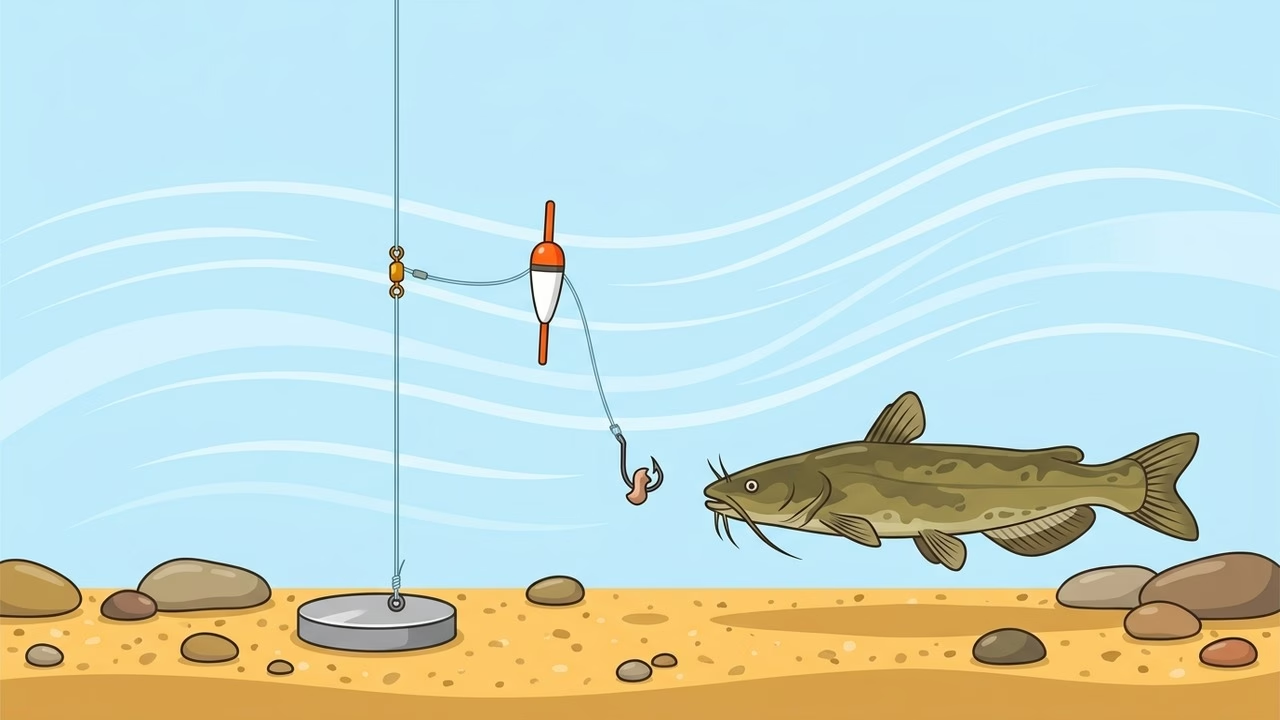
Peg Floats & 8/0 Offset Circle Hooks
Elevates your bait 6 to 12 inches out of bottom silt and rock crevices while keeping hookups locked cleanly inside the fish’s corner jaw.
How Our Catfish Sinker Weight Calculator Models River Current Physics
Most anglers pick sinker weights by guessing in 1-ounce increments until the bait stops drifting. While trial and error wastes expensive lead in snags, river holding power actually follows predictable fluid mechanics defined by the hydrodynamic drag equation and static bottom friction.
📐 River Drag & Submerged Sinker Physics Used in This Tool
1. Lateral Water Drag: Fd = 0.5 × ρwater × veff² × (Cd,line·d·L + Cd,bait·Abait)
2. Submerged Lead Weight: Wsubmerged = Wair × (1 − 1/11.34) = 0.912 × Wair
3. Minimum Anchor Hold: Wlead (oz) = Fd (ozf) / (μshape × μbottom × 0.912)
Notice two critical truths buried inside those three equations:
- The Velocity-Squared Trap (v²): Going from a gentle
1.5 MPHcreek eddy to a3.0 MPHmain-channel current seam does not merely double the load on your rig—it multiplies fluid drag by(3.0 / 1.5)² = 4.0×. That is why a1.5 ozsinker that sits dead still inside a slack pocket tumbles like a bowling ball once the current hits3.5 MPH, instantly requiring5 to 6 ozof flat lead to hold position. - Mainline Diameter Acts Like an Underwater Sail: Look at the Line Belly Drag readout in our catfish sinker weight calculator. In
25 to 40 feetof moving river water, more than 55% to 70% of total downstream pull comes from water slamming into your submerged line bow—not the cut bait itself! Dropping from thick30 lb monofilament (0.55 mm)to thin50 lb 8-carrier PE braid (0.36 mm)cuts submerged frontal line area by 35%, immediately allowing you to anchor in fast rivers with 2 to 3 ounces less weight.
Before launching your boat or hiking down a steep muddy bank, you can check exact live river discharge (CFS) and mean stream speed on the USGS National Water Dashboard to estimate flow speeds after upstream rain events or dam generation releases.
Master River Current Speed vs. Catfish Sinker Weight Matrix
Use this benchmark table alongside our live vs. cut catfish bait showdown and James River trophy catfish guide to size your lead fast on the bank (assuming 20–30 ft depth on 50 lb braided mainline):
| River Flow Speed | Small Bait (Punch / 1.5" Cut) | Large Bait (3.5"–4.5" Skipjack) | Trophy Live (6" Bluegill / Shad) | Ideal Lead Shape | Matched Rod Casting Power |
|---|---|---|---|---|---|
| 0.2–0.6 MPH (Still Lake) | 0.5–1 oz | 1–1.5 oz | 2 oz | No-Roll / Egg / Bank | Medium-Heavy (15–30 lb) |
| 1.0–2.0 MPH (Slow Eddy) | 1.5 oz | 2–3 oz | 3–4 oz | Flat No-Roll | Medium-Heavy (1–4 oz) |
| 2.5–3.5 MPH (Moderate River) | 3–4 oz | 4–6 oz | 6–8 oz | Flat No-Roll / Pyramid | Heavy Catfish (2–8 oz) |
| 4.0–5.0 MPH (Fast Main Channel) | 5–6 oz | 6–8 oz | 8–10 oz | Disc Coin / No-Roll | Heavy to XH (3–10 oz) |
| 5.5–7.0+ MPH (Dam Tailrace) | 8 oz | 8–10 oz | 10–12+ oz | Disc Coin / Heavy Bank | Extra-Heavy (4–12 oz) |
Always cross-check your rod’s printed lure/weight rating before chucking 6 oz to 10 oz of lead with a full-strength overhead cast. Launching an 8 oz sinker plus a 4 oz skipjack head (12 oz total load) on an under-rated medium rod snaps blanks instantly—verify true throwing ratings in our best catfish rods for bank fishing and Ugly Stik catfish rod breakdown.
Visual Blueprint: River Hydrodynamics & Sinker Anchoring Rigs
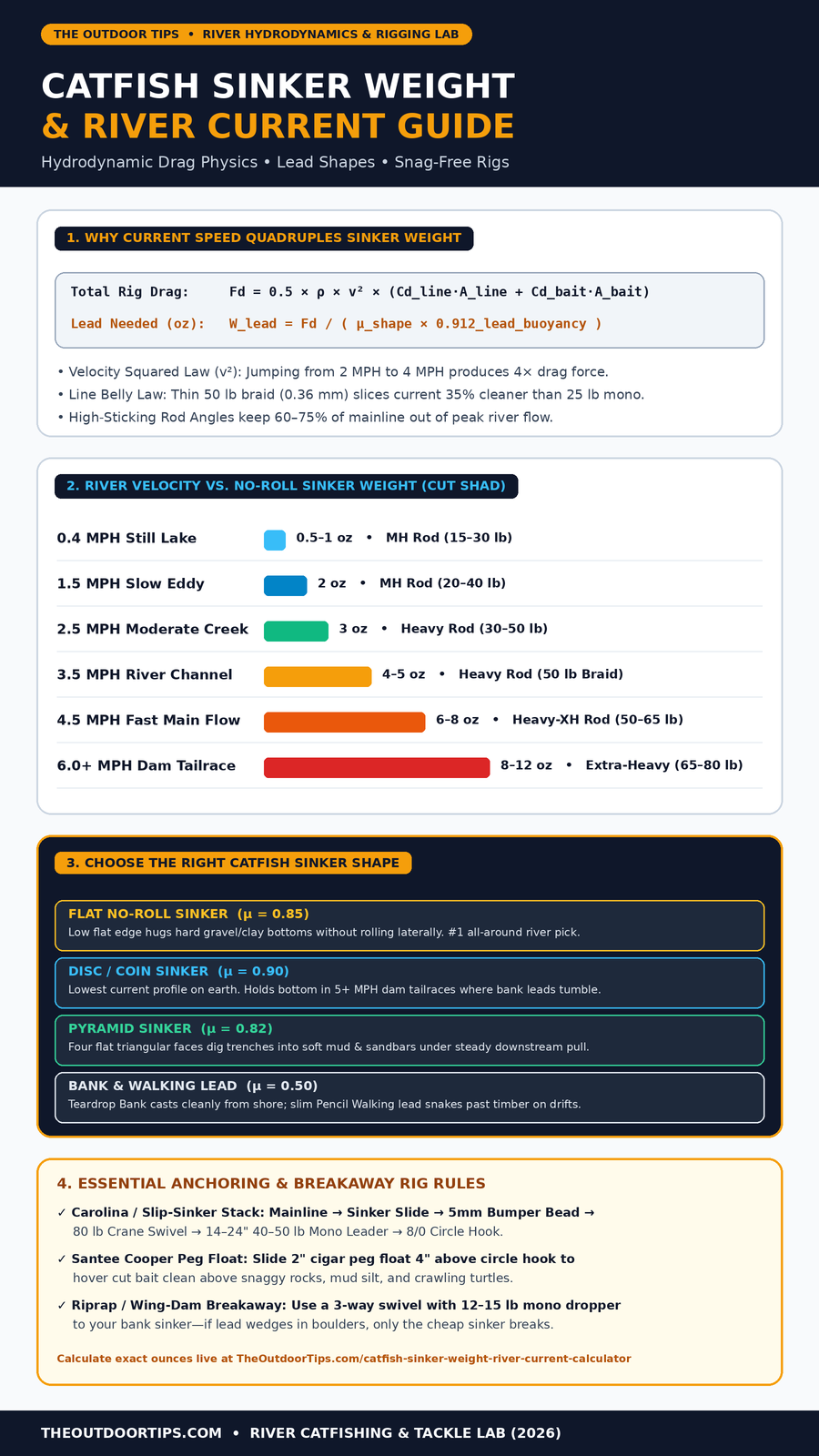
Comparing the 5 Essential Catfish Sinker Shapes
Weight on the scale only tells half the story. Two 4 oz lead sinkers behave completely differently once current pushes against their side walls:
- Flat No-Roll Sinker (μeff ≈ 0.85): Built like a wide, low-slung oval pancake with rounded leading edges, the Flat No-Roll hugs hard clay, sand, and smooth gravel shelves without rotating laterally. Because an inline hole runs straight down its flat core, heavy blue catfish and flatheads pick up the bait cleanly with minimal resistance. It is the #1 default anchor shape in our catfish sinker weight calculator.
- Disc / Coin River Sinker (μeff ≈ 0.90): Sporting an attached brass eyelet on top of a thin circular lead wafer, Disc sinkers slice under roaring
5.0+ MPHtailrace flows with almost zero lift profile. Pair them exclusively with a heavy-duty sinker slide above a bumper bead so you can unclip a10 ozdisc in five seconds before driving home. - Pyramid Sinker (μeff ≈ 0.82): When you fish soft delta mud, tidal flats, or fine shifting sandbars where flat leads slide slowly backward, four sharp triangular pyramid faces wedge straight downward into the sediment bed like tiny boat anchors. Avoid pyramids in chunk rock—their sharp corners lock permanently between boulders.
- Bank / Teardrop Sinker (μeff ≈ 0.52): Because spherical teardrops roll sideways like marbles in
3+ MPHcurrent, bank sinkers require nearly 40% more lead weight to hold bottom cleanly compared to No-Roll leads. However, their compact silhouette punches cleanly through strong headwinds on marathon bank casts and breaks free cleanly from riprap holes when suspended below a 3-way dropper loop. - Pencil / Walking Sinker (μeff ≈ 0.48): Reserved specifically for controlled catfish drift fishing behind a boat or kayak in
0.5 to 1.5 MPHdrift speeds, long slim walking weights step effortlessly up and over brush piles and logjams without wedging tight.
Step-by-Step Anchoring Rigs: Protecting Your Knot from Heavy Lead
Casting 4 oz to 8 oz of lead hammers terminal knots repeatedly like a slide hammer against a rock wall. Whether rigging for giant river blue and flathead catfish or fast-biting channels (compare channel vs. flathead feeding zones), follow these exact component stacks:
- Slip-Sinker Carolina / Santee Cooper Rig (Hard Bottoms & Channels): Thread your braided mainline straight through either a Flat No-Roll weight or a Duo-Lock Sinker Slide holding your Disc/Bank lead. Next, slide on a 5 mm soft rubber or silicone bumper bead (never hard plastic—soft rubber absorbs
6 ozshock loads against your knot!). Tie an80 lbball-bearing crane swivel using a Palomar Knot, then attach14 to 24 inchesof40 to 50 lbabrasion-resistant monofilament leader ending in a Snell-knotted7/0 or 8/0circle hook. - Adding the Santee Cooper Peg Float: In snaggy mud, turtle-infested coves, or mild boulder seams, peg a
2-inch EVA cigar floatroughly4 to 5 inchesabove the circle hook. River flow pushes the buoyant cut shad into a tantalizing, scent-streaming hover just off bottom where cruising predators spot it immediately. - 3-Way Riprap Breakaway Dropper Rig (Wing Dams & Boulders): Whenever rock crevices steal your sinker slides on every third cast, replace the slip rig with a heavy
80 lb3-way brass swivel. Tie your heavy50 lbleader + circle hook to one horizontal eye, and tie a12-inch dropperof weak12 to 15 lbcheap monofilament to a teardrop Bank sinker on the bottom vertical eye. When boulders pinch your lead, steady rod pressure snaps only the sacrificial15 lbdropper—rescuing your trophy circle hook, float, and fish every time.
Video Walkthrough: Heavy River Current Catfish Anchoring Setup
Watch this concise field breakdown showing practical river anchoring rigging, sinker slide setup, and leader balance on moving water:
3 Field Tactics That Cut Required Sinker Weight by 35%
Before strapping an exhausting 10 oz brick onto your rod, apply these three line-management adjustments to hold bottom cleanly with lighter, more sensitive tackle:
1. Downsize Braid Diameter
Switching from 25 lb monofilament (0.50 mm) to 50 lb 8-carrier PE braid (0.36 mm) cuts lateral current force by nearly 30% to 35% while doubling breaking strength. Size your spool fill accurately with our fishing reel line capacity calculator.
2. High-Stick Rod Holders (60° Angle)
Laying bank rods flat toward the water lets surface velocity trap 50 feet of sideways belly bow. Elevate rods at a 55° to 65° bank angle so line slices down cleanly at a steep pitch, shrinking submerged sail length immediately.
3. Feed 10 Feet Before Locking
Never clamp your spool bail down mid-arc in fast flow. Let your sinker hit the bed with free line slack for 2 seconds so it settles straight beneath the bait before cranking tight into the rod holder—keeping the lead planted flat rather than suspended mid-current.
For anglers matching rod power to terminal weights across deep channels and current seams, review our full best catfish fishing rods guide and balance your spool with our rod and reel combo guide.
Best Catfish Sinkers, Slides & Anchoring Hardware (2026 Picks)
Cheap thin-wire snaps bend straight open when a 6 oz sinker slams through fast river current, and brittle plastic sinker slides saw braided mainlines clean through on heavy casts. These three terminal components survive 5+ MPH rivers season after season:
Flat No-Roll Catfish Sinkers (2–8 oz)
μ = 0.85 Anti-Roll • Inline Free-Slip
Smooth diamond-flattened lead profile stays glued to hard gravel, clay drops, and mid-river ledges while letting wary blue and channel catfish run freely without feeling heavy sinker weight.
Heavy-Duty Duo-Lock Sinker Slides
Stainless Snaps • Smooth Polymer Tube
Rounded internal collar prevents braided fibers from fraying under 10 oz cast shock and lets you upsize or downsize Disc, Pyramid, and Bank leads on the bank without re-tying knots.
Santee Peg Floats & 8/0 Circle Hooks
High-Buoyancy EVA • High-Carbon Steel
Elevates cut shad and live bluegill clean above snaggy boulders and silt shelves while locking offset circle points squarely into the corner of monster catfish jaws.
Final Verdict: Match Lead to Water Speed & Keep Your Bait Locked in the Strike Zone
Stop losing rigs to sideways downstream drift. Dial your water speed, depth, bait size, and mainline width into our catfish sinker weight calculator above, pack Flat No-Roll weights for 1 to 4 MPH rivers alongside Disc sinkers on Duo-Lock slides for 5+ MPH tailraces, and switch immediately to a 12 lb breakaway dropper whenever fishing riprap boulders.
Frequently Asked Questions: Catfish Sinker Weight & River Current
What size sinker should I use for catfish in a fast river?
In moderate 2.5 to 3.5 MPH main river channels carrying large cut shad on 50 lb braid, plan on 4 oz to 6 oz Flat No-Roll sinkers. In roaring 4.5 to 6.0+ MPH main channels or hydro dam tailraces, step up to 8 oz to 12 oz Disc/Coin or Bank sinkers paired with high-sticked rod holders.
What sinker shape holds best in river current?
Disc (Coin) sinkers (μ=0.90) and Flat No-Roll sinkers (μ=0.85) deliver the highest river holding power per ounce because their low, wide flat faces resist side lift and keep lead from rolling sideways like round egg or teardrop bank sinkers.
Should I use heavy braid or thick mono to reduce sinker weight?
Use 50 lb PE braid (0.36 mm) instead of thick 25 lb to 30 lb monofilament (0.50 to 0.55 mm). Line belly drag makes up over 55% to 70% of total downstream pull in deep current, so cutting mainline diameter by a third reduces your minimum required sinker weight by 2 to 3 ounces.
Do I need a rubber bumper bead above my catfish sinker swivel?
Yes—always slide a 5 mm soft rubber bumper bead between your sinker (or sinker slide) and your 80 lb swivel knot. Repeated casts with 4 to 8 oz of lead hammer an unprotected knot on impact and can slice braided mainlines cleanly after a dozen casts.
When should I switch from a No-Roll sinker to a Pyramid sinker?
Use a Pyramid sinker strictly when anchoring over soft mud flats, delta silt, or fine tidal sand where smooth flat weights skate slowly backward. Avoid pyramid leads on rocky wing dams because their sharp edges wedge permanently between boulders.
What size sinker works best for still lakes and farm ponds?
In still reservoirs, slow coves, or ponds with minimal wind drift (<0.5 MPH), use a 1/2 oz to 1.5 oz No-Roll or Egg sinker so cruising channel catfish pick up punch bait or cut bait with minimal resistance.
How do I keep heavy catfish sinkers from snagging in rocks and riprap?
Rig a 3-Way Breakaway Dropper: attach your sinker using a short 12-inch dropper of weak 12 lb to 15 lb monofilament below a brass 3-way swivel while keeping your 50 lb leader + circle hook intact. If boulders lock the weight, steady rod pull snaps only the cheap sinker dropper.