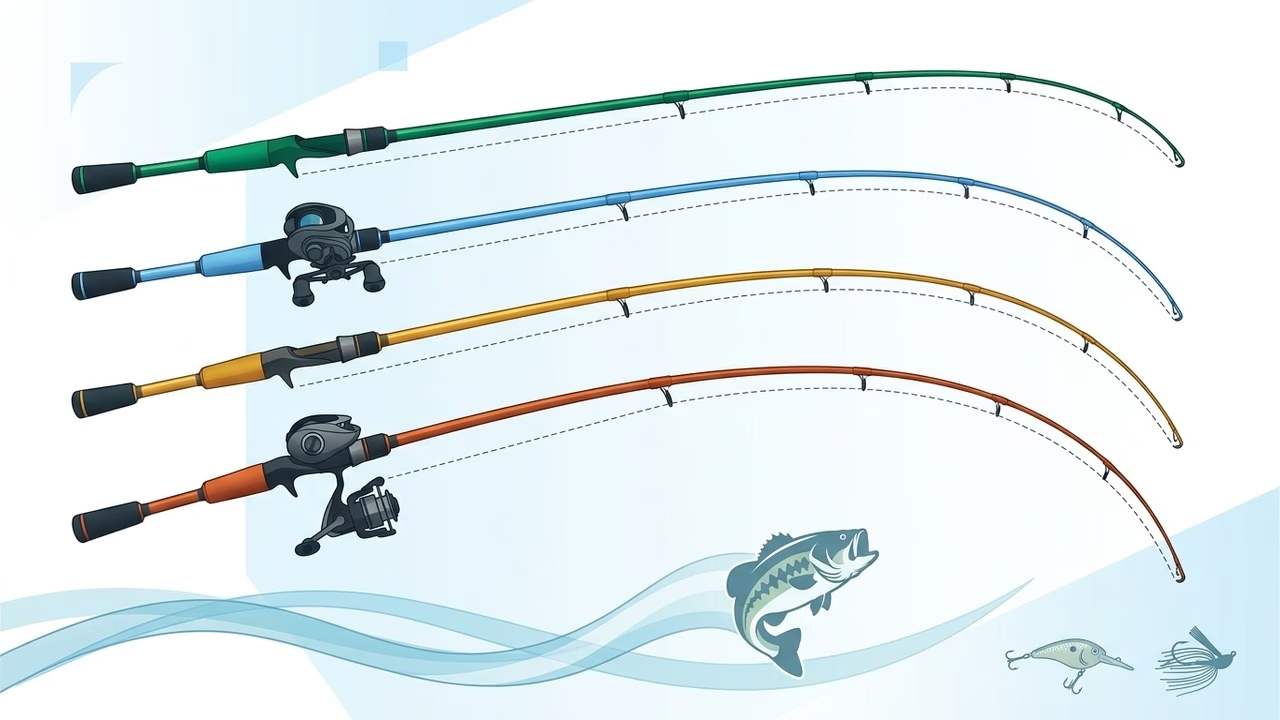
Buying a high-dollar graphite blank won’t stop fish from unbuttoning mid-jump if your tip recovers too fast for treble hooks or folds flat when setting stout jig steel across lily pads. Nearly half of lost strikes trace back to mistaking rod power (lifting strength) for rod action (flex speed and curvature).
Run your target species, primary bait profile, and cover structure through our 3-step fishing rod power and action calculator below to generate your exact rod blueprint—and inspect matched setups across Dobyns Fury, St. Croix, and Ugly Stik builds.
Fishing Rod Power, Action & Species Matcher
Answer 3 quick setup questions to compute exact rod power, blank deflection action, length window, and top-matched Dobyns Fury, St. Croix, and Ugly Stik builds.
Sets fish weight class, jaw stiffness, and surging run reserve.
Single thick-wire hooks demand crisp recovery; trebles/circles need cushion.
Refines blank length for casting leverage and cover extraction.
Matched Rod Blueprint Builds (Dobyns Fury, St. Croix & Ugly Stik)
Updating matched rod specs…
Dobyns Fury Series FR 734C (7’3″ MH Fast)
High-modulus graphite blank with AA-grade cork and balanced tip recovery tailored for crisp sensitivity and rock-solid hooksets.
St. Croix Bass X / Triumph (7’1″ MH Fast)
Crafted on premium SCII carbon blanks for pinpoint casting accuracy, lightweight all-day comfort, and responsive tip deflection.
Ugly Stik GX2 / Carbon (7’0″ MH Mod-Fast)
Renowned Ugly Tech graphite-fiberglass Clear Tip design survives boat gunwales, heavy bank weights, and violent headshakes.
Rod Power vs. Rod Action Explained: The Physics Behind Our Calculator
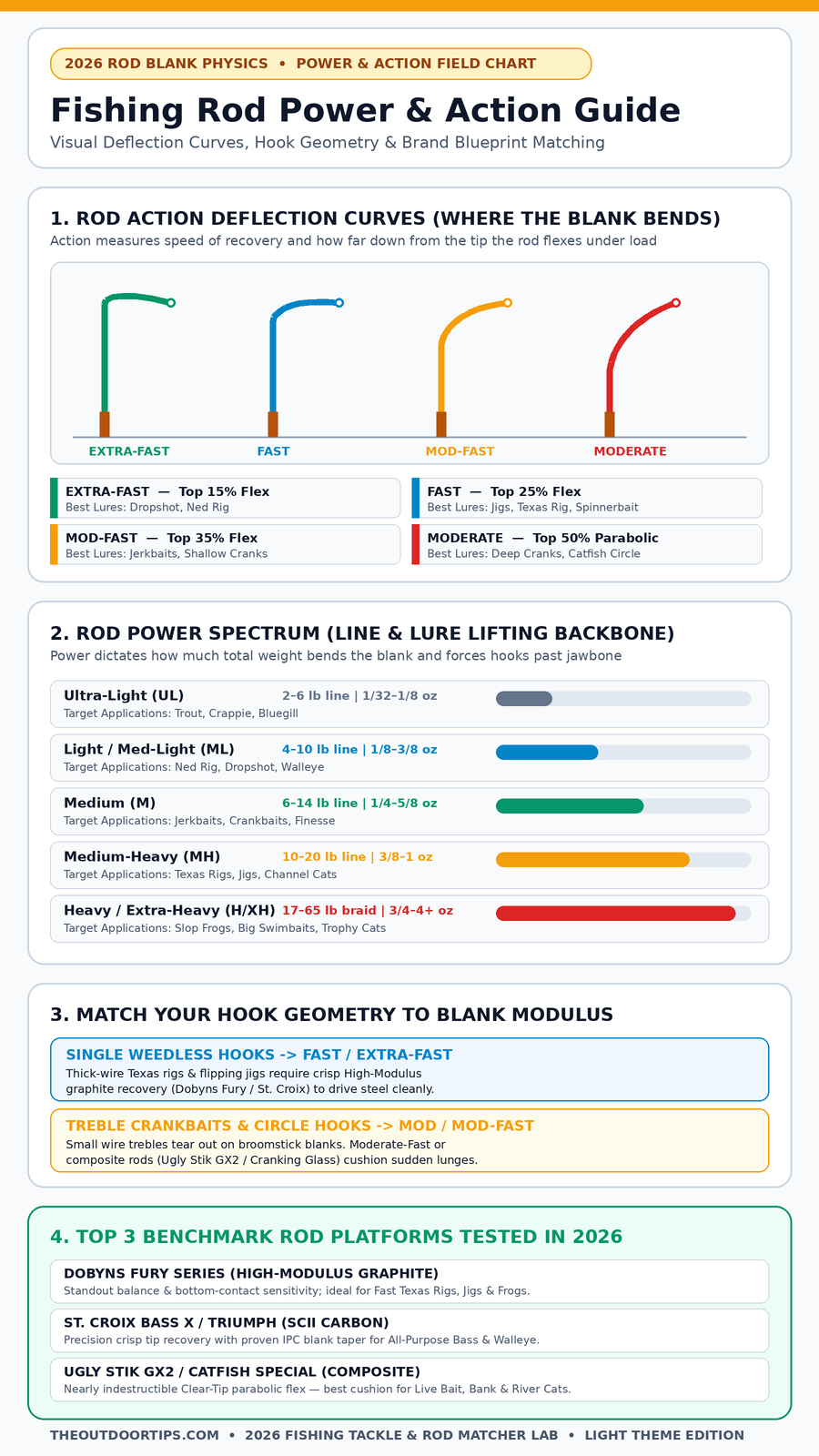
Although tackle shops often mention power and action in the same breath, the two terms describe completely independent structural behaviors governed by blank taper geometry and carbon modulus.
📐 Core Rod Blank Mechanics Used in This Matcher Quiz
1. Rod Power (Backbone): Force (lbs) required to flex the mid-section & butt 90° (EI stiffness rating)
2. Rod Action (Taper Flex %): Fraction of tip length bending before backbone locks (15% X-Fast → 50% Mod)
3. Casting Load Window: Optimal lure weight deflects the upper third cleanly at peak whip velocity
Power Dictates Line Strength & Lure Mass
Rod power scales from Ultra-Light (UL) up through Extra-Heavy (XH) and determines both your safe drag ceiling and the lure weights the blank can catapult without feeling dead or overloading on the backcast. Overloading an Ultra-Light tip with a 1/2 oz jig collapses casting accuracy, whereas throwing a 1/8 oz weightless worm on a Heavy flipping stick fails to flex the carbon at all. If you want to verify how much braid or fluorocarbon fits your reel underneath these rated lines, check our Fishing Reel Line Capacity & Backing Calculator before spooling.
Action Dictates Bite Delay, Hook Penetration & Forgiveness
Rod action measures where the rod starts bending down from the tiptop and how quickly the tip snaps back straight. An Extra-Fast rod bends strictly in the top 15%, transmitting faint ticks on slack line straight into your reel seat while driving heavy single-wire hooks almost instantly. Conversely, a Moderate or Moderate-Fast taper bends smoothly down through the upper 35% to 50% of the blank, acting like a shock absorber so fish inhaling treble crankbaits or self-setting circle hooks load the hook cleanly instead of tearing small wire free.
Master Rod Power, Action & Line Weight Reference Chart
Use this field reference matrix whenever cross-shopping spinning rods and baitcasting blanks for freshwater bass, walleye, inshore redfish, and big river catfish. Notice how pairing the right fishing knot strength efficiency with matched blank power prevents broken tips on locked-down hooksets.
| Rod Power Class | Line Rating Window | Optimal Lure / Weight Range | Best Paired Action | Primary Techniques & Species |
|---|---|---|---|---|
| Ultra-Light (UL) | 2–6 lb Mono / Braid | 1/32–1/8 oz | Fast / Moderate-Fast | Creek trout spinners, crappie marabou jigs, bluegill floats |
| Light / Medium-Light (ML) | 4–10 lb Line | 1/8–3/8 oz | Extra-Fast / Fast | Dropshot bass, Ned rigs, finesse walleye hair jigs |
| Medium (M) | 6–14 lb Line | 1/4–5/8 oz | Mod-Fast (Trebles) / Fast | Squarebill crankbaits, jerkbaits, weightless Senkos, inshore trout |
| Medium-Heavy (MH) | 10–20 lb Line | 3/8–1 oz | Fast (Single) / Mod (Cats) | Texas rigs, casting jigs, spinnerbaits, channel catfish rigs |
| Heavy (H) | 17–65 lb PE Braid | 3/4–2.5 oz | Fast / Mod-Fast | Slop frogs, flipping brush piles, 1–6 oz medium river catfishing |
| Extra-Heavy (XH) | 30–80 lb PE Braid | 2–10+ oz Lead | Moderate-Fast | Big swimbaits, trophy blue/flathead catfish in swift tailrace currents |
Why Hook Geometry Controls Your Ideal Rod Action
The single smartest rule in modern rod selection is matching hook wire diameter and point count to blank speed—not simply picking the stiffest carbon pole on the rack.
🎯 The Hook-Action Golden Rule: Single Stout Steel vs. Multi-Treble & Circle Hooks
Thick Single EWG / Flipping Hooks need a Fast or Extra-Fast graphite blank that leaves zero slack lag between wrist snap and barb penetration through plastics. Light-Wire Treble Crankbaits & Offset Circle Hooks require a Moderate or Moderate-Fast curve so the rod yields fractionally as a fish turns away—letting the treble or circle hook rotate neatly into the corner of the mouth instead of ripping out prematurely.
Video Breakdown: Visual Deflection Difference Between Power & Action
Dobyns Fury vs. St. Croix vs. Ugly Stik: Choosing the Right Blank Material
Even identically labeled 7'0" Medium-Heavy Fast rods from different manufacturers cast and bend differently because resin content, fiber modulus, and E-glass blending radically reshape tip speed. If you are building your very first full combo from scratch, start with our complete rod and reel combo buyer’s guide and pair spinning blanks cleanly using our spinning reel sizing chart.
| Rod Platform | Blank Construction | Weight & Tip Feel | Ideal Application |
|---|---|---|---|
| Dobyns Fury Series | High-Modulus Graphite + Kevlar Wrapping | Exceptionally balanced handle-heavy feel; crisp tip | All-day bass jigs, Texas rigs, buzzbaits, heavy slop frogs |
| St. Croix Bass X / Triumph | SCII Carbon Blank (IPC Continuous Taper) | Light in hand, razor-predictable progressive load | Precision dock skipping, walleye jigs, inshore plastics, Finesse |
| Ugly Stik GX2 / Bigwater | Ugly Tech Graphite + Fiberglass Clear Tip | Heavier blank, ultra-forgiving parabolic flex arc | Bank catfishing, live bait, young anglers, rough boat storage |
- When to Choose Dobyns Fury: Dobyns balances long handles with high-modulus carbon so tip-heavy fatigue vanishes over 8-hour casting tournaments. Their
FR 734C (7'3" Heavy Fast)acts closer to a traditional stout Medium-Heavy-Plus blank, crushing heavy weed jigs highlighted in our bass fishing in heavy cover playbook. - When to Choose St. Croix: St. Croix’s continuous mandrel taper removes flat dead spots along the guide train, making their
Medium-Light Extra-FastandMedium Fastspinning rods effortless casters for light lures and newcomers browsing top beginner bass rods. - When to Choose Ugly Stik: Whenever you heave
3 oz to 8 ozlead sinkers along rocky riprap banks or fish live cut bait with circle hooks, fragile high-modulus carbon can crack from accidental rock dings. A fiberglass-reinforced composite blank like the models in our Ugly Stik catfish rod review bends double without fracturing—and you can size your heavy weights directly using our Catfish Sinker Weight & River Current Calculator.
Species-Specific Blueprints: Bass, Inshore, Walleye & Big River Catfish
Matching species behavior to blank taper isn’t just about maximum break force—it directly impacts bite conversion across different mouth anatomies, feeding speeds, and current drag profiles:
- Tournament Largemouth & Smallmouth Bass: Carry at least two complementary blanks whenever chasing bass across seasonal depth changes: one
7'1"–7'3" Medium-Heavy Fastcasting rod for jigs, spinnerbaits, and Texas rigs, paired with a6'10"–7'0" Medium-Light Extra-Fastspinning setup for dropshots and small Ned rigs. When targeting smallmouth cruising open rocky flats, that lighter tip prevents light-wire finesse hooks from pulling free mid-jump. - Walleye, Redfish & Spotted Sea Trout: Paper-mouthed species like crappie and speckled trout combined with hard-crushing coastal redfish thrive on a 7’0″ Medium Power, Fast Action blank spooled with
15 lb PE braidand a fluorocarbon leader. You gain sensitive feel on soft muddy bottoms while retaining enough mid-blank cushion near the kayak or boat to absorb tail-walking lunges cleanly without straightening 1/4 oz jigheads. - Creek Trout, Crappie & Bluegill (Ultra-Light): Step down cleanly to a
6'0"–6'6" Ultra-LightorLightspinning rod rated for1/32 to 1/8 ozmicro jigs and inline spinners. Using a heavier Medium bass stick strips out throwing distance completely with tiny lures and causes zero rod bend during the fight. - River Channel & Blue Catfish: Bank and anchor fishermen running
30 lb to 65 lbbraid benefit from longer7'6" to 8'0"rods to lift heavy lead rigs smoothly over submerged boulders and boat wakes, as covered in our best bank catfishing rods and overall catfish rod comparison. Slow-trolling anglers can pairModerate-Fastfiberglass tips directly with tactics in our catfish drift fishing manual and cut and live catfish bait breakdown.
How Handle Length & Reel Weight Affect Real Perceived Action
Always test rod balance with your reel bolted into the reel seat rather than flexing bare display tubes inside a store aisle. Pairing an ultra-light 6 oz magnesium spinning reel with a nose-heavy 7'6" Heavy blank forces your wrist to tilt upward continuously, deadening your fingertips to subtle bites within an hour. Conversely, a slightly heavier reel or counterbalanced cork butt like the Dobyns Fury shifts the pivot point cleanly just in front of the spool—making the tip feel crisp, nimble, and dramatically more responsive all day.
Final Angler Summary: Locking Down Your Next Rod Spec
✅ 2026 Quick Rod Matcher Decision Rule
1. Pick Power By Lure & Cover First: Choose Medium-Light (UL/ML) for 1/8 oz finesse baits, Medium for crankbaits/plastics, Medium-Heavy for Texas rigs/jigs/channel cats, and Heavy/XH for thick weeds or 4+ oz river sinkers.
2. Pick Action By Hook Style Second: Pair single thick-wire hooks with crisp Fast / Extra-Fast carbon blanks (Dobyns Fury, St. Croix), and reserve Moderate / Moderate-Fast composite tips (Ugly Stik GX2 / Bigwater) for treble lures and circle hooks.
3. Balance Length to Cast Margin: Stay between 6'10" and 7'3" for all-day pinpoint casting accuracy, and step up to 7'6"–8'0" whenever throwing long river drifts or flipping heavy slop.
Frequently Asked Questions About Fishing Rod Power & Action
What is the difference between fishing rod power and rod action?
Rod power measures how much pressure or deadweight it takes to bend the lower half and backbone of the blank (rated from Ultra-Light to Extra-Heavy), matching your line pound test and lure weight. Rod action measures where the blank bends from the tiptop (Extra-Fast in the top 15% down to Moderate in the top 50%) and how rapidly the tip springs back straight after loading.
What is the best all-around rod power and action if I can only buy one rod?
If you throw primarily bass and mixed freshwater lures on a baitcaster, a 7’0″ to 7’2″ Medium-Heavy Power with a Fast Action handles Texas rigs, jigs, spinnerbaits, chatterbaits, and topwaters effortlessly. For spinning anglers tossing lighter finesse lures, trout baits, and mid-size jerkbaits, a 7’0″ Medium Power Fast Action is the single most versatile blank you can own.
Why do fish pop off treble-hook crankbaits on an Extra-Fast graphite rod?
Extra-Fast high-modulus graphite has minimal tip yield and springs back nearly instantaneously. When a bass shakes its head violently near the boat on small wire treble hooks, that stiff rod acts like a rigid prybar that either pulls the bite before loading or tears oversized holes in the fish’s mouth. Switching to a Moderate or Moderate-Fast taper adds crucial shock-absorbing cushion.
Are Dobyns Fury rods true to their stated power ratings?
Compared to St. Croix blanks, Dobyns Fury rods tend to feel roughly half a power lighter in tip flex while preserving stout lower-section lifting torque. For instance, the popular Dobyns 734C Heavy performs closely to an assertive Medium-Heavy Plus, giving you easier casting load with light jigs alongside heavy hook-setting power.
What rod power and action works best for river catfish circle hooks?
Unlike bass jigs that require a violent upward snap, circle hooks require a smooth, progressive bend so the hook slides forward into the corner jaw under steady loading. Pair a Medium-Heavy to Heavy Power composite rod (such as an Ugly Stik Catfish / Bigwater 7’6″–8’0″) featuring a Moderate-Fast action tip so big blues and channels load the blank cleanly before turning.
Does a longer fishing rod really cast farther?
Yes. Stepping up from a 6'6" rod to a 7'2" or 7'6" rod increases tip arc velocity on the forward cast and picks up significantly more slack line on long-distance hooksets. Shorter rods (6'0"–6'8") only win in tight bank brush or precision target pitching around low boat docks.
Can I use braided line on a fast-action fiberglass or composite rod?
Yes—and it is actually one of the smartest pairings for treble crankbaits and catfishing. Zero-stretch PE braid boosts casting reach and bite sensitivity, while the slower parabolic fiberglass/composite action provides the missing shock elasticity so hard strikes don’t rip hooks free or overstress knots.