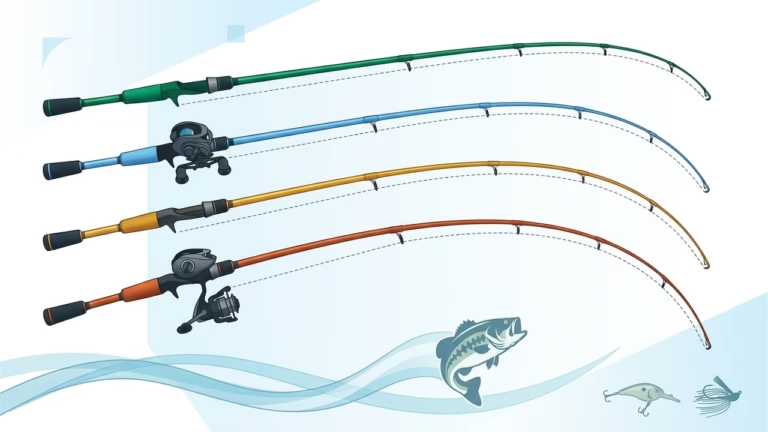
Buying a 150-yard spool of braided line and guessing how much monofilament backing goes underneath usually ends with either wasted superline or wind knots from an overfilled rim.
Because braided PE packs much thinner than nylon mono, a reel rated for 200 yds of 10 lb mono (0.30 mm) holds roughly 220 yds of 30 lb braid (0.28 mm). Use our fishing reel line capacity calculator below to compute exact mono-to-braid backing yards and handle cranks immediately.
Fishing Reel Line Capacity & Backing Calculator
Enter your reel’s printed monofilament capacity to compute exact braid yardage, mono backing bed, handle cranks, and line-dig risk.
Rated Yards
Exact Rated mm
Standard Rated Line Test Preset
Target Test Weight
Target mm (Editable)
Line Construction Packing Factor
Spooling Strategy
Backing Mono Size
Reel Speed (Inches / Turn)
Matched Line & Backing Loadout for Your Calculation
Sized for 30 lb Braid Top-Shot + 10 lb Mono Backing
PowerPro Spectra Fiber Braid (30 lb / 150 yd)
Body-enhanced 4-carrier micro-filament weave slices clean through pads and heavy cover while resisting abrasion around rocks and timber.
Sufix 832 Advanced Superline (30 lb / 150 yd)
7 Dyneema fibers plus 1 Gore performance fiber create a slick, whisper-quiet circular cross-section (k=0.96) for maximum casting range.
Berkley Trilene Big Game Mono (10 lb Quarter-Spool)
Bites cleanly into bare aluminum arbors without slipping and gives uniform coil support underneath ultra-thin braided mainlines.
How Our Fishing Reel Line Capacity Calculator Works (Spool Cylinder Volume Math)
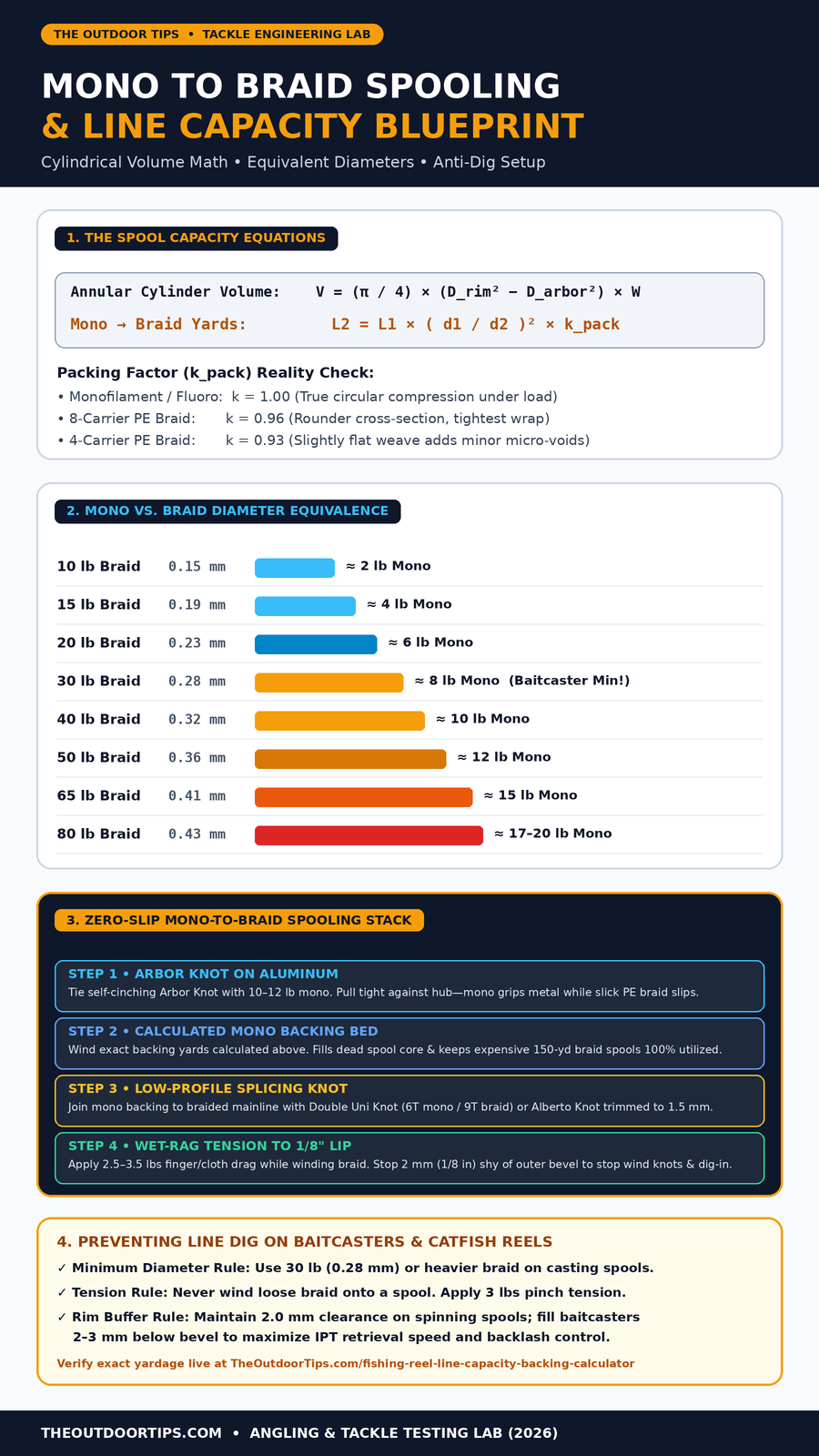
Every spinning, baitcasting, and conventional reel spool is engineered as a rigid hollow cylindrical annulus bounded by an inner arbor core diameter (Darbor), an outer lip or bevel diameter (Drim), and an internal traverse width (Wspool). When you crank line onto a reel under tension, the available geometric storage volume never changes—whether you wind stiff fluorocarbon, stretchy nylon monofilament, or limp 8-carrier braided PE.
📐 Core Engineering Formulas Used by the Calculator
1. Available Spool Volume: Vspool = (π / 4) × (Drim² − Darbor²) × Wspool
2. Exact Line Conversion: L2 = L1 × (d1 / d2)² × kpack
3. Two-Layer Backing Split: Lbacking = L1 × (d1 / dback)² × (1 − [Lbraid,target / Lbraid,max])
Notice the exponent in Equation 2: line capacity scales with the inverse square of the line diameter ((d1 / d2)²), not linearly. Halving your line diameter does not double spool capacity—it quadruples (4×) how much line fits inside the exact same metal cup. For example, dropping from standard 0.30 mm 10 lb monofilament down to 0.15 mm 10 lb finesse braid increases theoretical yardage by (0.30 / 0.15)² = 4.0×, transforming a 180-yard spinning reel into a 690-yard abyss before applying the braid packing coefficient (kpack).
Wait—why does the packing coefficient (kpack) matter? Unlike nylon monofilament, which holds a round cross-section and lightly compresses into interstitial valleys under levelwind pressure, braided PE fibers resist axial compression. Smooth 8-carrier superlines (such as Sufix 832 or Daiwa J-Braid x8) sit nearly circular at kpack ≈ 0.96, whereas stiffer 4-carrier braids (like original PowerPro) exhibit a subtle diamond/ribbon profile that traps slightly more microscopic air volume between wraps (kpack ≈ 0.93). Our calculator builds that real-world compression penalty directly into every output.
Master Mono-to-Braid Diameter & Reel Capacity Comparison Table
Use the reference matrix below alongside our spinning reel size guide for bass fishing and rod and reel combo guide to benchmark common US braided line ratings against real spool sizes:
| Braid Rating (US) | Typical Diameter | Mono Diameter Match | 2500 Spinning (160 yd / 8 lb) | 3000 Spinning (220 yd / 10 lb) | 200 Baitcaster (155 yd / 10 lb) | 6500 Catfish (320 yd / 14 lb) |
|---|---|---|---|---|---|---|
| 10 lb Braid | 0.15 mm (0.006") | ~2 lb Mono | 461 yds | 845 yds | 595 yds | N/A (Finesse) |
| 15 lb Braid | 0.19 mm (0.007") | ~4 lb Mono | 288 yds | 527 yds | 371 yds | 1,102 yds |
| 20 lb Braid | 0.23 mm (0.009") | ~6 lb Mono | 196 yds | 359 yds | 253 yds | 752 yds |
| 30 lb Braid | 0.28 mm (0.011") | ~8 lb Mono | 132 yds | 243 yds | 171 yds | 507 yds |
| 40 lb Braid | 0.32 mm (0.013") | ~10 lb Mono | 101 yds | 186 yds | 131 yds | 388 yds |
| 50 lb Braid | 0.36 mm (0.014") | ~12 lb Mono | N/A | 147 yds | 103 yds | 307 yds |
| 65 lb Braid | 0.41 mm (0.016") | ~15 lb Mono | N/A | 113 yds | 80 yds | 237 yds |
| 80 lb Braid | 0.43 mm (0.017") | ~17–20 lb Mono | N/A | N/A | 73 yds | 215 yds |
Note on US vs. JDM Braid Labeling: North American braid boxes routinely state conservative pound tests whose actual wet breaking strength (as governed under IGFA line-class testing standards) and physical diameter exceed the printed box rating. For instance, many US “30 lb” braids actually measure 0.28 mm (closer to Japanese PE #3.0) rather than thin PE #2.0. Always check the millimeter specification printed on the filler spool and plug that exact figure into our fishing reel line capacity calculator’s Exact Target Diameter (mm) box for millimeter-accurate backing math.
Visual Blueprint: Spool Volume & Mono-to-Braid Backing Stack
How to Calculate Exact Mono Backing Without Wasting Expensive Braid
Unless you are hunting pelagic tuna or locking up on heavy offshore bottom fish that peel 250+ yards on a single run, spooling pure braid from bare aluminum arbor to rim on a bass, walleye, or freshwater catfish reel wastes money. In everyday freshwater and inshore saltwater fishing, 95% of your casts, hooksets, and fights use only the outer 60 to 120 yards of line. Everything buried deeper stays wet, UV-protected dead weight that supports outer wrap diameter.
Splitting a single 300-yard bulk spool of braid across two 150-yard reels (or neatly loading a single 150-yard retail filler spool onto a deep-cup 3000 spinning reel) saves $15 to $25 per respool cycle while keeping the spool diameter high enough to maximize your reel’s advertised Inches Per Turn (IPT) retrieval speed.
The Two Precision Methods for Loading Calculated Mono Backing
- Method A — The Handle Crank Counting Method (Single Reel, Zero Extra Gear): Let the calculator compute both your Mono Backing Yards and Estimated Handle Cranks. Note that when winding backing onto a bare spool core, the effective circumference of an empty arbor is roughly 14% smaller than the reel’s full-spool IPT rating; our calculator automatically compensates with a
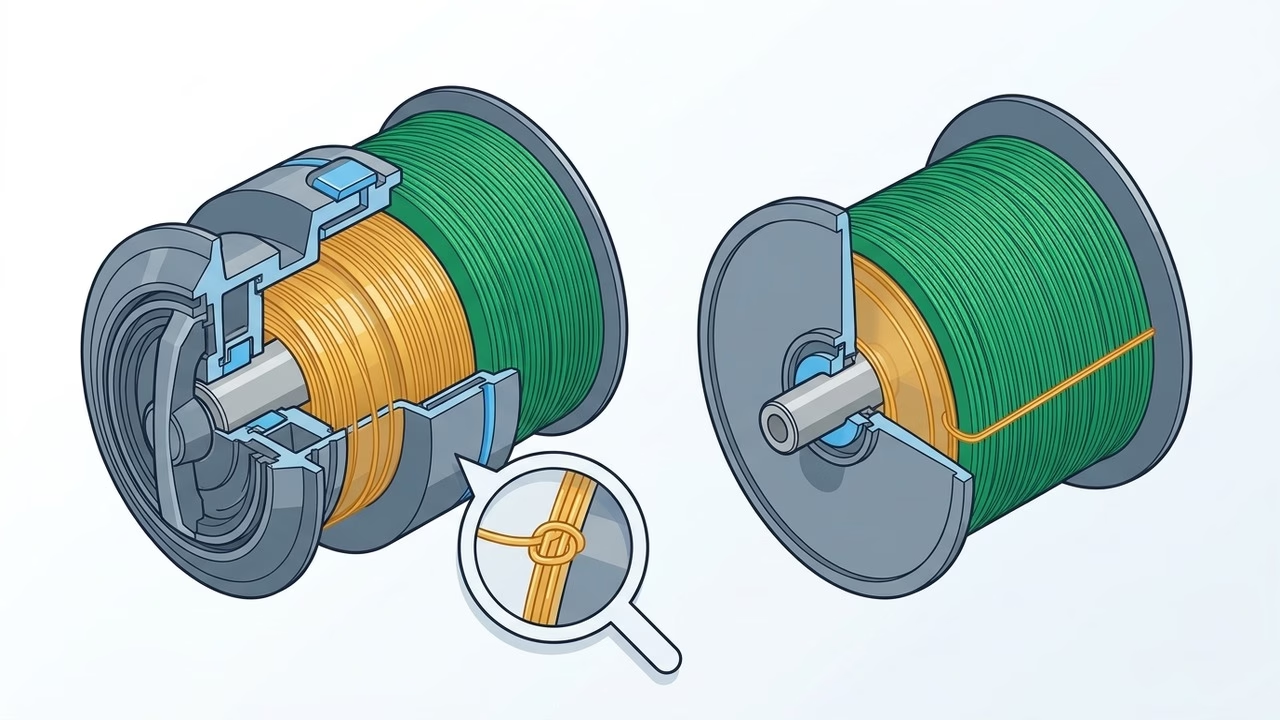
0.86×core-radius factor. Tie your monofilament arbor knot, count your handle revolutions slowly under light tension until you hit the crank target, tie your Double Uni splice, and wind the entire 150-yard braid filler spool smoothly up to the2.0 mm (1/8 in)lip boundary. - Method B — The Reverse Transfer Method (100% Exact Fill with Spare Reel or Spool): If you own an identical spare spool (common on Penn and Shimano spinning reels) or an old baitcaster with an open spool, wind your
150 yardsof braided mainline onto the spare spool first. Tie your mono backing onto the braid with a Double Uni Knot, then top off the spare spool with mono backing right until the coils sit precisely2.0 mmshy of the lip bevel. Finally, unspool the filled spare spool backward onto your primary reel—your mono backing naturally lands dead bottom against the aluminum core, and your braided top-shot stops flush at the ideal casting height.
If you regularly rig heavy bank rods for river monsters (see our best catfish rods for bank fishing and heavy catfish rod comparisons), leaving 30% to 40% high-visibility 20 lb mono backing underneath 50 lb or 65 lb braid accomplishes two jobs at once: it pads deep-arbor conventional spools like the Abu Garcia 6500/7000 series and provides a sacrificial buffer cushion if a snag forces you to hand-wrap and break off the terminal rig.
Step-by-Step: Tying an Arbor Knot & Mono-to-Braid Backing Splice
Skipping monofilament backing and tying slick PE braid directly around a polished anodized aluminum hub causes one of angling’s most embarrassing failures: spool slip. When you set the hook or tighten the star drag on a heavy fish, the entire cylinder of braided coils breaks friction and spins freely around the stationary metal hub. Even if you crank your drag down until the washers creak, line still strips out—not because the drag slipped, but because your braided knot is skating on bare metal. (Electrical tape residue melts in summer trunks and turns into gummy bearing contamination; 10–12 lb nylon monofilament bites into metal cleanly and never degrades.)
- Tie the Overhand Stopper: Wrap
10 lbor12 lbnylon monofilament backing once around the bare spool hub. Tie a simple overhand knot in the extreme tag end to act as a mechanical wedge. - Complete the Slip Loop (Arbor Knot): Tie a second overhand knot using the tag end around the standing mainline so the loop glides freely. Pull the standing line firmly while pushing the loop down against the arbor—when tension hits the stopper wedge, the collar locks tightly into the anodized surface with zero slip. Trim the remaining tag to
3 mm. - Wind the Backing Bed Evenly: Keep the filler mono spool flat on the floor (spinning reels: line peels off counter-clockwise against rotor direction; baitcasters: line peels straight over the top of a pencil axle). Wind until you reach the exact yardage or crank count given by the fishing reel line capacity calculator above.
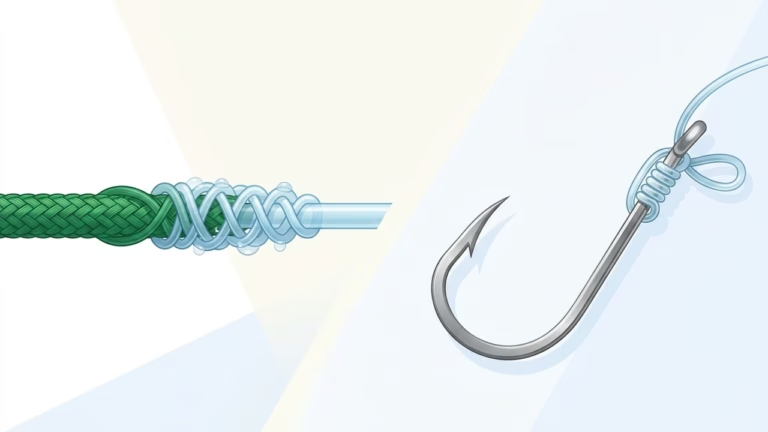
- Join Mono Backing to Braid (Double Uni Knot): Overlap
6 inchesof mono backing and your braided mainline. Make 5 wraps on the stiffer monofilament side and 8 to 10 wraps on the slicker braided side (braid needs extra turns so it cannot pull through under shock load). Wet both knots thoroughly with saliva or water, cinch each coil tight individually, then pull the standing lines apart to seat both knots against each other neatly. - Trim Flush & Bury the Splice: Clip both tag ends cleanly to
1.5 mmwith sharp braid scissors. Before burying the splice under your braided top-shot, seat the Double Uni cleanly against the outer corner of the spool edge so outbound coils glide smoothly past without catching.
Video Demonstration: Spooling Braid with Mono Backing (Zero Slip & Twist)
Watch this concise hands-on spooling demonstration showing the clean arbor-to-braid backing connection and thumb tension technique before loading your reel:
How to Prevent Braided Line Dig on Baitcasters & Heavy Catfish Reels
On spinning reels, braided line lies sideways around an open stationary cup and rarely traps itself under impact. Baitcasting reels and round catfish conventional reels behave completely differently: because your thumb or crank transfers 100% of hookset torque straight down into layered horizontal coils at narrow arbor radii, soft ultra-thin braid loves to wedge down between softer underlying wraps—a mechanical lockup known as line dig-in. Once buried 3 millimeters deep between base coils, your next cast stops dead mid-flight and hurls a $20 crankbait snapping off at the splice.
1. The 0.28 mm (30 lb) Floor Rule
Never load sub-0.23 mm braid (10 lb–20 lb) onto a full-sized bass baitcaster unless you own a dedicated shallow BFS spool. Hair-thin PE knifes instantly between coils during an aggressive heavy-cover bass hookset. Stick to 30 lb (0.28 mm) minimum for open water and 50–65 lb (0.36–0.41 mm) for frogs and flipping.
2. The 3.0 lb Wet-Cloth Tension Lock
Spooling braid with loose finger pinch leaves spongy air gaps underneath. Pass the incoming braid through a damp folded microfiber towel clamped firmly in front of the stripper guide to maintain 2.5 to 3.5 lbs of continuous drag load. Base coils will feel nearly solid as cedar wood under your thumbnail.
3. Strict 2.0 mm (1/8") Rim Clearance
Leave roughly 2.0 mm from the top braid wrap to the edge where the spool flange tapers upward. Overfilling causes coiled spring-offs and tangles; underfilling by 4+ mm forces outbound line to drag across raw metal rim edges, slashing casting distance by up to 22%.
Pairing your line diameter with the correct rod blank action prevents premature line shock too. Before locking down heavy braided drags on a stiff rod, verify balance and hookset shock absorption in our guides on choosing a balanced beginner bass rod and rigging live/cut river offerings in our catfish bait showdown.
Best Braided Lines & Backing Spools Tested for Exact Capacity
Even the cleanest calculator math falls flat if a budget no-name braid lies about its diameter by 35% (a rampant problem with unlabeled import spools whose “20 lb” string measures thicker than true 50 lb PE). These three industry benchmarks consistently measure tight within ±0.015 mm of printed caliper specs:
PowerPro Spectra Fiber (150 / 300 yd)
0.28 mm (30 lb) • k = 0.93 • Zero-Stretch Saw
Enhanced Body Technology saturates individual Spectra strands so the line stays stiff enough to prevent wind knots on spinning reels and line dig-in on baitcasters around flooded brush and riprap.
Sufix 832 Advanced Superline (150 / 300 yd)
0.28 mm (30 lb) • k = 0.96 • Gore Fiber Core
Combining seven high-modulus Dyneema strands around one dense GORE Performance core yields superior circular symmetry, quieter guide flow, and tight, predictable spool capacity efficiency.
Berkley Trilene Big Game (10–15 lb)
0.30–0.38 mm • k = 1.00 • 900+ yd Value
Supple, high-friction copolymer monofilament cushions bare anodized reel hubs for slip-proof Arbor knots and builds cheap, uniform backing beds across six to ten reel respools per bulk spool.
Final Verdict: Stop Guessing Yardage & Lock Every Spool to Spec
Before tearing into a fresh filler spool, run your reel’s printed monofilament capacity through the fishing reel line capacity calculator above, lock down an anti-slip 10 lb or 12 lb mono arbor bed, join your mainline with a low-profile Double Uni or Alberto splice, and apply firm wet-cloth winding tension up to the 2.0 mm (1/8 in) lip edge. For river drift setups and big-water catfish tackle, also explore our salmon drift rigging guide and catfish drift fishing tactics.
Frequently Asked Questions: Fishing Reel Line Capacity & Backing
How much 30 lb braid fits on a reel rated for 12 lb mono?
Standard 12 lb monofilament measures roughly 0.33 mm, while typical 30 lb braided line measures 0.28 mm. Because spool volume scales with the square of diameter ratio times packing efficiency ((0.33 / 0.28)² × 0.96 ≈ 1.33×), a reel holding 150 yards of 12 lb mono fits roughly 200 yards of 30 lb 8-carrier braid—so adding about 35 to 40 yards of 10 lb mono backing lets a standard 150-yard braid spool fill the reel perfectly.
How much monofilament backing do I put under braided line?
You need at least 15 to 25 yards (or enough turns to cover bare aluminum twice cleanly) strictly to prevent line slipping on the hub. Beyond that anti-slip floor, add only enough mono backing to take up excess spool capacity so your 150-yard or 300-yard braid filler spool ends 1/8 inch (2 mm) below the outer lip rim.
What pound test monofilament is best for backing?
Use 10 lb to 12 lb monofilament (0.30 mm to 0.33 mm) for almost all freshwater bass, trout, walleye, and inshore 2500–4000 spinning or baitcasting setups. For deep-cup catfish conventional reels or heavy 50–80 lb braid, step up to 15 lb or 20 lb mono backing so the splice knot transitions cleanly without stepping down sharply in diameter.
Can you spool braided line directly onto a reel without mono backing?
Only if your reel features a rubber-inlaid “braid-ready” arbor band or knurled spool center pin. On smooth bare anodized aluminum spools, bare PE braid lacks surface friction and will eventually spin completely around the hub when you tighten your drag, simulating a broken drag stack.
What is the best knot to tie mono backing to braided line?
The Double Uni Knot (5 to 6 wraps on monofilament, 8 to 10 wraps on slick braid) or an Alberto Knot provides over 90% knot efficiency and slides low against the backing bed. Avoid bulky surgeon’s loops or square knots, which create ridges that catch outbound braid loops during long casts.
Why does braid dig into my baitcaster spool on hooksets?
Braided line dig occurs for two reasons: winding braid thinner than 0.28 mm (30 lb test) onto a wide baitcasting spool, or spooling the lower wraps with insufficient winding tension. Keep baitcasters at 30 lb (0.28 mm) or thicker braid and apply 2.5 to 3.5 lbs of continuous damp-cloth drag pressure while filling the spool.
How full should a spinning or baitcasting reel spool be?
Stop winding approximately 1/8 inch (2.0 mm to 3.0 mm) inside the outer flared lip bevel of a spinning spool or rim edge of a baitcaster. Overfilling triggers spontaneous coil loops and wind knots on slack casts, while underfilling beyond 4 mm sacrifices casting distance and slows real-world retrieve speed per crank.