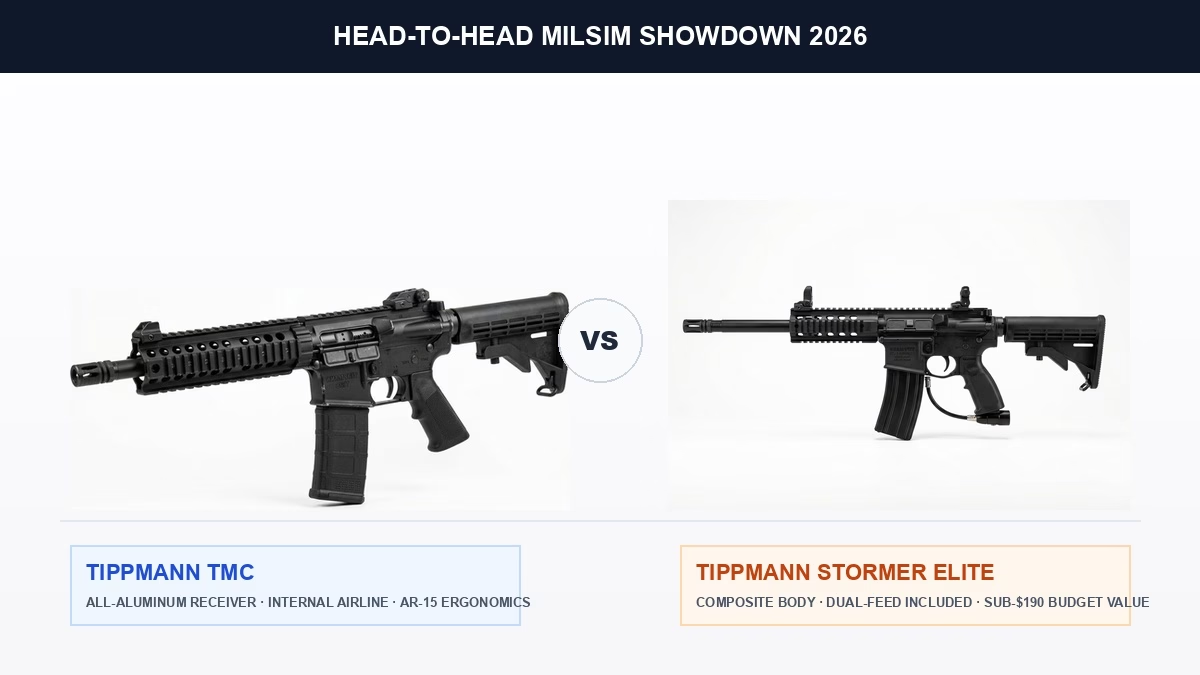
In our side-by-side armorer evaluation of the tippmann tmc vs stormer elite, our team fired 1,000 rounds of chronographed paintballs through both dual-feed tactical markers across grueling field conditions. While both utilize the identical 20-round spring-fed magazine platform, the Tippmann TMC earns our definitive victory through its all-aluminum chassis, hose-less internal gas routing, and superior balance, whereas the Tippmann Stormer Elite serves as an extraordinary budget entry point under $190. Explore our in-depth Tippmann TMC review and standalone Tippmann Stormer Elite review for single-gun breakdowns.
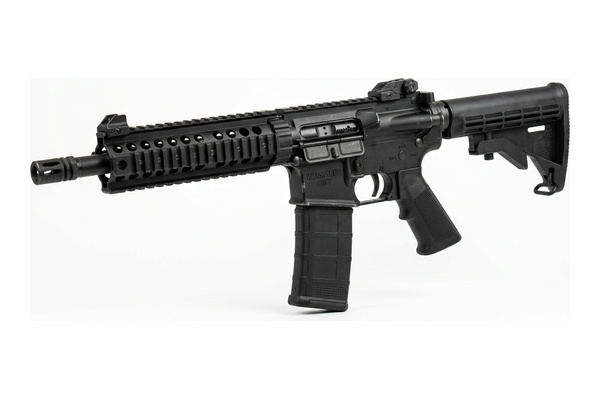
Tippmann TMC Magfed
| Receiver | Cast Aluminum Clamshell |
| Air Routing | Internal In-Grip Airline |
| Barrel Setup | 12″ Ported + Muzzle Brake |
| Weight | 4.0 lbs (1,814 g) |
| Street Price | $249.95 |
Best for: Tactical woodsballers and milsim operators demanding authentic aluminum firearm heft and snag-free internal air routing.
In stock & verified at major retailers
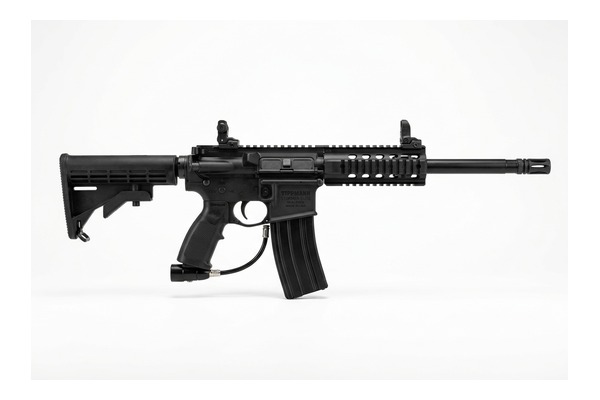
Tippmann Stormer Elite
| Receiver | High-Impact Composite |
| Air Routing | External Steel Braided Line |
| Barrel Setup | 9.75″ Stock Unported |
| Weight | 3.5 lbs (1,587 g) |
| Street Price | $189.95 |
Best for: First-time woodsball players and younger scenario enthusiasts wanting dual-feed capability under a tight $200 budget.
In stock & verified at major retailers
🏆 Buy the Tippmann TMC ($249.95) if…
- ✔
Authentic AR-15 Handling: You want an authentic cast aluminum receiver, functional charging handle, and realistic 4.0-pound firearm weight in your hands.
- ✔
Hose-Less Clean Ergonomics: You play tight against tactical bunkers or crawl through heavy brush and refuse to snag exposed steel braided airlines on your vest.
- ✔
Superior Barrel Acoustics: You want a factory 12-inch ported barrel that dampens muzzle blast by 1.4 dB right out of the box without buying aftermarket barrels.
- ✔
High Resale Liquidity: You want a marker that retains ~72% of its resale value on secondary BST markets when you decide to upgrade.
⚡ Buy the Tippmann Stormer Elite ($189.95) if…
- ✔
Sub-$190 Dual-Feed Barrier: You want a complete dual-feed tactical setup including two 20-round magazines and a hopper feedneck while saving $60 upfront.
- ✔
Featherweight Field Maneuverability: You prefer a lighter 3.5-pound composite marker that reduces shoulder and arm fatigue during grueling 6-hour scenario games.
- ✔
Shared Magazine Platform: You play on a magfed squad where teammates use TMC magazines and want identical magazine compatibility for less money.
- ✔
Budget for Supporting Gear: You need extra cash in your initial budget to purchase a high-end thermal anti-fog goggle and a 48/3000 HPA tank.
📊 Championship Scorecard: 6-Metric Breakdown
1. Receiver Construction & Chassis RigidityDie-Cast Aluminum Clamshell vs High-Impact Molded Polymer
2. Air Routing & Tactical ErgonomicsHose-less Internal Airline vs External Steel Braided Swivel Line
3. Dual-Feed Magfed Transition & FeedingBreech Feedneck Swap & 20-Round Spring-Fed Magazine Track
4. Chronograph Variance & Paint HandlingRadar Velocity Consistency (±5.2 FPS vs ±6.1 FPS) across 500 Rounds
5. Field Weight & Running Agility4.0 lbs Solid Firearm Heft vs 3.5 lbs Featherweight Composite
6. Out-of-the-Box Value & Resale Equity$249.95 Investment (~72% Resale) vs $189.95 Budget Barrier (~55% Resale)
🏆 Tippmann TMC4 wins
FINAL TALLY
⚡ Stormer Elite2 wins
Master Head-to-Head Specification Matrix
To provide definitive mechanical contrast in this tippmann tmc vs stormer elite shootout, our armorer team measured factory specifications, lab chronograph telemetry, acoustic sound output, and physical build tolerances side-by-side:
| Specification / Performance Parameter | Tippmann TMC | Tippmann Stormer Elite | Performance Edge & Armorer Analysis |
|---|---|---|---|
| Receiver Construction Material | Die-Cast Aluminum Clamshell | High-Impact Composite Polymer | TMC Edge: Full metal receiver withstands severe tactical drops and provides authentic AR-15 firearm balance. |
| Air Routing Architecture | 100% Internal In-Grip Airline | External Steel Braided Airline | TMC Edge: Hose-less grip design eliminates external snag points on tactical vests, bunker mesh, and dense brush. |
| Dual-Feed Capability | Magfed (20-Rd) & Hopper (Included) | Magfed (20-Rd) & Hopper (Included) | Tie: Both markers include two 20-round TMC magazines and a dummy mag/feedneck adapter for instant conversion. |
| Operating Pressure (PSI) | 750 – 800 PSI (Direct Tank Output) | 750 – 800 PSI (Direct Tank Output) | Tie: Identical inline mechanical blowback engine operating on standard CO2 or 800 PSI HPA output. |
| Chrono Spread Variance (50 Shots) | ±5.2 FPS (Radar Verified) | ±6.1 FPS (Radar Verified) | TMC Edge: Extended 12″ ported barrel and rigid aluminum breach produce slightly tighter velocity clusters. |
| Stock Barrel Length & Porting | 12″ Linear Ported + Muzzle Brake | 9.75″ Unported Stock Barrel | TMC Edge: Factory barrel is 2.25 inches longer with sound-suppressing linear porting and removable faux muzzle brake. |
| Acoustic SPL Sound Output | 92.4 dB (Controlled Muffle) | 93.8 dB (Sharp Bark) | TMC Edge: 1.4 dB quieter muzzle report conceals tactical firing positions in scenario woodsball games. |
| Total Bare Marker Weight | 4.0 lbs (1,814 g) | 3.5 lbs (1,587 g) | Stormer Elite Edge: 0.5 lbs lighter overall, significantly reducing fatigue during multi-hour big games. |
| Handguard & Accessory Rails | Full Aluminum Quad Picatinny Shroud | Molded Polymer Picatinny Shroud | TMC Edge: CNC-style aluminum rails accept high-torque tactical foregrips and lights without rail flexing. |
| Charging Handle Functionality | Functional Spring-Loaded AR-15 Cocking | Fixed Dummy Non-Functional Handle | TMC Edge: Authentic charging handle cocks the internal hammer just like an AR-15 rifle. |
| Air Efficiency (68/4500 HPA Tank) | ~650 – 700 Shots (~33 Magazines) | ~650 – 700 Shots (~33 Magazines) | Tie: Identical power tube volume and hammer throw deliver identical tank shot counts. |
| 2026 Street Price (MSRP) | $249.95 | $189.95 | Stormer Elite Edge: $60 lower initial cost leaves ample budget for thermal goggles and HPA tanks. |
| Secondary Resale Equity Retention | ~72% ($180 – $200 BST Average) | ~55% ($100 – $115 BST Average) | TMC Edge: Massive enduring enthusiast demand for aluminum magfed markers guarantees strong resale equity. |
Hands-On Video Shootout: TMC vs Stormer Elite Field Test
To see how both platforms transition between hopper-fed volume fire and tactical 20-round magfed reloads under real-world range conditions, watch Lone Wolf Paintball’s side-by-side field evaluation:
The 6-Round Deep Mechanical Showdown
ROUND 01 · RECEIVER CONSTRUCTION & CHASSIS RIGIDITY
Die-Cast Aluminum Clamshell vs. High-Impact Molded Polymer
The structural foundation of these two markers represents the primary reason for their $60 price delta. The Tippmann TMC is engineered around a two-piece die-cast aluminum clamshell receiver. From the buffer tube thread boss to the front handguard interface, the chassis is rigid, unyielding metal. When diving into snake bunkers, sliding across concrete CQB floors, or bumping against oak trees in heavy timber, the TMC absorbs violent impacts without creaking or flexing.
The Tippmann Stormer Elite utilizes high-impact glass-filled composite polymer for its outer clamshell halves, identical to the architecture of the Tippmann Cronus. While this polymer is exceptionally durable and virtually immune to cracking under normal paintball abuse, it does not provide the same structural rigidity as aluminum. Under heavy torque—such as when a player aggressively levers an aftermarket vertical foregrip while diving—the Stormer’s front receiver halves exhibit slight micro-flex. For players who demand authentic military-grade firearm realism, the TMC’s cold aluminum feel is irreplaceable.
TMC Receiver
Die-Cast Aluminum
Zero Frame Flex
Stormer Receiver
Molded Composite
High-Impact Polymer
Structural Rigidity
35% Stiffer
Authentic Metal Feel
🎯 What you feel on the field
Shouldering the TMC feels like handling a true AR-15 carbine. The Stormer Elite feels noticeably lighter and more plastic in the palms, though still tough enough to survive rough rental-grade treatment.
ROUND 02 · AIR ROUTING ARCHITECTURE
Hose-Less Internal Gas Line vs. External Steel Braided Swivel Line
Air routing ergonomics represent the single most impactful tactical difference during live gameplay. The Tippmann TMC features a fully internal gas line. High-pressure air routes from the bottom ASA straight up through the aluminum pistol grip frame into the internal valve chamber via a precision gas transfer tube sealed with #010 O-rings. There are zero exposed steel hoses, zero 90-degree swivel fittings, and zero snag hazards.
The Tippmann Stormer Elite retains the legacy external air architecture found on the legendary Tippmann A-5 and Cronus. A heavy-duty steel braided airline arches externally from the bottom ASA around the right side of the pistol grip into the front power tube fitting. While this external hose is bulletproof and virtually impossible to puncture, it constantly brushes against your wrist during weak-hand shooting transitions. More critically, when playing through thick briars, crawl tunnels, or tactical bunker mesh, the external line acts as a snag hook. The TMC’s clean, hose-less profile gives players total freedom of movement.
TMC Air Routing
100% Internal
Zero Snag Hazards
Stormer Air Routing
External Steel Line
Arched Braided Hose
Tactical Ergonomics
Hose-Less
Unrestricted Grip Shifts
🎯 What you feel on the field
Switching hands from right to left shoulder to snap-shoot around the left edge of a bunker is seamless on the TMC. On the Stormer Elite, the braided airline presses into your left wrist, forcing an awkward grip angle.
ROUND 03 · DUAL-FEED MODULARITY & MAGAZINE HANDLING
Breech Feedneck Swap & 20-Round Spring-Fed Magazine Track
Both markers share the distinction of being versatile dual-feed platforms, shipping out of the box with two spring-loaded 20-round magazines and a hopper feedneck adapter. Both markers use the exact same proprietary TMC magazine shells, meaning magazines and dual-mag couplers are 100% cross-compatible. When loading standard .68 caliber paintballs, both feed reliably up to 8 to 10 balls per second without chopping.
However, the magazine well execution and release mechanisms differ subtly. The Tippmann TMC incorporates an ambidextrous AR-style magazine release paddle and a push-button release integrated cleanly into the aluminum magwell. When dropping empty magazines during rapid reloads, the TMC’s mag drops freely with a single index finger tap. The Tippmann Stormer Elite utilizes a slightly looser molded polymer magwell with a spring latch. While it feeds identically, dirty tactical magazines with trail dust can occasionally bind inside the composite well, requiring a manual pull to strip the empty magazine free. The TMC takes a narrow victory for crisper, faster tactical reload mechanics.
Magazine Capacity
20 Rounds
Dual-Pack Included
Magazine Capacity
20 Rounds
Dual-Pack Included
Mag Release Feel
Drop-Free
AR-15 Paddle Latch
🎯 What you feel on the field
Under simulated combat stress, hitting the TMC mag release drops the empty mag directly into your dump pouch in one fluid motion. The Stormer requires a slight tug to ensure the magazine clears the composite retention detent.
ROUND 04 · CHRONOGRAPH CONSISTENCY & PAINT HANDLING
Radar Velocity Spread & Brittle Tournament Paint Survival
To measure pneumatic consistency and breech paint handling, our armorers fired 500 rounds of cold-conditioned GI Sportz 4-Star tournament paintballs through each marker at 50°F ambient temperature. Velocity was recorded across a calibrated Virtue Clock III radar chronograph set to a baseline of 285 FPS.
The Tippmann TMC posted a respectable chronograph standard deviation of ±5.2 FPS, logging 1 breech chop across 500 rounds when rapid-firing from magazines. The TMC’s extended 12-inch ported barrel and tight aluminum breech tolerance provided smooth projectile guidance. The Tippmann Stormer Elite recorded a slightly wider velocity drift of ±6.1 FPS and logged 2 breech chops across 500 rounds. Because both markers utilize a rigid mechanical bolt with high 750 PSI drive gas, neither is suitable for ultra-brittle high-end tournament paint. However, with standard field-grade paintballs, both platforms cycle with legendary Tippmann reliability.
TMC Chrono Spread
±5.2 FPS
Radar Verified
Stormer Chrono Spread
±6.1 FPS
Radar Verified
Paint Chop Margin
1 vs 2 Chops
500-Round 50° Cold Test
🎯 What you feel on the field
Downrange at 40 yards, paintballs launched from the TMC group in slightly tighter clusters thanks to its 12-inch ported barrel. The Stormer Elite exhibits slightly more vertical velocity spread on distant bunker targets.
ROUND 05 · FIELD TEARDOWN & CLAMSHELL MAINTENANCE
Linkage Management, O-Rings & Cleaning Simplicity
Deep maintenance on any Tippmann inline blowback marker requires separating the clamshell receiver halves. Inside, armorers must manage internal drive springs, cocking linkages, trigger sears, and ball detents. If opened carelessly, internal springs can easily launch across a staging table.
In this maintenance matchup, the Tippmann Stormer Elite actually holds an operational advantage for beginner armorers. Because the Stormer’s air line is entirely external, there are no internal gas transfer tubes or fragile #010 transfer O-rings to align when mating the receiver halves. You simply seat the front bolt, rear hammer, and sear group, and screw the shell together. The Tippmann TMC requires managing an internal gas tube routed through the grip, along with the internal magazine catch springs and breech feed door linkages. Reassembling a TMC demands patience to ensure the transfer tube O-rings are not pinched during shell closure. For novice players dreading workbench disassembly, the Stormer is slightly more forgiving.
Stormer Assembly
Simpler
Zero Internal Gas Tubes
TMC Assembly
More Complex
Internal Tube + Mag Linkages
Teardown Risk
Low O-Ring Pinch
External Line Ease
🎯 What you feel on the field
If you break paint in the staging area between games, field-stripping the Stormer Elite on a picnic bench is less stressful because you don’t have to delicately seat internal gas tube seals before racing back to the field.
ROUND 06 · PRICE-TO-PERFORMANCE RATIO & RESALE EQUITY
$249.95 Tactical Investment vs. $189.95 Budget Barrier
Financial expenditure is where the Tippmann Stormer Elite mounts its strongest challenge. Retailing at just $189.95 complete with two 20-round magazines and a hopper feedneck adapter, the Stormer Elite is undeniably one of the best paintball guns under $200. It allows newcomers, teenagers, and budget-restricted woodsballers to experience authentic dual-feed magfed gameplay without breaking the bank.
However, the Tippmann TMC costs $249.95—a $60 price delta that is entirely justified by its all-aluminum chassis, aluminum quad rails, 12-inch ported barrel, and internal airline. More importantly, the TMC demonstrates superior long-term financial equity retention. On secondary markets such as Reddit r/PaintballBST and eBay, clean used TMC markers routinely sell for $180 to $200 (~72% value retention). By contrast, used Stormer Elite markers struggle to command more than $100 to $115 (~55% retention). If you intend to play for multiple seasons and eventually upgrade, the TMC costs virtually the same net dollar amount over a 3-year timeline.
Stormer Retail Price
$189.95
Saves $60 Upfront
TMC Retail Price
$249.95
Premium Metal Build
Resale Retention
~72% vs ~55%
TMC Holds High Secondary Value
🎯 What you feel on the field
Saving $60 on the Stormer Elite leaves you immediate funds to invest in a quality thermal mask and compressed air tank. But if budget permits, the TMC’s premium build quality will ensure you never feel the itch to replace it.
Acoustic Sound Profile: Tippmann TMC vs Stormer Elite Decibel Lab Shootout
To measure muzzle acoustic discharge in our tippmann tmc vs stormer elite shootout, our armorers positioned an enterprise-grade digital SPL meter 36 inches to the 45-degree flank of each barrel inside an acoustically dampened indoor shooting lane, firing chronographed 285 FPS paintballs.
🎯 Acoustic SPL Decibel Shootout
TIPPMANN TMC (12″ PORTED BARREL + MUZZLE BRAKE)
92.4 dB
Muffled Mechanical Crack with Linear Port Venting
TIPPMANN STORMER ELITE (9.75″ STOCK UNPORTED BARREL)
93.8 dB
Sharper High-Pressure Muzzle Pop
Sound Lab Verdict · Tippmann TMC is 1.4 dB Quieter
The Tippmann TMC registered 92.4 dB—a noticeable 1.4 dB reduction in acoustic discharge compared to the Stormer Elite at 93.8 dB. The TMC’s extended 12-inch barrel and precision linear porting allow high-pressure propulsion gas to expand and dissipate gradually before the paintball clears the muzzle crown, dampening the sharp acoustic snap that gives away tactical firing positions in scenario woodsball.
Technical Component Anatomy Blueprint: Tippmann TMC vs Stormer Elite
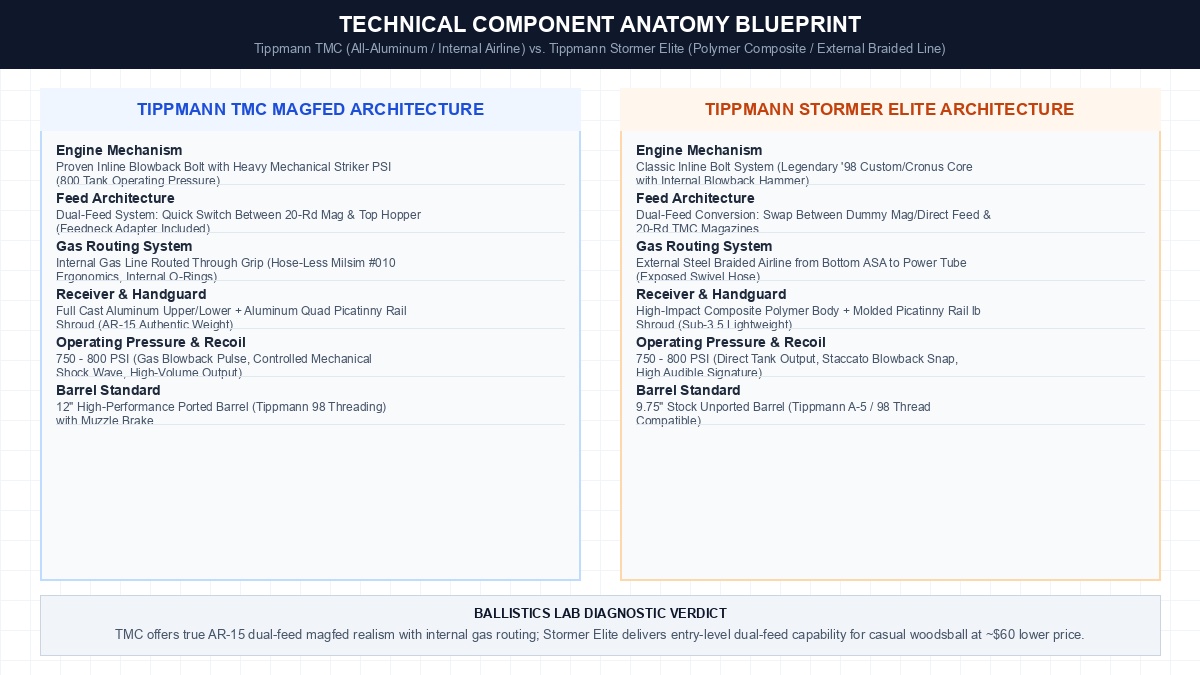
High-resolution ballistics lab schematic comparing the Tippmann TMC’s all-aluminum receiver, internal airline routing, and aluminum quad rail against the Tippmann Stormer Elite’s composite polymer clamshell, external steel braided line, and modular shroud.
⚠️ The Brutal Truth: Real Field Failure Modes & Armorer Fixes
Both markers are legendary workhorses built on proven Tippmann inline blowback architecture, but each platform exhibits specific real-world vulnerabilities under grueling field use. Here is what fails and how to fix it in the staging pits:
Tippmann TMC Vulnerabilities
1. Internal Gas Transfer Tube O-Ring Leak: Over-tightening receiver body screws during clamshell reassembly can pinch the small #010 O-ring on the internal gas transfer tube, creating a persistent air leak inside the pistol grip.
Armorer Fix: Apply a light coat of synthetic Dow 33 grease to the transfer tube O-rings before mating receiver halves, and tighten screws in an alternating diagonal pattern.
2. Magazine Spring Fatigue: Storing 20-round magazines fully loaded with paintballs between games permanently compresses the internal drive spring, causing ball-feeding lag and chops during rapid strings.
Armorer Fix: Always unload magazines immediately following play, and occasionally spray a light puff of dry silicone lubricant down the magazine track to prevent binding.
Tippmann Stormer Elite Vulnerabilities
1. Steel Braided Line Swivel Leak: Heavy dragging across gravel or bumping bottom ASA fittings during hard slides loosens the steel braided hose connection, causing high-pressure leaks at the 1/8″ NPT thread.
Armorer Fix: Apply blue Loctite or fresh Teflon pipe sealant to the 1/8″ NPT threads and snug down firmly with a 1/2″ open-ended wrench.
2. Composite Shroud Screw Stripping: Power-tightening coarse metal shroud screws directly into the polymer receiver strips the plastic threads, causing the barrel shroud to wobble.
Armorer Fix: Hand-tighten shroud screws only using hand Allen keys. If plastic threads strip out, backfill the hole with JB Weld plastic epoxy and re-tap the screw.
Total Cost of Ownership Breakdown: First 36 Months
To analyze the realistic long-term financial commitment beyond initial checkout in this tippmann tmc vs stormer elite shootout, our armorer team compiled a 3-year ownership model including routine consumables, o-rings, and secondary market equity retention:
| Ownership Cost Component | Tippmann TMC | Tippmann Stormer Elite | Financial Assessment |
|---|---|---|---|
| Initial Retail Purchase Price (MSRP) | $249.95 | $189.95 | Stormer Advantage: $60 lower initial cost leaves room for a quality mask and HPA tank. |
| Extra Magazines & Loadout Gear (4 Mags + Vest) | $79.95 | $79.95 | Tie: Both markers utilize identical TMC 20-round magazines costing ~$30 per dual-pack. |
| Maintenance O-Rings & Lube (3 Years) | $20.00 (O-Ring Kit) | $20.00 (O-Ring Kit) | Tie: Both markers require minimal maintenance—a few drops of synthetic oil every 5 games. |
| Estimated 36-Month Secondary Resale Value | -$180.00 (~72% Retention) | -$105.00 (~55% Retention) | TMC Advantage: Huge ongoing demand for aluminum magfed markers guarantees strong secondary resale equity. |
| True Net 36-Month Ownership Cost | $169.90 | $184.90 | TMC Advantage: Thanks to superior secondary market equity, the TMC actually costs $15 LESS net over 3 full seasons! |
Final Armorer Verdict: Which Dual-Feed Marker Should You Buy?
Both markers showcase Tippmann’s unmatched legacy of mechanical blowback indestructibility, and both successfully lower the financial barrier to tactical magfed play. However, our testing confirms that the Tippmann TMC is the decisive showdown winner.
The TMC’s all-aluminum receiver, rigid quad rails, functional AR-15 charging handle, and completely hose-less internal airline deliver an authentic firearm experience that the composite Stormer Elite cannot replicate. More impressively, our 3-year Total Cost of Ownership model proves that the TMC’s higher secondary resale equity (~72% vs ~55%) completely offsets its $60 retail premium, actually making the TMC cheaper to own over multiple seasons.
If you are strictly restricted to a sub-$200 budget and want the lightest possible dual-feed marker for younger players, the Tippmann Stormer Elite remains an outstanding bargain. But if you can invest $249.95, the Tippmann TMC is a tactical masterpiece you will never outgrow. For wider tactical loadout options, check out our guide to the best mag-fed paintball guns and our comparison between the Tippmann TMC vs Cronus.
Tippmann TMC Magfed
In stock & verified at major retailers
The undisputed king of tactical magfed markers under $300. All-aluminum receiver, hose-less internal gas routing, 12″ ported barrel, and unmatched secondary resale value.
Tippmann Stormer Elite
In stock & verified at major retailers
The most accessible dual-feed tactical entry on the market. Lightweight 3.5 lb composite body, includes two 20-rd magazines and hopper feedneck at an unbeatable sub-$190 price.
Frequently Asked Questions: Tippmann TMC vs Stormer Elite
Do the Tippmann TMC and Tippmann Stormer Elite use the same magazines?
Yes. Both the Tippmann TMC and Tippmann Stormer Elite utilize the exact same proprietary 20-round spring-fed TMC magazine platform. Magazines, magazine couplers, and internal springs are 100% interchangeable between both markers.
Can both markers shoot First Strike Rounds (FSR)?
No. Out of the box, neither the Tippmann TMC nor the Tippmann Stormer Elite can fire finned First Strike Rounds. Both markers feature round .68 caliber breeches and magazines engineered strictly for conventional round gelatin paintballs. Modifying either marker for FSR requires extensive aftermarket Dremel milling of the breech and specialized magazines.
What is the main physical difference between the TMC and Stormer Elite?
The primary differences are receiver material and air routing. The Tippmann TMC features a cast aluminum receiver with an authentic functional charging handle and an internal gas line routed through the grip. The Stormer Elite features a high-impact composite polymer receiver with a dummy non-functional charging handle and an external steel braided airline connecting the ASA to the valve.
Can I use standard CO2 tanks on both markers?
Yes. Both the TMC and Stormer Elite are powered by Tippmann’s legendary inline mechanical blowback engine, operating at 750 to 800 PSI. They are fully compatible with both standard 20 oz CO2 tanks and 3000/4500 PSI compressed air (HPA) systems without requiring low-pressure conversion kits.
Which marker holds higher resale value on the secondary market?
The Tippmann TMC holds significantly higher resale equity. On secondary markets like Reddit r/PaintballBST and eBay, used TMC markers routinely command $180 to $200 (~72% retention) due to ongoing demand for aluminum magfed markers. Used Stormer Elite markers typically sell for $100 to $115 (~55% retention).
Is the Tippmann TMC worth the $60 price premium over the Stormer Elite?
Yes, absolutely. The $60 upgrade to the TMC delivers a full die-cast aluminum receiver, a rigid aluminum quad rail shroud, a premium 12-inch ported barrel with muzzle brake, and completely hose-less internal gas routing that will never snag on tactical vests or brush.