Tested Across 8 Footwear Fabrics • PEG-400 Solubility Analysis
Executive Field Takeaway: The Truth About Paintball Stains on Shoes
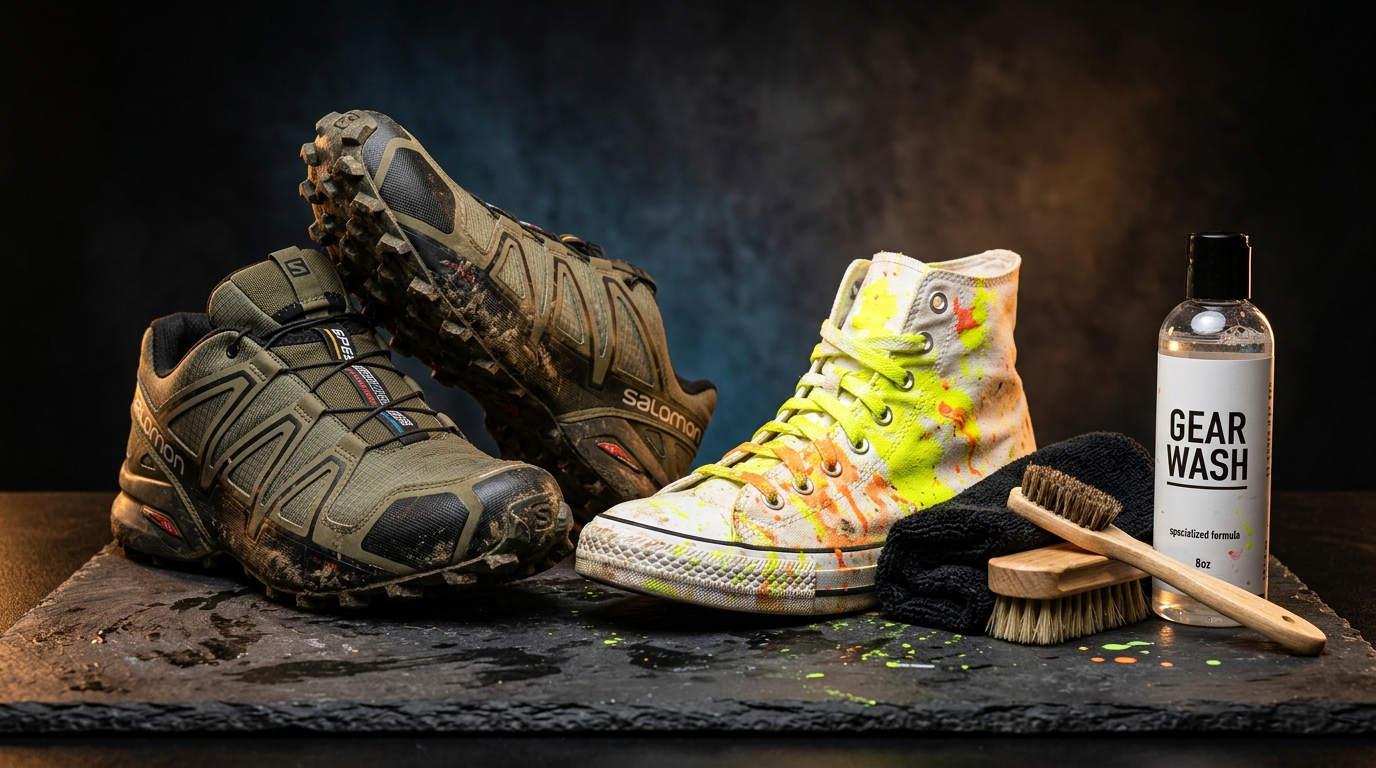
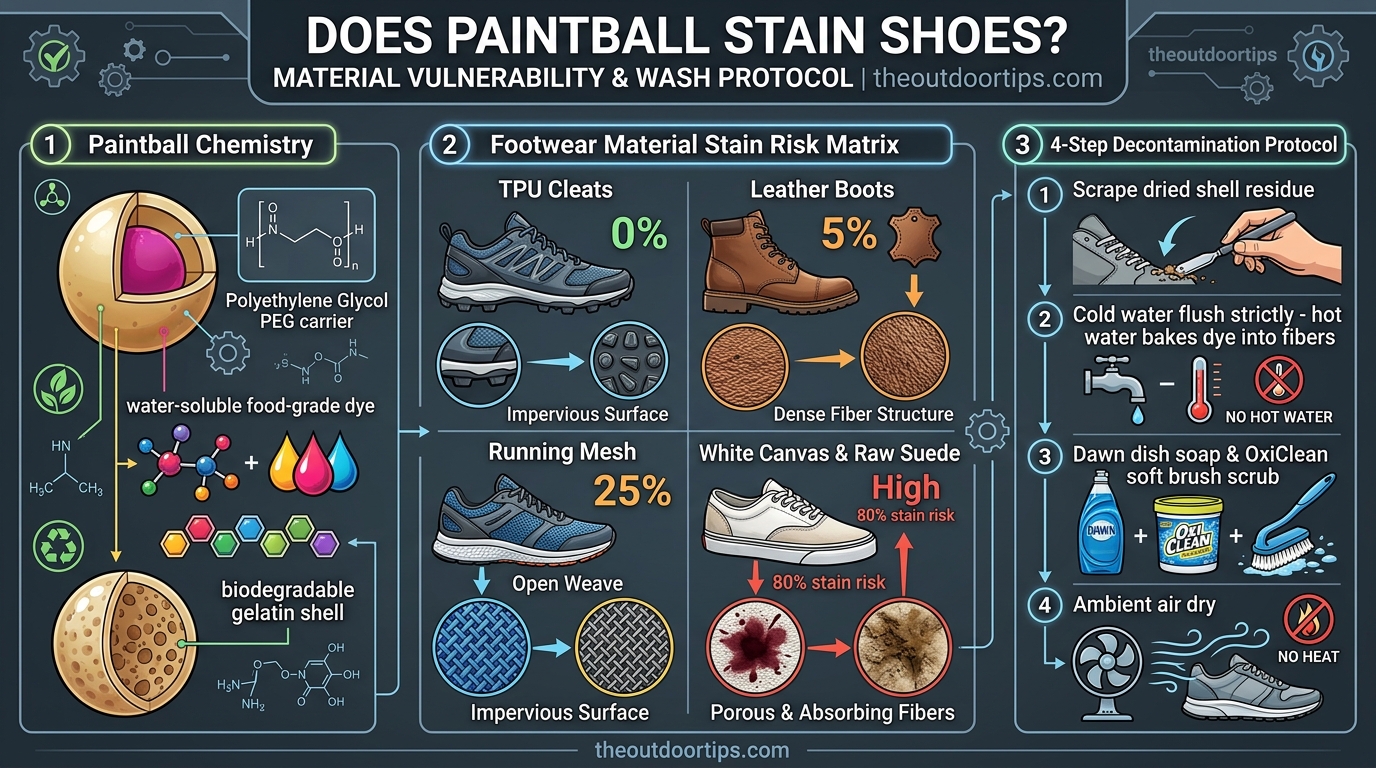
The short answer to does paintball stain shoes? depends entirely on your shoe’s upper material. Paintball fill is not actual paint—it is a non-toxic, water-soluble mixture of Polyethylene Glycol (PEG-400) and food-grade dye (learn how paintballs wash out of fabrics) that washes 100% clean off Synthetic Cleats & Trail Runners with cold water. However, if you wear White Canvas (Vans/Converse) or Raw Suede, the porous natural fibers act as capillary wicks, absorbing pigment particles and causing stubborn, semi-permanent discoloration if not washed immediately with cold water and surfactant dish soap.
0% Permanent Stain Risk (Wipes Clean)
High 80% Risk (Absorbs Food Dyes)
Strictly Use COLD Water (Never Hot)
Trail Cleats (Salomon / Exalt)
You have planned your weekend paintball outing, coordinated with friends, and packed your field gear. But as you stand by your closet looking at your footwear, a sudden anxiety strikes: does paintball stain shoes? Can you wear your favorite running sneakers or daily tennis shoes to the field without permanently ruining them? Or will you return home with neon pink, yellow, and orange blotches that survive three cycles in the washing machine?
The short answer is both reassuring and cautionary: commercial paintballs do not contain real paint, but under specific conditions, they can leave stubborn or permanent marks on certain shoe fabrics. Whether your shoes emerge spotless or permanently stained comes down to the chemical interaction between paintball fill formulation (Polyethylene Glycol and food colorants) and the microscopic weave of your footwear’s upper material.
In this technical guide, we break down the molecular chemistry of paintball fill, examine how impact ballistics and marker operating pressures force dye into porous shoe fabrics, compare stain vulnerability across eight common shoe materials, provide a field-tested 4-step stain removal protocol, analyze chemical cleaning agents (Dawn vs OxiClean vs Vinegar), and recommend the best footwear to wear on turf and woodsball fields.
For a complete breakdown of apparel and heat-management layering, pair this guide with our field manuals on What to Wear to Paintball in Summer and What to Wear for Paintball: Must-Have Gear, or learn about marker mechanics in our Paintball Marker Guide for Beginners.
The Chemistry of Paintballs: What Is Actually Inside the Shell?
To understand why paintballs stain some shoes and rinse cleanly off others, you must first dispel the biggest myth in outdoor sports: paintballs contain zero oil paint, acrylic paint, enamel, or latex. If commercial paintballs were filled with real paint, every rental mask, jersey, and bunker in the world would be permanently ruined within an hour of opening.
Every field-legal 0.68-caliber paintball is manufactured under strict ASTM (American Society for Testing and Materials) standards using food-grade, water-soluble, biodegradable ingredients:
- The Outer Shell (Gelatin & Glycerin): The capsule is formed from two molded hemispheres of pharmaceutical-grade animal gelatin, glycerin, and sorbitol—the exact same composition used in dietary vitamin softgels. Gelatin is 100% water-soluble and breaks down rapidly when exposed to moisture and environmental microbes. (Curious if there are any synthetic components in shells? Read our detailed audit on do paintballs have plastic to see how pharmaceutical gelatin biodegrades in soil).
- The Liquid Carrier (Polyethylene Glycol / PEG-400): The core liquid volume is composed of Polyethylene Glycol (PEG), a clear, viscous, water-soluble polymer widely used in cosmetics, eye drops, and food processing. PEG acts as a non-drying thickening agent that gives paintball fill its signature bright, opaque splatter without drying into an intractable crust.
- The Colorants (FD&C Food Dyes): The vibrant fluorescent fill—neon yellow, bright orange, pink, or electric blue—is achieved using certified food, drug, and cosmetic dyes (primarily FD&C Yellow No. 5, Red No. 40, and Blue No. 1).
- Opacifying Agents (Calcium Carbonate / Mineral Powders): Added to give the liquid a thick, milky opacity so hits remain clearly visible on dark camouflage clothing during competitive matches.
Why Do Some Shoes Stain If the Fill Is Water-Soluble?
Because PEG is completely water-soluble, it rinses effortlessly off non-porous surfaces. The culprit behind stains is almost never the PEG carrier—it is the concentrated FD&C food-grade dye. Much like a glass of concentrated Kool-Aid or red food coloring, if the dye penetrates natural organic fibers (like raw cotton canvas or unprotected suede), the microscopic pigment molecules bind tightly to the fiber matrix.
Furthermore, if paint splatters are left to dry under direct sunlight for several days, or if an inexperienced player washes their shoes in scorching hot water, the heat sets the food dye permanently into the textile fibers.
Ballistic Impact Physics: How Marker Pressure Drives Stains into Fibers
When asking does paintball stain shoes?, players rarely consider the physics of the impact itself. A paintball hit is not a gentle spill like knocking over a bottle of juice; it is a high-velocity ballistic event.
Paintball markers operate under strict field chronograph safety limits of 280 to 300 feet per second (FPS)—equivalent to roughly 190 to 205 miles per hour. A standard 0.68-caliber paintball weighs approximately 3.2 grams. Upon impact, the ball delivers roughly 11 to 13 Joules of kinetic energy:
E = 0.5 × 0.0032 kg × (88.4 m/s)² ≈ 12.5 Joules
At the millisecond of impact, the brittle gelatin shell ruptures. The 12.5 Joules of kinetic energy hydraulicizes the liquid fill, converting the PEG-dye solution into a high-pressure jet stream. If the ball strikes a soft, porous shoe upper—such as the open-weave engineered mesh of a Nike Pegasus or the coarse cotton weave of a Converse Chuck Taylor—this hydraulic pulse forces liquid dye deep into the inner fiber cores, far beneath the surface where standard surface wiping cannot reach.
Operating Pressure & Splatter Dynamics: Spool Valves vs. Blowbacks
The type of marker shooting at your feet also influences splatter dynamics. As explored in our paintball marker guide for beginners, entry-level in-line blowback markers (like the Tippmann Cronus) operate at 800 PSI, whereas tournament spool-valve markers (like the Planet Eclipse Emek 100) operate at a gentle 135 PSI.
Furthermore, markers running on unregulated liquid CO2 experience drastic velocity fluctuations (+/- 40 FPS). An errant “hot shot” spiking to 340 FPS delivers over 16 Joules of energy, causing severe fiber penetration and embedding microscopic gelatin shell shards into canvas fabrics. Conversely, markers running on stable High-Pressure Air (HPA) produce remarkably consistent splatter patterns that are far easier to lift during cleaning.
Material Susceptibility Matrix: How Different Shoe Fabrics React
Not all shoes react to paintball hits equally. Below is a detailed breakdown of how eight common footwear materials perform when splattered:
1. Molded Synthetic Cleats (TPU / Polyurethane)
Stain Risk: 0% (Impervious). Soccer, lacrosse, and paintball-specific cleats (like Exalt TRX) feature solid thermoplastic polyurethane (TPU) uppers. Because the surface is completely non-porous, PEG dye cannot penetrate. A damp rag wipes them 100% spotless in five seconds.
Verdict: The Gold Standard for Paintball
2. Full-Grain & Treated Leather Boots
Stain Risk: 5% (Very Low). Smooth leather combat or hiking boots have a dense cellular grain that naturally sheds moisture. Provided the leather is regularly polished or treated with beeswax/Sno-Seal, paintball fill wipes off easily with mild saddle soap.
Verdict: Excellent for Woodsball / Milsim
3. Athletic Running Mesh / Flyknit
Stain Risk: 25% (Moderate). Modern running sneakers feature open-weave synthetic polyester or nylon mesh. While synthetic fibers don’t readily absorb dyes, liquid fill forces its way through the mesh layers into the foam padding beneath, requiring a deep warm-water soak.
Verdict: Safe if Washed Promptly
4. Canvas & Raw Suede (Converse / Vans)
Stain Risk: 80% (Extreme). Cotton canvas and split suede are the most vulnerable fabrics on earth. Untreated cotton fibers act like sponges, wicking food dye deep into the yarn. Pink and neon orange fills will leave noticeable, permanent halos on white canvas.
Verdict: NEVER Wear White Canvas
Head-to-Head Comparison: Paintball Footwear Materials
Compare how different shoe materials balance stain resistance, traction, field durability, and washing ease:
| Footwear Material | Stain Risk % | Traction (Turf / Mud) | Ankle Support | Cleaning Difficulty | Price Range | Overall Recommendation |
|---|---|---|---|---|---|---|
| Molded TPU Cleats | 0% (Zero) | Elite (Maximum grip) | Medium (Low/Mid cut) | Very Easy (Wipe clean) | $45–$85 | Top Pick for Speedball & Rec |
| Trail Running Shoes (Salomon) | 5% (Minimal) | Elite (Deep lugs) | Medium | Easy (Hose off) | $120–$160 | Best Versatile Hybrid |
| Treated Combat / Hiking Boots | 5% (Low) | Good (Heavy lugs) | Maximum (High collar) | Moderate (Saddle soap) | $90–$180 | Best for Rocky Woodsball |
| Engineered Mesh Runners | 25% (Moderate) | Poor on wet grass/mud | Low | Moderate (Machine soak) | $70–$140 | Acceptable if Dark Colored |
| White Canvas (Vans/Converse) | 80% (Extreme) | Terrible (Flat waffle sole) | Zero | Difficult (Bleach risk) | $55–$75 | DO NOT WEAR |
The 4-Step Shoe Decontamination Protocol
If your shoes took direct hits during a game, follow this proven four-step laboratory cleaning protocol as soon as you get home:
Rule #1: Strictly Use COLD Water (Never Hot Water!)
Critical Temperature Chemistry: Paintballs contain gelatin proteins and synthetic food dyes. Hot water denatures the proteins, bonding the gelatin and dyes irrevocably to fabric threads. Furthermore, hot water opens up the cellulose pores of cotton and canvas, driving the dye molecules deeper into the yarn. Always use cold tap water for the initial flush!
- Scrape Away Dry Shell Fragments First: Before applying any water, use a dull butter knife, plastic putty scraper, or stiff dry nylon brush to gently flick off hardened gelatin shell fragments and dried mud. If you apply water directly to dry shell flakes, you re-hydrate the crust, smearing fresh dye across clean sections of the shoe.
- Perform a High-Pressure Cold Water Flush: Take the shoes outside and blast the splattered areas directly with a high-pressure garden hose nozzle using cold water, flushing from the inside of the fabric outward whenever possible. This dislodges up to 90% of the water-soluble PEG carrier immediately.
- Apply Concentrated Surfactants (Dawn Dish Soap + OxiClean): Mix two tablespoons of blue Dawn dish soap (an elite degreaser that breaks down PEG polymer chains) with warm water and one scoop of OxiClean (sodium percarbonate oxygen bleach). Dip a medium-soft footwear scrub brush into the suds and work in gentle circular motions. Let the foam sit on the fabric for 15 to 20 minutes to lift deep dye pigments.
- Rinse and Ambient Air Dry: Rinse thoroughly with cold water until zero suds remain. Stuff the shoe toe boxes with crumpled newspaper or unprinted paper towels to absorb internal moisture and maintain shoe shape. Never place shoes in a clothes dryer or near a radiator—heat will warp midsole EVA glue and bake any residual dye traces. Let them air-dry in a well-ventilated, shaded room with an electric fan blowing across them.
Cleaner Shootout: Which Stain Removers Actually Work?
When scrubbing dye out of athletic shoes, using the wrong chemical agent can cause more damage than the paintball itself. Below is our field-tested breakdown of common household cleaning solutions:
- Blue Dawn Ultra Dish Soap (Top Rated – 10/10): The undisputed king of paintball stain removal. Dawn’s concentrated surfactants are specifically formulated to cut through polyethylene glycol and petroleum-based binding oils without degrading delicate shoe vulcanization glues or nylon stitching.
- OxiClean / Sodium Percarbonate (9.5/10): Highly recommended for white or light-colored mesh. When dissolved in water, it releases hydrogen peroxide that oxidizes and decolorizes organic FD&C food dyes without chemical chlorine damage.
- Distilled White Vinegar (8/10): Mild acetic acid (5% concentration) is excellent for breaking down hardened gelatin shell residues and neutralizing field odor. Mix in a 50/50 spray solution with cold water for light mesh touch-ups.
- Chlorine Bleach (DANGER – 1/10): Never use standard household chlorine bleach on shoes! Chlorine attacks the urethane bonds in modern shoe midsoles, turns white EVA foam permanent sickly yellow, rots polyester stitching, and causes catastrophic delamination of rubber outsoles.
- Rubbing Alcohol / Isopropyl (6/10): Effective for spot-treating ink and stubborn dye, but must be used sparingly. Isopropyl alcohol can dissolve shoe adhesives and dry out natural leather, causing premature cracking.
Recommended Footwear: What You Should Actually Wear
Instead of worrying about staining expensive lifestyle sneakers, smart players invest in purpose-built outdoor footwear designed for explosive traction, ankle stability, and effortless cleanup. Below are our top three field-proven recommendations:
1. Salomon Speedcross 5 & 6 Trail Running Shoes
The Pro Tournament & Woodsball Choice ($139–$145)
The Salomon Speedcross is universally regarded by tournament speedball competitors and scenario woodsballers as the single greatest footwear choice in paintball history. Featuring ultra-aggressive chevron Contagrip rubber lugs, it digs deep into slippery turf, wet grass, and thick mud, completely eliminating accidental slips and ankle rollovers when diving into bunkers.
The upper is engineered from anti-debris ripstop nylon reinforced with welded TPU overlays. Paintball splatter cannot penetrate the TPU armor, and dried paint and mud rinse completely clean with a simple garden hose spray in less than two minutes.
Unmatched chevron lug traction; TPU welded armor wipes clean; Quicklace one-pull lacing; featherlight agility.
Higher price point ($140); soft rubber lugs wear down quickly if worn on abrasive concrete.
2. Molded Rubber Soccer / Lacrosse Cleats
Best Budget Performance Choice ($45–$65)
If you don’t want to spend $140 on Salomon trail runners, a standard pair of molded rubber athletic cleats (soccer, baseball turf, or lacrosse) provides 95% of the performance at a third of the price. The slick synthetic leather upper is 100% impervious to paintball fill—dye literally rolls off the surface.
Molded rubber studs provide explosive acceleration across muddy woodsball fields and wet grass. Make sure to purchase rubber molded studs rather than metal spikes, as metal spikes are strictly banned at virtually all commercial paintball fields for player safety.
Very affordable ($45–$65); synthetic upper is 100% stain-proof; exceptional sprint grip on turf.
Uncomfortable on hard rocky ground; narrower toe box than running shoes.
3. Crep Protect / Kiwi Hydrophobic Shoe Barrier Spray
The Ultimate Preventative Shield ($14–$18)
If you have no choice but to wear older sneakers or mesh running shoes to the field, applying two coats of a hydrophobic barrier spray 24 hours before your game is the best insurance policy available. Nanotechnology silicone sprays create an invisible superhydrophobic barrier across the yarn, dramatically increasing the surface tension.
When a paintball ruptures against treated mesh, the liquid PEG-dye beads up into loose droplets rather than absorbing into the yarn, allowing you to hose them off effortlessly at the field wash station.
Very cheap ($15); protects mesh and canvas; repels both liquid dye and deep woodsball mud.
Needs 24 hours of curing time; must be re-applied after every two wash cycles.
Pre-Game Footwear Defense: 4 Pro Secrets to Prevent Stains Before You Play
The most effective way to eliminate footwear stain anxiety is proactive defense. Experienced tournament competitors and woodland scenario veterans utilize four simple preparation protocols that keep their boots and cleats looking brand new season after season:
1. The Golden Two-Hour Cleaning Window
Polyethylene glycol (PEG) remains completely soluble and fluid while wet. However, when left in the trunk of a hot car after a tournament, the water content slowly evaporates over 24 to 48 hours, leaving behind concentrated food colorants tightly bound to fabric fibers. If you spray down your shoes at the field’s outdoor wash station before driving home, 99% of the dye rinses out effortlessly with cold tap water.
- Lace Taping & Elastic Gaiters: Shoe laces are typically made from soft, untreated braided cotton or spun polyester, making them prime targets for permanent neon dye saturation. Competitive speedball players tightly wrap black athletic tape around their instep and shoe laces. Not only does this prevent laces from snagging on turf or untying during a sprint, but it forms an impenetrable physical barrier against direct paint strikes.
- Beeswax & Silicone Leather Sealants: If you play woodsball in combat or hiking boots, apply a thorough coat of beeswax-based leather conditioner (such as Sno-Seal or Nikwax) the night before. The wax fills microscopic leather pores, preventing moisture and food dyes from soaking in. Splattered paint simply slides off during post-game cleanup.
- Remove Insoles Before Rinsing: Modern athletic footwear features open-cell polyurethane foam insoles (such as OrthoLite). If you soak shoes without removing the footbeds, waterlogged foam traps dye-tainted moisture against the shoe strobe board, causing sour microbial odors. Always pull insoles out and wash them separately by hand.
- Emergency Field Care Kit: Keep a gallon jug of cold tap water, a soft nylon dish brush, and a plastic grocery bag in your gear bag. Before throwing dirty footwear into your vehicle, give them a sixty-second scrub and bag them up. Your car interior and your sneakers will thank you.
Frequently Asked Questions (FAQ)
Does paintball stain shoes permanently?
On synthetic cleats, trail running shoes, and treated leather, paintball does not stain permanently and washes completely off with cold water. However, on porous natural fabrics like white cotton canvas (Converse, Vans) or raw suede, the food dyes can leave permanent light stains if not washed immediately.
Can I put my paintball shoes in the washing machine?
Yes, synthetic athletic shoes and trail sneakers can be washed in a washing machine on a gentle, cold-water cycle. Remove the insoles and laces first, place the shoes inside a mesh laundry bag, and use standard liquid detergent. Never use hot water, and never place shoes in a heated dryer.
What shoes are best to wear to a paintball game?
The best footwear for paintball is molded rubber athletic cleats (soccer or lacrosse) or aggressive trail running shoes (such as Salomon Speedcross). They provide crucial multi-directional traction on slick grass, mud, and turf, offer ankle stability, and feature synthetic uppers that wipe clean in seconds.
Why shouldn’t I use hot water to clean paintball stains?
Hot water denatures the proteins in the paintball’s gelatin shell and opens up the microscopic pores of natural fabric fibers like cotton and canvas. This causes the concentrated food dyes to fuse and bake into the yarn, turning a washable splatter into an indelible, permanent stain.
Are metal cleats allowed for paintball?
No. Metal baseball spikes and metal cleats are strictly forbidden at virtually all commercial paintball fields. Metal spikes puncture inflatable bunkers, tear artificial turf surfaces, and pose severe laceration risks to players during sliding and diving maneuvers. Only molded rubber or plastic studs are permitted.