Executive Takeaway: Do Paintballs Have Plastic?
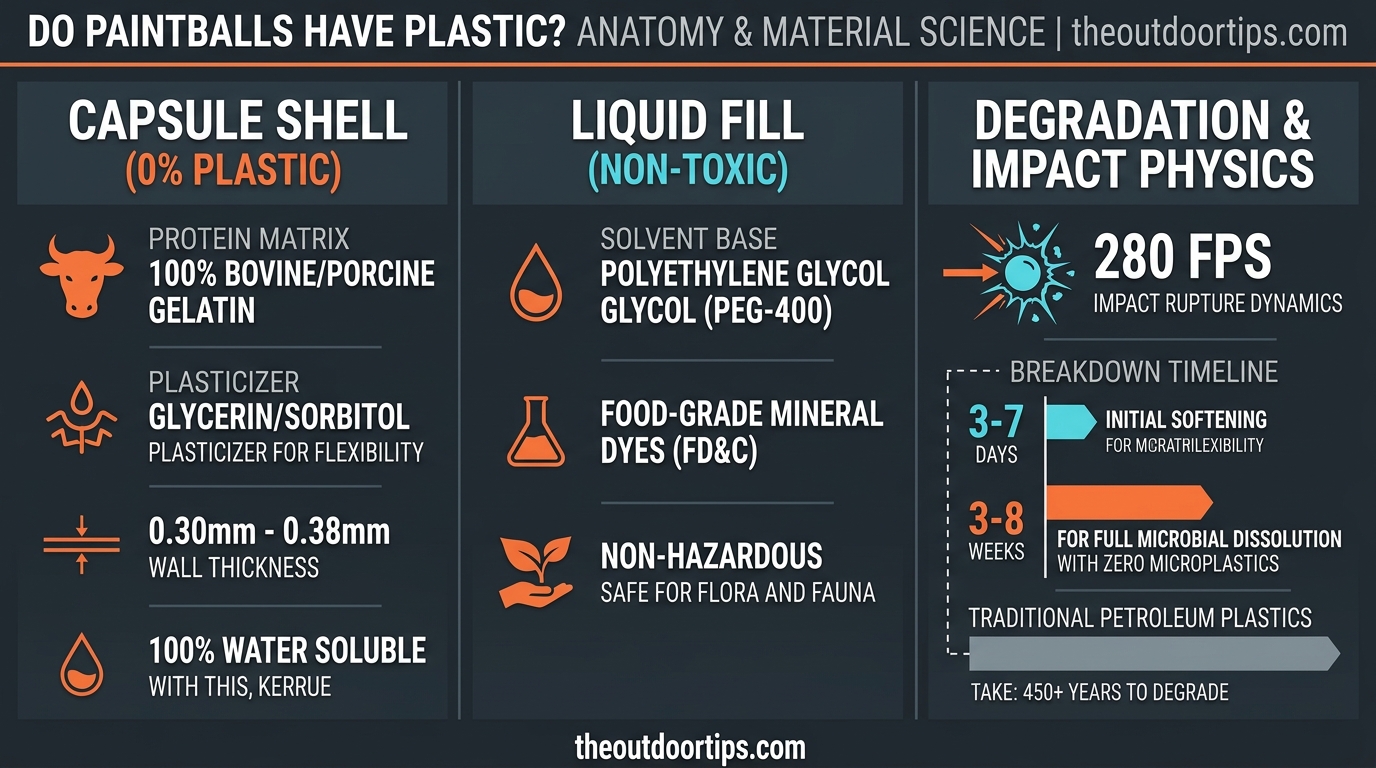
The definitive, scientific answer to do paintballs have plastic? is an unconditional no—standard commercial paintballs contain 0.0% petroleum plastic. The outer capsule shell is manufactured from 100% Pharmaceutical-Grade Gelatin (animal collagen) blended with food-grade glycerin plasticizers, while the bright liquid core consists of non-toxic Polyethylene Glycol (PEG-400), sorbitol, and mineral pigments (FD&C food dyes). Every component is 100% water-soluble (see our ballistics guides on whether paintballs are washable and how to store paintballs) and naturally biodegrades into harmless organic amino acids within 3 to 12 weeks of outdoor weather exposure.
Every weekend, millions of vibrant spherical capsules are fired across paintball parks, backyards, and woodland scenarios worldwide. When you pick up an unspent .68 caliber round, roll it between your fingers, or tap it against a hard table, it produces a firm, tactile click that feels remarkably like synthetic polyethylene or injection-molded acrylic. This tactile resemblance sparks an urgent question for environmentally conscious outdoor enthusiasts, property owners, and parents: do paintballs have plastic?
If millions of paintballs are shot into private forests, grass lawns, and public recreation areas every season, are players inadvertently blanketing the earth in tons of non-biodegradable microplastics? Are you contaminating local groundwater, poisoning grazing wildlife, or leaving persistent petrochemical debris on your property?
The definitive scientific answer is reassuring: recreational and tournament paintballs contain zero petroleum-derived plastic. The misconception stems from two factors: the glass-smooth, rigid feel of cured organic gelatin, and the chemical term plasticizer used in softgel manufacturing. In reality, a modern paintball is identical in chemical composition to a pharmaceutical vitamin E softgel capsule or an Advil liquid gel—completely organic, non-toxic, and 100% water-soluble.
In this technical 2026 material science guide, we conduct an exhaustive laboratory-grade breakdown of paintball shell anatomy, explore the rotary die manufacturing process, examine PEG-400 solvent chemistry, analyze pneumatic operating pressures and marker drivetrains, map out outdoor environmental biodegradation timelines, and detail the rare projectile exceptions you must know about.
1. The Shell Anatomy: How Pharmaceutical Gelatin Replaces Plastic
To understand why paintballs do not contain plastic, you must look at how they are manufactured. Paintballs were not invented in a munitions factory; they were born in the 1960s pharmaceutical industry using the rotary die encapsulation process pioneered by Robert Pauli Scherer in 1933 to produce sealed liquid medicine capsules.
The Gelatin Protein Matrix
The outer shell of a standard .68 caliber paintball consists of bovine (cow) or porcine (pig) gelatin. Gelatin is a natural protein derived from the thermal hydrolysis of collagen—the primary structural protein found in animal connective tissue, cartilage, and bone.
During manufacturing, purified gelatin granules are dissolved in heated demineralized water along with natural plasticizers. This liquid mixture is cast into two continuous, paper-thin gelatin ribbons. As these ribbons pass between two counter-rotating die cylinders, precision pockets form the hemispherical halves of the shell. Liquid fill is injected into the expanding cavity under pressure, and the dies pinch and heat-fuse the seam together in a continuous, airtight rotary seal.
The Source of the “Plasticizer” Linguistic Confusion
Why do some people claim paintballs have plastic? In chemical engineering, the term “plasticizer” refers to any non-volatile additive that increases the flexibility, plasticity, and workability of a material. In paintballs, manufacturers use food-grade glycerin (vegetable glycerol) or sorbitol as plasticizers to keep the gelatin shell pliable enough to feed through markers without shattering in the breech. Glycerin is a natural sugar alcohol derived from plant oils—it is not synthetic petroleum plastic. The word describes what the chemical does to the protein matrix, not what it is made of.
Shell Thickness & Formulation: Tournament Brittle vs. Recreational Rugged
The wall thickness of a paintball shell is engineered down to thousandths of an inch to match specific field requirements and marker operating pressures:
- Recreational / Field Grade Shells (0.35mm – 0.38mm / ~0.015 in): Contains higher gelatin concentration and calibrated glycerin ratios. Designed with a thicker, more durable wall that withstands rough handling in beginner mechanical blowback markers, high-capacity rental hoppers, and humid outdoor environments without rupturing in the barrel.
- Tournament / Ultra-Brittle Grade Shells (0.28mm – 0.31mm / ~0.011 in): Formulated with minimal moisture and thin gelatin cross-sections. Engineered to shatter on the softest fabric hit (such as a loose jersey or harness strap), eliminating bounces. However, these delicate shells require gentle low-pressure spool markers operating under 150 PSI to avoid breech breaks.
When selecting your gear setup, matching marker mechanics to shell brittleness is crucial. Learn more about marker operation in our detailed paintball marker guide for beginners and see entry-level recommendations in our roundup of the best paintball guns for beginners.
2. The Liquid Fill: Why Paintballs Don’t Contain Actual Paint
The term “paintball” is technically a historical misnomer. In the 1960s, the original Nelson Paint Company balls (the Nel-Spot 007 balls developed for foresters to mark trees and ranchers to tag cattle) contained real oil-based, lead-free exterior paint. Those early rounds smelled heavily of turpentine, stained permanently, and required toxic mineral spirits to wash off.
When recreational paintball exploded into a commercial sport in the 1980s, the chemical formulation underwent a complete revolution. Modern paintballs contain zero house paint, zero oil, and zero hydrocarbons. Instead, the bright liquid fill is a sophisticated, non-hazardous, water-soluble suspension:
| Ingredient | Percentage by Mass | Functional Role | Environmental & Biological Safety |
|---|---|---|---|
| Polyethylene Glycol (PEG-400) | 65% – 80% | Liquid carrier solvent; maintains viscosity across 30°F–100°F | 100% Non-toxic, water-soluble, biodegradable |
| Sorbitol / Glycerin | 10% – 15% | Humectant; prevents fill from drawing moisture from shell | Food-grade sweetener; completely organic |
| Calcium Carbonate / Starch | 5% – 12% | Opacifying agent; makes splatter thick, bright, and visible | Natural limestone mineral / organic corn starch |
| FD&C Food Dyes & Pigments | < 2% | Provides vivid neon coloration (Yellow 5, Red 40, Blue 1) | FDA-approved for food, cosmetics, and pharmaceuticals |
Because the primary carrier is Polyethylene Glycol (PEG-400), the fill dissolves effortlessly in water. When rain falls or you rinse your gear with a garden hose, the fill molecularly detaches from synthetic fabrics without harsh solvents. However, if bright food dyes soak into porous natural canvas or suede, the dyes can be stubborn. To understand how dyes interact with shoes and athletic fabrics, review our scientific testing on does paintball stain shoes and our recommendations on what to wear for paintball.
3. The Manufacturing Physics: Rotary Die Encapsulation & Bloom Strength
How do manufacturers transform animal collagen and vegetable glycerin into billions of uniform, perfectly spherical capsules that feed at 15 balls per second through a marker? Paintball production is one of the most demanding precision-chemistry manufacturing processes in the world.
Gelatin Bloom Strength & Elastic Modulus
The structural rigidity of a paintball shell is governed by its Bloom strength—a standard scientific measure of gel rigidity. Tested by pressing a standardized 0.5-inch diameter plunger 4 millimeters into a 6.67% gelatin solution at 10°C, commercial paintball gelatin typically measures between 150 and 220 Bloom.
A higher Bloom rating produces a stiffer, more brittle shell, while a lower Bloom rating produces a flexible, rubbery capsule. Tournament paint uses a high-Bloom formulation with reduced plasticizer to ensure that the moment a ball strikes a player at 280 FPS, the shell shatters instantly rather than flexing and bouncing off loose clothing.
The Rotary Encapsulation Wedge
During encapsulation, the two gelatin ribbons pass over precision-chilled stainless steel drums before meeting at the injection wedge. The brass wedge is heated precisely to 38°C to 42°C (100°F–108°F) to soften the gelatin ribbons. Positive displacement micro-pumps inject exactly 3.0 to 3.2 milliliters of liquid PEG fill into the cavity just as the die pockets meet.
The extreme pressure of the die teeth cuts the perimeter of the pocket while thermomechanically welding the two gelatin ribbons together along the equatorial seam. If the wedge temperature is 2 degrees too cold, the seam will fail to bond, leaking fill in the hopper; if it is 2 degrees too hot, the shell wall thins and tears.
Tumble Drying & Moisture Equilibrium
Freshly encapsulated paintballs leave the rotary press feeling soft and squishy, containing roughly 40% water. To attain the firm, smooth texture that players mistake for plastic, the paintballs are transferred into giant rotating tumble dryers bathed in warm, dehumidified air (70°F and 20% relative humidity).
After tumbling for several hours, the paintballs are spread onto curing trays in drying tunnels for 24 to 72 hours until the moisture content in the gelatin shell drops to an equilibrium level of 8% to 10%. At this exact moisture level, the gelatin proteins cross-link into a rigid, crystalline biopolymer with high tensile strength that holds its shape under spring tension in hoppers.
4. Drivetrain Ballistics & Operating Pressures: Protecting the Shell
Because paintballs are delicate organic gelatin spheres rather than solid plastic balls (like airsoft BBs), their structural survival inside a paintball gun depends directly on the pneumatic drivetrain and operating pressure of the marker.
Operating Pressure: 800 PSI Blowback vs. 135 PSI Low-Pressure Spools
When you pull the trigger on a paintball marker, pressurized gas transfers kinetic energy into the rear of the gelatin sphere to accelerate it from 0 to 280 FPS (191 mph) down a 14-inch barrel in approximately 5 milliseconds.
PNEUMATIC DRIVETRAIN IMPACT ON GELATIN SHELLS
1. High-Pressure Mechanical Blowback (800–850 PSI): Markers like the Tippmann Cronus, Tippmann 98, or Spyder operate on unregulated tank pressure (800–850 PSI). When the sear drops, a heavy steel hammer hits a poppet valve, releasing a sharp, violent burst of high-pressure gas. Because the initial shock is severe, these markers require rugged recreational paintballs with thick 0.38mm gelatin shells. If you load brittle tournament paint into an 800 PSI blowback, the pneumatic shock wave shatters the gelatin shell inside the breech (“breech blend”).
2. Low-Pressure Spool Valve (115–145 PSI): Modern tournament-level markers (such as the Planet Eclipse Emek 100, Etha 3M, or CS3) utilize an internal regulator to step tank pressure down to 135 PSI. Their drivetrain uses a softly accelerating spool bolt (like the Gamma Core). The bolt gently pushes the ball past the detent before releasing a voluminous, gentle plume of low-pressure gas. This gentle acceleration allows players to shoot razor-thin 0.29mm brittle tournament shells without cracking them in the marker.
Gas Thermodynamics: HPA vs. CO2 Shell Freezing
Another major reason paintballs behave inconsistently on the field comes down to the propellant gas used. When running on liquid carbon dioxide (CO2), rapid firing causes the liquid CO2 to vaporize rapidly inside the marker’s expansion chamber, absorbing massive amounts of heat. In rapid strings of fire, the marker’s valve temperature drops below 32°F (0°C).
When sub-freezing CO2 gas hits an organic gelatin shell, it causes thermal embrittlement. The gelatin loses its elasticity, becomes glass-brittle, and cracks instantly under centrifugal drag down the barrel. Conversely, High-Pressure Compressed Air (HPA) operates strictly as an ideal gas without liquid phase changes. HPA tanks deliver thermally stable, ambient-temperature gas that keeps gelatin shells supple and accurate. For complete details on gas dynamics and refills, explore our in-depth guides on CO2 vs compressed air HPA tanks, our interactive paintball tank shot calculator, and safety steps on how to refill a paintball tank.
Impact Kinetics: Gelatin Splatter vs. Solid Plastic Ricochet
Why did paintball adopt fragile gelatin rather than rigid plastic? The answer lies in impact physics and kinetic energy dissipation.
A standard .68 caliber paintball weighs approximately 3.2 grams (0.0032 kg) and is chronographed at 280 FPS (85.3 m/s). The kinetic energy carried downfield is:
If a paintball were made of rigid plastic, all 11.6 Joules of kinetic energy would be delivered into a tiny, concentrated surface area of your body—causing severe blunt trauma, deep lacerations, or broken bones. Because the shell is made of thin, brittle gelatin, the moment of impact creates hydrostatic pressure inside the liquid core. The shell ruptures instantly, venting the liquid radially and dissipating over 90% of the projectile’s kinetic energy into paint splatter rather than flesh trauma.
5. Environmental Biodegradation: What Happens to Paintballs Outdoors?
Because paintballs are completely plastic-free, they do not persist as microplastics in ecosystems. Once fired onto woodland floors or residential turf, paintballs undergo a rapid three-stage natural biodegradation cycle driven by weather and soil microorganisms:
Stage 1: Hydrolytic Dissolution (Hours to 7 Days)
When rain, morning dew, or lawn irrigation contacts the broken shell, the hydrophilic gelatin absorbs water molecules and softens. The liquid fill (PEG-400 and food dyes) dissolves rapidly into water runoff, soaking into the topsoil. Sunlight and UV radiation break down the food color pigments, causing the bright neon colors to fade within 48 to 72 hours.
Stage 2: Microbial Enzymatic Digestion (2 to 4 Weeks)
Once hydrated, the gelatin shell becomes a rich food source for common soil bacteria (such as Bacillus and Pseudomonas species) and indigenous fungi. These microorganisms secrete extracellular protease enzymes (specifically gelatinase) that cleave the collagen peptide bonds, breaking the protein matrix down into simple peptides and amino acids.
Stage 3: Full Mineralization (4 to 12 Weeks)
In moderate, temperate outdoor conditions with regular precipitation, the entire paintball shell and fill mineralize completely into carbon dioxide, water, and organic soil nitrogen. Unlike petrochemical plastics that fragment into microplastics lasting 450+ years, paintballs leave behind zero artificial synthetic residues.
Wildlife, Pet & Plant Toxicity
Are paintballs toxic to local wildlife or household pets? The ingredients (gelatin, glycerin, PEG-400, sorbitol, and FD&C food dyes) are classified as non-toxic and environmentally benign. They do not kill grass, harm flowerbeds, or poison deer, birds, or squirrels that encounter them in the woods.
While paintballs do not contain chemical poisons or plastics, dogs should never be allowed to consume dropped paintballs. Dogs are attracted to the sweet smell of glycerin and sorbitol and will vacuum up hundreds of unspent rounds off a lawn. Polyethylene Glycol (PEG-400) acts as an osmotic laxative in large doses, drawing water into the intestinal tract and causing severe vomiting, diarrhea, acute dehydration, and potentially life-threatening electrolyte imbalances (hypernatremia). If your dog ingests a large quantity of paintballs, contact your veterinarian immediately.
6. 5 Home Laboratory Tests to Verify Your Paintballs Have Zero Plastic
If you want to prove to skeptical neighbors, land managers, or environmental inspectors that your paintballs are 100% natural and contain zero plastic, you can conduct these five simple scientific tests in a home or field setting:
Test 1: The Warm Water Dissolution Test
Cut a paintball in half, empty the liquid fill, and place the outer shell in a glass of warm water (100°F–110°F). Because the shell is natural gelatin, it will swell within 2 minutes and dissolve completely into a clear liquid solution within 10 to 15 minutes. Synthetic petroleum plastic (polyethylene, PVC, or ABS) is insoluble in water and will float unchanged indefinitely.
Test 2: The Flame Ash Test (Protein vs. Petrochemical)
Hold a dried shell fragment with tweezers and expose it to a match or lighter flame. True gelatin chars slowly, smells distinctly like burnt hair or toasted marshmallows (characteristic of combusting organic keratin and collagen proteins), and crumbles into soft grey organic ash. Synthetic plastic melts quickly, drips noxious black soot, and releases a pungent acrid chemical smell.
Test 3: The Drop Test (Calibrated Elasticity)
Hold an intact paintball at chest height (approximately 5 to 6 feet above a smooth concrete floor) and drop it. A properly cured gelatin paintball will bounce 2 to 3 times without breaking. If you drop it from 8 to 10 feet, the hydrostatic pressure forces the gelatin seam to rupture, releasing a radial splash. Solid plastic balls (like airsoft BBs or Reballs) bounce violently without rupturing.
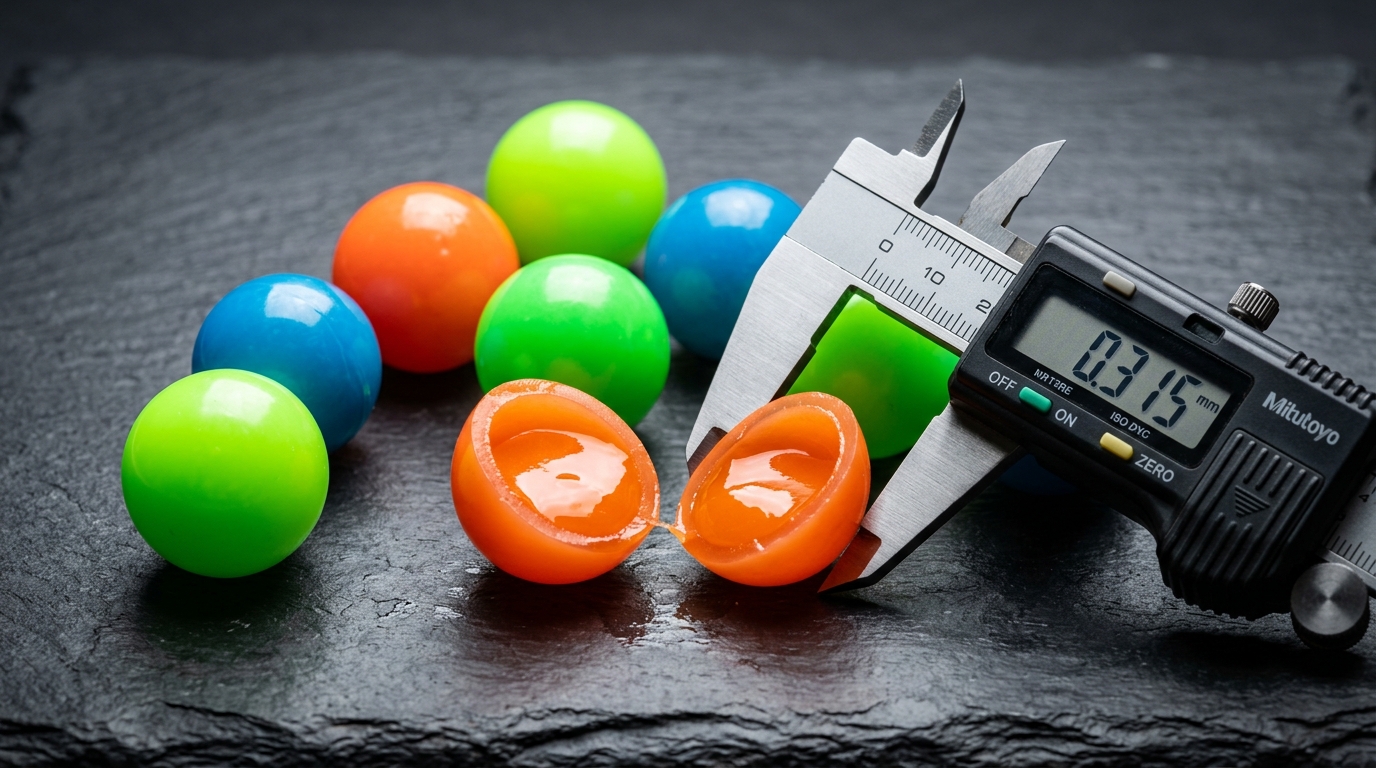
Test 4: Digital Micrometer Wall Measurement
Using a precision digital caliper or micrometer, measure the wall thickness of a bisected shell. Authentic pharmaceutical gelatin shells measure between 0.28mm and 0.38mm. Injection-molded plastic shells (such as less-lethal PepperBall projectiles) have rigid walls exceeding 0.75mm to 1.20mm to maintain structural integrity under high manufacturing mold pressures.
Test 5: The Soil Moisture Burial Test
Bury 5 spent shell fragments 1 inch beneath moist garden soil. Check them after 14 days. You will find that microbial activity and moisture have completely liquefied the gelatin fragments, leaving zero plastic flakes or synthetic polymers behind.
7. The Plastic Exceptions: When DO Projectiles in Paintball Contain Plastic?
While 99% of rounds shot at commercial recreational fields are 100% plastic-free gelatin balls, there are three specific projectile categories in the broader shooting sports community that contain synthetic plastics or polymers. Knowing the difference prevents confusion:
1. First Strike Rounds (FSR) – The Mag-Fed Finned Projectile
Contains Plastic Skirt
First Strike Rounds (FSR) are rifled, aerodynamic half-spherical projectiles used exclusively in specialized mag-fed sniper markers. While the front hemisphere is a standard gelatin paint shell, the rear rifled fin stabilization skirt is manufactured from injection-molded polystyrene (plastic). FSRs do not degrade like standard paintballs, and the plastic fin skirts will remain in the soil for years. For this reason, many commercial paintball parks strictly ban First Strike Rounds on environmental and velocity grounds.
2. Reusable Indoor Training Balls (“Reballs”)
100% Synthetic Polymer
Reballs are solid, seamless rubber balls manufactured from polyurethane or dense synthetic rubber. They contain zero liquid fill and are designed strictly for indoor target practice, speedball bunker drills, and marker testing where players can sweep them up and reuse them thousands of times. Reballs are never shot in outdoor recreational scenario play and must never be fired at commercial paintball fields.
3. PepperBalls & Less-Lethal Defense Rounds
Rigid Plastic Composite
Designed for law enforcement riot dispersal and home defense, PepperBalls are .68 caliber projectiles constructed from hard, ultrasonic-welded plastic or polycarbonate shells loaded with powdered capsaicin (OC/PAVA pepper powder). They are engineered to shatter upon striking concrete or human targets to disperse irritant clouds. These are defense munitions, not sporting paintballs, and are strictly prohibited in sporting paintball venues.
8. Material Science Comparison: Paintballs vs. Alternative Projectiles
To put the material composition and environmental sustainability of paintballs in clear perspective, review this side-by-side technical comparison across projectile types:
| Projectile Category | Shell / Body Material | Internal Core / Fill | Plastic Content | Outdoor Degradation Time | Impact Dynamics |
|---|---|---|---|---|---|
| Standard Paintball (.68) | 100% Bovine/Porcine Gelatin | PEG-400 + FD&C Food Dyes | 0.0% (Zero Plastic) | 3 to 8 Weeks | Hydrostatic rupture, 90% energy dump |
| Airsoft BB (6mm) | Acrylonitrile Butadiene Styrene (ABS) | Solid plastic sphere | 100% Petroleum Plastic | 450+ Years (Microplastics) | Rigid solid bounce / ricochet |
| First Strike Round (FSR) | Gelatin nose + Polystyrene fin | PEG-400 paint fill | ~35% (Plastic fin skirt) | Nose: weeks; Fin: 100+ years | Ruptures nose, fin survives |
| Reball Training Ball | Polyurethane / Synthetic Rubber | Solid elastic core | 100% Synthetic Polymer | Non-biodegradable (Reusable) | Elastic rebound, zero splatter |
| Less-Lethal PepperBall | Rigid ultrasonically welded polymer | Capsaicin (OC/PAVA powder) | 100% Rigid Plastic | Persistent plastic shards | Shatters on impact to disperse irritant |
9. Recommended Paintball Gear: Best Field-Tested Paint & Markers
Because paintballs are organic gelatin capsules sensitive to temperature, humidity, and marker operating pressures, shooting fresh, high-quality paint through a reliable marker prevents frustrating barrel breaks. Here are our top field-tested recommendations for fresh paintballs and gentle marker drivetrains:
Valken Infinity .68 Caliber
Engineered with a robust 0.36mm bovine gelatin shell and thick PEG-400 fill, Infinity resists humidity swelling and withstands violent mechanical blowback actions without barrel breaks.
Planet Eclipse Emek 100
Powered by the legendary Gamma Core spool drivetrain operating at just 135 PSI, its bolt gently cushions fragile gelatin shells into the breech before gas release, eliminating barrel breaks.
Planning a day on the field with a friend? Read our complete field logistics breakdown on can 2 people play paintball, check how much does paintball cost, and ensure you have high-capacity feeding support with our guide on whether you need a high-end hopper.
Interactive Paintball Ballistics & Field Calculators
To dial in your marker velocity, estimate paint budgets, match bore sizes, and prevent barrel breaks, explore our interactive suite of free paintball tools:
Match paint diameter with barrel inserts for ±2 FPS shot consistency.
Calibrate output pressure shims for mechanical vs spool markers.
Calculate kinetic energy impact and velocity limits at official field safety caps.
Calculate exact shot count based on air tank size (48ci vs 68ci) and operating pressure.
Verify tournament legality for NXL 10.2 BPS and local field firing rules.
Estimate paint consumption and case budget for recreational weekend games.
Check if your hopper can keep pace with fast semi-auto trigger pulls.
Evaluate humidity and thermal lens protection to keep your vision crystal-clear.
10. Frequently Asked Questions
Do paintballs contain plastic?
No. Standard recreational and tournament paintballs contain 0.0% plastic. The capsule shell is made from 100% natural, biodegradable gelatin (collagen) and food-grade glycerin, while the liquid core consists of non-toxic Polyethylene Glycol (PEG-400), sorbitol, and mineral food colorants. Every component breaks down completely in nature.
Are paintballs biodegradable?
Yes. Under normal outdoor weather conditions with rainfall and natural soil bacteria, paintballs dissolve and fully biodegrade within 3 to 12 weeks. Rain dissolves the water-soluble PEG fill, and soil microbes secrete enzymes that consume the protein-based gelatin shell, leaving zero microplastics behind.
What happens if a dog eats paintballs?
While paintballs do not contain toxic chemicals or plastics, dogs that ingest large quantities can suffer severe illness. The primary ingredient, Polyethylene Glycol (PEG-400), acts as an osmotic laxative, drawing fluid into the dog’s intestines and causing acute dehydration, vomiting, diarrhea, and severe electrolyte imbalances (salt poisoning). Seek immediate veterinary attention if your pet eats paintballs.
Do paintballs leave permanent stains or harm plants?
Paintballs will not harm lawn grass, trees, or garden plants; the fill washes into the soil as harmless organic compounds. On clothing and gear, paintball fill washes clean from synthetic fabrics (nylon, polyester, cleats) with cold water. However, if bright food dye sits on untreated canvas or porous leather for extended periods, it can leave stubborn marks that require detergent pre-treatment.
Why do paintballs feel like plastic if they are made of gelatin?
Cured gelatin is a dense structural biopolymer. When dried down to approximately 8% to 10% moisture content in a climate-controlled drying tunnel, gelatin forms a rigid, glassy shell with high tensile strength that feels smooth, hard, and plastic-like to human fingertips. However, as soon as water touches the shell, it immediately rehydrates and softens.
Can you shoot paintballs in the rain?
Yes, but you must keep unspent paintballs dry inside sealed pods and hoppers. Because the gelatin shell is water-soluble, prolonged exposure to rain drops or high humidity makes paintballs swell, stick together in the hopper, and break inside the barrel. Always use a rain lid on your hopper during wet weather games.