In our misty dawn bank sessions along Wahiawā’s steep red-clay points and afternoon kayak drifts beneath flooded albizia branches on Oahu, we have proven why the best catfish fishing spots in hawaii operate unlike any mainland river system in America. First, understand the essential regional biology: Hawaii has zero native freshwater catfish. Every trophy Channel Catfish swimming in the islands is a non-native gamefish introduced and managed by the Hawaii Department of Land and Natural Resources (DLNR)—anchored overwhelmingly inside Oahu’s 300-acre Lake Wilson (Wahiawā Reservoir) alongside world-famous Peacock Bass (tucunare), Largemouth Bass, and Red Devil cichlids.
Beyond Lake Wilson’s 43-pound-state-record Channel Catfish potential and occasional DLNR draw-permit openings at Nuʻuanu Reservoir No. 4, the remaining hawaii catfishing waters on Oahu, Kauai, and Hawaii Island center around smaller nocturnal Chinese Catfish (Clarias fuscus, known locally across the islands as puntat) introduced back in the 1800s. Knowing exactly which species inhabits each island basin—and obeying strict DLNR HAR 13-62 single-hook, PFD, and weekday-vs-weekend pole limits—makes every cast count when chasing catfish in hawaii.
✔ 2026 HAR 13-62 Rules & Rigs Verified
Hawaii Catfishing At a Glance: Top Waters & Winning Rigs
- #1 Trophy Waterway: Lake Wilson (Wahiawa PFA, Oahu) — Main Basin & South Fork red-clay drop-offs (15–45 ft; HI state record 43 lb 13 oz).
- Peak Bite Window: Year-round warm tropical water (72–82°F); prime surges hit during Kona rain inflows & low-light dusk shifts.
- 2026 DLNR Bag & Rod Rules: Wahiawa PFA limits Channel Catfish to 3 per person/day; 1 line weekends/holidays, max 2 lines weekdays (1 hook/lure per line; PFD required).
- Primary Winning Setup: Ugly Stik Catfish Special 7’6″ + Abu Garcia C3 6500 / Penn Battle IV + 50 lb Braid + Single-Hook Santee Cooper Rig.
Best Catfish Fishing Spots in Hawaii: 2026 Island Access & Biology Matrix
Because Hawaii splits sharply between DLNR-stocked Channel Catfish reservoirs and lowland marsh waterways holding smaller puntat, match your target species, permit requirements, and terminal weights against all eight island sectors below.
| Lake / Stream Section | Primary Target Species | Key Structure / Holding Zone | Best Legal Bait & Rig | Public Ramp / GPS Map |
|---|---|---|---|---|
| 1. Lake Wilson (Wahiawa PFA) — South Fork & Main Basin (Oahu) | Channel Catfish (5-43 lb HI Record) | 20-48 ft red-clay ledges & albizia timber | 1.5 oz Santee peg float w/ liver/shrimp | 📍 Map & Ramp (21.4980° N, 158.0270° W) |
| 2. Lake Wilson — North Fork & Kaukonahua Inflow (Oahu) | Channel Catfish (3-25 lb), Peacock Bass (C&R) | 10-26 ft mudline creek bends & gulches | 1 oz egg slip-sinker w/ hotdog/chicken | 📍 Map & Ramp (21.5090° N, 158.0060° W) |
| 3. Nuuanu Reservoir No. 4 (Oahu — DLNR Draw Permit Only) | Channel Catfish (4-18 lb, stocked) | 12-30 ft upper-valley clay banks | 1 oz Carolina rig w/ mesh liver/dough | 📍 Map & Ramp (21.3530° N, 157.8130° W) |
| 4. Wailua River & Reservoir Basin (Kauai) | Chinese Catfish (Puntat), stray Channel Cat | 6-16 ft slow tidal/freshwater bends | 1/2 oz split shot w/ worms & peeled shrimp | 📍 Map & Ramp (22.0450° N, 159.3540° W) |
| 5. Waita Reservoir (Koloa, Kauai — Guided Access Only) | Channel Catfish (4-16 lb), Peacock Bass | 10-24 ft plantation dam & brush edges | 1.5 oz slip-sinker w/ shrimp & cut bait | 📍 Map & Ramp (21.9080° N, 159.4640° W) |
| 6. Kawainui Marsh & Windward Canals (Kailua, Oahu) | Chinese Catfish (Puntat, Clarias fuscus) | 3-8 ft marsh drainage ditches & reeds | Light bobber/bottom rig w/ earthworms | 📍 Map & Ramp (21.3910° N, 157.7520° W) |
| 7. Waiakea Pond & Wailoa River Basin (Hilo, Hawaii Island) | Chinese Catfish (Puntat), Mullet & Tilapia | 4-12 ft spring-fed rockwalls & park bridges | 1/2 oz sliding lead w/ shrimp & bread | 📍 Map & Ramp (19.7190° N, 155.0760° W) |
| 8. Waimea River Lower Pools (Kauai) | Chinese Catfish (Puntat) & Estuary Species | 5-14 ft shaded irrigation pools & bends | Light 1/2-1 oz Carolina rig w/ worms | 📍 Map & Ramp (21.9580° N, 159.6690° W) |
1. Lake Wilson (Wahiawā Reservoir): Wahiawā Freshwater SRA & South Fork (Oahu)
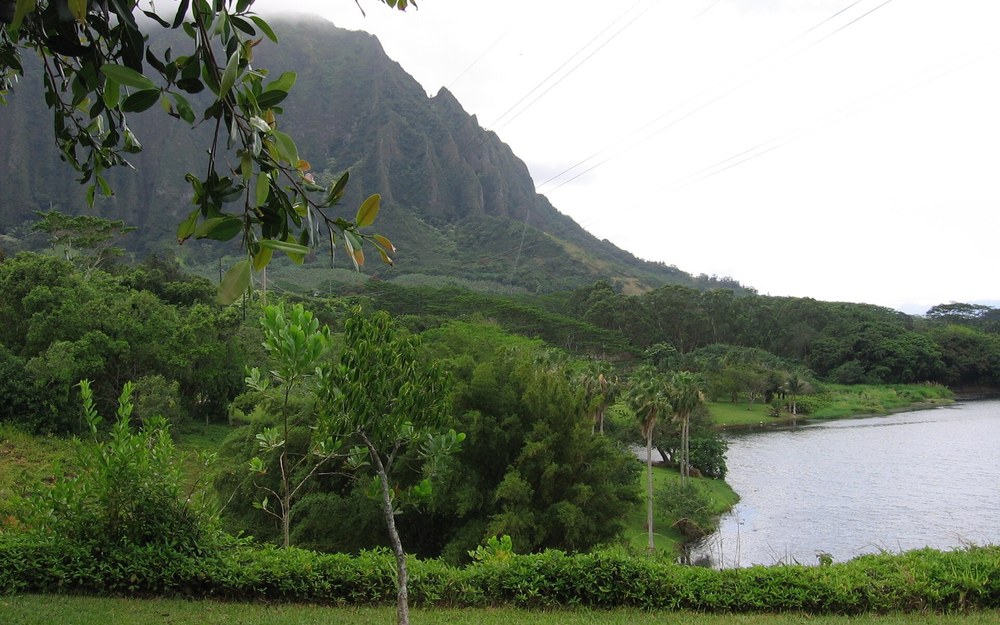
📍 Wahiawa Freshwater State Recreation Area, Oahu HI (GPS: 21.4980° N, 158.0270° W)
Spot Water & Access Specs
- Target Species: Channel Catfish (5-43+ lb HI Record), Peacock Bass & Largemouth (Strict C&R)
- Biological Status: Non-native Channel Catfish stocked & managed by Hawaii DLNR DAR
- Productive Depth: 18 to 48 ft flooded canyon walls, submerged red-clay points & timber
- 2026 DLNR Limit: Max 3 Channel Catfish/day; 1 line weekends/holidays, 2 lines weekdays
- Top Local Baits: Chicken liver in spawn mesh, raw shrimp, garlic hotdogs, bread/dough
- Public Launch: Wahiawa Freshwater State Recreation Area concrete ramp (U.S. PFD required)
Angler Field Log: Anchoring off a sharp 28-foot red-clay point in the South Fork arm thirty minutes before dusk on a quiet Wednesday evening (two weekday lines permitted under HAR 13-62), we lifted raw shrimp six inches off submerged albizia brush on 1.5-ounce Santee peg floats. Just after sunset, a thick 19-pound Channel Catfish bulldozed straight toward deep timber before sliding into our dip net.
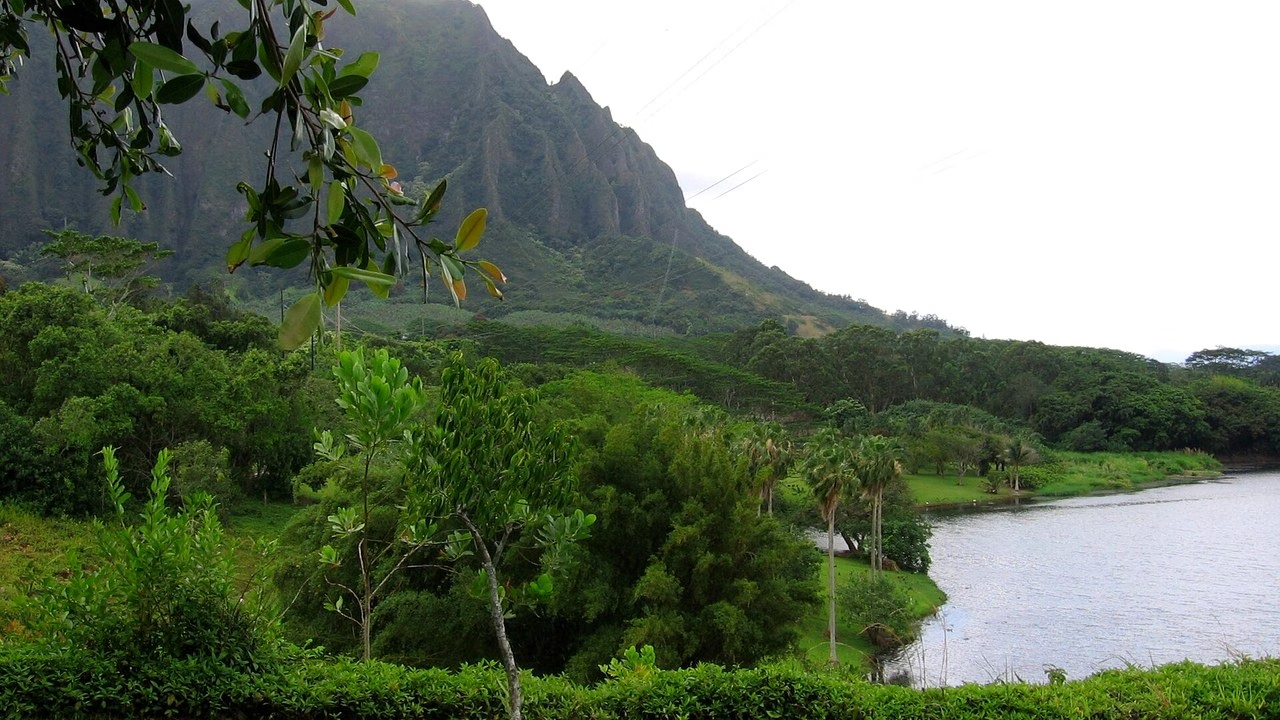
Cradled inside the central Wahiawā plateau between Oahu’s Waianae and Koʻolau mountain ranges, 300-acre Lake Wilson (officially the Wahiawā Public Fishing Area) is ground zero for genuine trophy hawaii catfishing. Originally impounded for agricultural irrigation in 1906, Lake Wilson’s warm, plankton-rich waters were stocked decades ago with non-native Channel Catfish alongside South American Peacock Bass (tucunare), Largemouth Bass, and oscars—producing Hawaii’s massive 43-pound, 13-ounce state-record Channel Catfish and regular 15- to 30-pounders every single season.
Working the South Fork and main reservoir basin out of the Wahiawā Freshwater State Recreation Area ramp requires reading steep underwater canyon topography rather than flat shoreline weeds. Because water levels fluctuate up to thirty feet between wet winter trade-wind months and dry late summers, flooded gulch points and drowned albizia tree lines shift depth constantly. Scan 18- to 42-foot channel bends for submerged timber edges where hungry Channels cruise away from daytime sun.
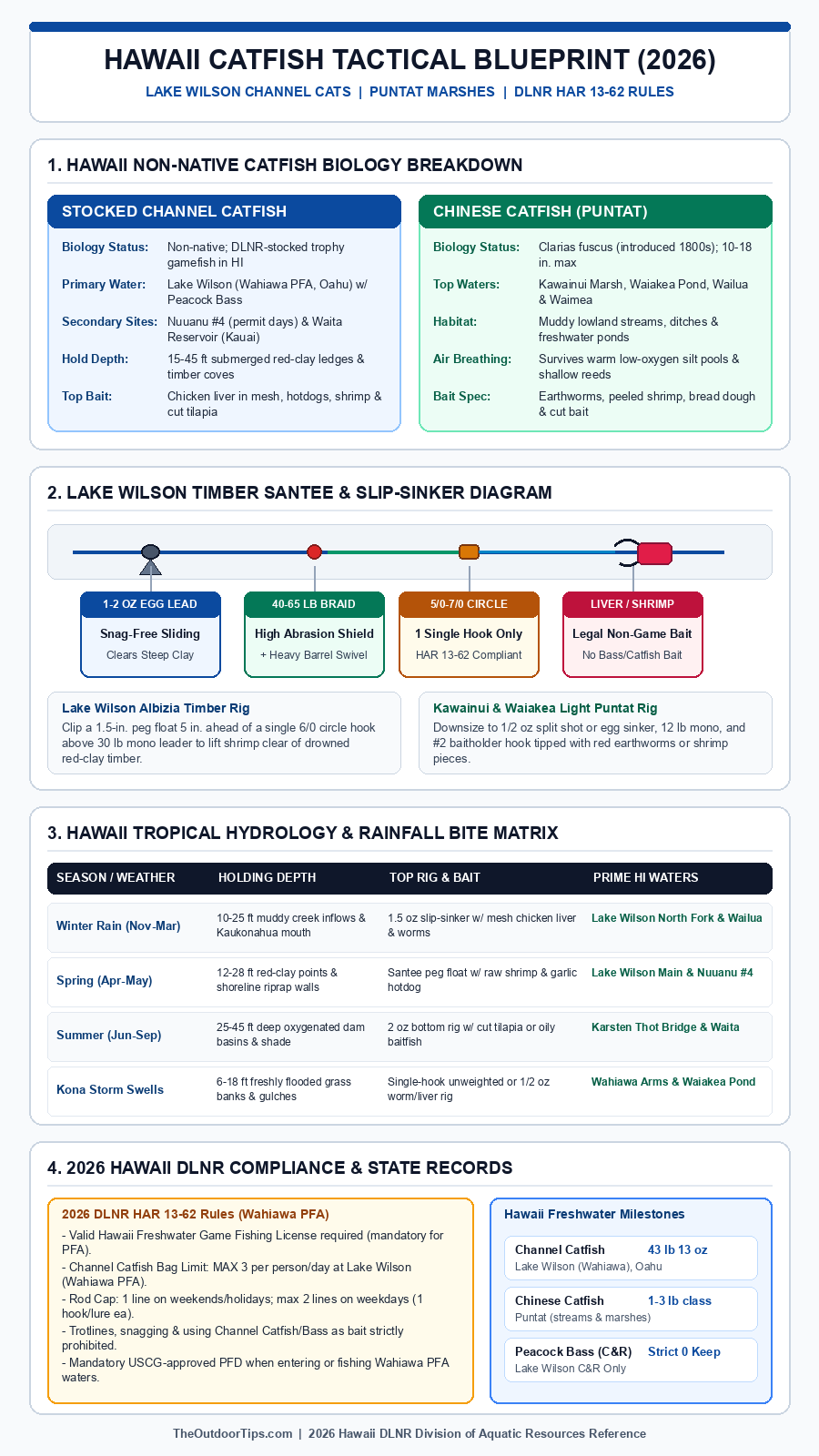
Under Hawaii Administrative Rules (HAR 13-62), every line on Lake Wilson is strictly restricted to a single baited hook (or single lure)—making multi-hook chicken rigs or trotlines completely illegal. Rig a snag-resistant Santee Cooper peg-float setup: thread a 1.5-ounce egg sinker onto 50-pound braid above a barrel swivel, add an 18-inch 30-pound monofilament leader, clip a small 1.5-inch float five inches behind a single 6/0 inline circle hook, and wrap fresh chicken liver or peeled raw shrimp in elastic spawn netting.
Understanding how Lake Wilson’s resident Peacock Bass (tucunare), Largemouth Bass, and Red Devil cichlids interact with stocked Channel Catfish saves both bait and wasted hooks. During bright midday hours, aggressive Peacock Bass patrol shallow 3- to 10-foot red-clay points herding schools of threadfin shad and mosquito fish, often slamming flashy lures or live baits before a bottom-oriented catfish ever smells them. To isolate Channel Catfish cleanly without constantly unhooking incidental cichlids or sharp-billed softshell turtles, slide deeper down onto 20- to 35-foot main-basin drop-offs and stick strictly to scent-heavy stationary bottom baits—especially chicken liver wrapped tightly inside fine spawn mesh or tough garlic-infused raw shrimp tail.
Respect Wahiawā PFA’s strict enforcement rules on every trip: carry a valid Hawaii Freshwater Game Fishing License, wear or carry a USCG-approved PFD at all times inside the PFA boundary, obey the 1-line cap on weekends/holidays (up to 2 lines weekdays), release all Peacock and Largemouth Bass immediately unharmed, and never use captured Channel Catfish or bass as cut bait. Arrive early at the Wahiawā Freshwater State Recreation Area ramp off Lakeview Circle during posted park gate hours so trailer parking stays hassle-free.
2. Lake Wilson: North Fork & Kaukonahua Stream Inflow Arm (Oahu)
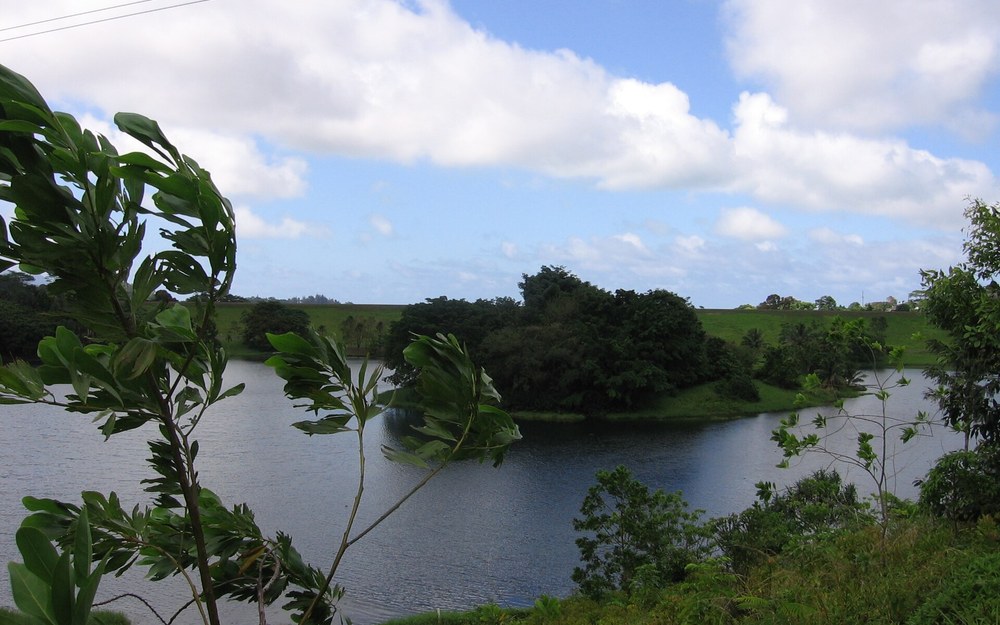
📍 Lake Wilson Wahiawa North Fork, Oahu HI (GPS: 21.5090° N, 158.0060° W)
Spot Water & Access Specs
- Target Species: Channel Catfish (3-25 lb), Red Devil Cichlids, Peacock Bass (C&R)
- Water Profile: Narrower shaded mountain gorge receiving cool Koʻolau stream runoff
- Prime Trigger: Mudlines and rising water following heavy Koʻolau mountain trade showers
- Productive Depth: 10 to 26 ft bends, undercut clay banks & fallen eucalyptus logjams
- Top Local Baits: Earthworms, garlic-marinated chicken breast, shrimp & stink dough
- Kayak & Bank: Launch kayak/skiff from Wahiawa SRA or fish public bridge pullouts carefully
Angler Field Log: Following an overnight Koʻolau rainstorm that pushed fresh chocolate runoff down Kaukonahua Stream into Lake Wilson’s upper North Fork, we eased a kayak along the sharp mudline transition in 14 feet of water. Simple 1-ounce sliding egg rigs tipped with garlic-soaked shrimp produced five solid 6- to 14-pound Channel Catfish in under two hours.
While giant boats concentrate around Lake Wilson’s wide lower basin near Wilikina Drive, the narrow, jungle-draped North Fork arm fed by Kaukonahua Stream delivers consistent daytime action whenever trade-wind rain squalls sweep across the Koʻolau summits. Cool, nutrient-loaded runoff washes earthworms, freshwater prawns, and terrestrial insects straight down the mountain valley, creating distinct muddy current seams where hungry Channel Catfish stack aggressively in shallower water.
Because towering eucalyptus and albizia canopies shade steep canyon walls along the upper North Fork, water temperatures stay slightly cooler and ambient light drops rapidly—allowing mid-sized five- to fifteen-pound Channels to prowl 10- to 20-foot bends well past mid-morning. Focus casts tightly along outside river bends and brushy deadfalls where silt runoff slows down into deeper slack pockets.
Downsize lead weights here compared to the deep main basin: a 3/4-ounce to 1-ounce sliding egg sinker on 30-pound braid keeps baits stationary in mild inflow currents without burying deeply into soft silt. Keep hooks strictly legal under HAR 13-62 rules (one single 4/0–6/0 circle or baitholder hook per line) and pack sturdy pliers for occasional Red Devil or armored suckermouth catfish bycatch.
Always watch upstream mountain weather carefully before kayaking deep up the Kaukonahua arm: intense Koʻolau cloudbursts can raise upper tributary water levels and push floating logs downstream rapidly within an hour.
3. Nuʻuanu Reservoir No. 4 (Oahu — DLNR Draw Permit Only)
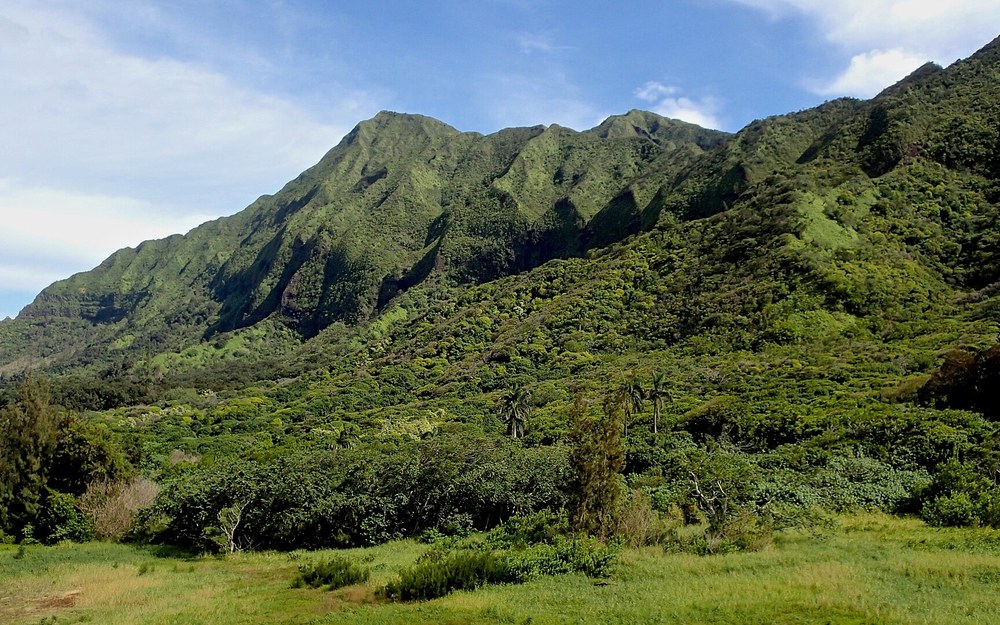
📍 Nuuanu Reservoir No 4, Honolulu HI (GPS: 21.3530° N, 157.8130° W)
Spot Water & Access Specs
- Target Species: Stocked Channel Catfish (4-18+ lb, pure single-species catfish focus)
- Access Rule: STRICTLY CLOSED except during official DLNR DAR scheduled permit-draw dates
- Water Profile: Cool 700-ft elevation rainforest reservoir operated by Board of Water Supply
- Prime Structure: Dam embankment riprap, gentle clay shoreline shelves (10-28 ft)
- Permit Rules: Valid HI Freshwater License + awarded DLNR Nuuanu draw permit required
- Top Local Baits: Chicken liver, commercial punch/dip baits, peeled shrimp & cut bait
Angler Field Log: During an official DLNR scheduled weekend draw opening at Nuuanu Reservoir No. 4, shoreline anglers spaced cleanly along the riprap bank easily reached 18-foot gravel drops using 1-ounce Carolina rigs loaded with mesh-wrapped chicken liver—landing limit catches of fat, clean-tasting 5- to 12-pound Channel Catfish in crisp mountain air.
Tucked high inside lush misty rainforest just minutes above downtown Honolulu off Pali Highway, Nuʻuanu Reservoir No. 4 operates as Oahu’s most exclusive regulated freshwater Channel Catfish fishery. Owned by the Honolulu Board of Water Supply and managed periodically for angling by the Hawaii DLNR Division of Aquatic Resources (DAR), this cool upland basin is stocked specifically with non-native Channel Catfish rather than aggressive bass—making it pure bank-fishing heaven on scheduled open days.
Crucial Legal Warning: Unlike Lake Wilson, which remains open year-round under PFA rules, Nuʻuanu Reservoir No. 4 is strictly off-limits to public entry and fishing except during official DLNR DAR permitted fishing windows (typically announced via online lottery/draw permits when water levels and maintenance schedules allow). Never hop watershed fences or trespass outside official permit dates.
When you draw an active DLNR weekend permit slot, travel light for comfortable shoreline walking along the earthen dam bank. Standard 7-foot medium-heavy spinning rods spooled with 20- to 30-pound braid, 1-ounce sliding egg sinkers, and single 4/0–5/0 circle hooks cast easily into productive 12- to 24-foot feeding zones where stocked Channels patrol for bait.
Because Nuʻuanu water sits noticeably cooler and cleaner than warm lowland irrigation ditches, fish caught during open permit seasons make top-grade table fare within posted DLNR draw bag limits. Monitor the official Hawaii DLNR Aquatic Resources website each spring and autumn for upcoming Nuʻuanu permit application dates, and bring biodegradable trash bags plus non-lead sinker alternatives whenever possible to protect Honolulu’s municipal drinking-water catchment basin.
4. Wailua River & Wailua Reservoir Basin (Kauai County)
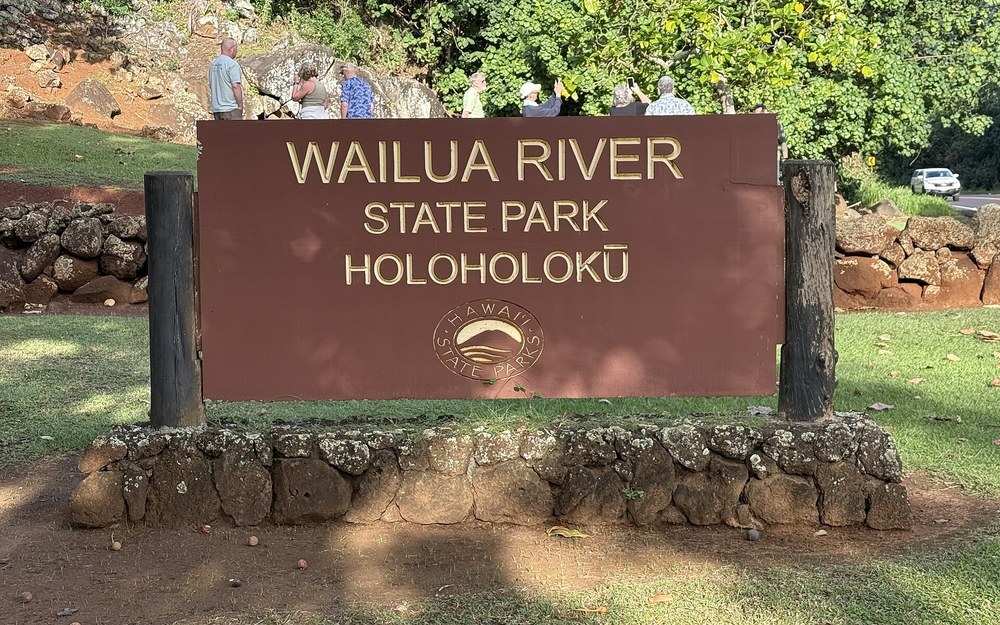
📍 Wailua River Marina Boat Ramp, Kapaa HI (GPS: 22.0450° N, 159.3540° W)
Spot Water & Access Specs
- Target Species: Chinese Catfish (Puntat / Clarias fuscus, 1-3 lb), rare stray Channel Catfish
- Water Profile: Only fully navigable freshwater river in Hawaii; tidal mouth to lush upper forks
- Prime Structure: Muddy hau-tree bank undercuts, tributary creek mouths & slow bends
- Top Local Baits: Red earthworms, small peeled shrimp chunks, bread dough, chicken bits
- Public Launch: Wailua River Marina / Wailua State Park boat & kayak ramp off Kuamoo Rd
- Access Note: Check private boundary lines carefully around adjacent plantation reservoirs
Angler Field Log: Paddling quietly upriver above the Wailua Marina landing just before dusk to stay clear of daytime Fern Grotto tour boats, we dropped 1/2-ounce split-shot worm rigs beneath overhanging hau branches in 7 feet of stained backwater—pulling steady nocturnal bites from slick bronze-black puntat alongside chunky tilapia.
Celebrated as Hawaii’s only truly navigable freshwater river, Kauai’s lush Wailua River winds cleanly out of Mount Waiʻaleʻale past historic plantation ditches and the Fern Grotto before meeting the Pacific near Kapaʻa. While Kauai boasts several historic upland sugar-plantation reservoirs, most sit behind private agricultural gates—making the public lower and middle Wailua River forks the island’s most accessible public water for targeting introduced Chinese Catfish (puntat) and rare stray Channel Catfish washed downstream from upland ditches.
Skip the busy mid-day kayak traffic around the lower marina bridge and paddle or motor slowly above the North and South Fork split during peaceful late afternoon or evening hours. Nocturnal puntat tuck tightly underneath tangled hau tree root mats and muddy creek mouths in four to twelve feet of slow-moving water, emerging after sunset to scavenge worms, freshwater shrimp, and organic drift.
Because puntat rarely exceed 14 to 18 inches and fight scrappily in tight brush, leave heavy 80-pound mainland gear at home. A nimble 6-foot-6 medium spinning setup with 12-pound monofilament or 15-pound braid, 1/2-ounce sliding sinker, and a sharp #2 or 1/0 baitholder hook dressed with fresh earthworms or small shrimp chunks delivers crisp bite detection without snagging endlessly in sunken branches.
Respect Hawaii’s unique island aquatic regulations: never release aquarium fish or transport live freshwater species between Kauai’s isolated drainages, and double-check public state park parking signage before staying past dark at Wailua Marina.
5. Waita Reservoir & Koloa Irrigation System (Kauai County — Guided / Permitted Access)
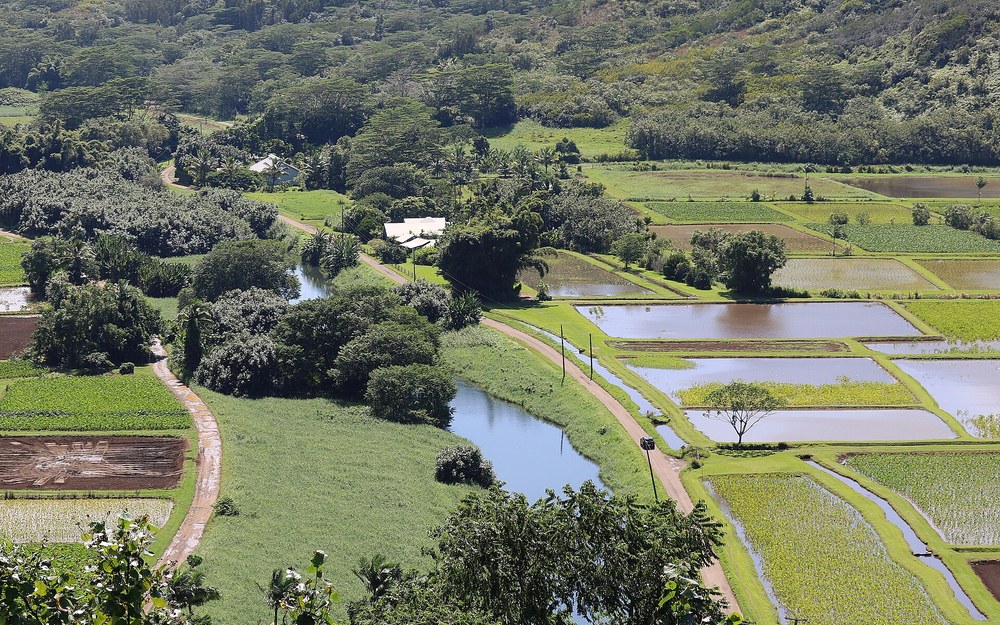
📍 Waita Reservoir, Koloa HI (GPS: 21.9080° N, 159.4640° W)
Spot Water & Access Specs
- Target Species: Stocked Channel Catfish (4-16+ lb), Peacock Bass, Largemouth Bass
- Size & Status: 424-acre historic sugar reservoir; PRIVATE property (authorized guide/permit only)
- Prime Structure: Red-dirt shoreline points, flooded brush shelves & intake ditch mouths
- Top Local Baits: Raw shrimp, cut tilapia/baitfish, chicken breast strips on slip rigs
- Booking Rule: NO DIY public bank or boat entry; book licensed Kauai freshwater outfitters
- Species Tip: Great option for Kauai visitors seeking mainland-style Channel Catfish
Angler Field Log: Working across Waita’s red-clay points with an authorized local Kauai guide after morning Peacock Bass topwater action slowed down under bright trade winds, switching over to 1.5-ounce Santee rigs baited with raw shrimp in 16 feet of stained water immediately produced steady 5- to 11-pound Channel Catfish.
Spreading across 424 acres beneath the green ridges of southern Kauai near Kōloa, Waita Reservoir stands as the largest inland freshwater lake in the entire state of Hawaii—even larger than Oahu’s Lake Wilson. Originally built in 1906 to irrigate sugarcane fields, Waita received early stockings of Largemouth Bass, Peacock Bass, and non-native Channel Catfish that still thrive across its warm, food-rich red-clay coves today.
Mandatory Access Disclosure: Unlike Wahiawā PFA on Oahu, Waita Reservoir sits entirely on private agricultural land owned by Grove Farm / Kōloa estates and is closed to unpermitted DIY public bank or kayak access. Visiting anglers wishing to fish Waita legitimately must book a trip through an authorized licensed Kauai freshwater fishing guide holding formal landowner access agreements.
Once on the water with a permitted boat, Waita fishes remarkably like a miniature southern mainland farm lake. Channel Catfish cruise 12- to 24-foot main-basin points, dam intake walls, and submerged brush lines—responding eagerly to simple 1- to 1.5-ounce sliding egg sinkers, 20-pound fluorocarbon leaders, and 4/0 circle hooks loaded with peeled shrimp or cut baitfish. During mid-afternoon trade-wind gusts that push surface chop against the earthen dam face, drifting along the downwind mudline concentrates suspended forage and pulls double-digit Channel Catfish up into shallow feeding range.
Ask your outfitter ahead of time whether catch-and-release applies to Waita’s Channel Catfish and bass populations so you pack appropriate barbless or circle terminal hooks that minimize deep-hooking mortality. Most Kauai freshwater guides also supply tournament-grade rods, reels, and iced bait, letting visiting travelers target Hawaii catfish without hauling eight-foot casting rods through airport baggage claim.
6. Kawainui Marsh & Windward Oahu Canals (Kailua, Oahu — Chinese Catfish)
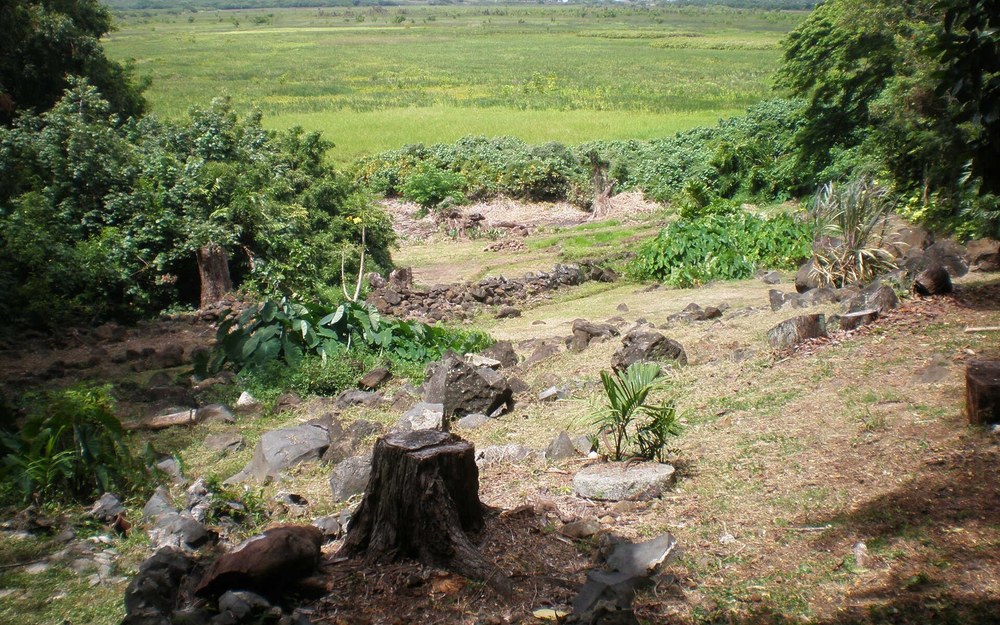
📍 Kawainui Marsh Trail, Kailua HI (GPS: 21.3910° N, 157.7520° W)
Spot Water & Access Specs
- Target Species: Chinese Catfish (Puntat / Clarias fuscus), Tilapia, Armored Catfish
- Habitat Profile: Hawaii’s largest freshwater wetland (~830 acres) bordered by drainage canals
- Biological Edge: Air-breathing Clarias catfish thrive in warm, muddy, low-oxygen reed pockets
- Top Local Baits: Red earthworms, small shrimp chunks, bread balls, chicken bits
- Access Points: Kawainui Marsh levee trailhead & Oneawa Channel public access points
- Tackle Spec: Light 10-15 lb spinning rig, #2 baitholder hook, 1/2 oz split shot or float
Angler Field Log: Casting just along the deeper outside bend of the Kawainui drainage canal right as Kailua dusk cooled the water surface, a simple #2 hook baited with half a raw shrimp weighted beneath a 1/2-ounce egg sinker drew quick, aggressive runs from 12- to 15-inch puntat hiding tight to muddy reed margins.
Stretching across 830 lush acres behind Kailua Beach on Windward Oahu, Kawainui Marsh represents the largest remaining freshwater wetland in the Hawaiian Islands. While visitors mainly jog the paved levee path admiring Koʻolau mountain views, local Windward bank anglers quietly target the marsh’s perimeter drainage canals and slow tributary ditches for Chinese Catfish (Clarias fuscus / puntat)—a hardy, air-breathing catfish species introduced from Asia during the late nineteenth century.
Unlike open-water Channel Catfish that demand deep oxygenated reservoirs, puntat possess specialized labyrinth breathing organs allowing them to gulp atmospheric oxygen and thrive inside warm, mud-bottomed marsh channels, taro ditches, and slow lowland canals. During twilight and rainy overcast afternoons, schools prowl three- to eight-foot canal bends searching for prawns, worms, and small tilapia.
Keep your tackle compact and nimble along Kawainui’s grassy banks: a light 6-foot-6 spinning rod paired with 12-pound monofilament, a 1/2-ounce split shot or small sliding sinker, and a single #2 or 1/0 hook keeps baits hovering right outside tangled reed mats. Always handle puntat carefully with heavy cloth or fish grippers—just like mainland bullheads, their sharp pectoral spines pack a nasty sting if grabbed carelessly.
Note that Kawainui is a protected wetland sanctuary: stick strictly to legal public levee/canal shorelines, pack out every scrap of tangled monofilament so endangered Hawaiian waterbirds never get snared, and practice clean catch-and-release in urban runoff canals.
7. Waiakea Pond & Wailoa River Basin (Hilo, Hawaii Island)
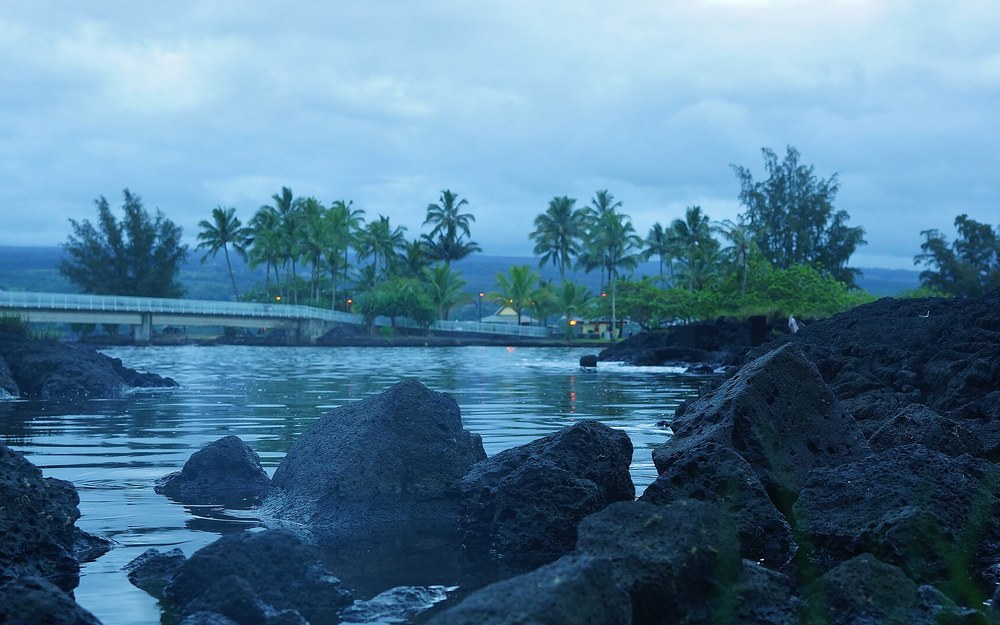
📍 Wailoa River State Recreation Area, Hilo HI (GPS: 19.7190° N, 155.0760° W)
Spot Water & Access Specs
- Target Species: Chinese Catfish (Puntat), Tilapia, Mullet, Coastal Jacks (ulua/papio)
- Water Profile: 24-acre spring-fed freshwater/brackish pond right inside Hilo town
- Prime Structure: Lava-rock seawalls, shaded park bridge pilings, freshwater spring vents
- Top Local Baits: Peeled shrimp, earthworms, bread dough, small squid strips
- Public Access: Wailoa River State Recreation Area grassy banks & paved parking lots
- Gear Note: Standard Hawaii saltwater/estuary awareness at lower Wailoa bridge mouth
Angler Field Log: Working the shaded lava-rock corners near Waiakea Pond’s freshwater spring inlets during a quiet Hilo evening, light 12-pound shore rigs baited with fresh shrimp chunks produced steady bites from stout 14-inch puntat before small brackish papio started chasing baitfish near the Wailoa outlet.
On the rainy windward coast of Hawaii Island right inside downtown Hilo, Waiakea Pond and the adjoining Wailoa River State Recreation Area give Big Island shore anglers effortless park-and-cast access without needing a trailered boat or private landowner pass. Fed continuously by cool underground volcanic springs mixing gently with Hilo Bay tidal inflow, Waiakea’s calm 24-acre basin sustains healthy populations of Chinese Catfish (puntat) alongside abundant tilapia, mullet, and cruising estuarine jacks.
Walk the broad grassy lawns surrounding the pond and focus your casts directly along submerged lava-rock shelves, concrete bridge abutments, and shallow shaded coves where cool spring water seeps out of the basalt shoreline. Because clear spring water keeps visibility higher here than in muddy Oahu reservoirs, drop down to subtle 10- to 12-pound fluorocarbon leaders so suspicious fish commit cleanly.
Bait up a light 1/2-ounce sliding egg sinker rig with small pieces of raw shrimp, earthworms, or dough balls, watching your rod tip closely for quick tapping runs as dusk settles over Mauna Kea. Keep an eye on Wailoa State Recreation Area posted gate hours and stay mindful of local Hawaii DLNR regulations governing both freshwater gamefish and coastal marine species near the lower harbor outlet. Packing a compact headlamp, needle-nose hemostats, and a damp towel makes unhooking slippery nocturnal puntat along Waiakea’s lava rock walls fast, safe, and clean.
8. Waimea River Lower Pools & Irrigation Ditches (Kauai County)
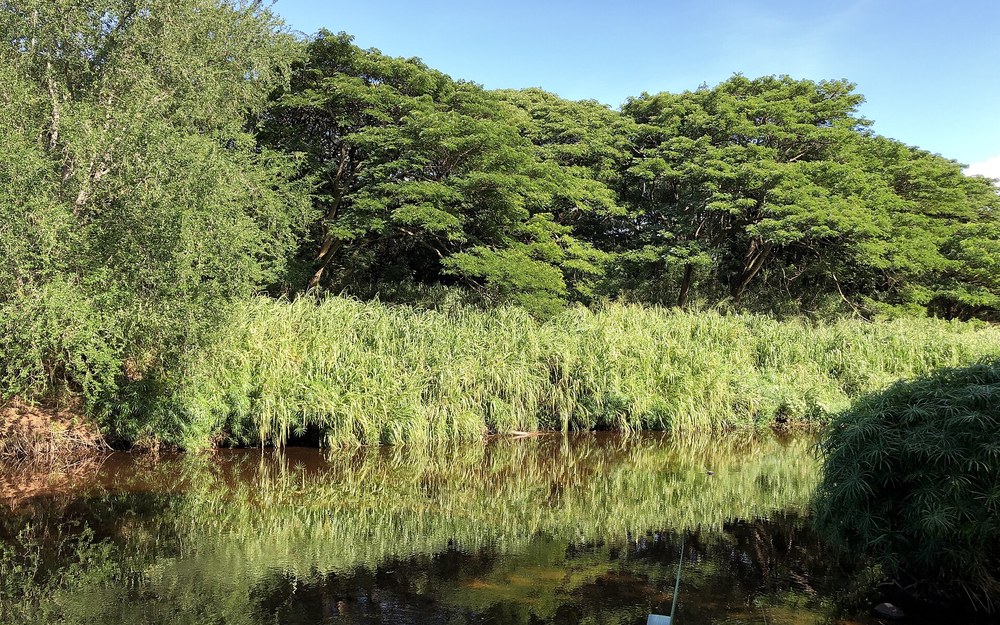
📍 Waimea River, Waimea Kauai HI (GPS: 21.9580° N, 159.6690° W)
Spot Water & Access Specs
- Target Species: Chinese Catfish (Puntat / Clarias fuscus), Tilapia, Mullet, Estuary Jacks
- Water Profile: Long dry-side Kauai river draining Waimea Canyon into slow coastal pools
- Prime Structure: Shaded outside bend pools (5-14 ft), bridge pilings & side ditch mouths
- Top Local Baits: Earthworms, raw shrimp pieces, cut baitfish strips at dusk
- Public Access: Lower Waimea Valley road bridge shoulders & coastal river mouth parks
- Safety Tip: Watch sudden canyon flash-flood surges if dark rain clouds stack inland
Angler Field Log: Settling beside a quiet eight-foot pool downstream of the Waimea River bridge as trade breezes died at sunset, light 3/4-ounce sliding sinkers carrying fresh shrimp chunks tucked cleanly along the shaded mud seam—yielding a brisk evening run of heavy-bellied puntat plus lively estuarine papio near the river mouth.
Draining the towering red cliffs of Waimea Canyon across Kauai’s sunny southwest leeward coast, the lower Waimea River slows dramatically as it flattens out across historic valley taro patches toward Waimea town. Those calm, mud-and-gravel lower bends hold deep shaded pockets where nocturnal Chinese Catfish (puntat) shelter from midday tropical sun before foraging actively along bankside weeds after dark.
Unlike windward Kauai streams hammered daily by heavy showers, the leeward Waimea corridor often maintains steadier, fishable water clarity through much of the year—rewarding stealthy bank approaches and light 10- to 15-pound spinning gear. Cast small 1/2- to 3/4-ounce Carolina rigs loaded with worms or shrimp gently into quiet pools trailing concrete bridge pilings and irrigation culvert mouths.
Exercise strict canyon flash-flood caution whenever dark storm cells build inland over Kōkeʻe or Waimea Canyon even if skies directly overhead in Waimea town stay bone dry. If river color suddenly turns dark chocolate or water rises rapidly over shoreline rocks, pack up immediately and step well clear of low gravel bars.
Hawaii Catfish Biology Breakdown & 2026 Terminal Rig Blueprint
Understanding Hawaii’s unique island freshwater biology immediately prevents wasted hours casting for species that simply do not live in the archipelago. Hawaii has no native freshwater catfish, and neither Blue Catfish nor Flathead Catfish exist in Hawaiian public waters. Instead, every legitimate catfish in hawaii catch falls into one of two distinct introduced species:
- Channel Catfish (Ictalurus punctatus — HI State Record: 43 lbs 13 oz): Stocked by Hawaii DLNR primarily in Lake Wilson (Wahiawa Reservoir) and periodic permit-only openings at Nuʻuanu Reservoir No. 4 on Oahu (plus private Waita Reservoir on Kauai). Easily recognized by their deeply V-forked tail, eight sensory barbels, and rounded 24–29 ray anal fin.
- Chinese Catfish / Puntat (Clarias fuscus — 10 to 18 inches): Introduced from East Asia during the 1800s; widespread across Oahu (Kawainui Marsh), Kauai (Wailua/Waimea rivers), and Hawaii Island (Waiakea Pond). Recognized instantly by their elongated eel-like body, smooth rounded un-forked tail, and ability to gulp air in warm low-oxygen mud canals.
- Peacock Bass & Bass Co-Habitants (Strict C&R at Lake Wilson): At Lake Wilson, Channel Catfish share exact clay points with aggressive Peacock Bass (tucunare) and Largemouth Bass—remember that all bass at Wahiawa PFA are strictly Catch-and-Release only!
Watch Our Single-Hook Santee & Slip-Sinker Catfish Rigging Demonstration
Because Hawaii DLNR HAR 13-62 strictly limits Lake Wilson anglers to a single baited hook per line, mastering snag-free Santee peg-float spacing keeps your single shrimp or chicken-liver presentation hovering cleanly above flooded albizia brush. Watch our terminal rigging breakdown below:
Recommended Hawaii Catfish Tackle & Rig Loadout (2026 Field Picks)
From winching 25-pound Lake Wilson Channel Catfish clear of red-clay timber snags to finessing light canal puntat in Kauai and Hilo, here are our four field-tested tackle pillars compliant with Hawaii DLNR gear rules:
| Gear Component | Recommended Model | Exact Spec (Power / Ratio / LB) | Why It Works in Hawaii | Check Live Price |
|---|---|---|---|---|
| Main Reservoir Rod | Ugly Stik Catfish Special 7’6″ MH | 15-40 lb Line, 1-5 oz Lure, E-Glass Blank | Tough enough to winch 25 lb Lake Wilson Channel Cats away from drowned albizia timber on steep clay walls. | |
| Primary Baitcaster | Abu Garcia Ambassadeur C3 6500 | 5.3:1 Gear Ratio, 245 yd / 14 lb, Bait Clicker | Smooth clicker freespool lets wary Lake Wilson Cats run cleanly before single-hook corner-jaw lockups. | |
| Bank / Shore Spinning | Penn Battle IV 5000/6000 Spinning Reel | 5.6:1 Ratio, Sealed HT-100 Carbon Drag | Corrosion-resistant aluminum body handles Oahu humidity, muddy Wahiawa banks & brackish Hilo ponds. | |
| Braid & Single-Hook Kit | 50 lb PowerPro + Gamakatsu 6/0 Circle | 50 lb Braid + 1 Single Hook Only (HAR 13-62) | Meets strict Hawaii DLNR single-hook-per-line rules while lifting baits above red-clay snags on Santee floats. |
Hawaii Tropical Hydrology & Rainfall Bite Windows
Unlike mainland reservoirs governed by freezing winter ice-outs, Hawaii’s tropical reservoirs stay comfortably between 70°F and 83°F year-round—meaning barometric trade-wind rain squalls and reservoir water levels drive catfish feeding far more than calendar months:
| Season / Weather Pattern | Where Catfish Hold in Hawaii | Highest-Percentage Presentation | Prime Island Water |
|---|---|---|---|
| Winter Rains (Nov-Mar) | 10-25 ft muddy creek inflows & rising red-clay gulch edges | 1-1.5 oz slip-sinker w/ mesh chicken liver & worms | Lake Wilson North Fork & Wailua |
| Spring Trades (Apr-May) | 12-28 ft main-basin points & shaded clay drop-offs | Single-hook Santee peg float w/ raw shrimp & garlic hotdog | Lake Wilson Main & Nuuanu #4 |
| Dry Summer (Jun-Sep) | 25-45 ft deep oxygenated dam basins & shaded timber pockets | 2 oz bottom slip rig w/ cut baitfish or oily chicken liver | Karsten Thot Bridge & Waita |
| Kona Storm Swells | 6-18 ft freshly flooded grass banks & marsh drainage ditches | Light 1/2 oz split-shot rig w/ earthworms or shrimp chunks | Wahiawa Arms & Waiakea Pond |
2026 Hawaii DLNR HAR 13-62 Rules & Wahiawa PFA Compliance
Always verify active Hawaii Department of Land and Natural Resources (DLNR) Division of Aquatic Resources (DAR) postings prior to wetting a line:
- Mandatory Freshwater Game Fishing License: A current State of Hawaii Freshwater Game Fishing License is required for freshwater gamefishing in regulated waters like Lake Wilson (Wahiawa PFA) and Nuʻuanu Reservoir openings (check youth exemptions under age 9 when fishing within an accompanying adult’s bag limit; permittees under 15 must be accompanied by an adult).
- Channel Catfish Daily Bag Limit: At Wahiawa Public Fishing Area (Lake Wilson), anglers may keep no more than 3 Channel Catfish per person per day.
- Weekday vs. Weekend Pole & Single-Hook Caps: Under HAR 13-62 at Lake Wilson, you may fish only 1 line on weekends and holidays, and up to 2 lines on weekdays (other than holidays). Each line is strictly limited to 1 lure, 1 baited hook, or 2 artificial flies—trotlines and snagging are strictly illegal.
- Mandatory PFD & Prohibited Baits: A USCG-approved PFD is required when entering or fishing Wahiawa PFA waters. Using Channel Catfish, Peacock Bass, Largemouth/Smallmouth Bass, or Oscars as bait is strictly prohibited, and all Bass/Peacock Bass at Lake Wilson are strictly Catch-and-Release only.
Dial In Your Rigging Numbers With Our Interactive Fishing Calculators
Before spooling fresh 50-pound braid for deep Lake Wilson canyon walls or sizing light leaders for Kauai river bends, use our fishing calculators to dial in exact rigging specs:
River Sinker Weight Calculator
Determine exact ounce egg or flat sinker weights for Kaukonahua rain inflows versus calm reservoir flats.
Reel Line Capacity Calculator
Calculate exact backing and 50 lb braid spool capacity on C3 6500 baitcasters and Penn 6000 spinning reels.
Knot Strength & Line Matcher
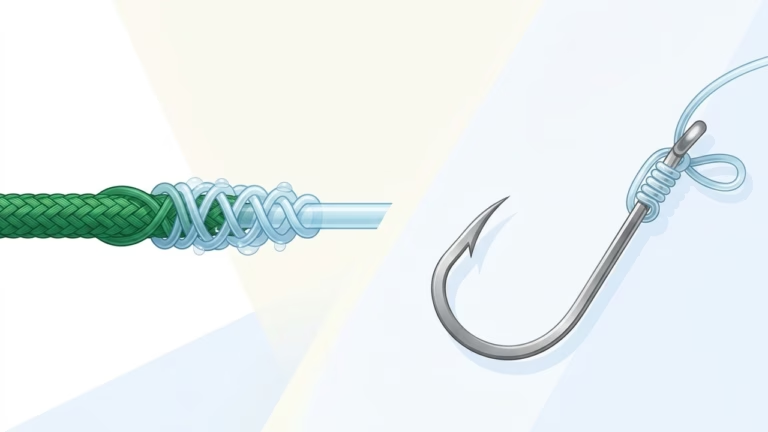
Pair slick braided mainlines cleanly to 25–30 lb monofilament Santee leaders for timbered Oahu coves.
Rod Power & Action Matcher
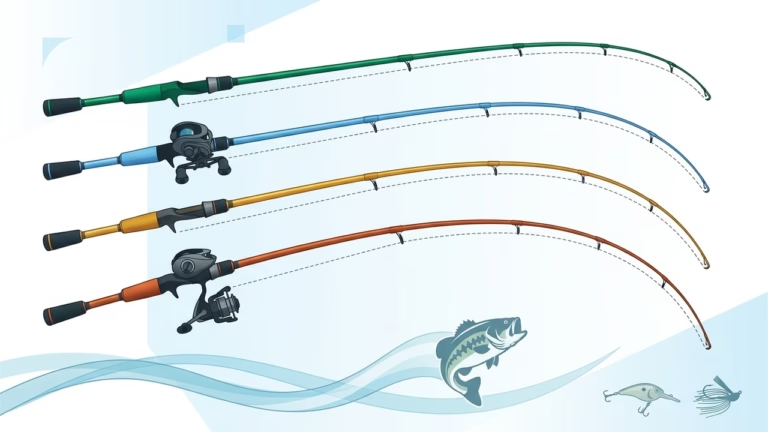
Match heavy composite blanks for 25 lb Channel Cats against ultralight spinning rods for marsh puntat.
Solunar & Barometric Timer
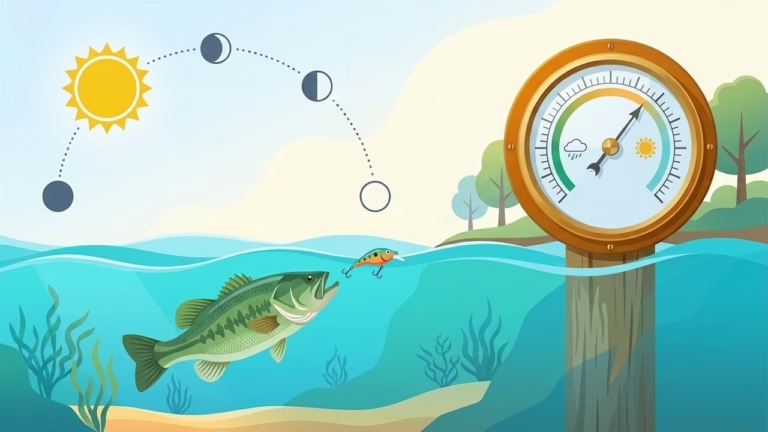
Line up overhead tropical moon phases and falling trade-wind barometric shifts over Lake Wilson.
Complete Catfish Bait Guide
Compare mesh-wrapped chicken liver, raw shrimp, and garlic-scented baits without violating DLNR bait bans.
Final Captain’s Verdict: Picking Your Ideal 2026 Hawaii Catfish Run
Once you understand Hawaii’s non-native freshwater biology, targeting the best catfish fishing spots in hawaii comes down cleanly to which island you are standing on:
- For Trophy 10–40+ lb Channel Catfish: Head straight to Lake Wilson (Wahiawa PFA) on Oahu with your Hawaii Freshwater Game Fishing License, USCG PFD, single-hook Santee Cooper peg floats, and mesh-wrapped chicken liver or raw shrimp—keeping 1 line on weekends (2 on weekdays) and staying under the 3-fish daily limit.
- For Scheduled Permit-Only Bank Fishing: Watch Hawaii DLNR announcements for lottery/draw openings at Nuʻuanu Reservoir No. 4, or book a licensed guide on Kauai’s private Waita Reservoir.
- For Light-Tackle Nocturnal Puntat: Pack nimble 12-pound spinning gear and earthworms for Windward Oahu’s Kawainui Marsh canals, Hilo’s Waiakea Pond, or Kauai’s Wailua and Waimea rivers.
Hawaii Catfishing FAQs: Biology, DLNR Permits & Tackle Rules
Are catfish native to Hawaii, and where are Channel Catfish found?
No—Hawaii has zero native freshwater catfish. Channel Catfish were introduced and stocked by Hawaii DLNR primarily in Lake Wilson (Wahiawa Reservoir) on Oahu alongside Peacock Bass (tucunare) and Largemouth Bass, with secondary stocked populations in Nuʻuanu Reservoir No. 4 (open only on scheduled DLNR permit dates) and privately accessed Waita Reservoir on Kauai.
What are the 2026 Hawaii DLNR limits for Channel Catfish at Lake Wilson?
At Wahiawa Public Fishing Area (Lake Wilson), anglers may keep a maximum of 3 Channel Catfish per person per day. You may use only 1 line on weekends and state holidays, or up to 2 lines on weekdays, with a maximum of 1 baited hook or 1 lure per line. Trotlines, snagging, and using Channel Catfish or Bass as bait are strictly prohibited.
Do I need a fishing license and life jacket at Lake Wilson (Wahiawa PFA)?
Yes. Every angler fishing Wahiawa PFA (unless exempt under age 9 within an accompanying adult’s bag limit) needs a valid State of Hawaii Freshwater Game Fishing License, and DLNR HAR 13-62 requires a USCG-approved personal flotation device (PFD) when entering or fishing Wahiawa PFA waters.
What is the difference between Hawaii Channel Catfish and Puntat?
Channel Catfish (Ictalurus punctatus) are large, deeply forked-tail gamefish reaching 43+ pounds in Lake Wilson. ‘Puntat’ refers to introduced Chinese Catfish (Clarias fuscus)—smaller 10- to 18-inch air-breathing catfish with elongated bodies and rounded tails found in Hawaii marshes, streams, and ponds like Kawainui Marsh, Wailua River, and Waiakea Pond.