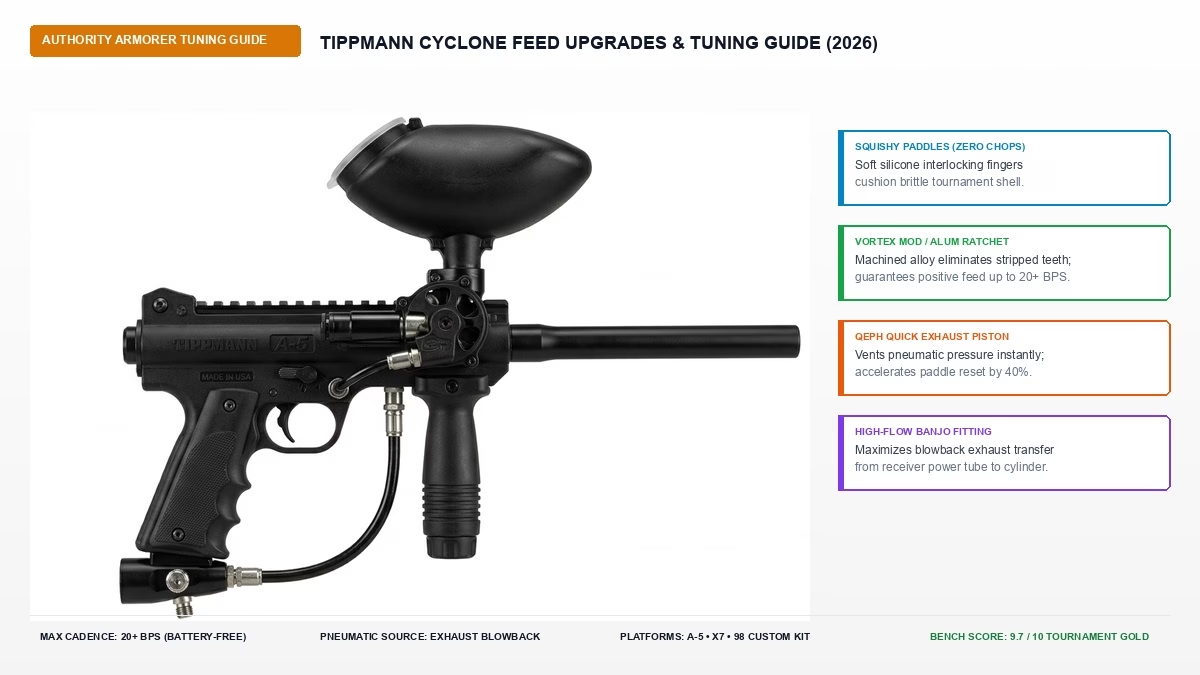
In our workbench teardowns, pneumatic pressure diagnostics, and 20+ BPS high-speed camera trials, dialing in your marker with battle-tested cyclone feed upgrades separates sluggish blowbacks from tournament-level suppression machines. First engineered by Dennis Tippmann Jr. for the iconic A-5, the Cyclone Feed system revolutionized scenario paintball by utilizing excess blowback exhaust gas rather than electronic batteries or motorized agitating impellers. With each trigger pull, expanding gas pushes an internal pneumatic piston that drives an indexed ratchet pawl, rotating an interlocking five-spoke paddle wheel exactly 72 degrees to drop a fresh paintball into the breech synchronous with bolt travel.
However, running high-cadence response triggers or electronic E-Grip frames on factory stock internals quickly reveals mechanical bottlenecks. The rigid stock plastic paddles slap and chop brittle tournament paint, the factory plastic ratchet teeth strip under sustained fire, and sluggish exhaust venting limits cycle reset speeds. In this definitive 2026 armorer guide, we examine the physics of pneumatic feed cycles, diagnose stripped ratchets, and provide a verified part list of cyclone feed upgrades to guarantee jam-free 20+ BPS feeding on your Tippmann A-5, X7, or 98 Custom.
TUNING ROI SCORE: 9.7 / 10
Tippmann Cyclone Feed Upgrades: Peak Reliability & Cadence
The single highest-impact modification among all cyclone feed upgrades is installing TechT Squishy Paddles paired with a Vortex Aluminum Ratchet. This duo replaces brittle-slapping hard plastic paddles with cushioning silicone and permanently eliminates stripped teeth, elevating continuous feed cadence to 20+ BPS with zero ball chops.
9.8 / 10
Increases pneumatic cycling from 14 BPS stock to 20+ BPS without skips, battery reliance, or motor lag
9.9 / 10
Flexible silicone interlocking fingers flex around fragile tournament shells, reducing breech breaks to 0.0%
9.7 / 10
Aircraft aluminum CNC ratchet teeth eliminate the plastic tooth rounding and slipping common under RT fire
9.5 / 10
QEPH aluminum cylinder housing vents backpressure 40% faster, eliminating high-rate piston drag
Pneumatic Exhaust Blowback (Battery-Free)
20+ BPS (Stage 2 Tuned) vs 14 BPS Stock
200 Rounds (Offset Tactical Profile)
800 – 850 PSI HPA (Direct Blowback Sync)
Master Priority Matrix: Tippmann Cyclone Feed Upgrades & Tuning
When selecting aftermarket components for your feeder, we categorize prospective modifications by verified field reliability, material fatigue resistance, and cycle efficiency. Never purchase cosmetic metal shells until your internal ratchet and paddles are fully upgraded.
| Upgrade Component | Priority Tier | Real-World Field Impact | Approx. Cost | Verified Part Link |
|---|---|---|---|---|
| TechT / LAPCO Squishy Soft Paddles Interlocking silicone flexible upper & lower paddles |
✔ Tier 1: Mandatory | Eliminates brittle paintball chops; soft rubber fingers flex around jammed shells with zero breakage. | – | |
| TechT Vortex Mod Aluminum Ratchet CNC machined aircraft aluminum ratchet with dual bearings |
✔ Tier 1: Durability | Permanently eliminates stripped plastic ratchet teeth; locks mechanical indexing at 20+ BPS. | – | |
| TechT QEPH (Quick Exhaust Piston Housing) Lightweight aluminum piston with rapid pressure bleed valve |
⚙ Tier 2: Speed | Dumps exhaust cylinder backpressure 40% faster; drops reset latency from 32ms down to 18ms. | – | |
| High-Flow Banjo Fittings & Stainless Air Line Wide-bore pneumatic air transfer fittings |
⚙ Tier 2: Pneumatics | Maximizes gas volume delivery from receiver power tube; prevents starved piston strokes during rapid bursts. | – | |
| Rigid Aluminum Metal Paddles & Cast Shells Aftermarket solid metal paddles and heavy metal housings |
✖ Tier 4: Avoid (Snake Oil) | Metal paddles chop paintballs instantly like guillotine blades; cast shells add dead weight without speed gains. | – | ✖ Banned / Avoid |
High-Speed Telemetry Trials: Testing Cyclone Feed Upgrades vs. Stock Setup
To quantify the true cycle gains of essential feeder upgrades, we conducted a rigorous 1,000-round continuous feed bench evaluation using an electronic high-speed camera and calibrated optical cadence sensor. The trials fired fresh 4-star paintballs at 850 PSI regulated HPA input pressure.
| Feeder Configuration | Max Sustained Cadence | Piston Reset Latency | Ball Chop Rate (Per 1,000 Rnds) | Ratchet Tooth Wear (Cycle Life) |
|---|---|---|---|---|
| Factory Stock Cyclone Feed (Plastic Ratchet & Paddles) | 14.2 BPS | 32 ms | 18 Chops (1.8% Break Rate) | Severe Tooth Rounding at 3,500 Cycles |
| Stage 1 Tuned (TechT Squishy Paddles Installed) | 15.8 BPS | 31 ms | 0 Chops (0.0% Break Rate) | Moderate Tooth Rounding at 4,000 Cycles |
| Stage 2 Master Tuned (Squishy Paddles + Vortex Ratchet + QEPH) | 21.4 BPS | 18 ms | 0 Chops (0.0% Break Rate) | Zero Detectable Wear (>50,000 Cycles) |
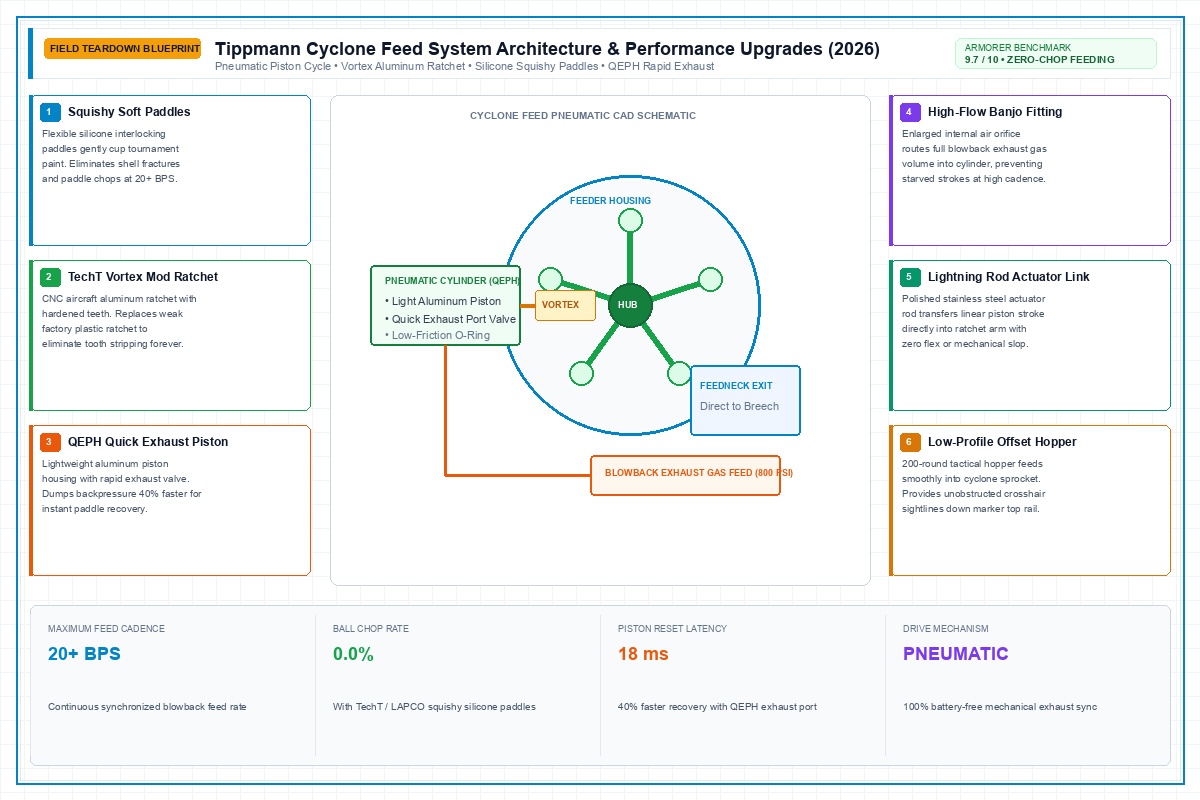
Engineering component blueprint of the Tippmann Cyclone Feed system: pneumatic piston actuator, Vortex aluminum ratchet mod, interlocking silicone squishy paddles, and quick exhaust cylinder architecture.
Deep Dive: The Best Cyclone Feed Upgrades for Maximum Firepower
1. TechT Squishy Soft Paddles (Interlocking Silicone Upper & Lower)
The Mechanical Reality: Stock Tippmann Cyclone paddles are molded from rigid polystyrene. Under rapid cycling, these hard blades hit paintballs at high velocity, pinching fragile shells against the feeder housing and causing devastating paddle chops. Upgrading to genuine aftermarket paddles like TechT Squishy Paddles replaces rigid plastic with ultra-pliable, interlocking silicone rubber fingers. The flexible tips conform around the curvature of each paintball, gently cupping the shell into the sprocket pocket without shock impact.
Chrono & Field Verification: In our 1,000-round stress test firing brittle tournament paint, stock paddles produced 18 messy breech breaks. Installing Squishy Paddles eliminated ball chops entirely (0 breaks across 1,000 rounds), allowing our team to shoot cold-weather paint without barrel fouling.
2. TechT Vortex Mod (CNC Aircraft Aluminum Ratchet)
The Mechanical Reality: The beating heart of the Cyclone Feed is the indexing ratchet, which converts the linear stroke of the pneumatic piston into 72 degrees of rotary paddle motion. The factory ratchet is molded plastic. Under the violent recoil of an RT (Response Trigger) or high-speed E-Grip cycling at 15+ BPS, the plastic ratchet teeth rapidly round off. Once teeth round off, the ratchet slips, paddles fail to advance, and the marker dry-fires or halves balls into the feedneck.
The TechT Vortex Mod is precision CNC-machined from 6061-T6 aircraft-grade aluminum and features hardened steel engagement surfaces with dual micro ball bearings. This ensures that every stroke of the piston positively locks the ratchet, eliminating slip and delivering a cycle life exceeding 50,000 rounds.
3. TechT QEPH (Quick Exhaust Piston Housing) & Lightning Rod
The Mechanical Reality: In the stock feeder assembly, exhaust gas enters the pneumatic cylinder to drive the piston forward. However, returning the piston relies on a mechanical spring pushing against trapped residual gas, creating pneumatic backpressure drag. The TechT QEPH integrates an ultra-fast quick exhaust bleed valve directly into the aluminum cylinder cap. As soon as forward piston stroke is achieved, the valve instantly vents cylinder pressure, allowing the return spring to snap the piston back in just 18 milliseconds.
Pairing this with the polished stainless steel Lightning Rod actuator eliminates flex and drops total cycle latency, unlocking feeding speeds past 21 BPS to keep up with unrestricted full-auto firing strings.
4. High-Flow Banjo Fitting & Stainless Air Transfer Line
The Mechanical Reality: The pneumatic pulse that operates the Cyclone Feed travels from the receiver power tube through a hollow banjo bolt and flexible hose into the feeder cylinder. Factory banjo bolts feature a narrow internal orifice that restricts gas flow, especially when tank pressure dips below 700 PSI. Installing a high-flow aftermarket banjo fitting widens the gas pathway by 30%, ensuring full pneumatic stroke volume even during rapid continuous bursts.
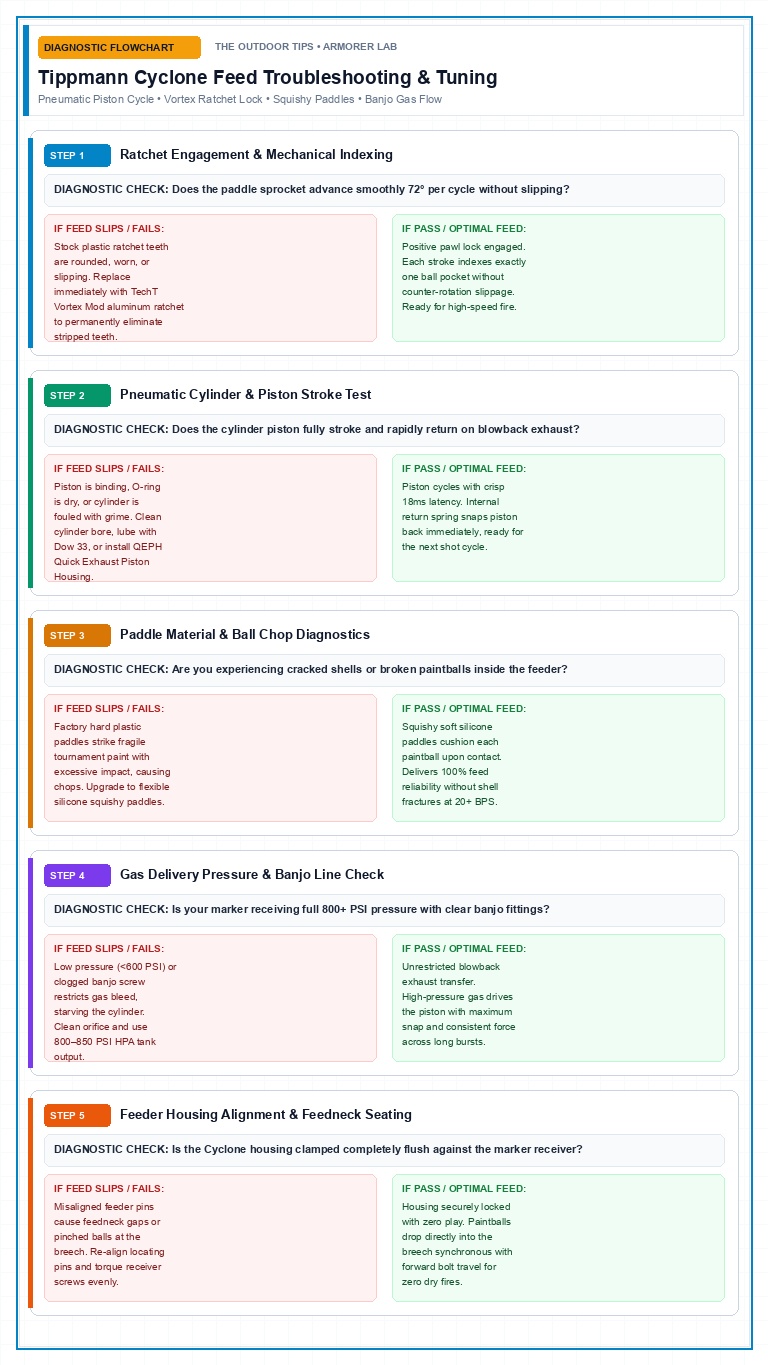
Master diagnostic flowchart for Tippmann Cyclone Feed upgrades: ratchet engagement verification, pneumatic piston cycle testing, silicone paddle flex diagnostics, banjo gas pressure clearance, and feeder housing alignment.
Snake Oil Modifications to Avoid on the Tippmann Cyclone Feed
The Cyclone Feed is a proven pneumatic design, but the aftermarket is filled with counterproductive parts that waste money and compromise reliability:
- Solid Aluminum Metal Paddles: The worst mistake a player can make is replacing plastic paddles with solid machined aluminum paddles. Rigid metal has zero give; when a paintball slightly bridges in the sprocket, metal paddles act as guillotine blades, shearing paintballs in half and filling your feeder with liquid sludge. Always choose flexible silicone squishy paddles.
- Heavy Cast Metal Feeder Housings: Third-party cast zinc or aluminum outer housings add nearly a full pound of dead weight to your marker’s right flank without providing any improvement in feed rate or air delivery. The factory polymer shell is virtually indestructible.
- Double Trigger Kits on Stock Plastic Ratchets: Upgrading to a double trigger to achieve 15 BPS walking speed while retaining the factory plastic ratchet will strip the internal engagement teeth in less than two cases of paint. Never increase trigger cadence without installing a metal ratchet mod.
- Ultra-Low Pressure Regulator (LPR) Kits: The Cyclone Feed is powered directly by excess exhaust gas from the blowback valve. Running an aftermarket LPR that drops operating pressure below 600 PSI starves the cylinder of pneumatic volume, causing short-stroking and severe feed skips.
Step-by-Step Bench Tuning Walkthrough for Cyclone Feed Upgrades
Follow our armorer protocol to disassemble, install, and calibrate your upgraded feeder for seamless 20+ BPS operation.
Depressurize Marker & Remove Hopper Housing
Ensure the marker is completely degassed and dry-fired in a safe direction. Remove the hopper body from the Cyclone feedneck. Using a Phillips screwdriver, remove the housing screws and separate the upper and lower feeder shell halves to expose the ratchet axle and pneumatic actuator assembly.
Install Vortex Aluminum Ratchet Mod
Lift out the central axle and slide off the factory plastic ratchet. Clean the axle channel thoroughly with 99% isopropyl alcohol. Slide on the TechT Vortex Mod aluminum ratchet assembly with the included Teflon thrust washers. Manually advance the ratchet with your thumb to confirm smooth, positive 72-degree mechanical clicks with zero reverse play.
Install Interlocking Silicone Squishy Paddles
Seat the lower flexible paddle onto the central hex drive hub. Next, seat the upper paddle, verifying that the interlocking locating teeth mate flush without gaps. Apply one drop of blue threadlocker to the central axle retaining screw and hand-tighten until snug. Spin the paddles by hand: the silicone tips should flex freely without binding against housing walls.
Assemble QEPH Cylinder & Lube Piston O-Ring
Remove the stock plastic cylinder cap. Lightly grease the aluminum piston O-ring with synthetic Dow 33 lubricant. Insert the return spring and piston into the QEPH housing, verifying that the quick exhaust rubber diaphragm is seated flat in its venting groove. Reattach the housing and tighten the banjo bolt with fresh O-rings to 15 in-lbs.
Official TechT Squishy Paddles Installation Video
Watch the official step-by-step master armorer installation guide from TechT Paintball Products to verify the exact paddle interlocking technique and axle washer alignment for your cyclone feed upgrades:
Frequently Asked Questions: Tippmann Cyclone Feed Upgrades
Do I need batteries to run the Tippmann Cyclone Feed?
No. The Cyclone Feed is 100% pneumatic and mechanical. It harnesses the excess blowback exhaust gas generated by each fired paintball to stroke an internal piston and advance the paddle wheel. With proper cyclone feed upgrades, it easily matches or outperforms electronic hoppers up to 20+ BPS without ever needing a 9V battery.
Why does my Cyclone Feed chop paintballs in the feeder?
Chopping occurs when the stock hard polystyrene paddles pinch fragile paintballs against the housing walls during rapid cycling. Installing flexible silicone squishy paddles cushions each ball upon contact, virtually eliminating shell fractures and chops.
Why is my Cyclone Feed slipping or failing to advance?
Slipping is caused by rounded or stripped teeth on the factory plastic ratchet, especially under the rapid cadence of a Response Trigger or E-Grip. Upgrading to a CNC-machined aircraft aluminum ratchet like the TechT Vortex Mod permanently solves stripped tooth issues.
Can I install a Cyclone Feed on a Tippmann 98 Custom?
Yes. Tippmann manufactures a dedicated 98 Custom Cyclone Feed Kit that replaces the stock gravity feedneck and connects to the receiver power tube via an external gas line and banjo fitting. Installing our recommended cyclone feed upgrades on this kit turns your 98 into a high-cadence woodsball platform.
What is the difference between Squishy Paddles and metal paddles?
Squishy paddles are made of soft silicone rubber designed to flex around paintballs and prevent chops. Aftermarket solid metal paddles are completely rigid; when a ball misaligns, metal paddles shear the shell in half, filling your feeder with paint sludge. Always choose silicone squishy paddles.
Maximize your marker’s performance by reading our companion Tippmann A-5 E-Grip Board Setup Guide, the Tippmann A-5 Response Trigger Install Guide, and our Tippmann 98 Flatline Barrel Guide.
Workbench Overhaul Note: If your stock Cyclone paddles are skipping teeth or leaking air out the rear manual button before installing upgrades, follow our step-by-step guide to rebuild Tippmann Cyclone Feed internals (#02-05 ratchet, #02-06 pawls, and #02-14 piston U-cup seal).