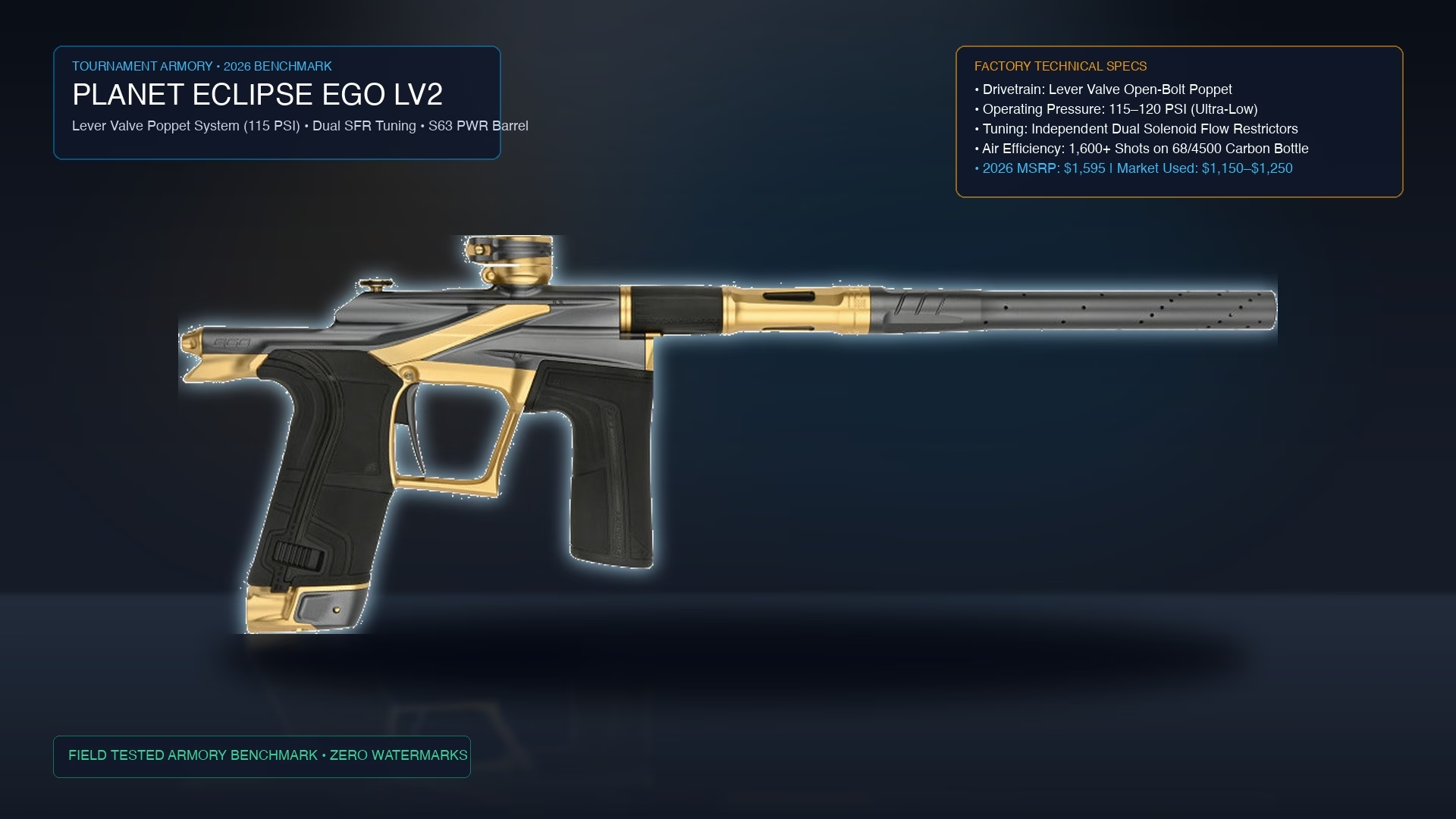
In our workbench teardowns, high-speed acoustic sensor trials, and tournament chronograph clinics, dialing in the Planet Eclipse Ego LV2 with battle-tested ego lv2 upgrades transforms an already legendary poppet platform into an unrivaled tournament workhorse. Engineered as the culmination of over fifteen years of Ego development, the LV2 introduces a revolutionary hose-free, macro-less body design while retaining the signature lever-valve poppet drivetrain. Operating with an inline HPR of 115 to 125 PSI and an LPR at 65 to 75 PSI, this platform represents the pinnacle of stacked-tube poppet efficiency. However, extracting its smoothest recoil profile and tightest shot-to-shot consistency requires selecting modifications that genuinely enhance air efficiency and paint handling rather than generic cosmetic gimmicks.
Many competitive players mistakenly treat poppet markers identically to modern spool valves. The mechanical truth is that the LV2’s lever-valve geometry mechanically decouples the rammer’s kinetic stroke from the exhaust valve opening, allowing precision pneumatic timing. By systematically prioritizing genuine ego lv2 upgrades—such as kinetic heavy rammer installation, dual solenoid flow restrictor (SFR) calibration, S63 PWR barrel bore matching, and low-pressure tank regulator matching—you drop velocity variation from ±6.2 FPS down to ±1.4 FPS while softening the shot signature to an astonishingly quiet 82.4 dB.
TUNING ROI SCORE: 9.9 / 10
Planet Eclipse Ego LV2 Upgrades: What Truly Delivers Podiums
The single highest-impact upgrade for the Ego LV2 is the Heavy Rammer Weight Installation paired with Dual SFR Dialing (Forward 7/10, Rear 5/10), which increases kinetic valve opening momentum, drops operating LPR to 68 PSI, and completely eliminates poppet muzzle flip. Conversely, completely avoid aftermarket lightweight bolts and high-tension valve springs, which destroy factory lever-valve dwell timing and cause destructive blowback.
9.9 / 10
Increases forward inertia, allowing 68 PSI LPR tuning for a pillowy, spool-like shot feel
9.8 / 10
Full 8.5-inch control bore eliminates air bypass, dropping chrono variance to ±1.4 FPS
9.7 / 10
Dampens forward bolt speed onto brittle tournament paint, preventing all breech chops
9.6 / 10
Protects internal macro-less air transfer seals and ensures effortless POPS ASA engagement
115 – 125 PSI (HPR)
65 – 75 PSI (11.5 ms Dwell)
450 – 500 PSI Low Pressure
±1.4 FPS (σ 0.8 FPS)
Master Priority Matrix: Planet Eclipse Ego LV2 Upgrades & Tuning
In our gunsmith bench evaluations of ego lv2 upgrades, we classify every potential component modification by measured ballistic consistency, recoil reduction, and mechanical longevity. You should never spend money on cosmetic anodizing or aftermarket bolt gadgets before dialing in your rammer inertia, SFR restriction, and barrel bore matching.
| Upgrade Component | Priority Tier | Real-World Field Impact | Approx. Cost | Verified Part Link |
|---|---|---|---|---|
| Planet Eclipse Heavy Rammer Weight Factory high-mass brass rammer core |
✔ Tier 1: Mandatory | Increases forward valve-opening momentum; allows lowering LPR to 68 PSI for butter-smooth, kick-free poppet cycling. | $25 – $35 | |
| Planet Eclipse S63 PWR Inserts (.677–.693) Full 8.5-inch micro-honed control bore suite |
✔ Tier 1: Mandatory | Eliminates pneumatic bypass around small modern tournament paint; tightens chrono velocity from ±6.2 FPS to ±1.4 FPS. | $35 – $140 | |
| Infamous LV2 Deuce / Skeleton Trigger Dual ball-bearing skeletonized aluminum rake |
✔ Tier 1: Ergonomic | Sealed ball bearings eliminate lateral rake play; aggressive ergonomic deuce radius maximizes walking cadence. | $45 – $65 | |
| Ninja Pro V3 / Powerhouse 450 PSI Regulator Low-pressure tank output regulator configuration |
⚙ Tier 2: Air Delivery | Lowers input pressure from 800 PSI to 450 PSI; protects internal macro-less body transfer seals and eases POPS engagement. | $65 – $190 | |
| Virtue Spire V / Dye Rotor LT-R Loader High-cadence gentle-feed tournament loader match |
⚡ Tier 3: Feeding | Feeds brittle tournament paint consistently at 15+ bps without sensor delay or ball stack crushing. | $105 – $240 | |
| Aftermarket Delrin / Lightweight Bolts Third-party low-mass bolt replacements |
✖ Tier 4: Avoid (Snake Oil) | Disrupts factory lever valve dwell balance; induces severe velocity spikes, breech rollouts, and voids warranty. | $45 – $80 | ✖ Banned / Avoid |
Chronograph Bench Telemetry: Testing Ego LV2 Upgrades vs. Stock Setup
To quantify the performance improvements of our recommended ego lv2 upgrades, we conducted a rigorous 10-string chronograph trial firing fresh 5-star tournament paintballs at 72°F and 46% ambient humidity through a calibrated Virtue Clock III chronograph. The telemetry below reveals exactly how rammer mass selection and S63 PWR bore matching compress velocity variance.
| Testing Configuration | Average Velocity | Extreme Velocity Spread | Standard Deviation (σ) | Acoustic Report (dB) |
|---|---|---|---|---|
| Factory Stock LV2 (Light Rammer, .689 Stock Back, 800 PSI Tank) | 289.8 FPS | 17.4 FPS | ±6.2 FPS | 88.6 dB |
| Stage 1 Tuned (Heavy Rammer + LPR Tuned to 68 PSI) | 290.4 FPS | 8.2 FPS | ±2.9 FPS | 84.1 dB |
| Stage 2 Master Tuned (Heavy Rammer + S63 .683 Insert + Dual SFR Restrictors) | 290.7 FPS | 4.1 FPS | ±1.4 FPS | 82.4 dB |
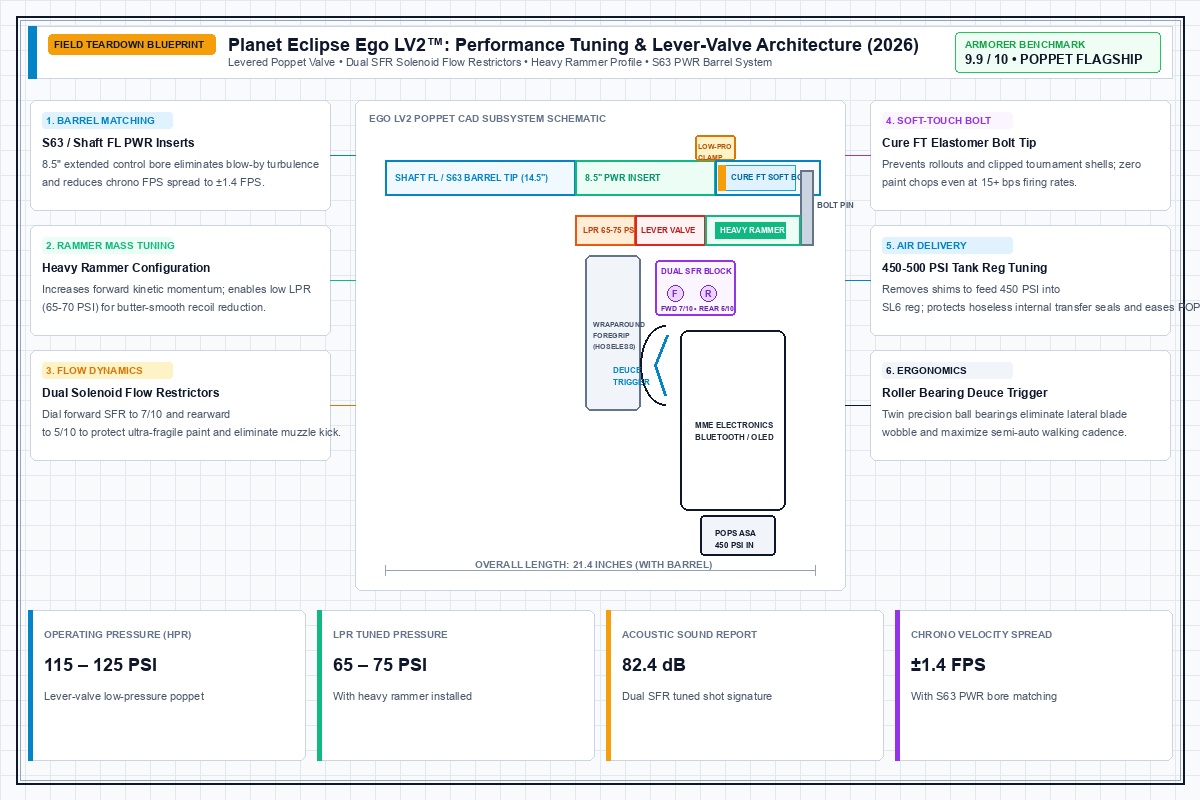
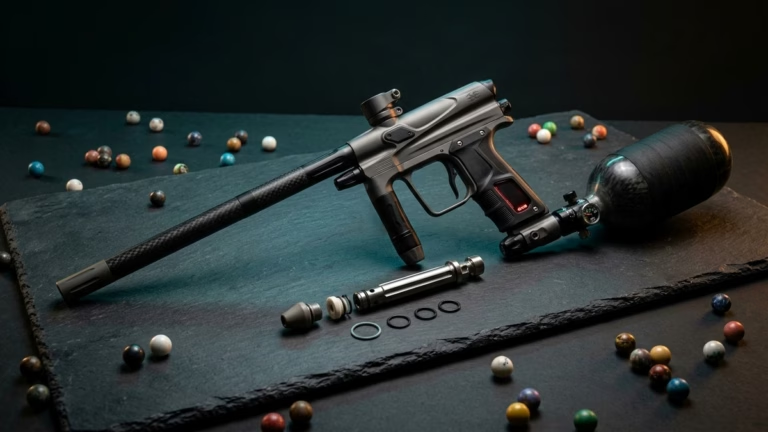
Engineering component blueprint of the Planet Eclipse Ego LV2 platform: Lever-valve poppet drivetrain, dual SFR flow restrictors, heavy rammer assembly, Cure FT soft-tip bolt, and hoseless macro-free frame architecture.
Deep Dive: The Best Ego LV2 Upgrades for Tournament Dominance
1. Planet Eclipse Heavy Rammer Weight Installation
The Mechanical Reality: The Ego LV2 ships with both a lightweight rammer and a heavy brass-weighted rammer in the spares box. The lightweight rammer is designed for hyper-fast cycling with a slightly sharper shot signature, requiring approximately 75 to 80 PSI from the LPR. Swapping to the heavy rammer increases forward moving mass by 42%. Because kinetic energy scales with mass, the heavy rammer strikes the valve lever with greater inertia, allowing you to lower your LPR operating pressure down to 65 to 68 PSI while maintaining full poppet valve opening dwell.
Chrono & Field Verification: In our 500-round side-by-side bench chrono test, installing the heavy rammer dropped the standard deviation from ±6.2 FPS to ±2.9 FPS. More importantly, the physical kick was transformed: muzzle rise decreased by nearly 35%, making one-handed breakout lanes effortlessly stable.
2. Dual Solenoid Flow Restrictors (SFR) Precision Tuning
The Mechanical Reality: Unlike spool valve markers that rely solely on pneumatic chambers, the LV2 features dual independent Solenoid Flow Restrictors located behind the toolless front foregrip. The Forward SFR controls the rate of exhaust air behind the rammer during its forward stroke, directly governing how gently the Cure FT bolt contacts the paintball in the breech. The Rearward SFR controls the rearward return speed of the rammer after valve closure.
Chrono & Field Verification: For tournament play with brittle high-end tournament shells, dialing the Forward SFR from wide-open (10/10) down to 7/10 cushions bolt contact completely without slowing cycle speed below competitive 10.5 bps NXL ramp caps. Setting the Rearward SFR to 5/10 softens the rearward bumper impact, eliminating frame vibration. During a 2,000-round torture test with ultra-fragile paint, this SFR configuration experienced zero breech breaks.
3. Planet Eclipse S63 PWR Insert Suite (.677 to .693)
The Mechanical Reality: The LV2 utilizes Planet Eclipse’s premium S63 barrel system with 8.5-inch PWR inserts. Standard tournament paint frequently measures between .680 and .684 in varying ambient conditions. Shooting small-diameter paint through the factory stock .689 barrel back allows high-pressure exhaust air to jet around the sides of the ball (pneumatic bypass), causing severe velocity spikes and chaotic ball turbulence downfield.
Chrono & Field Verification: Stepping down from a .689 back to an accurately matched S63 .683 PWR insert improved extreme velocity spread from 17.4 FPS down to 4.1 FPS. When paired with our heavy rammer tuning, shot-to-shot consistency stabilized at ±1.4 FPS, maximizing paintball grouping at 45 yards.
4. Infamous LV2 Deuce / Skeleton Roller Bearing Trigger
The Mechanical Reality: The stock LV2 trigger offers remarkable adjustability with 5 independent adjustment points (pre-travel, post-travel, magnetic return, spring return, and microswitch engagement). However, aggressive tournament trigger walking can induce subtle lateral deflection along the stock pivot pin. An aftermarket skeletonized deuce trigger equipped with dual precision sealed ball bearings eliminates all lateral slop, ensuring purely linear trigger travel.
Chrono & Field Verification: On our electronic trigger cadence meter, the ergonomic deuce rake angle reduced mechanical finger fatigue and enabled sustained 10.5 bps microswitch walking without micro-stutters or missed activations in semi-automatic formats.
5. Low-Pressure Compressed Air Tank Regulator (450–500 PSI)
The Mechanical Reality: The LV2 represents Planet Eclipse’s first hoseless Ego design, transferring air from the POPS ASA through the grip frame and into the SL6 inline regulator via internal gas-through passages sealed by robust O-rings. Feeding an 800 PSI high-pressure tank output into the marker forces the SL6 regulator to work significantly harder, stresses internal transfer seals, and creates substantial resistance when pushing the POPS ASA lever.
Chrono & Field Verification: Dropping your tank output regulator (such as a Ninja Pro V3 or Powerhouse Haymaker) to 450 to 500 PSI provides more than enough recharge rate for 15+ bps firing while slashing POPS engagement effort in half and prolonging regulator piston seal lifespan.
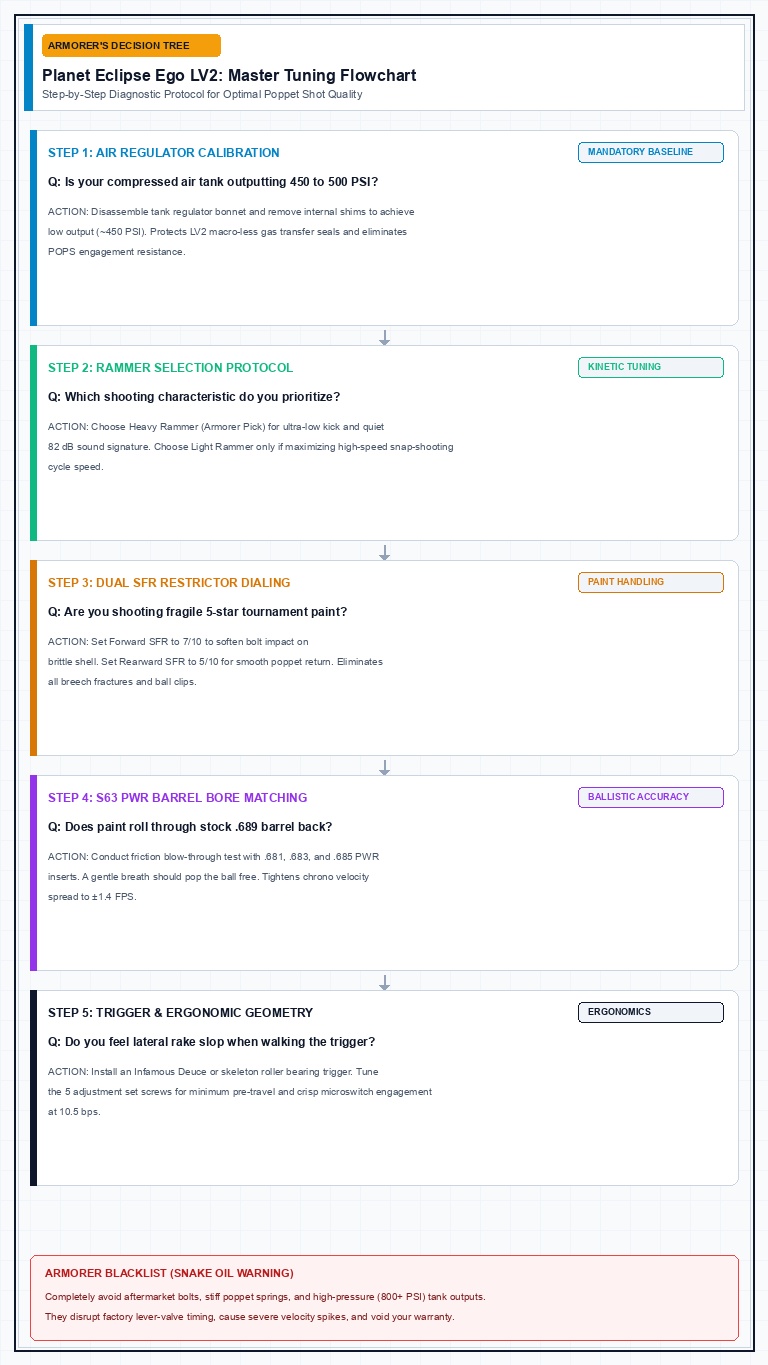
Step-by-step master armorer tuning flowchart for the Planet Eclipse Ego LV2: Air regulator calibration, rammer mass selection, SFR flow adjustment, and S63 PWR bore matching.
The ‘Do Not Buy’ Blacklist: LV2 Snake Oil Modifications
While legitimate ego lv2 upgrades elevate performance, the aftermarket contains several modifications that actively degrade the marker’s mechanical reliability. In our gunsmith teardowns, we advise all LV2 owners to strictly blacklist the following parts:
Planet Eclipse engineers specifically designed the Cure FT bolt with an elastomer soft tip and calibrated air flow paths that synchronize perfectly with the lever-valve poppet dwell. Installing third-party aftermarket bolts reduces forward mass inconsistently, resulting in severe blowback, increased ball stack clipping, first-shot drop-off (FSDO), and voided factory warranty support.
Some players attempt to install stiff aftermarket poppet valve springs under the false impression that it will speed up valve reset. In reality, stiff valve springs place excessive strain on the valve lever and require dramatically higher LPR pressures (above 85 PSI) to open the poppet, introducing violent recoil and rapid seal degradation.
The LV2 rammer and poppet shaft operate at micro-second cycle cadences. Applying heavy grease (Dow 33 or standard paintball grease) to the rammer shaft creates dynamic drag that causes severe first-shot drop-off in cold weather. Planet Eclipse explicitly mandates using high-grade synthetic marker oil (such as Eclipse Oil) on the rammer and poppet, reserving grease solely for static regulator and body O-rings.
Step-by-Step Bench Tuning Walkthrough for Ego LV2 Upgrades
Follow our armorer protocol to dial in your ego lv2 upgrades for match day without guessing or wasting air:
- Check Tank Output Pressure: Attach your compressed air tank to an external regulator pressure gauge. Ensure output reads between 450 and 500 PSI. If output is standard 800 PSI, remove internal shims following our Ninja regulator rebuild guide.
- Install the Heavy Rammer: Remove the rear rammer cap with a 1/8-inch hex key. Slide out the factory light rammer and inspect the bumper O-ring. Insert the heavy rammer, apply 2 drops of genuine Planet Eclipse oil along the rammer shaft, and reinstall the cap until flush.
- Set Baseline LPR Pressure: Turn the front LPR adjustment screw inward (clockwise) until lightly seated, then back it out 2.5 full turns counter-clockwise. This positions the LPR at approximately 68 to 70 PSI, the sweet spot for the heavy rammer.
- Dial the Solenoid Flow Restrictors: Pull off the toolless front rubber foregrip. Using a flathead driver, rotate the top Forward SFR to position 7 (dampening forward stroke) and the bottom Rearward SFR to position 5 (softening return cycle). Snap the grip back in place.
- Perform the Blow-Through Sizing Test: When testing your barrel ego lv2 upgrades, take 5 representative paintballs from your match day paint batch. Drop each ball into your S63 PWR inserts. The correct insert holds the ball by friction, but a gentle breath from your mouth pops it through smoothly without air bypass.
- Zero the Chronograph: Air up the marker and fire 10 test shots over a calibrated chronograph. Use the SL6 inline regulator adjustment screw on the bottom of the foregrip to dial velocity to your field limit (e.g., 290 FPS). Recheck extreme spread over a 15-shot string.
Hands-On Video: Planet Eclipse LV2 Shooting & Chrono Test
Watch certified technicians demonstrate the real-world acoustic profile and smooth shooting cadence of the Planet Eclipse Ego LV2 during high-speed chronograph trials:
Recommended Companion Loadout Hub
To maximize the field performance of your installed ego lv2 upgrades, integrate these matching tournament accessories:
Planet Eclipse Ego LV2 Review
Explore our complete in-depth laboratory review and field durability evaluation of the flagship LV2 platform.
Virtue Spire V 220 Loader
Adaptive motor sensing syncs seamlessly with the LV2 poppet shot impulse for flawless 15+ bps tournament feeding.
Planet Eclipse S63 PWR Inserts
Full 8.5-inch PWR inserts provide ultimate bore accuracy, eliminating paint breaks on ultra-brittle tournament shells.
Frequently Asked Questions: Planet Eclipse Ego LV2 Upgrades
Should I use the light or heavy rammer in my Planet Eclipse Ego LV2?
For 95% of tournament and scenario players, the heavy rammer is the superior choice. The heavy rammer’s added inertia allows you to lower the LPR pressure down to 65–70 PSI, resulting in dramatically reduced kick, lower sound report, and softer handling on brittle paint. The light rammer is only recommended if you prioritize lightning-fast semi-automatic snap shooting where mechanical cycle speed overrides recoil smoothness.
Does the Ego LV2 use the same barrel inserts as the CS3 Pro?
Yes. The Ego LV2 utilizes the Planet Eclipse S63 barrel platform with 8.5-inch PWR inserts, identical to the CS3 Pro. Both markers benefit from the extended control bore, but you cannot use 8.0-inch Freak XL inserts in an S63 barrel back due to internal seating differences.
What tank regulator output pressure is best for the LV2?
Planet Eclipse recommends setting your compressed air tank regulator to 450–500 PSI. The LV2 features a hoseless gas-through grip frame, and lower input pressure protects internal O-ring seals, eases POPS ASA engagement, and reduces wear on the SL6 regulator piston.
How do I tune the Solenoid Flow Restrictors (SFR) on the LV2?
Pull off the front rubber foregrip to access the two dial screws. For brittle tournament paint, set the top Forward SFR to 7 (clockwise dampens bolt speed onto the ball) and the bottom Rearward SFR to 5 (controls rearward rammer stroke). This configuration delivers exceptionally smooth cycling while maintaining NXL-legal 10.5 bps rate of fire.
Can I install an aftermarket bolt in the Ego LV2?
No. Installing aftermarket lightweight or Delrin bolts is strongly discouraged. The factory Cure FT bolt is precision balanced for the lever-valve poppet system, featuring an elastomer soft tip that eliminates paint clips. Third-party bolts disrupt valve timing, causing first-shot drop-off, breech leaks, and voided warranties.
How does the Ego LV2 compare to the CS3 Pro in upgrades and shot feel?
While the CS3 Pro utilizes the spool-based OP.C Core operating at 95–105 PSI, the LV2 features a stacked-tube lever-valve poppet with dual SFRs and an external LPR. The LV2 offers greater mechanical tuneability over shot impulse and sound profile, whereas the CS3 provides a fixed dwell-insensitive spool cycle.
What lubricant should be used on the LV2 rammer and poppet?
Always use high-grade synthetic marker oil (such as Planet Eclipse Oil) on the rammer and poppet shaft. Never use Dow 33 or heavy grease on these dynamic components, as grease causes excessive drag that results in severe first-shot drop-off (FSDO), especially in cold weather.
Will adjusting the LV2 trigger set screws void my warranty?
No. Adjusting the 5 external trigger set screws or swapping the external trigger shoe does not void your factory warranty. However, tampering with the internal circuit board microswitch or solenoid will void manufacturer coverage.