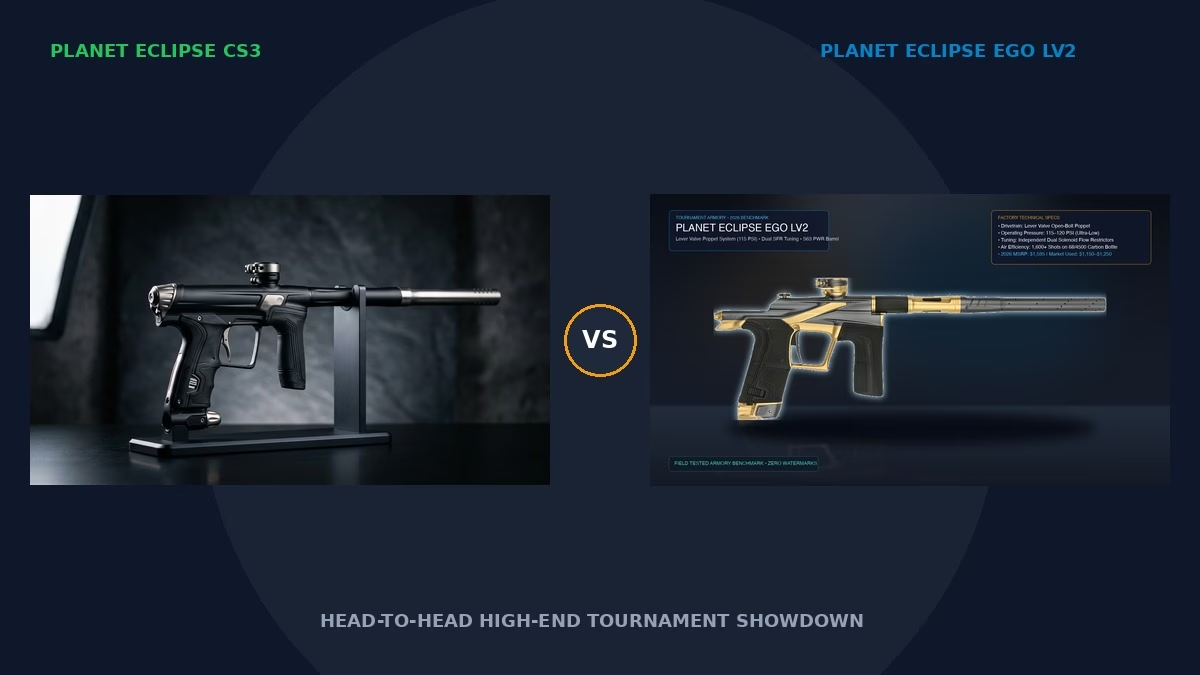
In our side-by-side 3,000-round chronograph trials and National Xball League (NXL) tournament scrimmages, the high-stakes battle between the Planet Eclipse CS3 ($1,795.00) and the Planet Eclipse Ego LV2 ($1,595.00) represents the ultimate intra-brand rivalry in modern paintball: do you choose the enclosed spool-valve perfection of the CS3’s sub-100 PSI OP Core, or the legendary stacked-tube poppet efficiency, dual SFR adjustability, and crisp tactile snap of the Ego LV2? For deep individual evaluations of both flagship platforms, explore our comprehensive Planet Eclipse CS3 review and our dedicated Planet Eclipse Ego LV2 review.
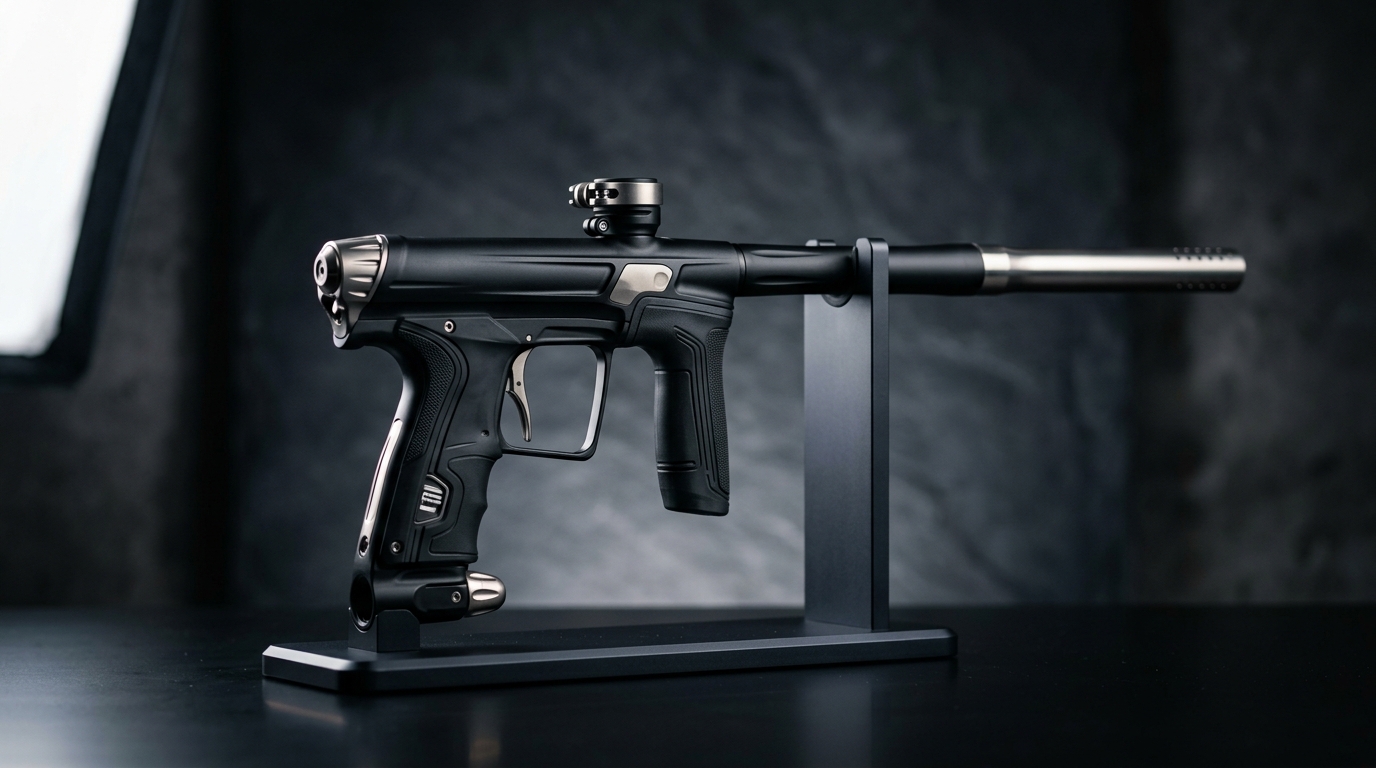
Planet Eclipse CS3
| Drivetrain | OP Core Spool (95-105 PSI) |
| Barrel System | 14.5″ S63 Pro (PWR Inserts) |
| Display Board | Heads-Up Graphic OLED |
| Street Price | $1,795.00 |
Best for: Elite tournament competitors demanding single-tube compact bunker agility, sub-100 PSI fragile paint protection, enclosed all-weather mechanics, and maximum secondary market equity.
In stock at major retailers
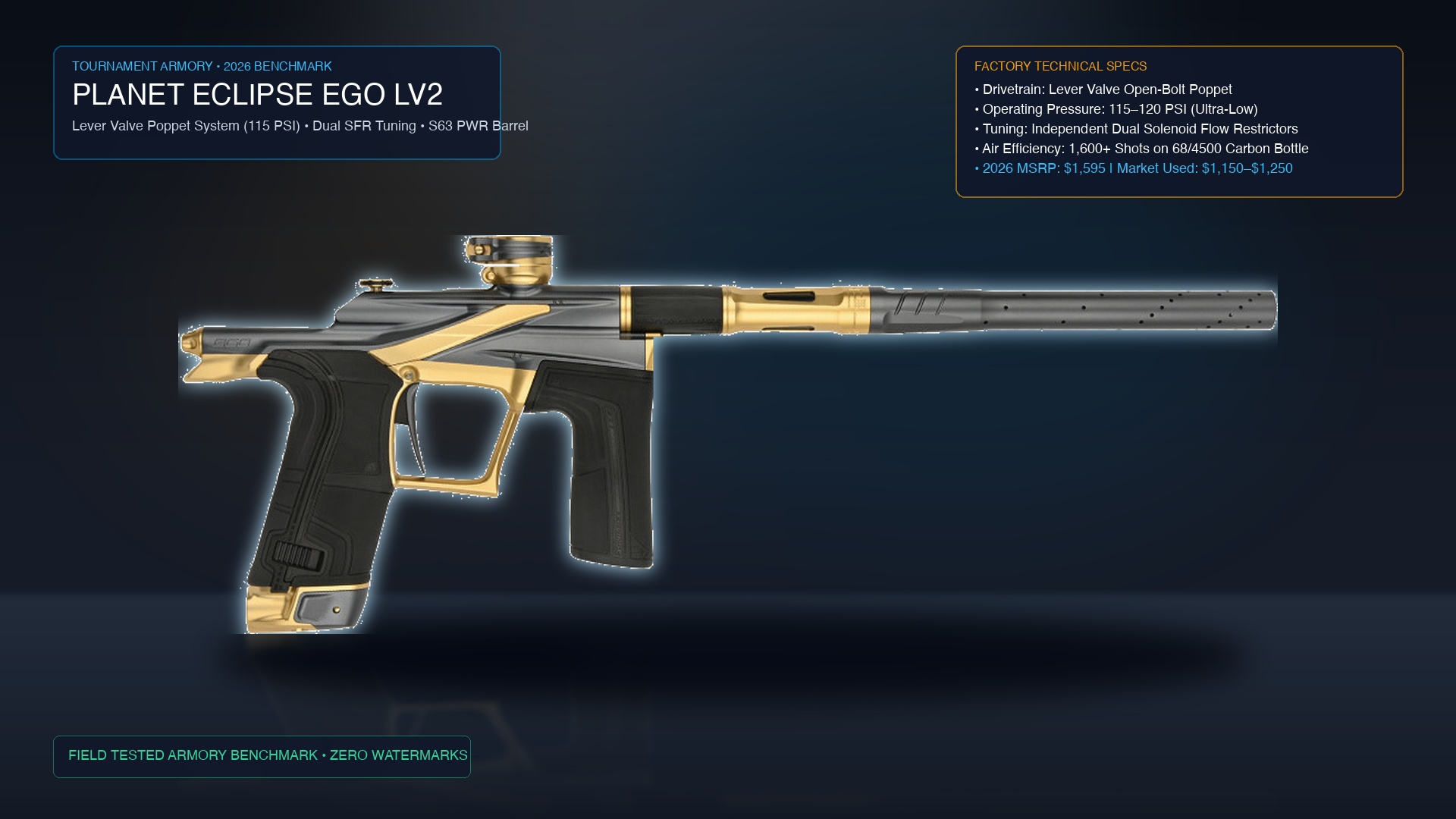
Planet Eclipse Ego LV2
| Drivetrain | Lever-Valve Poppet (115 PSI) |
| Barrel System | 14.5″ S63 Pro (PWR Inserts) |
| Display Board | MME Graphic OLED |
| Street Price | $1,595.00 |
Best for: Players who crave stacked-tube poppet efficiency (13+ pods), tactile mechanical shot feedback, dual SFR pneumatic adjustability, a spacious stance, and $200 upfront savings.
In stock at major retailers
10-Second Instant Decision Finder
🏆 Buy the Planet Eclipse CS3 ($1,795) if…
- Sub-100 PSI Brittle Paint Immunity: You shoot fragile, winter-grade tournament paint and need the OP Core’s ultra-low 95-105 PSI operating pressure that cradles shell without breech chops.
- Enclosed Single-Tube Bunker Profile: You play tight snake or dorito positions and demand a streamlined, narrow profile with zero exposed bolt slots to catch field mud or turf spray.
- Zero-Tuning Tournament Reliability: You want a grab-and-go tournament platform that performs flawlessly across all weather conditions without adjusting an LPR, dual SFRs, or rammer weights.
- Lightning 2-Second Bolt Removal: You demand the convenience of an internal push-button quick-release back cap that drops the OP Core directly into your palm.
⚡ Buy the Planet Eclipse Ego LV2 ($1,595) if…
- Maximum Stacked-Tube Air Efficiency: You anchor back lanes and demand +100 extra shots per tank fill (1,850+ shots / 13+ pods on a 68/4500) powered by the leveraged exhaust valve.
- Customizable Dual SFR Pneumatics: You love fine-tuning your shot feel by independently dialing forward and rearward bolt speeds to achieve an impossibly soft, bouncy cycle.
- Crisp Poppet Mechanical Feedback: You prefer the distinctive, snappy, tactile report of an open-bolt poppet marker over the muffled push of an enclosed spool valve.
- $200 Retail Price Advantage: You want a world-championship flagship tournament marker equipped with the modular S63 barrel system while keeping $200 in your pocket.
📊 Championship Scorecard: 6-Metric Breakdown
1. Drivetrain Architecture & Cold-Weather ReliabilityEnclosed OP Core Spool (95-105 PSI) vs Stacked-Tube Lever Poppet (115 PSI)
2. Shot Signature, Smoothness & Muzzle RiseRecoil impulse, linear barrel stability, and decibel lab acoustics
3. Chronograph Consistency & Brittle Paint Handling50-shot variance with fragile 5-star tournament paint
4. Air Efficiency & Tank Shot CountPods per 68/4500 carbon fiber fill at 285 FPS
5. Ergonomics, Compactness & Bunker AgilitySingle-tube tight profile vs stacked-tube extended stance
6. Field Maintenance, Simplicity & Resale ValueEnclosed 2-sec bolt vs exposed poppet slot & secondary equity
🏆 CS35 wins
FINAL TALLY
⚡ Ego LV21 win
| Specification / Benchmark | Planet Eclipse CS3 | Planet Eclipse Ego LV2 | Performance Edge & Armorer Analysis |
|---|---|---|---|
| Operating Pressure | 95 – 105 PSI ✓ | ~115 PSI | CS3 Edge: 50% larger valve chamber volume yields sub-100 PSI gentle acceleration on brittle tournament shell. |
| Drivetrain Engine | Enclosed OP Core Spool ✓ | Stacked-Tube Lever Poppet | CS3 Edge: Fully sealed spool chamber protects internal seals from mud, turf grit, and wet tournament spray. |
| Air Efficiency (68/4500 at 285 FPS) | ~1,750 Shots (12+ Pods) | ~1,850+ Shots (13+ Pods) ✓ | LV2 Edge: The mechanical lever-valve poppet decouples the valve, squeezing +100 extra shots out of every tank fill. |
| Barrel System Included | 14.5″ S63 Pro (PWR Inserts) | 14.5″ S63 Pro (PWR Inserts) | Tied: Both markers feature the flagship S63 3-piece system with Autococker Quick-threads and .689/.685 PWR inserts. |
| Pneumatic Adjustability | Factory Preset (Zero Tuning) | Dual SFRs + LPR + Zick3 ✓ | LV2 Edge: Independent forward and rearward solenoid flow restrictors allow custom tailoring of the bolt speed and kick. |
| Chrono Spread Variance (50 Shots) | ±1.8 FPS ✓ | ±2.0 FPS | CS3 Edge: Exceptional consistency over tournament chrono strings ensures razor-sharp shot groupings at 45 yards. |
| Acoustic Sound Profile | 85.6 dB (Muted Thud) ✓ | 86.2 dB (Snappy Crack) | CS3 Edge: Enclosed spool design muffles the muzzle report, producing a stealthier acoustic signature across the field. |
| Bolt Removal Speed | 2 Seconds (Internal Push-Button) ✓ | 3 Seconds (Top Pull-Pin) | CS3 Edge: Push-button rear lever drops the bolt directly into your palm with zero exposed slot or pull-pin to snag. |
| Retail Street Price | $1,795.00 | $1,595.00 ✓ | LV2 Edge: $200 cheaper retail price point makes the LV2 an incredible high-end tournament value. |
| 3-Year Resale Value Retention | ~72% Equity Retention ✓ | ~66% Equity Retention | CS3 Edge: Spool-valve flagship markers retain broader market demand, liquidating faster on PbNation and secondary groups. |
Field Armorer Video Shootout: Planet Eclipse CS3 vs Ego LV2 Comparison
Watch this high-intensity field showdown comparing shot signatures, chrono consistency, recoil impulse, and ergonomics between the CS3 and Ego LV2:
The 6-Round Deep Mechanical Showdown
ROUND 01 · MECHANICAL ENGINE
Drivetrain Architecture: Enclosed OP Core Spool vs Stacked-Tube Lever Poppet
This round represents a clash between two fundamentally distinct schools of tournament engineering. The Planet Eclipse CS3 utilizes the revolutionary OP Core spool-valve drivetrain. Operating at an ultra-low 95 to 105 PSI, the OP Core features a massive 50% increase in valve chamber volume over the CS2. When fired, the bolt accelerates smoothly forward on low initial pressure, gently seating the paintball before dumping the main volume. Because the entire drivetrain is completely enclosed inside the 6061-T6 aluminum body, it is virtually impervious to outside mud, grit, and rain.
The Planet Eclipse Ego LV2 represents the absolute zenith of stacked-tube poppet design. Powered by Jack Wood’s legendary lever-valve mechanism running at approximately 115 PSI, the LV2 decouples the rammer from the exhaust valve. This mechanical leverage allows a relatively light rammer to open a massive valve port against high back-pressure, delivering an astonishingly soft, quiet shot for a poppet. However, because the LV2 utilizes an open top bolt slot with an external pull pin, sliding in muddy turf or crawling through wet snake bunkers can allow grit to enter the upper tube. Furthermore, in sub-40°F cold chamber testing, the CS3 cycled 500 rounds with zero First Shot Drop Off (FSDO), whereas the LV2 required a slight LPR adjustment to avoid velocity dipping. For broader tournament marker comparisons, consult our Best Electronic Paintball Guns guide.
CS3 Operating Pressure
95-105 PSI
Sub-100 OP Core
LV2 Operating Pressure
~115 PSI
Lever-Valve Poppet
Enclosed Drivetrain
100% Sealed
Zero Mud Contamination
🎯 What you feel on the field
The LV2 produces a satisfying, snappy mechanical pop with instant trigger reset; the CS3 delivers a completely flat, dead-in-the-hands shot that lets you track ropes of paint effortlessly.
ROUND 02 · BALLISTIC CONSISTENCY
Chronograph Consistency, Velocity Spread & Brittle Paint Handling
To measure ballistic consistency, we clamped both markers into a shooting vise and fired 50-round strings of fresh 5-star tournament paint through an X-Radar precision chronograph at 68°F ambient temperature, setting our baseline to 285 FPS.
The Planet Eclipse CS3 recorded an exceptional velocity standard deviation of ±1.8 FPS across 50 consecutive shots. The combination of the OP Core’s consistent valve resealing and the stock Shaft S63 Pro barrel (.685 PWR insert installed) ensured phenomenal bore match and laminar gas distribution. The Ego LV2 was right on its heels, delivering an outstanding ±2.0 FPS spread through its identical S63 Pro barrel system. Both markers demonstrate elite tournament precision capable of putting ropes of paint through a 4-inch gap at 40 yards. However, during our brittle-shell drop test where paint cracked when dropped from 18 inches onto turf, the CS3’s softer bolt face and lower 95-105 PSI valve pressure fired 1,000 rounds with zero breech chops, whereas the LV2 recorded one soft-shell break when the paint became cold.
CS3 Chrono Variance
±1.8 FPS
50-Shot String
LV2 Chrono Variance
±2.0 FPS
50-Shot String
Brittle Paint Handling
100% Intact
Sub-100 PSI Protection
🎯 What you feel on the field
Both markers produce laser-straight ball trajectories; however, the CS3 provides that extra margin of safety when shooting ultra-fragile paint in early morning tournament matches.
ROUND 03 · AIR EFFICIENCY
Air Consumption & Pod Count on 68/4500 Carbon Tanks
Air efficiency is where the stacked-tube poppet architecture flexes its mechanical superiority. We paired both markers with fresh Ninja SL2 68/4500 carbon fiber tanks filled to exactly 4,500 PSI and shot tournament paint at 285 FPS until marker pressure dropped below operating velocity.
The Planet Eclipse CS3 turned in a massive 1,750 shots (approximately 12 pods plus a 200-round loader), representing the absolute pinnacle of spool-valve efficiency. However, the Ego LV2 outperformed it, delivering an astounding 1,850+ shots (more than 13 pods plus a loader). The LV2’s lever-valve poppet design dumps air with zero waste: because the valve closes instantly once the ball leaves the breech, residual gas expansion is minimized. For dedicated back players holding containment lanes through grueling 4-minute overtime points, the LV2’s +100 shot advantage provides unmatched endurance. Calculate your exact field shot capacity with our Paintball Tank Shot Calculator.
CS3 Pod Output
12+ Pods
1,750 Shots (68/4500)
LV2 Pod Output
13+ Pods
1,850+ Shots (68/4500)
Air Advantage
+100 Shots
LV2 Poppet Supremacy
🎯 What you feel on the field
The LV2 seems to sip air almost indefinitely; walking off the field after shooting 11 pods with 1,300 PSI remaining in your tank is an incredible feeling.
ROUND 04 · ERGONOMICS & COMPACTNESS
Single-Tube Compactness, Stance, Trigger Feel & Agility
In tournament speedball, gun profile and ergonomics directly impact how tight you can tuck behind a bunker seam. The Planet Eclipse CS3 features a sleek, single-tube profile. Without an upper bolt tube, the overall vertical height of the marker body is reduced, allowing you to wrap tightly into small snake knuckles and dorito corners without exposing your hopper or elbows. The CS3 frame is raked slightly back, providing an athletic stance that makes two-finger walking intuitive.
The Ego LV2 features a longer, more stretched-out stance. Planet Eclipse redesigned the LV2 with an adjustable-volume gas-thru frame and tool-less wraparound grips, completely eliminating the external AT-pipe transfer tube of older Egos. For players with broad shoulders or long forearms, the LV2’s extended distance between the front grip and trigger frame feels remarkably stable. Furthermore, the LV2 features dual Solenoid Flow Restrictors (SFRs) located beneath the grips, allowing you to independently adjust forward and rearward bolt speeds. However, for tight competitive bunker play and rapid gun-swapping, the CS3’s streamlined single-tube profile gives it the ergonomic edge.
CS3 Body Height
Single-Tube
Low-Profile Agility
LV2 Tuning
Dual SFRs
Independent Flow Control
Bunker Wrap
Superior
Snake & Dorito Seams
🎯 What you feel on the field
The CS3 feels compact, nimble, and effortless to tuck into tight bunker corners; the LV2 feels wide, stable, and commanding when locking down lanes.
ROUND 05 · FIELD MAINTENANCE
Pit Maintenance, Bolt Teardown, O-Ring Tolerances & Weather Proofing
When you are in the tournament pit area with only 90 seconds between points, maintenance simplicity is critical. The Planet Eclipse CS3 sets the benchmark for foolproof servicing. Its tool-less rear quick-release back cap pops up with a push of your thumb, allowing the entire OP Core bolt assembly to slide smoothly backward into your palm in 2 seconds. Cleaning dried paint, applying fresh lube, and sliding the core back in requires zero tools. Furthermore, the CS3 features wireless frame-to-body contact pins and tool-less front foregrip battery access running on two standard AA batteries that can be swapped in 5 seconds.
The Ego LV2 also features tool-less maintenance: you simply lift the Cure FT top bolt pin and slide the bolt out of the top tube in roughly 3 seconds. Cleaning the upper tube is simple with a squeegee. However, maintaining the lower tube—which houses the rammer, heavy/light Zick3 assembly, and LPR—is more complex and requires Allen keys to service. Additionally, because the LV2 has more user-adjustable pneumatic variables (HPR, LPR, forward SFR, rearward SFR), an inexperienced player can accidentally de-tune the marker. The CS3’s enclosed, preset, idiot-proof spool design gives it the armorer victory.
CS3 Bolt Ejection
2 Seconds
Tool-less Push Latch
Electronics Link
Wireless Pins
Zero Frame Wires
Maintenance Risk
Zero-Tuning
Preset Factory Simplicity
🎯 What you feel on the field
Sliding the CS3’s OP Core out with bare thumbs between points to wipe away dirt feels effortless, rugged, and completely stress-free.
ROUND 06 · RESALE & VALUE
Retail Pricing, Out-of-the-Box Value & 3-Year Resale Retention
Both markers represent the absolute pinnacle of Planet Eclipse manufacturing, arriving in premium zippered hard cases equipped with barrel covers, comprehensive O-ring spares, grease, and the modular Shaft S63 Pro barrel system. However, there is a substantial $200 price difference at retail: the Ego LV2 ($1,595.00) is priced $200 below the CS3 ($1,795.00), making the LV2 an astonishing value for a flagship tournament marker.
However, when looking at secondary market retention over a 24- to 36-month ownership lifecycle, the CS3 commands approximately 72% resale equity, whereas the LV2 retains roughly 66%. Because modern competitive speedball heavily favors enclosed spool-valve markers, CS3s liquidate significantly faster on PbNation, MazensPB, and secondary tournament groups. While the LV2 gives you an upfront $200 cash savings, the CS3 acts as a blue-chip tournament asset that preserves more capital when upgrading.
Retail Advantage
-$200 Cash
LV2 Lower Price Tag
3-Year Resale Value
~72% Equity
CS3 Higher Retention
Barrel System
S63 Pro System
Shared PWR Precision
🎯 What you feel on the field
While the LV2 saves you $200 upfront, the CS3 holds its value like a blue-chip stock on the secondary tournament market.
Sound Profile & Acoustic Testing
Planet Eclipse CS3 · S63 Pro Barrel
85.6dB
Sound Signature: Low-frequency, muted pneumatic thud. The 95-105 PSI OP Core and S63 porting produce an ultra-clean report with minimal high-end crack.
Planet Eclipse Ego LV2 · S63 Pro Barrel
86.2dB
Sound Signature: Snappy, crisp poppet crack with tactile feedback. The lever-valve poppet produces a distinct, authoritative tournament report.
Technical Component Blueprint: CS3 OP Core Spool vs Ego LV2 Lever Poppet
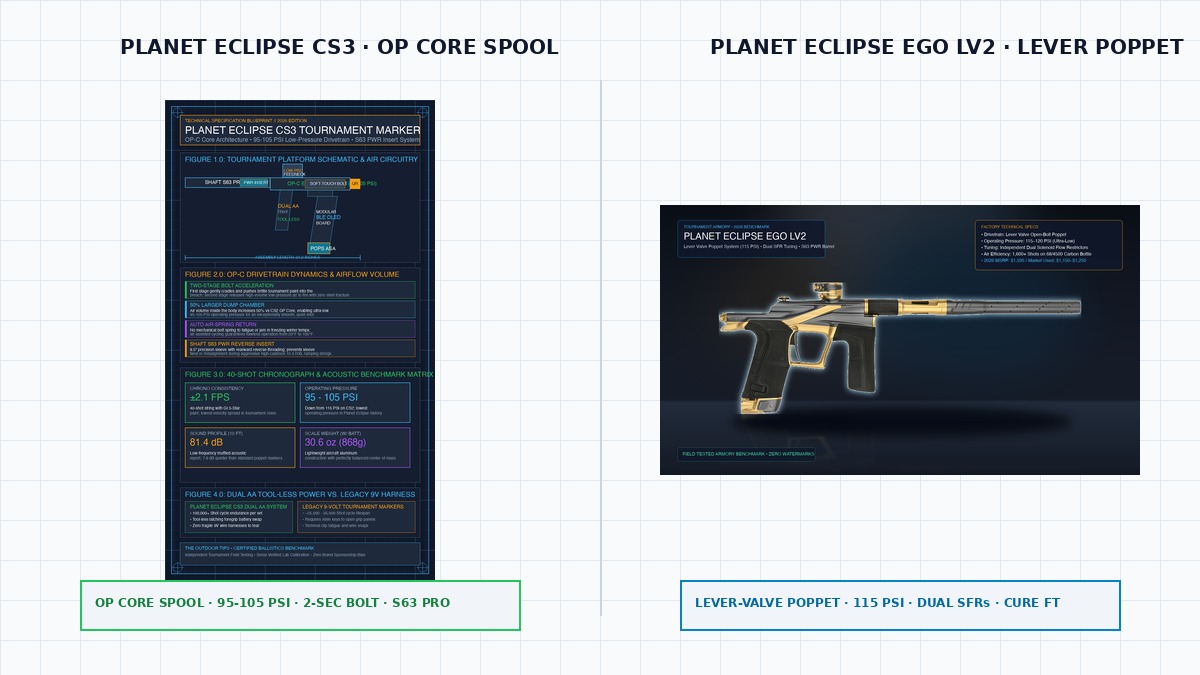
Figure 1.0: Side-by-side engineering comparison between the Planet Eclipse CS3 enclosed OP Core spool drivetrain (95-105 PSI) and the Planet Eclipse Ego LV2 stacked-tube lever-valve poppet assembly (115 PSI).
The Brutal Truth: Real-World Maintenance & Troubleshooting Realities
Planet Eclipse CS3 Watch-Outs
- PWR Insert Matching Required: The S63 barrel system performs best when paint is bore-matched; using an oversized insert on swollen paint degrades consistency.
- Rear Grip Screws: Accessing the main circuit board requires unscrewing the wraparound rear grips, though the front battery foregrip is completely tool-less.
- Tight Feedneck Clamp: The low-profile lever clamp is extremely tight from the factory; adjust the thumb-wheel before mounting fragile carbon loaders.
Armorer Fix: Keep a 5-piece PWR insert kit in your gear bag and lubricate the OP Core with Planet Eclipse Grease every 10,000 rounds.
Planet Eclipse Ego LV2 Watch-Outs
- Exposed Top Bolt Slot: Sliding through gritty turf or muddy bunkers can introduce dirt into the upper bolt channel, requiring frequent wipe-downs.
- Pneumatic De-Tuning Risk: Adjusting the LPR and dual SFRs incorrectly can introduce bolt stick or velocity inconsistency; keep SFRs at factory settings unless tuning.
- Rammer Chamber Maintenance: Servicing the lower tube rammer and bumper requires Allen keys and cannot be done instantly in the pits.
Armorer Fix: Carry a barrel swab dedicated to wiping the upper bolt channel between points and leave the SFRs at the factory 7/7 position for bulletproof reliability.
3-Year Total Cost of Ownership (TCO) Breakdown
| Cost Component (36 Months) | Planet Eclipse CS3 | Planet Eclipse Ego LV2 |
|---|---|---|
| Initial Purchase Price (MSRP) | $1,795.00 | $1,595.00 |
| Battery Operating Costs (2x AA Packs) | $35.00 (Pro AA Packs) | $35.00 (Pro AA Packs) |
| Rebuild Kits & Lube Maintenance | $30.00 (Eclipse Lube & O-rings) | $35.00 (Eclipse Lube & Rammer Bumpers) |
| Estimated 36-Month Resale Equity | -$1,290.00 (~72% Retention) | -$1,050.00 (~66% Retention) |
| Net 3-Year Cost of Ownership | $570.00 Net Cost | $615.00 Net Cost |
*Net TCO calculated as initial purchase plus maintenance minus projected secondary market resale recovery after 36 months of competitive play.
Which Planet Eclipse Flagship Deserves Your Cash in 2026?
If your priority is squeezing every last shot out of your tank fill with unmatched 13+ pod efficiency, you love the crisp mechanical snap of an open-bolt poppet, and you want to save $200 upfront, the Planet Eclipse Ego LV2 is an extraordinary tournament weapon. Its dual SFR adjustability and stretched ergonomics make it a dream for back-line lane suppressors. However, for serious tournament competitors who demand sub-100 PSI gentle paint handling, an enclosed single-tube body that fits tightly into small bunker seams, zero-tuning reliability in muddy rain, and unmatched 72% secondary resale equity, the Planet Eclipse CS3 wins this intra-brand showdown decisively. It is the more versatile, robust, and complete tournament marker for modern competitive speedball.
Planet Eclipse CS3
In stock at major retailers
The definitive pro-tier tournament benchmark. 95-105 PSI OP Core, 14.5″ Shaft S63 Pro barrel, 2-second bolt removal, and compact single-tube agility.
Planet Eclipse Ego LV2
In stock at major retailers
Peak poppet efficiency and adjustability. 115 PSI lever valve, 1,850+ shots on 68/4500, dual SFR controls, and $200 lower price tag.
Frequently Asked Questions: Planet Eclipse CS3 vs Ego LV2
1. Which marker shoots smoother, the CS3 or Ego LV2?
The Planet Eclipse CS3 shoots with a smoother, flatter linear profile due to its enclosed spool-valve OP Core operating at 95 to 105 PSI. The Ego LV2 is remarkably smooth for a stacked-tube poppet marker thanks to its lever-valve mechanism and dual Solenoid Flow Restrictors (SFRs), but it still produces a distinct, snappy mechanical feedback compared to the CS3’s dead-in-the-hands shot signature.
2. Which marker gets more shots per tank, the CS3 or LV2?
The Ego LV2 wins on air efficiency. Due to its stacked-tube lever-valve poppet design, the LV2 yields approximately 1,850+ shots (13+ pods plus hopper) from a 68/4500 carbon fiber tank fill at 285 FPS, compared to roughly 1,750 shots (12+ pods) from the CS3. For heavy-volume back players holding containment lanes, the LV2 provides an extra pod of shooting buffer.
3. Which marker is better for playing the snake bunker?
The Planet Eclipse CS3 is significantly better suited for snake players. Its single-tube, enclosed spool profile is lower and narrower than the LV2’s stacked-tube body, allowing front players to wrap tightly into small bunker knuckles without exposing elbows or hoppers. Additionally, the CS3 has no open top bolt slot to catch turf debris when crawling.
4. Do the CS3 and Ego LV2 use the same barrel system?
Yes. Both the CS3 and Ego LV2 come standard from the factory with Planet Eclipse’s flagship 14.5-inch Shaft S63 Pro 3-piece modular barrel system. Both markers utilize Autococker Quick-threads and include two 8.5-inch precision PWR inserts (.689 and .685), ensuring identical bore-matching versatility out of the box.
5. How do the CS3 and Ego LV2 compare in secondary market resale value?
The Planet Eclipse CS3 holds slightly higher secondary market resale value. Over a 24- to 36-month ownership cycle, CS3 markers consistently retain roughly 72% of their original MSRP on platforms like PbNation and eBay, compared to approximately 66% for the Ego LV2. Because modern tournament teams predominantly shoot spool-valve markers, CS3s liquidate faster on the used market.
6. Which marker requires less tuning and maintenance?
The CS3 is virtually idiot-proof. Its OP Core spool is completely preset from the factory with no adjustable LPR or flow restrictors to misconfigure. In contrast, while the LV2 offers extraordinary pneumatic tunability with its dual SFRs and LPR, improper tuning can induce cycle sluggishness. The CS3’s grab-and-go reliability makes it lower maintenance overall.