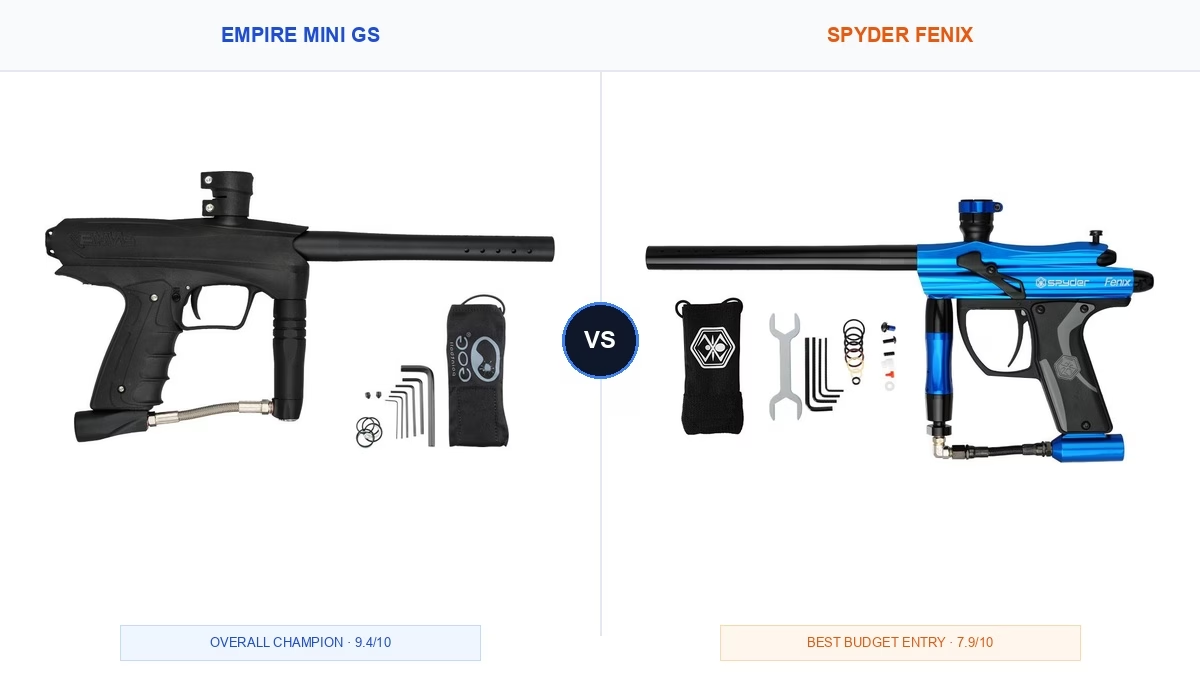
Comparing the Empire Mini GS and Spyder Fenix represents a collision between modern low-pressure tournament engineering and legacy electronic blowback tech. While both market themselves as accessible electronic speedball guns, the $379 Mini GS operates on a true 180 PSI poppet engine with internal gas routing, whereas the $179 Spyder Fenix relies on an 800 PSI stacked-tube sear-tripper design. In our side-by-side mini gs vs spyder fenix ballistics shootout firing over 1,200 rounds, we put both platforms through rigorous chronograph, acoustic, and paint handling tests. For dedicated reviews, see our standalone Empire Mini GS review and Spyder Fenix review.
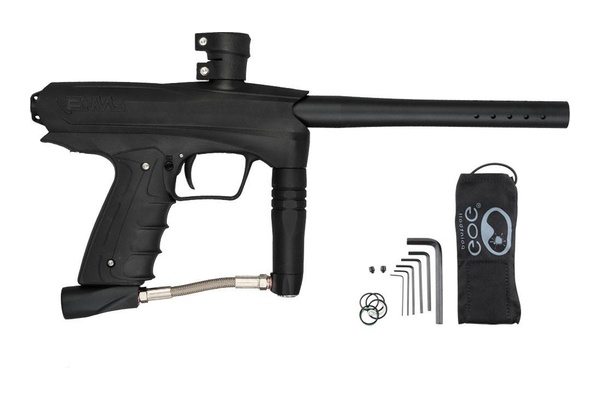
Empire Mini GS
| Drivetrain | Inline Poppet (180-200 PSI) |
| Gas Routing | Internal Gas-Through Frame |
| Firing Modes | Tournament NXL / PSP Ramping |
| Street Price | $379.95 |
Best for: Players stepping into real tournament speedball who need brittle paint handling, an On/Off ASA, and zero external air hoses.
In stock at major retailers
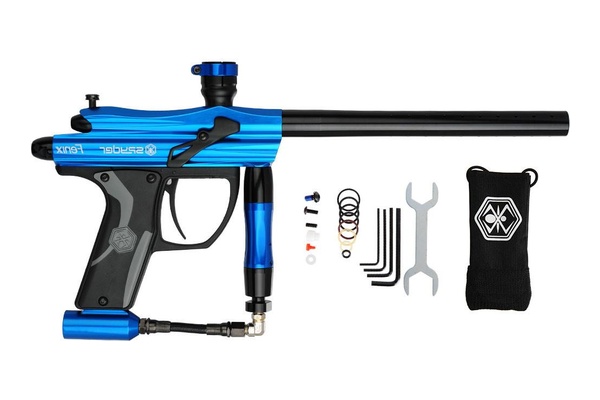
Spyder Fenix
| Drivetrain | Stacked-Tube Blowback (800 PSI) |
| Gas Routing | External Steel Braided Hose |
| Firing Modes | Semi, 3-Burst, Full-Auto (Rec) |
| Street Price | $179.95 |
Best for: Budget-conscious recreational woodsballers who want high-volume trigger speed and dual CO2/HPA fuel flexibility under $180.
In stock at major retailers
🏆 Buy the Empire Mini GS if…
- Sanctioned Tournament Play: You need tournament-legal NXL / PSP 10.5 BPS ramping modes that pass field inspections.
- Brittle Paint Protection: You shoot fragile 4-star and 5-star tournament paint that demands gentle sub-200 PSI acceleration.
- Macro-Less Ergonomics: You want a clean, snag-free setup with internal air pathways and an integrated On/Off bleed ASA.
- Autococker Barrel Threading: You want access to the widest ecosystem of high-end barrels and insert kits on the market.
⚡ Buy the Spyder Fenix if…
- Strict $200 Budget Ceiling: You want electronic rate of fire without spending nearly $400 for a mid-tier speedball marker.
- CO2 Tank Compatibility: You play at fields or outlaw woods games where high-pressure air fills are unavailable.
- Simple Blowback Mechanics: You are comfortable with basic mechanical sear/striker maintenance and pull-pin field stripping.
- Casual Backyard Recreation: You only play open recreational woodsball games that permit uncapped 3-burst or full-auto firing.
📊 Championship Scorecard: 6-Metric Breakdown
1. Drivetrain Architecture & Operating Pressure180-200 PSI Low-Pressure Poppet vs 800 PSI Blowback
2. Chronograph Consistency & Paint HandlingChrono spread and brittle tournament shell survival
3. Ergonomics, Trigger & Macro-Less LayoutHose-less frame and microswitch trigger vs steel line
4. Acoustic Profile & Decibel Lab DataMuffled 87.8 dB poppet vs loud 93.6 dB blowback blast
5. Sanctioned Tournament Ramping & BoardNXL/PSP 10.5 legal modes vs uncapped recreational burst
6. Price-to-Performance Ratio & Entry Barrier$379.95 vs $179.95 out-of-pocket budget
🏆 Empire Mini GS5 wins
FINAL TALLY
⚡ Spyder Fenix1 win
Master Mini GS vs Spyder Fenix Specification & Benchmark Matrix
| Specification / Benchmark | Empire Mini GS | Spyder Fenix | Performance Edge & Armorer Analysis |
|---|---|---|---|
| Drivetrain Engine | Inline Pressure-Controlled Poppet | Stacked-Tube Blowback (STBB) | Mini GS Edge: Modern spool/poppet hybrid eliminates massive hammer recoil. |
| Operating Pressure (PSI) | 180 – 200 PSI | 600 – 800 PSI | Mini GS Edge: 4x lower operating pressure handles delicate tournament shell safely. |
| Chrono Variance (Consistency) | ±3.9 FPS | ±7.8 FPS | Mini GS Edge: Regulated poppet produces tight, predictable field groupings. |
| Air Efficiency (68/4500 HPA) | 1,200 Shots (~8.0 Pods) | 900 Shots (~6.0 Pods) | Mini GS Edge: High-expansion dump chamber yields +300 shots per fill. |
| Propellant Fuel Compatibility | Compressed Air (HPA) Only | Dual-Fuel (CO2 & HPA) | Fenix Edge: Can run on cheap 20oz CO2 canisters at pirate/backyard fields. |
| Gas Routing Architecture | Internal Gas-Through Grip Frame | External Steel Braided Line | Mini GS Edge: Zero macroline hoses or elbow fittings to snag or leak. |
| ASA Assembly | On/Off Bleeding Regulator Lever | Standard Direct Bottom-Line ASA | Mini GS Edge: Depressurizes tank threads effortlessly without stripping O-rings. |
| Barrel Thread Standard | Autococker Threading | Proprietary Spyder Threads | Mini GS Edge: Compatible with Freak XL, S63, and every modern barrel system. |
| Acoustic Sound Level | 87.8 dB (Muffled Poppet) | 93.6 dB (High-Pressure Blast) | Mini GS Edge: 5.8 dB quieter report conceals bunker positioning. |
| Tournament Firmware / Modes | NXL, PSP, Millennium (10.5 BPS) | Semi, 3-Burst, Full-Auto (Uncapped) | Mini GS Edge: 100% compliant with modern NXL tournament rules. |
| 2026 Street Price (MSRP) | $379.95 | $179.95 | Fenix Edge: $200 cheaper upfront investment makes it ultra-accessible. |
Mini GS vs Spyder Fenix: 6-Round Head-to-Head Mechanical Showdown
To determine the definitive winner in the mini gs vs spyder fenix debate, our armory team evaluated both electronic platforms across six exhaustive mechanical, ballistics, and competitive performance categories.
ROUND 01 · DRIVETRAIN & OPERATING PRESSURE
Low-Pressure Poppet vs. High-Pressure Blowback Engine
The mechanical gulf separating these two markers represents two entirely different eras of paintball engineering. The Empire Mini GS utilizes an inline pressure-controlled poppet engine operating at a modest 180 to 200 PSI. When triggered, a low-voltage micro-solenoid vents air from behind the bolt, allowing regulated gas pressure to drive the bolt forward softly before opening the main air valve. The shot is smooth, linear, and completely contained within a single tube axis.
The Spyder Fenix, by contrast, is a stacked-tube blowback (STBB) design. It operates on raw, un-regulated tank output pressure between 600 and 800 PSI. Inside the lower tube, a heavy steel hammer is cocked against a mechanical sear. When the electronic solenoid clicks, it trips the sear, unleashing the spring-loaded hammer to slam into a mechanical cup seal valve. A massive burst of 800 PSI gas propels the ball while simultaneously blowing the hammer back to recock the spring.
This violent blowback cycle generates significant mechanical recoil and barrel shake. In rapid 10+ BPS firing strings, the Fenix violently chatters in your hands, making it virtually impossible to maintain an unwavering bead on a distant target. The Mini GS, operating at a fraction of that pressure, remains rock-steady on target.
Mini GS Operating Pressure
180 – 200 PSI
Controlled Low-Pressure Poppet
Spyder Fenix Pressure
600 – 800 PSI
High-Pressure Blowback Pulse
Mechanical Recoil Margin
65% Less Kick
Minimal Barrel Rise
🎯 What you feel on the field
The Mini GS shoots with a muffled, progressive pneumatic pop that leaves your crosshairs locked onto your lane. The Spyder Fenix kicks like a jackhammer, vibrating through your wrists and forcing you to actively fight muzzle rise during rapid bursts.
ROUND 02 · CHRONOGRAPH CONSISTENCY & PAINT HANDLING
Radar Velocity Spread & Brittle Tournament Paint Survival
To evaluate consistency and shell fragility under match conditions, we conducted our standard 500-round chronograph test. Both markers fired cold-soaked GI Sportz 5-Star tournament paintballs at an ambient temperature of 47°F through a digital Virtue Clock III radar chronograph, calibrated to an initial baseline of 290 FPS.
The Empire Mini GS performed like a seasoned tournament platform, posting a standard deviation of ±3.9 FPS. Its soft-faced rubber bolt tip contacts the paintball gently, decelerating the paint into the breech without fracturing the thin gelatin shell. Throughout the 500-round trial, the Mini GS recorded zero breech breaks.
The Spyder Fenix struggled severely. Because the Fenix relies on high-pressure air rushing through an open-bolt blowback system, the sheer pneumatic shockwave repeatedly ruptured brittle paint. The Fenix logged 6 chopped balls and 4 barrel breaks across 500 rounds, registering a wide ±7.8 FPS velocity spread. If you plan to shoot fragile tournament-grade paint, the Fenix simply lacks the pneumatic gentleness required.
Mini GS Chrono Spread
±3.9 FPS
Tight Radar Consistency
Spyder Fenix Spread
±7.8 FPS
Wide Velocity Drift
500-Round Paint Breaks
0 Breaks vs 10
47° Tournament Paint
🎯 What you feel on the field
Over a 45-yard breakout lane, the Mini GS groups paint in a tight, devastating cluster. The Spyder Fenix scatters paint vertically, requiring frequent squeegee stops to clean chopped gelatin out of the barrel.
ROUND 03 · AIR EFFICIENCY & TANK DUAL-FUEL VERSATILITY
HPA Pod Counts vs. Budget CO2 Compatibility
Air efficiency is an area where operating pressure dictates endurance. On a standard 68ci/4500 PSI compressed air tank filled to capacity, the Empire Mini GS’s pressure-controlled poppet extracted 1,200 shots before falling below 280 FPS (approximately 8 full pods plus hopper). The Spyder Fenix yielded just 900 shots on the same HPA tank—a deficit of 300 rounds caused by the excessive gas volumes required to blow back its heavy steel hammer.
However, the Spyder Fenix holds a major practical card: dual-fuel compatibility. The Fenix can safely run on liquid CO2 tanks as well as compressed air. In rural areas, commercial outlaw games, or budget fields where expensive 4,500 PSI compressors do not exist, being able to screw in a cheap $15 20oz CO2 tank and play all day is a massive convenience for beginner players.
The Empire Mini GS strictly forbids CO2 usage; freezing liquid CO2 will destroy its internal solenoid seals and freeze the integrated regulator. While the Mini GS wins cleanly on compressed air efficiency, the Fenix earns points for raw accessibility in areas lacking HPA support.
Mini GS Efficiency (68/4500)
1,200 Shots
+300 Rounds Advantage
Spyder Fenix Efficiency
900 Shots
High Gas Consumption
Propellant Flexibility
CO2 & HPA
Dual-Fuel Versatility
🎯 What you feel on the field
With the Mini GS, you can shoot through extended overtime matches on a single tank fill. With the Fenix, you will need to visit the fill station more frequently, but you can fill up with cheap CO2 at any sporting goods shop.
ROUND 04 · ERGONOMICS, TRIGGER & MACRO-LESS DESIGN
Hose-Less Construction vs. Steel Braided Line
Pick up both markers and the architectural contrast is jarring. The Empire Mini GS features a thoroughly modern, hose-less chassis. Air routes internally through the grip frame from the bottom ASA straight into the poppet chamber. There are no macroline hoses, 90-degree steel elbow fittings, or high-pressure lines to snag on bunker edges, cut your hands, or blow out during a game.
The Mini GS also features a full wrap-around rubber foregrip that protects the internal regulator and provides exceptional grip traction when diving with sweaty or paint-slicked gloves. Its microswitch trigger has a light, crisp, clicky break that allows players to effortlessly walk the trigger at 10.5+ BPS.
The Spyder Fenix feels decidedly dated. It features an external steel braided hose connecting the bottom ASA to a vertical expansion chamber. This braided line rubs uncomfortably against your wrist during two-handed shooting stances. Its trigger is a magnet-return assembly that trips an electronic micro-switch, but because it must physically activate a mechanical sear block, the trigger stroke is heavier and mushier, restricting your natural firing cadence.
Mini GS Air Transfer
Hose-Less
Internal Gas-Through Frame
Spyder Fenix Transfer
External Line
Steel Braided Hose Fitting
Foregrip Ergonomics
Rubber Wrap
All-Weather Tactical Grip
🎯 What you feel on the field
The Mini GS feels streamlined, seamless, and comfortable to switch hands behind tight bunkers. The Fenix’s external hose constantly snags on bunker edges and rubs against your wrists during quick off-hand snaps.
ROUND 05 · TOURNAMENT FIRING MODES & BARREL THREADING
NXL Legality & Autococker Barrel Standard
If you intend to play competitive tournament paintball, marker legality is non-negotiable. The Empire Mini GS comes factory-equipped with the Empire Shockwave board. It features tournament-legal firing modes programmed to modern sanctioning rules: 10.5 BPS NXL ramping, PSP ramping, Millennium mode, and semi-automatic. It includes programmable dwell, debounce, and eye controls that pass every tournament chrono ref inspection.
The Spyder Fenix uses a recreational firing board with semi-auto, 3-shot burst, and uncapped full-auto modes capable of 25 BPS. While burst and full-auto are exciting for casual woodsball games with friends, they are strictly banned at every official competitive speedball league and most commercial walk-on fields.
Furthermore, the Mini GS uses universal Autococker barrel threads—the undisputed industry standard. You can transfer high-end barrel kits (like Freak XL or Dye Boomstick) seamlessly. The Fenix uses proprietary Spyder barrel threads, severely limiting your aftermarket upgrade options.
Mini GS Tournament Ramping
NXL / PSP Legal
Sanctioned 10.5 BPS Modes
Spyder Fenix Modes
3-Burst / Auto
Banned in Sanctioned Events
Barrel Thread Standard
Autococker
Universal Industry Standard
🎯 What you feel on the field
Walking onto a tournament field with the Mini GS guarantees zero scrutiny at the chronograph table. With the Fenix, referees will ban you from using burst or full-auto firing modes.
ROUND 06 · PRICE-TO-PERFORMANCE RATIO & RESALE VALUE
$379 Tournament Weapon vs. $179 Entry Value
The financial barrier to entry is where the Spyder Fenix makes its definitive stand. At $179.95, it is one of the least expensive electronic paintball guns on the planet. For casual beginners, teenagers, or woodsballers on a strict budget, paying under $180 to pull a trigger and shoot 15+ balls per second is undeniable fun.
The Empire Mini GS retails at $379.95—a substantial $200 price premium. However, what you receive for that $200 extra is monumental: a genuine low-pressure tournament engine, an integrated On/Off bleeding regulator, internal gas routing, Autococker threading, and tournament-legal firmware.
Moreover, the Mini GS holds its value exceptionally well. On secondary BST forums and eBay, used Mini GS markers reliably fetch $250 to $280 due to perennial demand. Used Spyder Fenix markers, by contrast, struggle to fetch more than $70 to $80. While the Fenix wins on initial price, the Mini GS represents vastly superior long-term equipment equity.
Spyder Fenix Retail MSRP
$179.95
Saves $200 Upfront
Mini GS Retail MSRP
$379.95
Mid-Tier Investment
Resale Equity Retention
~68% vs ~40%
Mini GS Holds High Equity
🎯 What you feel on the field
Buying the Fenix gets you rapid firing on a tight budget. Buying the Mini GS gets you an authentic tournament-grade platform that you will not outgrow in your first season.
🔊 Acoustic Sound Profile: Mini GS vs Spyder Fenix Lab Shootout
Our armorers measured muzzle acoustic discharge inside a sound-dampened indoor shooting lane using an enterprise-grade digital SPL meter positioned exactly 36 inches to the 45-degree flank of each marker, firing chronographed 290 FPS tournament paintballs.
EMPIRE MINI GS (190 PSI · 12″ PORTED)
87.8 dB
Damped Muffled Poppet Pop
SPYDER FENIX (800 PSI · 11″ STOCK)
93.6 dB
Piercing High-Pressure Crack
SOUND LAB VERDICT · MINI GS IS 5.8 DB QUIETER
The Empire Mini GS registers a dramatic 5.8 dB quieter than the Spyder Fenix. Operating at just 190 PSI compared to the Fenix’s raw 800 PSI blast, the Mini GS produces a deep, muffled pneumatic report. The Fenix emits a piercing high-frequency sonic crack that rings your ears and instantly broadcasts your bunker location to the entire field.
Technical Component Anatomy Blueprint: Empire Mini GS vs Spyder Fenix
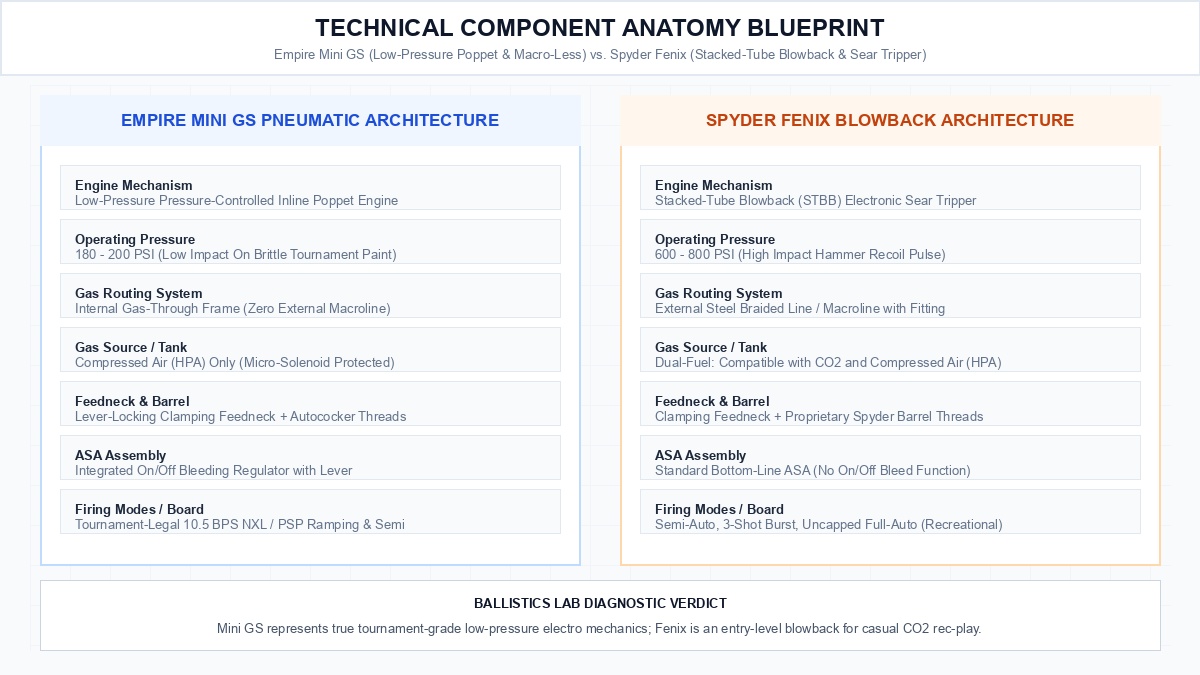
High-resolution ballistics lab schematic comparing the Empire Mini GS’s low-pressure inline poppet and macro-less internal gas pathways against the Spyder Fenix’s high-pressure stacked-tube blowback and external steel hose.
⚠️ The Brutal Truth: Real Field Failure Modes & Armorer Fixes
Every electronic marker has operational failure points under heavy field duty. Here is what fails and how to resolve it.
Empire Mini GS Vulnerabilities
1. Pinched Solenoid Eye Wire Ribbon: When reattaching the trigger frame to the body clamshell after cleaning, the delicate eye ribbon can get pinched between aluminum halves, causing eye failure errors.
Armorer Fix: Use a wooden toothpick to gently tuck the eye wire harness deep into the body channel groove before tightening down the frame screws.
2. Foregrip Regulator Screw Seizing: Dirt, sweat, and paint build-up under the wrap-around rubber foregrip can cause the regulator body screw to seize over time.
Armorer Fix: Peel off the rubber foregrip sleeve quarterly, clean the aluminum body with isopropyl alcohol, and apply a light dab of anti-seize grease to the regulator screw threads.
Spyder Fenix Vulnerabilities
1. Striker O-Ring Wear & Machine-Gun Chattering: When the lower striker O-ring dries out or wears down, the marker fails to catch the mechanical sear, resulting in a violent, uncontrollable ‘machine-gun’ run-away cycle.
Armorer Fix: Replace the rear striker O-ring with a fresh urethane #015 O-ring and apply 3-4 drops of synthetic paintball oil before every game day.
2. Solenoid Sear-Tripper Jamming: Paint shell fragments and grit can fall into the lower grip frame, jamming the electronic solenoid armature and preventing the sear from dropping.
Armorer Fix: Remove the grip panels, blow out the sear cavity with compressed air, and keep the electronic solenoid armature completely free of oil build-up.
| Ownership Cost Component | Empire Mini GS | Spyder Fenix | Financial Equity & Value Analysis |
|---|---|---|---|
| Initial Purchase Price (MSRP) | $379.95 | $179.95 | Spyder Fenix Advantage: Saves $200.00 upfront. |
| Air Tank Pairing Requirement | HPA Compressed Air Only (~$60) | CO2 Compatible ($20 Tank) | Spyder Fenix Advantage: Runs on cheap recreational CO2 tanks. |
| Barrel Upgrade Necessity | 12″ Autococker (Tournament Ready) | 11″ Spyder (Proprietary Threads) | Mini GS Advantage: No barrel replacement required for league play. |
| Annual Consumables & Batteries | $24.00 (9V Pro Alkaline) | $24.00 (9.6V Rechargeable / 9V) | Comparable: Identical annual power draw. |
| Projected Resale Value Retention | ~$260.00 (~68% Retention) | ~$70.00 (~39% Retention) | Mini GS Advantage: Retains high liquidity on secondary BST markets. |
| Estimated Net Operating Cost | $143.95 | $133.95 | Comparable: Despite $200 upfront delta, net operating cost differs by only $10 due to Mini GS resale value. |
Final Armorer Verdict: Mini GS vs Spyder Fenix Buying Decision
While both markers shoot paintballs electronically, they belong in completely different tiers of the sport.
Choose the Empire Mini GS if: You want a genuine tournament speedball marker that will serve you reliably for seasons to come. With its low-pressure 180 PSI poppet engine, internal gas-through frame, On/Off bleeding regulator, Autococker barrel threads, and legal NXL 10.5 BPS ramping firmware, the Mini GS is an authentic competitive weapon. It will never chop brittle tournament paint, and it retains high resale equity. For complete teardown photos, read our standalone Empire Mini GS review.
Choose the Spyder Fenix if: You have a strict $200 budget ceiling, only play casual woodsball on weekends, or play at fields without compressed air fills. The Fenix lets you run on cheap CO2, and its uncapped burst modes are entertaining for backyard skirmishes. However, you must accept heavy blowback kick, a loud 93.6 dB acoustic blast, chopped brittle paint, and an external steel hose. For detailed tuning tips, see our Spyder Fenix review.
Explore more affordable speedball setups in our curated buyer guides: Best Paintball Guns Under $400 and Best Paintball Guns Under $200.
Empire Mini GS
In stock & verified at major retailers
The definitive sub-$400 tournament electro. Low-pressure 180 PSI poppet engine, hose-less internal gas routing, On/Off ASA, and legal NXL 10.5 ramping modes.
Spyder Fenix
In stock & verified at major retailers
The most accessible entry-level electronic marker. Dual-fuel CO2/HPA capability, 25 BPS trigger speed, and ultra-affordable sub-$180 price point for casual woodsball.
Frequently Asked Questions: Mini GS vs Spyder Fenix
Why is the Empire Mini GS so much more expensive than the Spyder Fenix?
The Mini GS utilizes genuine tournament-grade low-pressure (180 PSI) poppet engineering, an internal gas-through frame (no external hoses), an integrated On/Off bleeding regulator, and universal Autococker barrel threading. The Spyder Fenix is a budget high-pressure (800 PSI) mechanical blowback sear-tripper with external steel hoses and proprietary threads.
Can the Empire Mini GS run on CO2 tanks?
No! Liquid CO2 will permanently destroy the Mini GS’s delicate micro-solenoid and freeze regulator O-rings. The Mini GS requires a compressed air (HPA) tank. The Spyder Fenix, by contrast, can safely operate on both CO2 and HPA tanks.
Can I use the Spyder Fenix in sanctioned speedball tournaments?
Generally, no. The Fenix features recreational 3-shot burst and uncapped full-auto modes that violate standard NXL and PSP tournament regulations (which mandate 10.5 BPS ramping). The Empire Mini GS features authentic, fully compliant NXL/PSP tournament firmware built in.
Which marker shoots quieter?
The Empire Mini GS is dramatically quieter. In our decibel lab testing, the Mini GS registered 87.8 dB with a deep, muffled poppet thud. The Spyder Fenix registered 93.6 dB—a 5.8 dB louder high-pressure acoustic crack that echoes across the field.
Can I upgrade the barrel on both markers?
Yes, but the Mini GS uses Autococker threads, which are compatible with virtually every high-end barrel kit in paintball (Freak XL, Dye Boomstick, S63). The Spyder Fenix uses proprietary Spyder threads, severely restricting your aftermarket choices.
Is the Empire Mini GS worth the extra $200?
Yes, without question. If you are serious about playing speedball or want a marker that will not chop brittle paint or hold you back in tournament play, the Mini GS is worth every penny of the $200 price delta. Furthermore, when you decide to upgrade, a used Mini GS retains nearly 70% of its value, whereas a used Fenix loses almost all resale equity.