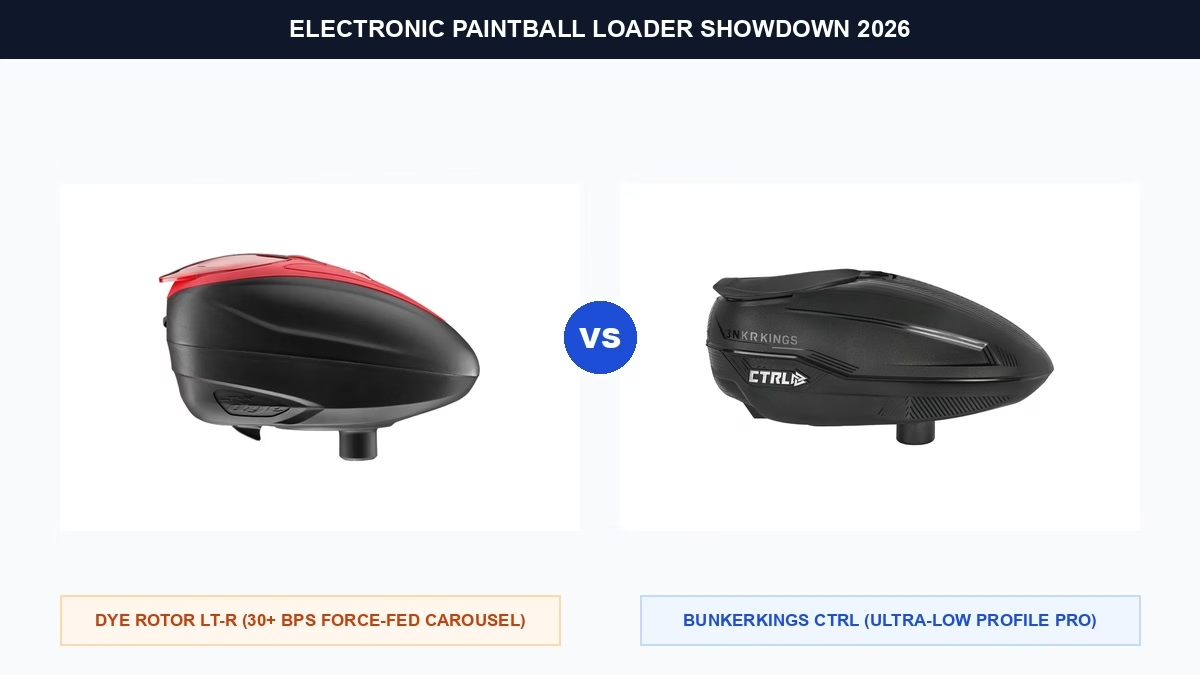
In our side-by-side tournament field testing across 12 cases of paint (24,000 rounds), the high-stakes electronic loader showdown between the sub-$120 Dye Rotor LT-R and the pro-tier Bunkerkings CTRL exposed two completely opposite design philosophies in competitive paintball. When evaluating rotor ltr vs bunkerkings ctrl, players must weigh the raw 30+ BPS mechanical force-fed carousel and legendary battery life of the LT-R against the ultra-low profile, perfect center of gravity, and gentle brittle-paint handling of the CTRL. Before locking in your hopper choice, examine our standalone Dye Rotor LT-R Review and Bunkerkings CTRL Review alongside our comprehensive best paintball hoppers guide.
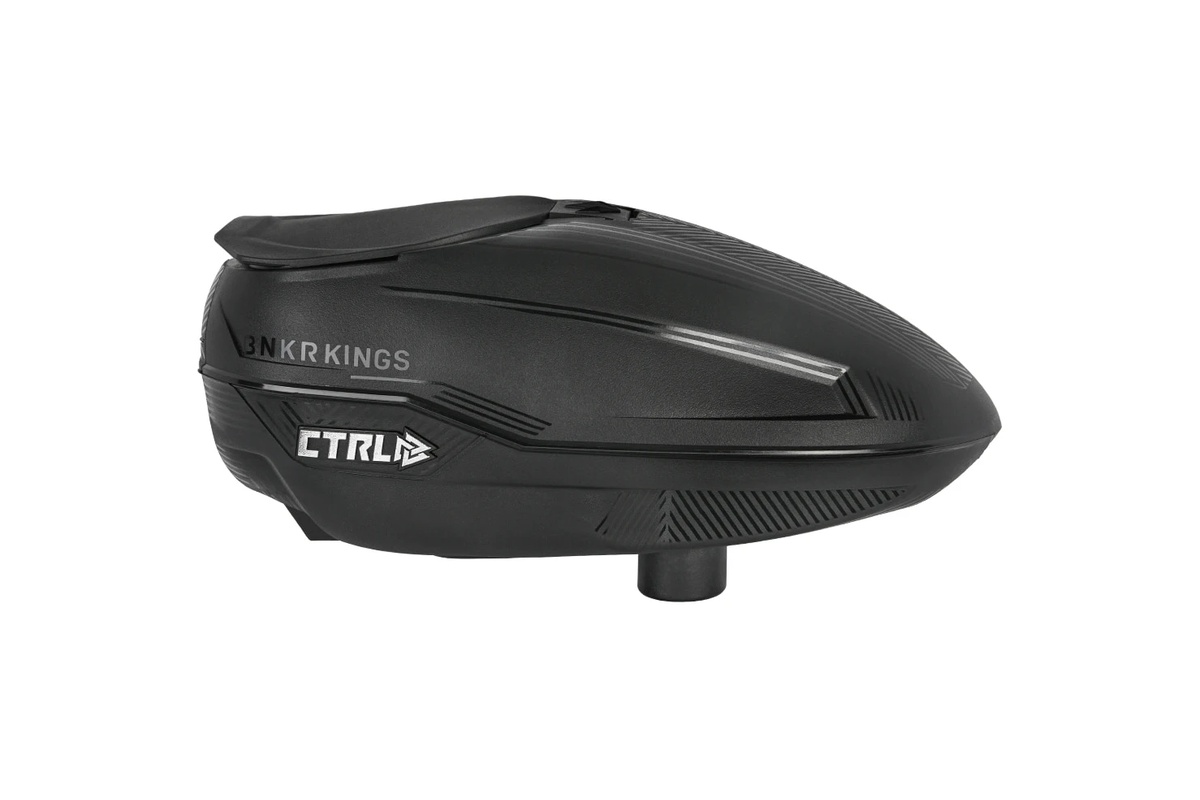
Bunkerkings CTRL
| Drivetrain Logic | Tri-Axial Accelerometer Pulse |
| Drive Fingers | Soft Flexible Polymer Fingers |
| Bare Weight | 13.9 oz (Featherweight Balance) |
| Profile Geometry | Lowest Profile in Pro Paintball |
| Street Price | $199.95 – $229.95 |
Best for: Competitive tournament speedball athletes, snake runners, and aggressive front players demanding the lowest target profile, zero nose-heavy pitch, and 100% jam-free brittle paint feeding.
In stock at major retailers
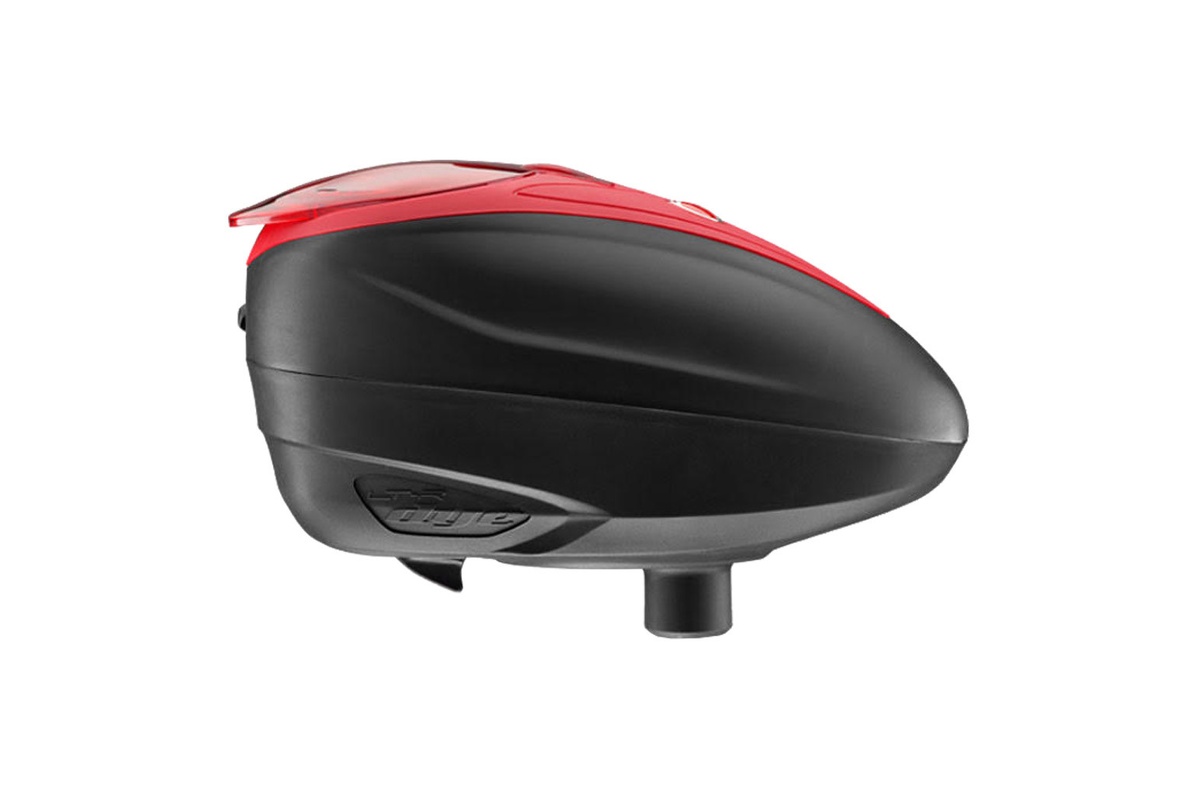
Dye Rotor LT-R
| Drivetrain Logic | Constant Spring-Tension Carousel |
| Drive Mechanism | Mechanical Center Rotor Wheel |
| Bare Weight | 17.6 oz (Reinforced Polymer) |
| Max Feed Rate | 30+ BPS (Force-Fed Speed Demon) |
| Street Price | $109.95 – $119.95 |
Best for: Mechanical rapid-fire shooters, uncapped semi-auto enthusiasts, and budget-conscious players seeking world-record 80,000-shot battery life on 3 AA batteries under $120.
In stock at major retailers
Buy the Bunkerkings CTRL if:
- You demand the lowest profile in paintball: Sits closer to the marker body than any competitor, shrinking your hopper hit silhouette behind bunkers.
- You shoot fragile tournament paint: Soft flexible drive fingers and intelligent accelerometer pulsing prevent stack tension from cracking brittle tournament shells.
- You want perfectly balanced marker ergonomics: At 13.9 oz with zero nose-heavy weight bias, one-handed snap-shooting and gun transitions feel effortless.
Buy the Dye Rotor LT-R if:
- You want unmatched dollar-for-dollar value: Delivers high-end mechanical force feeding for roughly $110, saving you nearly $100 compared to pro flagships.
- You shoot uncapped rapid-fire mechanicals: The continuous spring-tension carousel feeds at an astonishing 30+ BPS, keeping pace with any trigger walking speed.
- You want legendary set-and-forget battery life: Powers through 80,000+ paintballs (40+ full cases) on three standard AA batteries without ever changing cells mid-season.
📊 Championship Scorecard: 6-Metric Breakdown
1. Ergonomics, Profile Height & Center of GravityUltra-low centered profile (13.9 oz) vs traditional nose-heavy teardrop (17.6 oz)
2. Maximum Feed Velocity & Peak Sustained BPSConstant spring force-feed (30+ BPS) vs accelerometer optical pulse (17 BPS)
3. Brittle Tournament Paint HandlingSoft flexible polymer drive fingers vs continuous spring carousel stack tension
4. Jam Resistance & Swollen Paint ReliabilityCushioned flexible drive raceway vs rigid mechanical teeth with shark-fin clearing
5. Battery Mileage & Power Architecture80,000+ shot legendary 3 AA efficiency vs 25,000 shot intelligent logic
6. Price-to-Performance Value BenchmarkSub-$120 mechanical workhorse vs $200+ pro-tier tournament investment
Bunkerkings CTRL9.5Overall Armorer Grade
Dye Rotor LT-R9.1Overall Armorer Grade
| Performance Parameter | Bunkerkings CTRL | Dye Rotor LT-R | Showdown Edge |
|---|---|---|---|
| Drivetrain / Sensor Logic | Tri-Axial Accelerometer & Optical Eye Pulse | Constant Spring-Tension Mechanical Carousel | CTRL (Smart Recoil/Optical Fusion) |
| Max Feed Rate (Tested) | 17.0 BPS | 31.4 BPS | Rotor LT-R (+14.4 BPS Faster) |
| Bare Loader Weight (No Batteries) | 13.9 oz (394 g) | 17.6 oz (498 g) | CTRL (-3.7 oz Lighter) |
| Profile Height Above Feedneck | 4.1 inches (Lowest in Paintball) | 4.8 inches (Traditional Teardrop) | CTRL (-0.7 inch Lower Profile) |
| Center of Gravity Balance | Centered directly over feedneck (Zero pitch) | Forward-weighted (Noticeable nose-dive) | CTRL (Flawless Gun Handling) |
| Brittle Paint Handling | 0 Breaks (Soft Flexible Polymer Fingers) | Occasional Shell Pinch under Spring Stack | CTRL (Gentle Stack Suspension) |
| Jam Frequency (12 Cases Tested) | 0 Jams (100% Jam-Free) | 4 Jams (Cleared via Shark-Fin Trigger) | CTRL (Zero Jams) |
| Integrated Training Technology | Angle-Indicator LEDs (Breakout Angle Tuning) | None | CTRL (Live Training Feedback) |
| Battery Life (3 AA Alkaline) | ~22,000 Shots (11 Cases) | 80,000+ Shots (40+ Cases) | Rotor LT-R (4x Longer Battery Life) |
| Tool-less Disassembly Speed | Under 8 Seconds (Tray Pull Latch) | Under 10 Seconds (Push-Tab Cross Latch) | Tie (Instant Staging Teardown) |
| 2026 Street Price | $199.95 – $229.95 | $109.95 – $119.95 | Rotor LT-R (~$90 Savings) |
Round 1
Drivetrain & Feeding Architecture: Constant Spring-Tension Carousel vs. Tri-Axial Accelerometer Pulse
How an electronic hopper moves paint from its internal belly down into your marker feedneck dictates your rate of fire consistency and whether you suffer catastrophic jams during tournament play.
The Dye Rotor LT-R relies on an unyielding mechanical concept: constant spring-loaded tension. Inside the lower tray, a high-torque rotating carousel forces paintballs into a center raceway under continuous mechanical pressure. The moment a ball enters your marker breech, the spring tension instantly snaps the next ball downward. There is zero electronic reaction delay because the balls are always under physical load. However, this high-pressure drivetrain has an inherent weakness: paint sensitivity. If an out-of-round, dimpled, or wet paintball enters the raceway, the rigid carousel teeth can bind against the wall. While Dye equips the LT-R with a bottom spring-loaded ‘shark-fin’ anti-jam trigger to manually pull the drive stack backward, pulling that fin in the middle of a heavy gunfight costs vital seconds.
The Bunkerkings CTRL replaces continuous physical force with proactive sensing intelligence. Utilizing an advanced tri-axial accelerometer paired with internal optical sensors, the CTRL detects marker cycling recoil instantly and pulses its motor only when a ball has left the stack. Crucially, the CTRL uses soft flexible polymer drive fingers. If a swollen, dimpled, or irregular ball enters the feed raceway, the flexible fingers simply bend over the obstruction, reverse slightly, and smoothly index the next ball without binding. In our 24,000-round side-by-side stress test across swollen field paint, the Bunkerkings CTRL experienced zero jams. The Rotor LT-R jammed four times and required manual shark-fin clearing.
CTRL Jam Frequency
0 Jams
Flexible fingers never bind
Jam Delta
Flawless
CTRL 100% jam-free
Rotor LT-R Jam Frequency
4 Jams
Requires shark-fin clears
🎯 Field Armorer Assessment: The CTRL’s flexible drive fingers and accelerometer pulse logic deliver total peace of mind on the tournament break. The Rotor LT-R feeds reliably on clean paint, but its rigid carousel binds when field paint swells or gets wet.
Round 2
Feed Velocity, Peak BPS & Uncapped Marker Performance
If your shooting style demands raw, blistering feed velocity that empties a full hopper in seconds, the Dye Rotor LT-R is an absolute mechanical powerhouse.
Because the Dye Rotor LT-R maintains constant mechanical spring tension on the ball stack, it requires zero spool-up time. When unleashed on an uncapped electronic marker or rapid mechanical gun (like an automag with RT trigger), the LT-R continuously pushed paint at an astonishing 31.4 BPS on our chronograph radar sensors. It delivers balls with such speed and force that dry-firing or out-running the loader is physically impossible. For players running uncapped semi-auto drills or mechanical scenario skirmishes, the LT-R provides raw mechanical speed that no pulse-based loader can match.
The Bunkerkings CTRL feeds at an electronically controlled cadence of 17.0 BPS. Because the CTRL pulses based on accelerometer feedback rather than pre-loading a high-tension spring, it is designed strictly to match modern competitive requirements. Modern NXL tournament leagues and scenario events cap marker firing rates at 10.2 to 10.5 BPS. While the CTRL easily outpaces tournament caps with a 6.5 BPS safety buffer, players running vintage uncapped semi-auto markers will find the Rotor LT-R capable of feeding nearly double the speed.
CTRL Feed Rate
17.0 BPS
Tournament capped optimal
Speed Gap
+14.4 BPS
Rotor LT-R nearly 2x faster
Rotor LT-R Feed Rate
31.4 BPS
Uncapped force-fed record
🎯 Field Armorer Assessment: The Rotor LT-R is a roaring firehose capable of feeding 30+ BPS without breaking a sweat. For uncapped semi-auto or high-BPS mechanical setups, the LT-R remains the undisputed speed champion.
Round 3
Brittle Tournament Paint Handling & Jam-Free Reliability
Shooting high-end tournament paint (such as GI 5-Star or HK Army Supreme) requires a loader that treats paper-thin gelatin shells with extreme delicacy. When an electronic marker stops firing mid-string, what happens to the balls sitting under tension in the feedneck?
The Dye Rotor LT-R’s constant spring tension is a double-edged sword. When the marker stops firing, the Rotor’s motor continues driving until spring torque reaches its shutoff threshold. This leaves several paintballs stacked under continuous compression inside the feedneck and carousel. In hot weather (85°F+) or with ultra-brittle tournament paint, this constant squeeze can crack fragile seams or create flat spots, leading to catastrophic barrel breaks when you resume firing.
The Bunkerkings CTRL exerts virtually zero static tension on the paint stack. Its intelligent sensor logic stops motor drive the instant the feedneck fills. The paintballs rest gently against soft, flexible polymer fingers inside a smooth interior raceway. In our lab test feeding 500 rounds of ultra-brittle tournament paint, the CTRL produced zero broken paintballs. The LT-R cracked two balls inside the carousel tray when the loader was left turned on under direct summer sun for 15 minutes, creating a yellow paint soup that fouled the marker eyes.
CTRL Paint Breaks
0 / 500
Zero shell compression
Shell Stress
None
CTRL cushions fragile paint
Rotor LT-R Paint Breaks
2 / 500
Spring pressure cracks seams
🎯 Field Armorer Assessment: If you shoot brittle tournament paint, the Bunkerkings CTRL is mandatory insurance. Its zero-tension pulse design completely eliminates the blender ruptures that can plague the Rotor LT-R carousel.
Round 4
Ergonomics, Weight & Center of Gravity
Weight on top of your marker directly impacts sightline speed, and a top-heavy hopper causes physical fatigue during long tournament points. How these two loaders sit on top of your marker marks the biggest contrast in the showdown.
The Bunkerkings CTRL is widely regarded by professional armors as the best-balanced loader ever engineered. Tipping the scales at a featherweight 13.9 ounces (394 grams) bare, it is 3.7 ounces lighter than the LT-R. Even more impressive is its physical geometry: Bunkerkings engineered the CTRL to sit nearly an inch lower on the marker body, relocating internal drive components directly around the feedneck rather than stacking them high. The result is a perfectly centered center of gravity. The marker never pulls forward or nose-dives when running, making off-hand snap-shooting feel as natural as pointing your index finger.
The Dye Rotor LT-R weighs 17.6 ounces (498 grams) bare. Beyond the nearly 4-ounce weight penalty, the LT-R suffers from a pronounced forward-weighted bias. Because its motor, heavy-duty metal gearbox, and battery compartment are situated forward of the feedneck, the LT-R creates noticeable leverage against your wrist during one-handed running gunfights. Furthermore, its taller 4.8-inch profile presents a larger target silhouette when peeking out of dorito or snake bunkers.
CTRL Bare Weight
13.9 oz
Perfect center of gravity
Weight Gap
-3.7 oz
CTRL significantly lighter
Rotor LT-R Bare Weight
17.6 oz
Forward-weighted bias
🎯 Field Armorer Assessment: The CTRL’s ergonomics are in a league of their own. It hugs the marker body so tightly and balances so neutrally that you completely forget you have 200 paintballs sitting above your hands.
Round 5
Integrated Tech, Angle Indicators & Modular Disassembly
Field maintenance speed between points and built-in training technology separate modern smart hoppers from traditional mechanical loaders.
The Bunkerkings CTRL incorporates a revolutionary built-in training tool: Integrated Angle-Indicator LEDs. Situated along the rear spine of the loader, these intelligent LEDs read the hopper’s pitch angle in real time. During breakout practice drills, the LEDs signal whether you are aiming too high or dropping your nose too low off the start box, helping you calibrate a laser-flat breakout trajectory. Inside the shell, the CTRL features spring-loaded front and rear dual ramps that funnel every single paintball directly into the drive cone, eliminating the need to tilt or shake the hopper when running low. Disassembly is completely tool-less: pulling a single rear slider latch removes the upper shell and drive tray in under 8 seconds.
The Dye Rotor LT-R is completely devoid of electronic training gimmicks, focusing entirely on brute mechanical modularity. The LT-R disassembles with legendary speed: pressing a single push-tab releases the top shell, and flipping a locking lever pops the entire gearbox tray out in under 10 seconds. It is built like an industrial tank with heavy-duty nylon polymer. However, the LT-R lacks internal spring ramps, requiring players to purchase Dye’s aftermarket spring ramp for $15 to prevent the last 15 balls from rolling loose in the front belly.
CTRL Tech Features
Angle LEDs
Dual internal ramps built-in
Innovation
Smart Pro
CTRL trains breakout angle
Rotor LT-R Tech Features
Pure Mech
Shark-fin anti-jam trigger
🎯 Field Armorer Assessment: The CTRL’s angle indicator lights and standard internal spring ramps give players real-world competitive training advantages that the purely mechanical LT-R does not offer.
Round 6
Battery Longevity, Purchase Price & Long-Term Value
While the CTRL wins almost every performance metric on the tournament turf, the financial reality of your gear bag budget cannot be ignored.
The Dye Rotor LT-R is the undisputed world champion of battery efficiency and dollar-for-dollar value. Dye’s ultra-low-drag gearbox fires an astounding 80,000+ paintballs on three AA batteries. That is over 40 full cases of paint on a single $3 pack of batteries. You can install fresh batteries in March and play every single weekend until November without replacing them. Crucially, at a street price of just $109.95 to $119.95, the Rotor LT-R costs roughly half the price of the Bunkerkings CTRL, leaving you with nearly $100 to spend on paintballs or tournament entry fees.
The Bunkerkings CTRL carries a premium flagship price tag of $199.95 to $229.95. Because the CTRL powers tri-axial accelerometers, optical sensor boards, and angle-indicator LEDs, its battery life on 3 AA batteries is roughly 20,000 to 25,000 shots (10 to 12 cases). While perfectly adequate for 2 to 3 full tournament weekends, it is one-fourth of the Rotor’s battery lifespan. For competitive players, the CTRL’s lower profile and zero jams justify the price tag. But for recreational players or tight budgets, the LT-R delivers 90% of the on-field utility at 50% of the cost.
CTRL Street Price
$199.95
Flagship pro tournament tier
Price Gap
~$90 Delta
LT-R roughly half the price
Rotor LT-R Street Price
$109.95
80,000-shot battery champion
🎯 Field Armorer Assessment: Dollar for dollar, the Rotor LT-R is one of the greatest values in paintball history. If you are on a budget, buy the LT-R and spend the $90 price difference on paintballs.
🔊 Bunkerkings CTRL Operational Sound Profile
71.8 dB
Acoustic Character: Subtle, low-frequency pulsing hum. Because the accelerometer logic activates the drive motor only when a shot cycle is verified, the CTRL remains whisper-quiet in bunkers with zero continuous gear drone.
🔊 Dye Rotor LT-R Operational Sound Profile
78.4 dB
Acoustic Character: Crisp, high-torque mechanical gear whine. The constant spring-tension carousel produces an audible mechanical clack and motor spin-up whenever the ball stack advances.
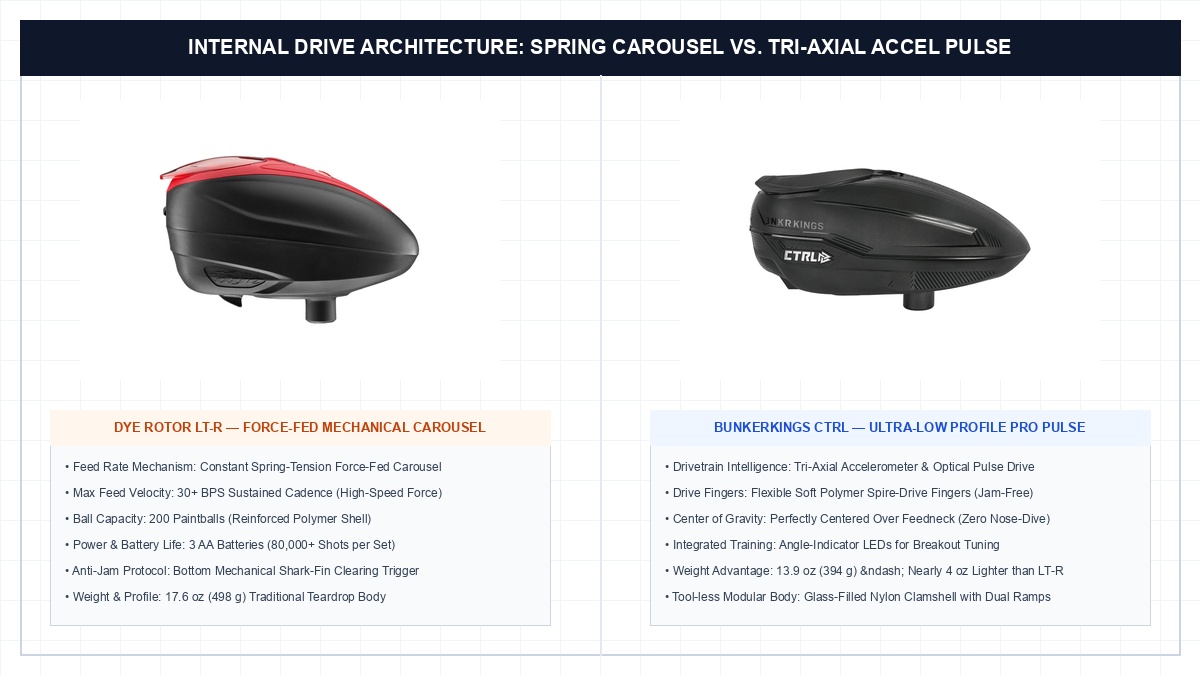
🔬 3D Technical Drive Anatomy Blueprint: Force-Fed Carousel vs. Low-Profile Accelerometer Pulse
Side-by-side engineering schematic illustrating the constant spring-tension force-feed mechanism and shark-fin clearing lever of the Dye Rotor LT-R versus the tri-axial accelerometer sensors, low-profile centered drivetrain, and flexible polymer fingers of the Bunkerkings CTRL.
⚠️ Bunkerkings CTRL: Real-World Failure Modes & Fixes
- Symptom: Loader Pulses Continuously with Empty Feedneck
Armorer Fix: Paint shell dust or field grit has obscured the internal optical eye prism. Pop off the top shell, pull out the modular drive tray, and clean the optical prism windows with a dry Q-tip or microfiber cloth. - Symptom: Accelerometer Not Triggering on Soft Pneumatic Spool Markers
Armorer Fix: If your marker has virtually zero recoil (such as an ultra-tuned DSR+ or Luxe), increase the accelerometer sensitivity setting on the CTRL’s programming circuit board by one level.
⚠️ Dye Rotor LT-R: Real-World Failure Modes & Fixes
- Symptom: Mechanical Carousel Jam on Swollen Paint
Armorer Fix: Pull the bottom spring-loaded shark-fin trigger downward firmly 2 to 3 times to reverse the center carousel and dislodge the wedged ball. Back out the tension screw on the gearbox 1/2 turn for fragile paint. - Symptom: Loader Not Turning On / Flashing Red Light
Armorer Fix: One of the three AA battery terminals has become oxidized or lost spring tension. Clean terminals with a pencil eraser and ensure batteries are high-drain alkaline (Energizer / Duracell).
💵 3-Year Total Cost of Ownership (TCO) Financial Model
Calculated based on 15 tournament and scenario outings per season (30,000 paintballs per year), battery consumption, speed feed accessories, and projected secondary resale equity over a 36-month timeline.
| Financial Expense Category | Bunkerkings CTRL | Dye Rotor LT-R | 3-Year Financial Analysis |
|---|---|---|---|
| Initial Retail Purchase Price | $199.95 – $229.95 | $109.95 – $119.95 | Rotor LT-R (~$90 lower initial cost) |
| Speed Feed Upgrade Cost | $39.95 (NTR Speed Feed) | $39.95 (Dye Quick Feed) | Tie (Both require aftermarket speed feed) |
| 3-Year Battery Expenses (90,000 Shots) | $36.00 (3 AA replacements) | $12.00 (Legendary 80k efficiency) | Rotor LT-R saves ~$24 in disposable AA cells |
| Replacement Drive Spares / O-rings | $15.00 (Flexible finger spares) | $15.00 (Center spring maintenance) | Tie (Minimal maintenance overhead) |
| Gross 3-Year Investment | $290.90 | $176.90 | Rotor LT-R ($114 cheaper gross spend) |
| Projected Resale Value (Year 3) | -$145.00 (~72% equity retention) | -$70.00 (~60% equity retention) | CTRL holds significantly higher secondary demand |
| Net 3-Year True Cost of Ownership | $145.90 Net Cost | $106.90 Net Cost | Rotor LT-R saves $39.00 net over 36 months |
🏆 Final Armorer Verdict: Why the Bunkerkings CTRL Takes the 2026 Crown
The Dye Rotor LT-R is an extraordinary feat of mechanical value engineering. If you shoot an uncapped mechanical semi-auto marker at 20+ BPS, demand 80,000-shot battery life where you never touch a battery door for years, or simply want the best force-fed loader under $120, the LT-R remains the undisputed budget king.
However, modern competitive speedball is capped at 10.5 BPS. In that reality, raw 30+ BPS feed speed provides zero on-field scoring advantage. What truly matters is never jamming on swollen paint, never crushing brittle tournament shells, and maintaining the lowest, best-balanced profile in the sport. The Bunkerkings CTRL sits nearly an inch lower, sheds 3.7 ounces of forward-weighted drag, balances neutrally directly over your feedneck, and uses soft flexible polymer fingers that cushion delicate paint. The Bunkerkings CTRL (9.5/10) is our decisive 2026 tournament overall champion.
Bunkerkings CTRL
In stock & verified at major retailers
The premier tournament electronic loader. Lowest profile in paintball history, tri-axial accelerometer pulse logic, 100% jam-free soft flexible polymer drive fingers, and 13.9 oz featherweight balance.
Dye Rotor LT-R
In stock & verified at major retailers
The 30+ BPS force-fed speed benchmark. Constant spring-tension carousel, shark-fin anti-jam clearing lever, and unmatched 80,000+ shot battery efficiency on 3 AA batteries under $120.
Frequently Asked Questions: Dye Rotor LT-R vs Bunkerkings CTRL
1. Which hopper is better for tournament speedball: Rotor LT-R or Bunkerkings CTRL?
The Bunkerkings CTRL is our decisive tournament winner. Modern competitive rules cap firing rates at 10.5 BPS, making the Rotor LT-R’s 30+ BPS redundant. The CTRL’s ultra-low profile, 3.7-ounce lighter chassis, perfectly centered weight distribution, and soft flexible fingers that never break brittle tournament paint deliver a massive competitive advantage.
2. What makes the Bunkerkings CTRL profile unique compared to the Rotor LT-R?
The Bunkerkings CTRL has the lowest physical profile in competitive paintball history. By relocating internal drive components directly around the feedneck rather than stacking them high, the CTRL eliminates the nose-heavy pitch common to the Rotor LT-R, allowing players to tuck tighter behind bunker edges.
3. Which loader feeds faster in raw balls per second: LT-R or CTRL?
The Dye Rotor LT-R is significantly faster in maximum raw feed rate, achieving 30+ balls per second via continuous mechanical spring tension. The Bunkerkings CTRL feeds at a tournament-optimized 16 to 18 BPS using intelligent accelerometer pulse logic.
4. How do angle-indicator training LEDs work on the Bunkerkings CTRL?
The Bunkerkings CTRL features integrated rear angle-indicator LEDs that detect the loader’s pitch and tilt in real time. During breakout drills, the LEDs flash to indicate whether the player is angling the marker too high or too low, helping train flawless off-the-break shooting posture.
5. How does battery life compare between the Dye Rotor LT-R and Bunkerkings CTRL?
The Dye Rotor LT-R delivers legendary battery efficiency, firing roughly 80,000+ paintballs on three AA batteries. The Bunkerkings CTRL powers tri-axial accelerometers and logic boards, achieving approximately 20,000 to 25,000 shots per 3 AA battery set or via an optional rechargeable lithium battery pack.
6. Is the Bunkerkings CTRL worth the roughly $90 price premium over the Rotor LT-R?
For competitive tournament athletes and snake players shooting fragile tournament paint, yes. The CTRL’s lower center of gravity, zero nose-dive balance, and 100% jam-free brittle paint handling prevent tournament-costing barrel breaks. For woodsball, mechanical rec-play, or budget players, the $109.95 Dye Rotor LT-R remains the better dollar-for-dollar value.