Executive Takeaway: Can 2 People Play Paintball?
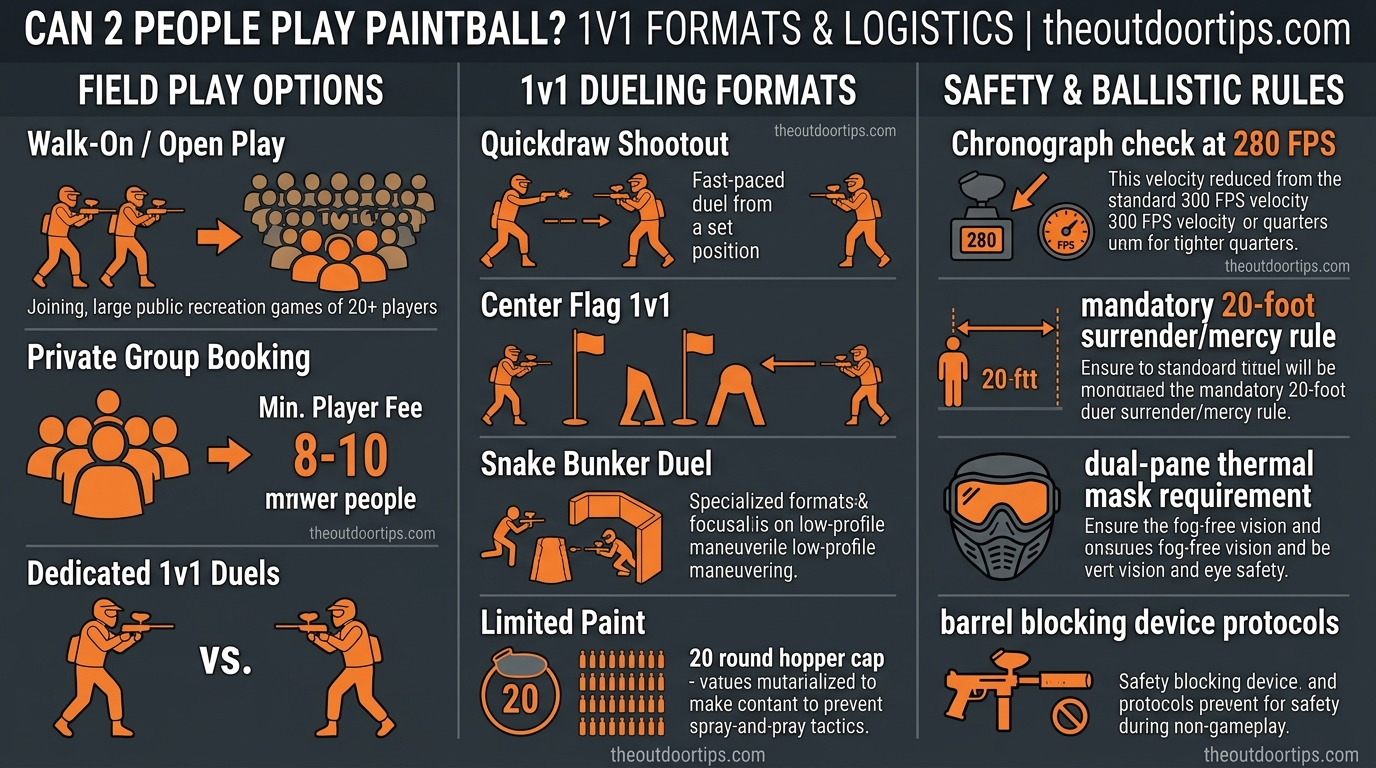
The definitive answer is yes, 2 people can absolutely play paintball, but your experience depends entirely on the venue and game format you select. At commercial fields, two players can join public Walk-On / Open Play Sessions to fight together (or against each other) in 20+ player squad matches without private group fees. Alternatively, if you want dedicated head-to-head duels, two players can execute 1v1 Top Gun Shootouts & Snake Duels on private land or during commercial field downtime, provided you enforce strict radar chronoing (280 FPS), ASTM-certified thermal masks, and mandatory 20-foot surrender rules.
You and your best friend have an open weekend, a hunger for tactical action, and an itch to pull some triggers. But as you search local paintball facilities, a common hesitation stops you in your tracks: can 2 people play paintball? Almost every promotional video and marketing photo features sprawling 15-player squads storming castles, charging airball bunkers, or ambushing across dense woodland. Does that mean paintball is off-limits if you cannot rally a ten-person bachelor party or corporate group?
The short answer is an emphatic no—you do not need a massive squad to play paintball. Whether you have never held a marker or you are a seasoned scenario veteran, two players can enjoy paintball in several distinct ways:
- Commercial Walk-On / Open Play: The most popular and budget-friendly route. You and your friend arrive at an established field and are integrated into the public recreation roster (often 20 to 50 players strong), giving you full-scale scenario warfare with zero minimum group penalties.
- Dedicated 1v1 Head-to-Head Duels: An adrenaline-fueled test of pure snapshot speed, trigger discipline, and spatial awareness. Played on symmetric hyperball, airball, or woodland arenas, 1v1 turns paintball into high-stakes athletic chess.
- Private Field Rental: Booking a commercial park exclusively for two players—though, as we will explore, this involves commercial minimum-player economics.
- Private Land / Backyard Skirmishes: Playing on private acreage under strict ASTM ballistic and safety parameters.
In this technical 2026 field guide, we break down commercial park logistics, the physics and pneumatic operating pressures behind 1v1 dueling, dedicated head-to-head game formats, critical safety protocols, and the exact gear setups that make two-player paintball an unforgettable experience.
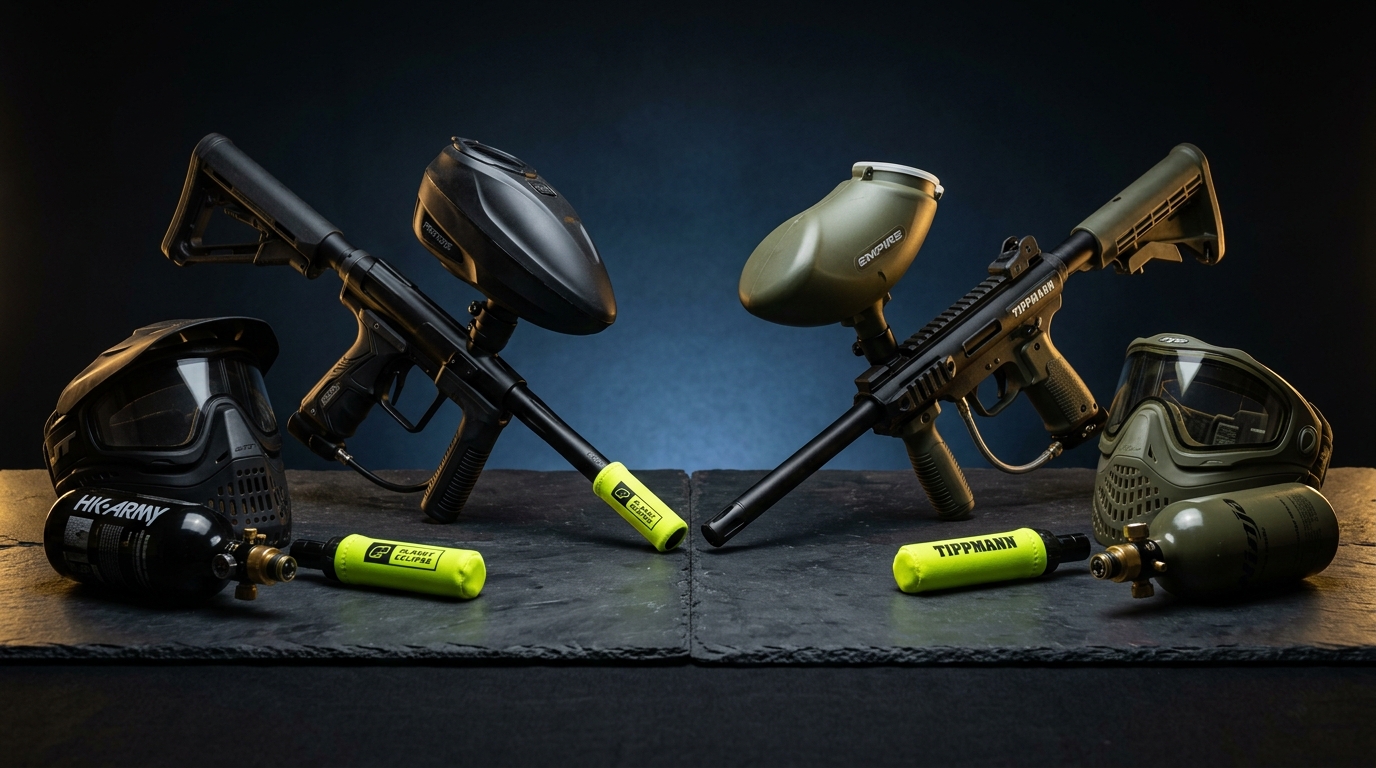
1. The Commercial Field Reality: How Two Players Fit Into Open Play
If you call a commercial paintball park and ask, “Can 2 people play paintball this Saturday?” the field coordinator will immediately invite you to their Walk-On (Open Play) session. Understanding how commercial fields schedule their operations is the key to getting maximum field time without paying unnecessary private reservation surcharges.
What Is Walk-On / Open Play?
Commercial paintball fields run Walk-On sessions every weekend (and select weekday evenings). During Open Play, any individual, pair, or small group can show up without a reservation, rent equipment or bring their own markers, and join a collective pool of players.
Once check-in, equipment distribution, and safety orientations conclude, the field referee staff divides the player pool into two balanced squads—typically designated as the Orange Team vs. Blue Team or Armband vs. No-Armband. The referee balances the teams based on gear tiers, ensuring that rental mechanical players are evenly matched and that seasoned players equipped with tournament electric markers are distributed equally on both sides.
Tactical Freedom for Pairs in Open Play
When you play Walk-On as a duo, you have complete tactical flexibility. You can inform the referee that you want to play on the same team, operating as a two-man fireteam where one player lays down suppressing fire while the other maneuvers for a bunker flank. Alternatively, you can ask to be split onto opposing teams, turning the massive 20v20 woodsball game into a personal cat-and-mouse hunt where your primary objective is tracking down and eliminating your friend across the tree line.
Before heading to your first walk-on session, ensure you are dressed for mobility and impact protection by reading our detailed breakdown on what to wear for paintball. If you are playing during hot summer months, prevent heat exhaustion and thermal lens fogging with our dedicated guide to what to wear to paintball in summer.
2. Private Group Bookings: The Economics Behind Field Minimums
What if you and your friend do not want to share the field with strangers? What if you want an entire woodsball compound, urban castle, or speedball field completely to yourselves for private 1v1 matches? This is where commercial facility economics come into play.
Paintball facilities operate on high overhead costs, including insurance liability policies, safety netting maintenance, air compressor depreciation, and referee payroll. To assign a dedicated referee who must oversee your matches, chronograph your guns, enforce mask compliance, and walk you across different map zones, the facility must cover its operational base cost.
| Booking Type | Headcount Required | Average Cost (Per Person) | Dedicated Referee? | Field Access Structure |
|---|---|---|---|---|
| Walk-On / Open Play | 1 or 2 Players (No Min) | $25 – $40 | Shared Public Ref | Full park rotation (5–8 fields) |
| Private Group Reservation | 8 – 12 Players Minimum | $45 – $65 | Yes (Exclusive Staff) | Private fields, exclusive map rotation |
| 2-Player Private Buyout | 2 Players (Covering Minimum) | $150 – $250+ | Yes (Dedicated Staff) | Private park buyout (Cost prohibitive) |
The “Off-Peak & Downtime” Insider Hack
If you and a friend specifically want 1v1 dueling at a commercial park without paying a massive private group buyout fee, you can use two insider strategies:
- The Lunch Break Airball Match: During mid-day lunch breaks on Saturday or Sunday, open play games pause for 30 to 45 minutes while players hydrate and eat. If you ask the head referee politely, they will often allow two players with personal gear to step onto an empty netted airball or speedball turf for a best-of-five 1v1 shootout. Because the netting is secure and the field is otherwise idle, referees will often oversee the match free of charge.
- Weekday After-Hours Practice: Many commercial parks open on Wednesday or Friday afternoons for team practices. By paying a standard practice entry fee ($15–$25), you and your partner can use open turf fields to run 1v1 snap-shooting drills alongside competitive players.
3. The Physics & Ballistic Mechanics of 1v1 Paintball
When you transition from a 20-player scenario game down to a 1v1 duel, paintball transforms from a game of volume suppression into an intense, millisecond-driven game of geometry, ballistics, and pneumatic reaction time. Understanding marker pneumatics and ballistics gives you an immense competitive advantage in head-to-head matches.
Operating Pressure: 800 PSI Blowbacks vs. 135 PSI Spool Valves
In standard recreation play, mechanical blowback markers like the legendary Tippmann Cronus or Tippmann 98 Custom perform flawlessly. They utilize an inline blowback drivetrain operating at full unregulated tank pressure—typically 800 to 850 PSI. When the sear releases, a heavy stainless steel hammer (striker) flies forward under heavy spring tension, opens the poppet valve to vent air down the barrel, and is thrown backward by expanding gas to recock.
In a 1v1 duel, however, this mechanical blowback cycle creates noticeable physical kick and muzzle rise. When you lean out from behind a Dorito or cylinder bunker to take a quick snapshot, that recoil impulse disrupts your sight picture. If your first shot misses, re-acquiring your opponent’s shoulder takes precious milliseconds.
In contrast, modern low-pressure spool valve markers (such as the Planet Eclipse Emek 100 or Etha 3M, detailed in our paintball marker guide for beginners) operate between 135 and 145 PSI. Using an internal regulator and an ultra-light balanced spool bolt (such as the Gamma Core drivetrain), they deliver paintballs at the exact same 280 FPS velocity, but with virtually zero recoil impulse. The marker stays laser-flat in your hands, allowing you to snap in and out of cover with pinpoint repeatability.
Kinetic Energy & Impact Mechanics at 1v1 Distances
A standard .68 caliber gelatin paintball weighs approximately 3.2 grams (0.0032 kg). When fired at the standard velocity of 280 FPS (85.3 meters per second), the projectile delivers kinetic energy calculated via Newtonian mechanics:
If a marker is improperly tuned and spikes to 300 FPS (91.4 m/s), that kinetic energy climbs to 13.38 Joules—a 15% increase in impact energy. In 1v1 duels where engagements often occur within 20 to 30 feet, maintaining a strict 280 FPS chronograph limit prevents painful welts and equipment damage.
Gas Consistency: HPA vs. CO2 in Snap-Shooting Duels
Nothing ruins a 1v1 duel faster than erratic velocity spikes. When using liquid CO2, every rapid burst of 2 to 3 snap-shots draws liquid into the expansion chamber. As the liquid boils into gas, it absorbs ambient thermal energy, rapidly cooling the valve assembly. In rapid snapshot exchanges, CO2 pressure can drop from 850 PSI down to 500 PSI, causing your second shot to fall short of the bunker.
High-Pressure Compressed Air (HPA), by contrast, remains purely in a gaseous state. Whether you shoot 1 shot every thirty seconds or 5 shots in a quick burst, HPA regulators deliver consistent shot-to-shot velocity within ±3 FPS. For an in-depth breakdown of tank physics and refilling procedures, explore our guide on CO2 vs compressed air HPA tanks, calculate your air capacity with our paintball tank shot calculator, and learn safety steps with our guide on how to refill a paintball tank.
The Limited Hopper Advantage: Why 20 Rounds Beats 200
In full-team tournament paintball, electronic loaders feed 200 paintballs at 20+ balls per second to hold shooting lanes. In a 1v1 duel, however, equipping two players with 200-round electronic loaders often ruins the gameplay. The match degenerates into a stationary “spray-and-pray” duel where neither player can move without facing an unbroken wall of paint.
The solution used by competitive 1v1 duelists is limited paint capacity. By swapping massive 200-round hoppers for compact 50-round gravity loaders (or restricting each player to a single 20-round hopper cap or 10-round spring tube), players are forced to make every single shot count. You cannot afford to spray blindly; you must maneuver, fake out your opponent, read their body language, and execute a surgical snapshot. To understand how feed systems impact your style, check our analysis on whether you need a high-end hopper.
4. The 5 Best 1v1 Paintball Game Formats
If you have access to a field or a private cordoned zone, playing standard elimination can become repetitive if one player simply camps in the back corner. These five structured 1v1 formats introduce strategic tension, objective-based pacing, and high replay value.
Format 1: The Top Gun Quickdraw (10-Pace Western Duel)
Duration: 30 Seconds
Setup: Two players stand back-to-back at the center of the field with barrel blocking socks removed, markers pointed strictly at the dirt at a 45-degree angle, and safety switches engaged. Each player loads exactly 5 paintballs into their marker.
Rules: On a shared audio timer or countdown (“3… 2… 1… GO!”), both players take 10 brisk paces away from each other, turn, dive behind the nearest bunker or stand their ground, disengage safety, and fire. The first confirmed break on the opponent wins the round. Best of seven rounds determines the field champion.
Format 2: Center Flag Push (Symmetric Airball / Hyperball)
Duration: 3 to 5 Minutes
Setup: Played on a symmetric layout with matching bunkers on both sides. A bright flag, bandanna, or marker cone is placed directly on the 50-yard center bunker. Both players start touching their respective back boundary walls.
Rules: Elimination is not the only win condition. To win, a player can either eliminate their opponent OR sprint to the 50-yard line, grab the center flag, and successfully advance it into the opponent’s starting bunker. This rule completely eliminates defensive camping—if you sit passively in your back bunker, your opponent will push the center, take the flag, and win the match.
Format 3: Snake Bunker Elimination (Low-Profile Crawl)
Duration: 2 to 4 Minutes
Setup: Confined exclusively to the “snake” side of a tournament turf or a linear trench/corridor line. Both players start at opposite ends of a low horizontal bunker line.
Rules: Players are not allowed to stand up; gameplay is restricted to kneeling, low-crawling, and belly sliding. This mode develops aggressive tournament-grade crawling mechanics, tight bunker tucking, and off-hand snap shooting. First break wins.
Format 4: The 20-Round Tactical Limited-Ammo Challenge
Duration: 5 Minutes
Setup: Standard woodsball or recball layout. Both players load exactly 20 paintballs into their hopper or feed tube. Zero reserve pods or pocket paint allowed.
Rules: Every single trigger pull has high tactical stakes. If a player burns 10 balls trying to suppress a bunker, they leave themselves with only 10 shots for defense. If both players expend all 20 rounds without scoring an elimination, the player closest to the enemy starting base wins on tactical positioning.
Format 5: Hunter vs. Prey (Woodsball Asymmetric Stalking)
Duration: 7 to 10 Minutes
Setup: Best played across a dense wooded area with natural terrain features. Player A is the “Hunter” (equipped with 50 rounds); Player B is the “Prey” (equipped with 10 rounds).
Rules: The Prey receives a 60-second head start to disappear into the brush and locate an extraction beacon. The Hunter must systematically clear tree lines to eliminate the Prey. If the Prey successfully eliminates the Hunter with one of their 10 rounds, or reaches the extraction beacon untouched, the Prey wins.
5. Private Land & Backyard 1v1: The 5 Non-Negotiable Safety Protocols
Playing paintball with two people on private residential land or rural property is an incredible weekend activity, but it introduces serious safety obligations that a commercial field normally handles for you. Without professional referees, you and your friend are 100% responsible for your own safety and that of bystanders.
PNEUMATIC DRIVETRAIN IMPACT: BLOWBACK VS LOW-PRESSURE SPOOL
1. High-Pressure Mechanical Blowback (800–850 PSI): Markers like the Tippmann Cronus, Tippmann 98, or Spyder operate on unregulated tank pressure. The heavy hammer strike provides rugged reliability in mud and dirt, but the violent pneumatic pulse demands durable recreational paint to prevent breech breaks.
2. Low-Pressure Spool Valve (115–140 PSI): Modern tournament-grade markers (Planet Eclipse Emek 100, Etha 3M) step pressure down to 135 PSI. The bolt gently cushions the ball past the detent before releasing gas volume, virtually eliminating paint breakage even on razor-thin tournament paint.
Worried about making a mess in your yard or ruining your footwear during backyard duels? Paintball fill is water-soluble PEG-400, but some materials hold onto dye. Read our scientific testing on does paintball stain shoes to keep your trail cleats spotless.
6. 2-Player Paintball Formats: Comprehensive Comparison Matrix
To help you decide how to structure your 2-player paintball session, review this side-by-side technical breakdown comparing the five primary play options across logistics, economics, ballistics, and tactical skill ceiling:
| Format | Venue & Setup | Paint Used (Per Person) | Cost / Player | Ideal Marker Type | Tactical Experience |
|---|---|---|---|---|---|
| Commercial Walk-On | Commercial Park (20+ players) | 500 – 1,000 rounds | $30 – $55 | Tippmann Cronus / Rental | Full squad warfare, large scenarios |
| Top Gun Quickdraw | Airball Turf / Backyard (10 paces) | 50 – 100 rounds | $5 – $10 (Paint only) | Mechanical or Pump Marker | Pure twitch reflex & first-shot accuracy |
| Center Flag Push | Symmetric Hyperball / Airball | 150 – 300 rounds | $10 – $20 | Planet Eclipse Emek 100 | Dynamic bunker chess, zero camping |
| Limited Ammo (20-Rds) | Woodsball / Natural terrain | 60 – 120 rounds | $5 – $15 | 50-rd Gravity Hopper / Stock Class | Extreme trigger discipline, flanking |
| Commercial Field Buyout | Private park rental with dedicated ref | 500 – 1,000 rounds | $150 – $250+ | Any Marker Type | Exclusive park access (High cost) |
7. Recommended Gear for 2-Player Paintball & 1v1 Duels
If you plan to make 2-player paintball or 1v1 dueling a regular part of your routine, selecting the right equipment prevents frustration, mechanical jams, and excessive paint expenses. Here are the top tested picks for markers, thermal goggles, and pneumatic support gear:
Tippmann Cronus Tactical
Bulletproof inline blowback poppet system operating at 800 PSI, high-impact composite receiver, Picatinny accessory rails, and effortless all-day mechanical reliability.
Planet Eclipse Emek 100
Tournament-grade Gamma Core balanced spool valve operating at an ultra-low 135 PSI. Whisper quiet, zero kick, and remarkable ±2 FPS consistency on fragile tournament paint.
Dye i5 Thermal Mask
GSR pro-strap dial adjustment, patent-pending soft foam ear protection, 290-degree spherical dual-pane thermal optical clarity that eliminates fogging during intense duels.
8. Step-by-Step Guide: How to Plan Your 2-Player Game Day
Executing a seamless two-player paintball day requires following a structured logistical checklist:
- Wednesday / Thursday Pre-Check: Call your chosen commercial field or check their website to verify their Walk-On / Open Play hours (usually 9:00 AM to 4:00 PM on Saturdays and Sundays). Confirm whether field paint is required (FPO: Field Paint Only).
- Gear Prep & O-Ring Lubrication: Night before, inspect both markers. Apply 3 drops of silicone paintball oil into the ASA, test the battery on your loader, and ensure your barrel blocking socks have intact elastic cords.
- Arrival & Registration: Arrive 30 minutes before first games begin. Sign liability waivers, rent or inspect safety equipment, and receive your player wristbands.
- Safety Briefing & Chronograph Station: Attend the mandatory referee orientation. Walk to the chronograph station and fire three test shots over the radar sensor. Ensure both markers cycle cleanly between 270 and 280 FPS.
- Phase 1: Open Play Warmup (Morning): Spend the morning playing in the large walk-on group (10v10 to 20v20). Coordinate as a two-man squad to practice communications and bunker advances under heavy crossfire.
- Phase 2: Head-to-Head Duels (Lunch / Afternoon): During mid-day field transitions or at the close of open play, ask the referee coordinator if you can use an open airball or hyperball turf for five rounds of 1v1 Center Flag or Top Gun duels.
- Decontamination & Pack Down: Clear all remaining paintballs from hoppers, install barrel socks, discharge remaining chamber air, and clean any shell residue from goggles and markers before leaving.
Interactive Ballistics & Game Planning Calculators
To calculate weekend paint consumption, verify tank shot counts, check kinetic energy limits, and tune marker pressures, explore our free interactive paintball tools:
Estimate paint consumption and case budget for 2-player sessions and duels.
Calculate exact shot count per air fill across 48ci vs 68ci tanks.
Calculate kinetic impact energy to maintain 1v1 backyard safety limits.
Verify trigger firing rates for mechanical duels vs electronic markers.
Match paint diameter with barrel inserts for ±2 FPS shot consistency.
Calibrate output pressure shims for mechanical vs spool markers.
Check if your hopper can keep pace with fast semi-auto trigger pulls.
Evaluate humidity and thermal lens protection to keep vision crystal-clear.
9. Frequently Asked Questions
Can 2 people play paintball at a commercial park?
Yes. Two people can arrive at almost any commercial paintball park during scheduled Walk-On / Open Play sessions (usually held every weekend). You do not need a large group; the facility referee staff will place you both into the general player pool of 20 to 50 players, where you can choose to play on the same team as a duo or compete against each other on opposing teams.
Is 1v1 paintball fun, or is it boring compared to team games?
1v1 paintball is one of the most intense, high-adrenaline forms of the sport when played with proper rules. While team games rely on heavy paint suppression, 1v1 duels test raw snapshot reflexes, stealth, and spatial awareness. To keep 1v1 exciting, use limited ammo (20 rounds per match) or objective rules like Center Flag to prevent stationary camping.
How much does it cost for 2 people to play paintball?
In standard commercial Walk-On play, two players typically spend $30 to $55 each (a total of $60 to $110 for the pair). This covers park entry, all-day compressed air refills, rental gear (marker, mask, tank), and 500 paintballs per person. If you bring your own gear and play 1v1 on private land, your only ongoing expense is paintballs ($15 to $20 for 500 rounds) and air refills ($5 per tank).
How many paintballs do 2 people need for an afternoon of 1v1?
For a dedicated afternoon of 1v1 dueling, two players need only 500 to 1,000 paintballs total (a single 500-round bag or half-case). Because 1v1 rounds conclude quickly after 5 to 20 shots per player, 500 paintballs allows you to play 15 to 25 intense rounds of dueling.
Can 2 people play paintball in a regular residential backyard?
Only if you have an exceptionally large lot (at least 150 feet of clear buffer to any neighbor or road) and local municipal bylaws permit discharging projectile devices. In standard suburban yards, stray paintballs traveling at 280 FPS can shatter neighbor windows or strike pedestrians. You must install 10-foot-high commercial paintball netting, wear ASTM-certified goggles, and lower marker velocities to 250 FPS.
What is the best paintball gun for 1v1 dueling?
The best marker for 1v1 dueling is the Planet Eclipse Emek 100 or Etha 3M. Operating at 135 PSI with the Gamma Core spool bolt, it produces virtually zero recoil, allowing instantaneous snapshot alignment behind bunkers. For entry-level budget players, mechanical markers like the Tippmann Cronus or Tippmann Stormer provide bulletproof reliability at under $150.